
](https://voltcrave-battery.com/wp-content/uploads/2026/10/What-Is-the-Typical-Size-of-a-BESS-Container.webp)
BESS containers can look similar from the outside, yet their dimensions, energy capacity, weight, cooling architecture, and internal equipment can differ significantly.
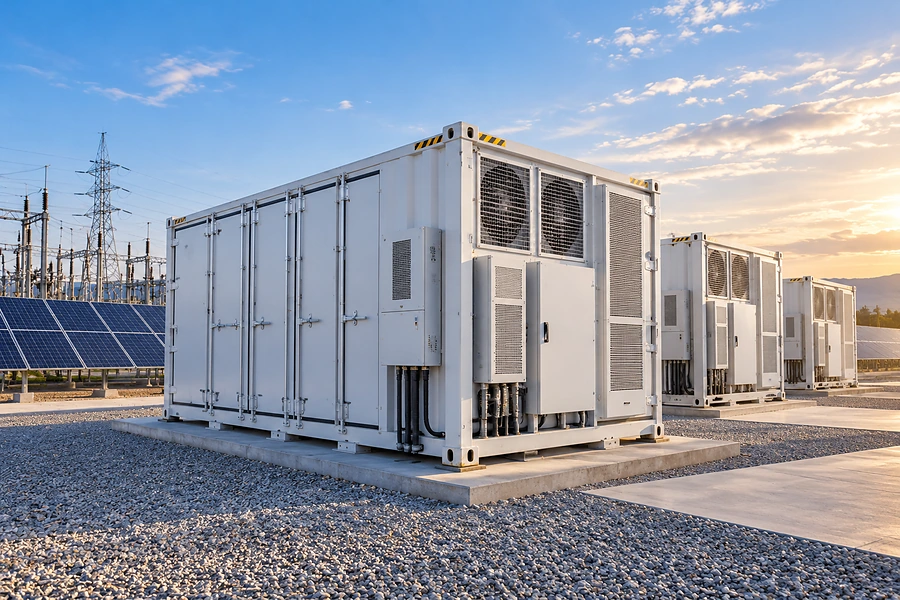
The most common utility-scale BESS format today is the 20-foot-class container, typically around 6.1 m long, 2.4 m wide, and roughly 2.6–2.9 m high. Modern 20-foot systems commonly store about 4–6+ MWh, although 10-foot, 40-foot, cabinet-style, and purpose-built non-ISO enclosures are also used.
BESS container size describes physical dimensions while MWh measures energy. Similar-sized containers can hold different capacities because cell, cooling, module and integration designs vary widely.
What Is the Most Common BESS Container Size?
For modern utility-scale battery storage, the 20-foot format has become one of the most common physical building blocks.
A typical modern utility BESS uses a 20-foot or 20-foot-high-cube-class enclosure. Current commercial examples range from approximately 4 MWh to more than 6 MWh in one 20-foot unit, depending on cell capacity, cooling technology, internal architecture, and whether the enclosure contains only batteries or also integrates a PCS.
Wärtsilä's current GridSolve Quantum2 provides a good reference.
It uses a:
20-foot high-cube ISO container
with dimensions approximately:
6.1 m × 2.4 m × 2.8 m
and nominal energy of about:
4.073 MWh.
Sungrow takes the same general physical class further.
Its PowerTitan 2.0 integrates:
5 MWh of batteries
and a:
2.5 MW PCS
inside one 20-foot container.
CATL's TENER shows how energy density continues to increase. CATL states that TENER places:
6.25 MWh
inside a:
20-foot container.
Therefore, I would use:
20 ft × approximately 8 ft × approximately 9 ft
as a practical mental picture for many current utility-scale BESS containers.
But that should never be treated as a universal specification.
What Are the Typical Dimensions of a 20-Foot BESS Container?
A 20-foot-class BESS is normally close to standard freight-container dimensions, but manufacturers may increase height, alter length, or design custom structures.
A practical planning assumption for a 20-foot BESS is approximately 6.1 m in length, 2.4 m in width, and about 2.6–2.9 m in height. High-cube-type BESS products are commonly near the upper end of that height range because additional internal volume is useful for battery racks, cooling, fire protection, busbars, and service access.
One current example is Wärtsilä Quantum2:
| Parameter | Approximate Specification |
|---|---|
| Length | 6.1 m |
| Width | 2.4 m |
| Height | 2.8 m |
| Format | 20-ft high-cube ISO |
| Nominal energy | 4.073 MWh |
These figures come from Wärtsilä's current Quantum2 specification.
However, a manufacturer may call a product:
20-foot-class
without reproducing every dimension of an ordinary freight container.
Why?
Because a BESS enclosure must accommodate much more than cargo.
It may contain:
battery racks,
liquid-cooling pipes,
HV DC busbars,
BMS controllers,
fire detection,
gas detection,
pressure-relief equipment,
auxiliary electrical systems,
and maintenance access.
That makes BESS packaging an engineering problem rather than simply a shipping-container conversion.
How Much Energy Fits Inside a 20-Foot BESS Container?
Energy density has increased rapidly, so container length alone no longer tells you how many MWh are inside.
Current 20-foot utility BESS products can contain approximately 4–6.25 MWh or more. Wärtsilä lists about 4.073 MWh for Quantum2, Sungrow integrates 5 MWh in PowerTitan 2.0, Fluence offers roughly 4.9–5.6 MWh in its 20-foot Gridstack Pro 5000 series, and CATL's TENER reaches 6.25 MWh.
That progression is important.
A few years ago, a project developer might have needed several containers to achieve:
5 MWh.
Today, approximately 5 MWh in one 20-foot-class enclosure is increasingly common among high-density utility products.
Fluence's current Gridstack Pro portfolio illustrates the change particularly well.
Its 5000 Series provides approximately:
4.9–5.6 MWh
in a:
20-foot enclosure.
CATL goes further with:
6.25 MWh / 20 ft.
Therefore:
20 ft ≠ 2 MWh
and:
20 ft ≠ 5 MWh
There is no fixed conversion.
Always request the actual:
nominal kWh
and:
usable kWh.
Are 40-Foot BESS Containers Still Used?
Yes. Forty-foot containers remain relevant, although the trend toward higher energy density has allowed many manufacturers to place large amounts of storage into smaller 20-foot enclosures.
Forty-foot BESS containers are still used in some commercial and utility projects, especially where older architectures, lower-density systems, service-space requirements, or particular transport and integration strategies favor a longer enclosure. However, high-density 20-foot systems are increasingly common because they can reduce site footprint and simplify modular deployment.
Fluence provides a useful comparison within one product family.
Its current product information describes the Gridstack Pro 2000 Series as designed around a:
40-foot container
with approximately:
2.4 MWh.
The newer high-density 5000 Series provides:
4.9–5.6 MWh
in a:
20-foot enclosure.
This illustrates how misleading container length can be.
A 40-foot enclosure can contain less energy than a newer 20-foot system.
The key variables are:
cell energy density,
cell capacity,
module integration,
rack architecture,
cooling,
DC voltage,
internal access,
and safety design.
Therefore, I would never specify a BESS project by saying:
“We need ten 40-foot containers.”
I would first specify:
MW + MWh + Duration + Electrical Architecture
and then determine the number and size of containers.
Are 10-Foot BESS Containers Available?
Yes. Smaller BESS containers are used when energy requirements or available site space do not justify a large utility-scale enclosure.
Ten-foot BESS containers are available for smaller commercial, industrial, microgrid, and distributed-energy projects. They typically store much less energy than modern utility-scale 20-foot products, but their compact footprint can make them practical for sites where modularity, access, or lower total capacity is more important than maximum energy density.
TESVOLT, for example, offers containerized commercial storage architectures in both:
10-foot
and:
20-foot
formats.
For one current TPS HV 80 E configuration, TESVOLT lists its 10-foot enclosure at approximately:
2.896 m high × 2.439 m wide × 3.786 m deep
as delivered, with configurations reaching up to:
640 kWh.
Its 20-foot version increases maximum energy to approximately:
1,280 kWh
for that particular commercial architecture.
This is much lower than a modern 5 MWh utility container.
That is not necessarily a disadvantage.
The products serve different applications.
A commercial site may prioritize:
smaller increments,
lower power,
indoor/outdoor installation flexibility,
and easier site integration.
A utility project may prioritize:
maximum MWh per hectare.
Is Every BESS Actually an ISO Shipping Container?
No. The term “BESS container” is often used broadly for large battery enclosures, even when the product is purpose-built and not shaped exactly like a conventional shipping container.
Many BESS products use ISO-compatible 20-foot or high-cube dimensions because standardization simplifies transport and lifting. Others use purpose-built battery enclosures with dimensions chosen for energy density, cooling, installation, serviceability, and electrical integration. Therefore, buyers should never assume ISO dimensions from the word “container” alone.
Tesla Megapack is a good example.
Tesla's current ordering information lists Megapack dimensions as approximately:
347 in wide × 65 in deep × 110 in high.
That converts approximately to:
8.81 m × 1.65 m × 2.79 m.
That is clearly different from a normal 20-foot shipping container.
Tesla currently lists roughly:
3.85–3.92 MWh
per Megapack depending on the selected duration configuration.
Therefore, utility storage increasingly includes both:
ISO-Container Architecture
and:
Purpose-Built Battery Enclosures.
Both can be described informally as containerized storage.
Why Are 20-Foot Containers So Common for BESS?
The 20-foot format creates a useful balance between energy density, transportability, weight, modularity, and site deployment.
Twenty-foot BESS containers are popular because they can store several MWh while remaining compatible with established logistics, lifting, transport, and modular project-design practices. Compared with very large enclosures, smaller standardized blocks can simplify manufacturing, transportation, replacement, site layout, and phased capacity expansion.
Imagine a:
100 MWh
project.
If every container contains:
5 MWh
the battery portion might require approximately:
100 ÷ 5
= 20 containers.
If each container stores:
2.5 MWh
the project requires approximately:
40 containers.
More containers can mean more:
foundations,
DC connections,
communications links,
cooling systems,
fire-protection units,
and installation activity.
This explains why manufacturers continue pushing toward:
Higher MWh per Container.
Sungrow says its 5 MWh PowerTitan 2.0 architecture can reduce system footprint compared with previous designs.
CATL similarly states that its 6.25 MWh TENER architecture increases energy density per unit area and reduces overall station footprint.
So container size is increasingly tied to:
site economics.
Does a 5 MWh BESS Usually Fit in a 20-Foot Container?
Yes. Approximately 5 MWh in a 20-foot-class enclosure is now a common design point among current high-density utility-scale products.
Modern liquid-cooled LFP systems can package approximately 5 MWh into a 20-foot BESS enclosure. Sungrow PowerTitan 2.0 provides 5 MWh plus a 2.5 MW PCS in one 20-foot container, while Fluence's Gridstack Pro 5000 Series reaches approximately 4.9–5.6 MWh in a 20-foot enclosure.
This density has been enabled by several developments:
larger prismatic cells,
higher cell volumetric energy density,
cell-to-pack integration,
improved rack structures,
higher DC voltage,
liquid cooling,
more compact busbars,
and better internal packaging.
The result is that:
5 MWh / 20 ft
is no longer unusual in new utility-scale designs.
However, a 5 MWh rating alone does not tell you whether the container includes:
PCS,
transformer,
switchgear,
or only battery DC equipment.
Sungrow's PowerTitan 2.0, for example, integrates the PCS.
Other 5 MWh containers may be:
DC blocks only.
Always verify scope.
Does BESS Container Size Determine Power Rating?
No. Container dimensions and stored energy do not directly determine MW output.
A BESS enclosure may store 5 MWh but be paired with different PCS power ratings. The same nominal energy could theoretically support a 5 MW one-hour system, a 2.5 MW two-hour system, or a 1.25 MW four-hour system. Container size describes physical packaging; MW describes instantaneous power capability.
The fundamental relationship is:
Duration = Energy ÷ Power
For:
5 MW / 5 MWh
duration is:
1 hour.
For:
2.5 MW / 5 MWh
duration is:
2 hours.
For:
1.25 MW / 5 MWh
duration is:
4 hours.
Sungrow PowerTitan 2.0 is a concrete example:
2.5 MW / 5 MWh
inside one 20-foot integrated unit.
That is approximately a:
2-hour architecture.
Therefore, project specifications should always include:
MW + MWh
rather than container size alone.
How Much Does a BESS Container Weigh?
Modern high-density battery containers are extremely heavy.
A multi-MWh BESS container can weigh tens of tonnes because most of its mass comes from battery cells, modules, racks, coolant, electrical equipment, and the enclosure itself. Weight becomes a critical logistics and civil-engineering parameter because it affects transport, cranes, foundations, road access, and installation planning.
Wärtsilä's current 4.073 MWh Quantum2 lists a weight of approximately:
38,000 kg.
By comparison, Tesla lists its current Megapack at up to approximately:
84,000 lb
or roughly:
38 tonnes.
The important point is:
BESS Container ≠ Ordinary Loaded Freight Container
High energy density can push equipment weights far beyond what someone might expect from an empty shipping container.
Site engineering therefore needs to consider:
foundation bearing capacity,
crane lift capacity,
transport route,
bridge limits,
turning radius,
delivery sequence,
and unloading strategy.
Physical dimensions are only half of the logistics problem.
How Much Site Space Does a BESS Container Actually Need?
The container footprint is smaller than the complete installed footprint.
A 20-foot BESS may physically occupy only about 15 m², but the project requires additional space for separation, maintenance access, cable routing, PCS equipment, transformers, switchgear, roads, drainage, fire-safety systems, and emergency access. Project land area should therefore never be calculated from container dimensions alone.
A simplified site may contain:
Battery Containers
+
PCS
+
MV Transformers
+
Switchgear
+
EMS/Control Equipment
+
Access Roads
+
Safety Separation
+
Maintenance Space
A 100 MWh battery plant using 20 × 5 MWh containers therefore requires much more than:
20 × container footprint.
This distinction is particularly important during:
land acquisition,
concept design,
and CAPEX estimation.
Manufacturers increasingly optimize spacing and energy density because reducing:
MWh per hectare
can have a direct financial benefit.
Does Higher Container Energy Density Always Mean a Better BESS?
Not necessarily.
Higher MWh per container can reduce land use, foundations, cables, and equipment count, but it also concentrates more stored energy inside one enclosure. Buyers should balance energy density against thermal management, fire testing, serviceability, transport weight, augmentation strategy, electrical architecture, availability, and project-specific safety requirements.
For example:
6.25 MWh / 20 ft
offers impressive energy density.
But a project developer must still evaluate:
thermal uniformity,
cell propagation behavior,
fire and explosion testing,
repair strategy,
container isolation,
replacement logistics,
and available crane capacity.
Fluence's 5.6 MWh 20-foot Gridstack Pro 5000 has undergone large-scale fire and explosion testing, illustrating how safety validation becomes increasingly important as energy density rises.
Therefore:
Maximum Energy Density ≠ Automatically Best System.
The best density is the one that works with the:
site,
grid connection,
fire strategy,
logistics,
maintenance model,
and project economics.
What Size BESS Container Should You Choose?
Start with project energy and power requirements rather than enclosure length.
Choose BESS container size by first defining required MW, usable MWh, duration, grid voltage, operating profile, site area, transport limits, cooling requirements, safety strategy, and expansion plan. Then compare container architectures by energy density, unit weight, equipment scope, PCS integration, maintenance access, certification, and total installed project footprint.
A useful comparison is:
| Format | Typical Role | Approximate Energy Range |
|---|---|---|
| Cabinet / skid | Small C&I / distributed storage | Tens to hundreds of kWh |
| 10-ft class | Commercial / small microgrid | Hundreds of kWh |
| 20-ft class | Modern C&I / utility BESS | ~1 MWh to 6+ MWh |
| 40-ft class | Larger or older container architectures | Highly product-dependent |
| Purpose-built enclosure | Utility / integrated systems | Product-specific |
These are practical market categories rather than universal engineering standards.
A purchasing specification should include:
Nominal Energy
Usable Energy
Continuous Power
Duration
Container Dimensions
Container Weight
DC Voltage
Cooling
PCS Included or Excluded
Transformer Included or Excluded
Safety Certification
Installation Spacing
Service Access
A phrase such as:
“20-ft, 5 MWh BESS”
is useful.
But:
“2.5 MW / 5 MWh, 20-ft liquid-cooled LFP BESS with integrated PCS”
is much more useful.
My Insights: What Really Matters When Comparing BESS Container Sizes
The industry is moving away from treating container length as a reliable indicator of battery capacity.
Modern BESS development is increasingly about maximizing safe and serviceable energy density rather than simply building larger containers. A 20-foot enclosure can now hold more energy than some older 40-foot products, so project developers should compare MWh, MW, weight, thermal design, PCS scope, safety testing, and site footprint together.
My First Insight: 20 Feet Has Become a Platform, Not a Capacity Rating
The same general 20-foot size can contain:
approximately 4 MWh,
5 MWh,
5.6 MWh,
or:
6.25 MWh.
Current examples from Wärtsilä, Sungrow, Fluence, and CATL demonstrate this range.
Therefore:
20 ft = Physical Format
not:
20 ft = Fixed Energy Capacity.
My Second Insight: Modern Energy Density Can Make a Smaller Container More Powerful Commercially
Fluence's portfolio illustrates this clearly.
Its newer 20-foot Gridstack Pro 5000 can provide approximately 4.9–5.6 MWh, while its 2000 Series uses a 40-foot logistics format for about 2.4 MWh.
Battery technology has changed the relationship between:
container length
and:
stored energy.
My Third Insight: Weight May Be More Important Than Length During Logistics
A 20-foot enclosure is easy to visualize.
A:
38–45 tonne battery block
is harder to transport and install than its dimensions suggest.
Crane capacity, route limits, foundation design, and delivery logistics can become project constraints before physical length does.
Therefore, always ask for:
Dimensions + Shipping Weight + Operating Weight.
My Fourth Insight: Project Footprint Is Not Container Footprint
A project needs more space than the battery boxes themselves.
The complete layout must consider:
electrical equipment,
maintenance,
transformers,
fire safety,
roads,
cabling,
drainage,
and emergency access.
So land-use comparisons should use:
MWh per Site Area
rather than simply:
MWh per Container.
My Fifth Insight: What Is the Typical Size of a BESS Container?
The most typical modern utility-scale BESS format is a 20-foot-class enclosure, commonly around 6.1 m long, 2.4 m wide, and approximately 2.6–2.9 m high. Current high-density systems can store roughly 4–6.25 MWh or more in this footprint. However, 10-foot, 40-foot, and custom purpose-built enclosures remain available for different commercial, industrial, and utility applications.
A simple comparison is:
| BESS Type | Typical Physical Size | Modern Example |
|---|---|---|
| 10-ft commercial container | ~3–4 m length class | TESVOLT commercial storage |
| 20-ft utility container | ~6.1 × 2.4 × 2.6–2.9 m | Wärtsilä, Sungrow, CATL |
| 40-ft container | ~12 m length class | Some commercial/utility architectures |
| Purpose-built enclosure | Manufacturer-specific | Tesla Megapack |
The most useful purchasing question is therefore not:
“How large is the container?”
It is:
“How many usable MWh and MW can I obtain from this footprint, at what weight, safety level, and installed site area?”
Conclusion
A 20-foot-class enclosure is the most common modern BESS format, typically about 6.1 × 2.4 × 2.6–2.9 m and capable of storing several MWh.
](https://voltcrave-battery.com/wp-content/uploads/2026/09/What-Is-the-Number-One-Portable-Power-Station-768x512.webp)
](https://voltcrave-battery.com/wp-content/uploads/2026/09/Large-Battery-Storage-Systems-Engineering-Grid-Integration-Industrial-Solutions-768x512.webp)
](https://voltcrave-battery.com/wp-content/uploads/2026/10/What-Is-the-Best-Portable-Power-Station-for-Home-Backup-768x512.webp)







































