
](https://voltcrave-battery.com/wp-content/uploads/2026/09/The-Differences-Between-Consumer-and-Industrial-Batteries.webp)
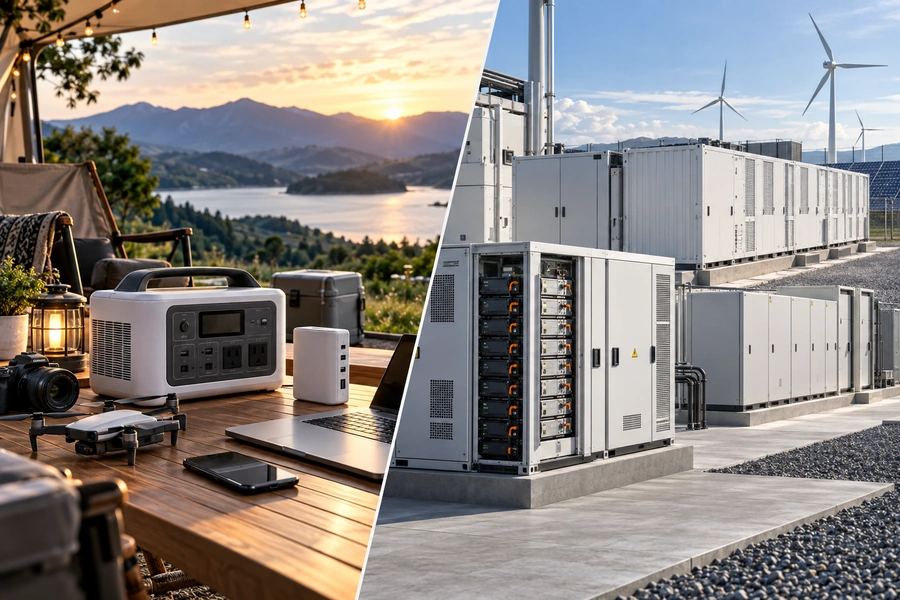
Consumer and industrial batteries may use similar chemistry, but their power requirements, operating environments, safety architecture, lifespan expectations, controls, and system complexity can be very different.
Consumer batteries are generally designed for portable electronics, household devices, tools, and smaller energy applications, prioritizing compact size, affordability, convenience, and energy density. Industrial batteries are engineered for heavier loads, longer operating periods, frequent cycling, harsh environments, scalability, monitoring, reliability, and integration with equipment such as factories, telecom systems, forklifts, UPS systems, microgrids, and large energy-storage systems.
The difference is therefore not simply small battery versus large battery. A consumer and industrial battery can sometimes use similar lithium-ion chemistry, but the complete products are engineered around very different operating requirements.
What Is a Consumer Battery?
Consumer batteries are designed primarily around the needs of individual users and relatively standardized products.
A consumer battery is typically designed to power personal electronics, household equipment, portable tools, mobility products, or smaller energy devices. Consumer battery design commonly emphasizes compact dimensions, low weight, affordability, convenience, simple charging, and sufficient runtime for the intended product rather than large-scale continuous industrial operation.
Common examples include batteries used in:
smartphones, laptops, cameras, cordless tools, portable power stations, household appliances, e-bikes, and small electronic devices.
The battery may be extremely sophisticated.
A smartphone battery, for example, requires careful management of temperature, voltage, charging, state of charge, and physical dimensions.
However, its operating objective is different from a battery supporting an industrial plant.
A consumer battery may need to deliver tens or hundreds of watt-hours.
An industrial energy-storage system may require hundreds of kilowatt-hours or several megawatt-hours.
This changes almost everything around the cells.
Higher system energy requires more attention to:
electrical protection,
thermal management,
communications,
fault isolation,
monitoring,
maintenance,
and system-level controls.
Therefore, consumer batteries should not be defined simply as “low-quality batteries.”
Many are technically advanced.
Their defining difference is primarily the application and design requirement.
What Is an Industrial Battery?
Industrial batteries are engineered around demanding equipment, processes, infrastructure, and energy applications.
Industrial batteries are designed for applications where reliability, power, energy capacity, cycling, monitoring, safety, environmental tolerance, maintainability, and system integration can be critical. They are commonly used in forklifts, telecom backup, UPS systems, factories, data centers, renewable-energy systems, microgrids, commercial ESS, utility storage, and other mission-critical infrastructure.
An industrial battery may be part of a much larger architecture:
Battery Cells → Modules → Racks → BMS → PCS/Inverter → EMS → Industrial Load
For a large battery energy storage system, additional equipment can include:
thermal management,
fire protection,
DC protection,
transformers,
switchgear,
SCADA,
communications,
and grid-interconnection equipment.
This means the battery cells themselves are only one part of the industrial system.
Consider a factory installing:
1 MW / 4 MWh
of battery storage.
The system contains:
4 MWh of energy
and can theoretically discharge at:
1 MW for four hours.
Managing that amount of energy requires a fundamentally different system architecture from managing a:
500 Wh
portable consumer battery.
The chemistry might still be lithium-ion.
The engineering around it is completely different.
What Are the Main Differences Between Consumer and Industrial Batteries?
The easiest way to understand the distinction is to compare design priorities.
Consumer batteries generally prioritize portability, convenience, compact dimensions, product cost, and sufficient runtime. Industrial batteries prioritize reliability, scalability, power capability, cycle performance, monitoring, integration, serviceability, and application-specific safety. Industrial systems may also require advanced BMS, thermal management, communications, redundancy, and centralized energy-management controls.
| Feature | Consumer Batteries | Industrial Batteries |
|---|---|---|
| Typical application | Personal and household products | Commercial and industrial equipment |
| Typical scale | Wh to smaller kWh systems | kWh to MWh-scale systems |
| Main priority | Convenience and portability | Reliability and performance |
| Weight sensitivity | Often very important | Application dependent |
| Space sensitivity | Usually high | Application dependent |
| Power requirement | Usually smaller | Can be very high |
| Monitoring | Usually simple for user | Often advanced |
| BMS complexity | Product dependent | Often system-level |
| Thermal management | Usually compact | Can be highly engineered |
| Communication | Limited/user-oriented | BMS, EMS, PCS, SCADA integration |
| Scalability | Usually limited | Often important |
| Maintenance | Often replacement-oriented | Often service-oriented |
| Redundancy | Usually limited | Can be critical |
| Operating environment | Mostly controlled | May be demanding |
| Backup requirement | Usually personal | Can be mission-critical |
| System integration | Relatively limited | Often extensive |
The distinction becomes especially clear when batteries are integrated into energy infrastructure.
A consumer battery usually powers a product.
An industrial battery can become part of an electrical system.
How Do Consumer and Industrial Battery Capacities Differ?
Capacity is one of the most visible differences, but it should be evaluated together with power.
Consumer batteries typically store relatively small amounts of energy compared with industrial systems. Industrial battery installations can scale from several kWh to many MWh. However, energy capacity alone does not define an industrial battery because industrial applications also require specific power, duration, cycle, safety, and integration capabilities.
Suppose a portable battery stores:
500 Wh.
That equals:
0.5 kWh.
A commercial ESS might store:
500 kWh.
That is:
1,000 times more energy.
A utility battery might store:
500 MWh.
That is:
one million times the energy of the 500 Wh example.
Scale creates new engineering requirements.
As stored energy increases, designers must consider:
how cells are connected,
how modules are isolated,
how current is controlled,
how heat is removed,
how faults are detected,
how equipment communicates,
and how emergency conditions are managed.
This is why scaling a consumer battery design is not simply a matter of adding more cells.
The complete architecture must change with the application.
How Do Power Requirements Differ?
Battery energy tells us how much electricity is stored, while power tells us how quickly it can be delivered.
Industrial batteries can require much higher power capability because they may operate motors, material-handling equipment, factory loads, UPS systems, EV chargers, microgrids, or grid-connected inverters. Consumer batteries generally support smaller loads, although power tools and mobility products can still require relatively high discharge rates for their size.
Consider:
Energy = 10 kWh.
Battery A can deliver:
2 kW.
Battery B can deliver:
10 kW.
Both contain the same nominal energy.
But Battery B can theoretically supply five times the instantaneous power.
At 2 kW:
10 kWh ÷ 2 kW
= 5 theoretical hours.
At 10 kW:
10 kWh ÷ 10 kW
= 1 theoretical hour.
Industrial applications often require careful coordination between:
kW + kWh.
A battery may have enough energy but insufficient power.
Or it may have enormous power capability but insufficient energy duration.
Therefore, industrial sizing usually starts with:
Load → Power → Duration → Energy
rather than selecting battery capacity alone.
Do Consumer and Industrial Batteries Use Different Chemistries?
Not necessarily. The same broad battery chemistry can appear in both markets.
Consumer and industrial batteries can both use lithium-ion chemistry, but chemistry selection depends on application priorities. Portable consumer products often emphasize high energy density and compact dimensions, while stationary industrial storage can place greater emphasis on cost, cycle performance, thermal characteristics, and long-term operation. LFP has consequently become especially important for stationary storage.
The IEA reports that lithium-ion technology dominates modern EV and storage applications.
Within lithium-ion, several chemistries are possible.
Two important examples are:
LFP — Lithium Iron Phosphate
and:
NMC — Nickel Manganese Cobalt.
NMC offers higher energy density, which can be valuable where weight and volume matter.
LFP has lower energy density but benefits from lower material cost and characteristics well suited to stationary applications.
The difference is visible in today's market.
The IEA reports that LFP represented around 90% of battery-storage deployments in 2025.
It also reports that LFP packs were more than 40% cheaper per kWh on average than NMC alternatives in 2025.
This helps explain why industrial stationary storage has moved strongly toward LFP.
Why Is Energy Density More Important for Consumer Batteries?
Portable products have strict physical constraints.
Energy density is often especially important for consumer batteries because smartphones, laptops, portable tools, and other mobile products need maximum runtime within limited weight and space. Industrial stationary batteries are usually less sensitive to weight, allowing designers to prioritize cost, cycle performance, reliability, thermal management, and maintainability instead.
Imagine two batteries.
Battery A stores:
1 kWh
and weighs:
5 kg.
Battery B stores:
1 kWh
and weighs:
8 kg.
For a portable product, the extra:
3 kg
could be unacceptable.
For a stationary industrial cabinet weighing hundreds of kilograms, that difference may matter much less.
This helps explain why chemistry preferences can differ between applications.
The IEA notes that LFP is less energy-dense than chemistries commonly used in EV applications but is typically cheaper and better suited to frequent cycling in storage.
Stationary storage therefore changes the optimization target.
Instead of maximizing:
Wh/kg,
designers may focus more heavily on:
Cost + Cycle Performance + Safety Architecture + Lifetime Value.
How Do Battery Management Systems Differ?
The BMS becomes increasingly important as system size and complexity increase.
Both consumer and industrial lithium-ion batteries can use battery-management electronics, but industrial BMS architectures often require more extensive monitoring, communications, protection, diagnostics, event logging, and coordination across modules or racks. Large ESS installations may use multiple levels of battery management connected with PCS, EMS, thermal, and supervisory-control systems.
A small battery may monitor:
cell voltage,
temperature,
current,
state of charge,
and basic protection conditions.
A large industrial BESS may need to monitor these variables across:
thousands of cells,
multiple modules,
multiple racks,
and several containers.
The hierarchy may look like:
Cell → Module → Rack → Container → Site Controller.
Industrial systems can also communicate with:
PCS,
EMS,
SCADA,
HVAC,
fire systems,
and site controllers.
Therefore, the BMS is not simply an electronic switch that prevents overcharging.
In an industrial system, it becomes part of a larger control and safety architecture.
How Does Thermal Management Differ?
Heat becomes a major engineering issue when many cells operate together.
Consumer batteries generally rely on compact thermal strategies matched to relatively small products, while industrial batteries may require engineered air cooling, liquid cooling, HVAC, temperature sensors, alarms, and centralized controls. The objective is to maintain acceptable cell temperatures and temperature uniformity while supporting performance, life, and safe operation.
Temperature affects battery behavior.
High temperatures can accelerate aging.
Very low temperatures can reduce available power and charging capability.
Temperature differences between cells can also cause different aging rates across a large battery pack.
Imagine one rack operating consistently warmer than another.
Over time, the warmer rack may degrade faster.
That creates imbalance across the system.
Industrial thermal management therefore aims not only to keep batteries:
cool enough
but also:
thermally uniform.
Large containerized systems increasingly use sophisticated cooling strategies because high energy density concentrates substantial stored energy within relatively compact enclosures.
Are Industrial Batteries Designed for More Cycles?
Industrial applications often place greater emphasis on cycling, but chemistry and warranty conditions still matter.
Many industrial batteries are designed around frequent or predictable cycling because applications such as peak shaving, renewable-energy shifting, forklifts, and grid services may charge and discharge regularly. Consumer cycling patterns vary widely. Actual cycle life for either category depends on chemistry, temperature, depth of discharge, C-rate, SOC, cell quality, and manufacturer specifications.
A stationary ESS used for energy shifting might cycle:
once per day.
That equals approximately:
365 cycles/year.
Over:
10 years,
that becomes:
3,650 cycles.
Over:
15 years:
5,475 cycles.
But cycle count should never be evaluated alone.
A specification of:
6,000 cycles
means little without knowing:
depth of discharge,
temperature,
charge rate,
discharge rate,
and:
end-of-life capacity.
Industrial buyers therefore often evaluate:
Warranty Years + Warranted Throughput + Retained Capacity.
This provides more information than a headline cycle number.
Why Is Reliability More Important for Industrial Batteries?
Battery failure can have very different consequences depending on the application.
Consumer battery failure may inconvenience an individual user, while industrial battery failure can interrupt production, telecom services, material handling, data processing, critical infrastructure, or grid operations. Industrial battery systems therefore may require stronger monitoring, fault detection, redundancy, service procedures, spare parts, and preventive maintenance.
Consider a smartphone battery failure.
The device stops working.
Now consider a battery supporting:
a data center,
factory,
telecommunications tower,
hospital microgrid,
or industrial process.
Downtime could create substantial financial or operational consequences.
This changes the design philosophy.
Industrial systems may use:
N+1 redundancy
or reserve capacity.
For example, if three battery units are required to meet a critical load, a system might install:
four units.
Then one unit can potentially be unavailable while the required capacity remains.
Not every industrial battery requires redundancy.
But industrial design is much more likely to consider:
failure consequences.
How Do Safety Requirements Differ?
Stored energy and operating environment strongly influence battery safety architecture.
Industrial battery installations often require more extensive system-level safety engineering because they contain larger amounts of energy and may operate near critical equipment or personnel. Protection can include BMS functions, overcurrent protection, disconnects, thermal management, fault detection, enclosure design, fire testing, ventilation strategies, monitoring, and application-specific installation requirements.
For North American stationary energy-storage systems, important frameworks include:
UL 9540
for ESS equipment/system safety,
UL 9540A
for thermal-runaway and fire-propagation testing,
and:
NFPA 855
for stationary ESS installation requirements.
The safety question therefore should not be:
“Is the battery chemistry safe?”
A more useful question is:
“How is the complete battery system designed, tested, protected, installed, monitored, and maintained?”
Chemistry matters.
But industrial safety is a system-engineering problem.
Why Are Industrial Batteries More Expensive?
Comparing only battery price can hide the cost of industrial engineering.
Industrial batteries can cost more because the buyer may be purchasing much more than battery cells. Industrial systems can require stronger enclosures, advanced BMS, cooling, high-power electronics, communications, protection, certifications, engineering, installation, commissioning, monitoring, maintenance, and integration with existing electrical or control systems.
Consider a commercial BESS.
Its total cost can include:
Battery + PCS + BMS + EMS + Thermal Management + Protection + Transformer + Switchgear + Engineering + Installation + Commissioning.
Therefore:
Cell Price ≠ Battery Pack Price
and:
Battery Pack Price ≠ Installed Industrial System Price.
This distinction has become increasingly important as battery prices decline.
The IEA reports that battery-storage project costs fell by around 40% in 2024 to approximately $150/kWh at utility scale. That figure is an industry benchmark rather than a universal quotation for industrial systems.
Industrial project pricing still depends heavily on:
power,
duration,
location,
electrical architecture,
installation,
and application.
What Applications Use Industrial Batteries?
Industrial batteries cover far more than large grid storage.
Industrial batteries are used in material handling, manufacturing, telecom, UPS, data centers, renewable-energy storage, microgrids, EV charging infrastructure, commercial buildings, remote power systems, and utility-scale BESS. Each application places different requirements on power, duration, cycling, redundancy, controls, communications, and maintenance.
A forklift battery needs:
high daily utilization,
predictable charging,
and mechanical durability.
A telecom battery emphasizes:
backup reliability.
A data-center UPS battery emphasizes:
rapid response and continuity.
A solar-storage battery emphasizes:
energy shifting and cycling.
A utility BESS may emphasize:
MW-scale power,
MWh-scale energy,
grid services,
and centralized control.
This is why “industrial battery” describes a broad category.
There is no single industrial battery specification suitable for every application.
The battery must be engineered around the load.
Why Are Industrial Energy Storage Batteries Growing So Quickly?
Industrial and grid batteries are becoming increasingly important as electricity systems add renewable generation and flexible loads.
Industrial stationary batteries are expanding because they can shift energy, reduce peaks, support renewable generation, provide backup, manage congestion, support grid services, and integrate new loads such as EV charging and data centers. Global battery-storage additions reached 108 GW in 2025, increasing 40% from 2024.
Around four-fifths of new battery-storage capacity added in 2025 was utility-scale.
The application mix is also changing.
According to the IEA, energy shifting represented more than 90% of new battery projects in 2025, compared with around 40% in 2015. Average duration of projects commissioned in 2025 increased to approximately three hours, up from roughly two hours in 2023.
This suggests industrial batteries are increasingly expected to move meaningful quantities of electricity across time rather than merely respond to short grid events.
Can Consumer Batteries Be Used for Industrial Applications?
A battery should be used within the application and operating conditions for which the complete product is designed.
A consumer battery should not automatically be substituted for an industrial battery simply because voltage and capacity appear similar. Industrial applications may require different power capability, cycle performance, communications, environmental protection, serviceability, safety certification, redundancy, thermal management, warranty terms, and integration with industrial equipment.
Imagine two batteries rated:
48 V / 100 Ah.
Nominal energy for each is approximately:
48 × 100
= 4.8 kWh.
On paper, they look similar.
But one might support:
50 A continuous discharge
while another supports:
100 A.
One might communicate with an industrial inverter.
The other might not.
One might be designed for:
daily cycling.
The other might be intended mainly for:
occasional use.
One may have appropriate environmental protection.
The other may require indoor controlled conditions.
Therefore:
Same Voltage + Same Ah ≠ Same Battery Capability.
How Should You Choose Between Consumer and Industrial Batteries?
The decision should begin with the application rather than the battery label.
Choose a battery by defining the required energy, power, runtime, cycle frequency, operating environment, safety requirements, communications, maintenance expectations, warranty, and consequences of failure. Consumer products are usually appropriate for personal or standardized applications, while industrial systems are better suited to demanding, scalable, continuously monitored, or mission-critical operations.
For a consumer application, I would prioritize:
size,
weight,
runtime,
ease of charging,
product compatibility,
and purchase cost.
For an industrial application, the evaluation expands to:
kW
kWh
duration
continuous current
peak power
cycle profile
temperature range
BMS architecture
communications
thermal management
system integration
safety
warranty
service
and:
lifecycle cost.
The difference is fundamentally about engineering requirements.
My Insights: What Really Separates Consumer and Industrial Batteries
Consumer and industrial batteries should not be separated only by physical size.
The real difference is design purpose. Consumer batteries optimize energy storage for personal products and standardized use, while industrial batteries are engineered around demanding loads, reliability, cycling, scalability, monitoring, safety, integration, and lifecycle economics. Similar cells can therefore become very different battery products depending on the system built around them.
My First Insight: Size Is a Result, Not the Main Difference
Industrial batteries are often larger.
But that does not mean:
Large = Industrial
and:
Small = Consumer.
A relatively small industrial UPS battery can be mission-critical.
A large portable consumer power station can store several kWh.
The real distinction is:
Application Requirements.
Industrial equipment is designed around defined operational and reliability requirements.
My Second Insight: The BMS Becomes More Important as the System Scales
A large battery contains many cells.
Those cells do not age identically.
They do not always operate at identical temperatures.
They can experience different electrical conditions.
Therefore, monitoring becomes increasingly important as systems scale.
The control hierarchy can expand from:
Cell Monitoring
to:
Module Management
to:
Rack Management
to:
System Management.
This is one reason industrial batteries become much more than collections of cells.
My Third Insight: Industrial Battery Value Comes From Reliability, Not Just Energy
Imagine two:
100 kWh
batteries.
Battery A costs less.
Battery B has:
better monitoring,
stronger warranty,
greater continuous power,
better integration,
and higher availability.
For an industrial user, Battery B may create more value even if its purchase price is higher.
The correct economic metric is therefore not always:
Lowest $/kWh.
It can be closer to:
Lowest Lifecycle Cost per Useful Service Delivered.
My Fourth Insight: Stationary Storage Is Moving Toward Purpose-Built Industrial Architecture
LFP's rise illustrates this transition.
Around 90% of battery-storage deployments in 2025 used LFP, according to the IEA.
This is significant because stationary systems do not need to optimize every kilogram in the way mobile products do.
They can prioritize:
cost,
cycling,
system integration,
thermal design,
and long-term operation.
Industrial stationary batteries are therefore increasingly being engineered as dedicated infrastructure rather than oversized versions of portable batteries.
My Fifth Insight: What Are the Differences Between Consumer and Industrial Batteries?
Consumer and industrial batteries differ primarily in design purpose, scale, power, cycling, reliability, monitoring, safety architecture, environmental tolerance, system integration, maintenance, and lifecycle expectations. Consumer batteries generally optimize convenience, portability, and product cost, while industrial batteries optimize dependable performance under demanding operating conditions.
The core differences can be summarized clearly:
| Question | Consumer Battery | Industrial Battery |
|---|---|---|
| Primary objective | Convenient stored energy | Reliable operational energy |
| Typical user | Individual | Business, facility, infrastructure operator |
| Scale | Usually smaller | Often larger and scalable |
| Energy density priority | Often high | Application dependent |
| Power requirement | Product specific | Can be very high |
| Cycling | Application dependent | Often frequent or defined |
| Monitoring | User-focused | Operational/system-focused |
| BMS | Usually product-level | Can be hierarchical |
| EMS integration | Uncommon | Common in ESS applications |
| Thermal system | Compact | Can use engineered air/liquid cooling |
| Communications | Usually limited | Often extensive |
| Maintenance | Often replace product/battery | Service and preventive maintenance |
| Redundancy | Rare | May be required |
| Environment | Usually moderate | Can be demanding |
| Failure consequence | Usually limited | Can be financially or operationally severe |
| Scalability | Usually limited | Often important |
| Lifecycle analysis | Less visible to user | Important |
| Common chemistry | Lithium-ion and others | Lithium-ion, LFP, lead-acid and others |
| Stationary LFP importance | Application dependent | Very high |
| Core buying question | “Will it power my product?” | “Will it reliably support my operation?” |
The engineering progression can therefore be expressed as:
Consumer Battery = Cells + Product-Level Management
while a large industrial storage application can become:
Industrial BESS = Cells + Modules + Racks + BMS + PCS + EMS + Thermal Management + Protection + Electrical Infrastructure
This does not mean industrial batteries are automatically “better.”
They are built for a different job.
A smartphone does not need:
a megawatt PCS,
SCADA,
industrial switchgear,
or a container cooling system.
A grid-scale BESS does not need to fit into someone's pocket.
Each design is optimized for its application.
The most useful distinction is therefore not:
Consumer vs. Industrial = Small vs. Large.
It is:
Consumer vs. Industrial = Different Engineering Priorities.
That distinction becomes increasingly important as industrial battery storage expands. Global storage additions reached 108 GW in 2025, up around 40% year over year, while LFP represented roughly 90% of deployments.
Industrial batteries are consequently becoming an important part of modern electricity infrastructure.
For buyers, the final decision should follow:
Application → Load → Power → Energy → Runtime → Environment → Safety → Controls → Maintenance → Lifecycle Cost.
That process provides a much more reliable battery choice than comparing:
voltage, Ah, or $/kWh alone.
Conclusion
Consumer batteries prioritize convenient everyday energy, while industrial batteries prioritize reliable, scalable, monitored performance for demanding applications where power, safety, integration, and lifecycle value matter.
](https://voltcrave-battery.com/wp-content/uploads/2026/09/Which-Industries-Are-Harnessing-the-Power-of-High-Voltage-Inverters-and-How-768x512.webp)
](https://voltcrave-battery.com/wp-content/uploads/2026/10/Is-Whole-House-Battery-Backup-Worth-It-768x512.webp)
](https://voltcrave-battery.com/wp-content/uploads/2026/09/BESS-Container-or-Battery-Building-Which-Is-Best-for-Solar-Power-Plants-768x512.webp)







































