
](https://voltcrave-battery.com/wp-content/uploads/2026/10/Portable-Power-Station-vs-Mobile-Energy-Storage-System-The-Real-Boundary.jpg)
Choosing the wrong battery power solution can increase costs, limit operating time, and create safety problems. Portable power stations and mobile energy storage systems often look similar in product descriptions.
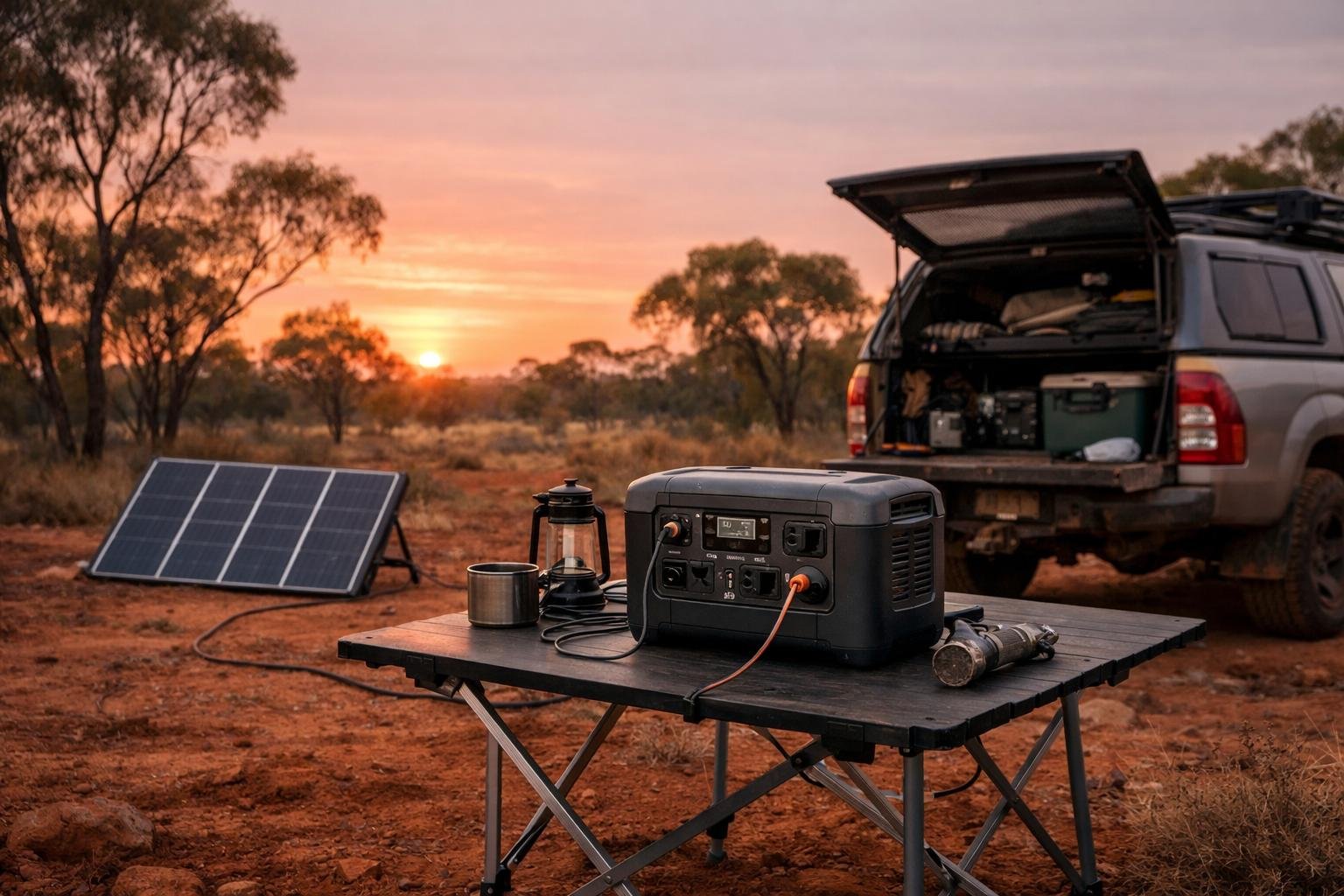
A portable power station is generally a self-contained battery-powered device designed to supply appliances and electronics through integrated outlets. A Mobile Energy Storage System (Mobile ESS) is a transportable power system designed to manage larger or more complex electrical loads. The real difference involves system architecture, electrical integration, operating requirements, and safety certification—not simply battery capacity.
Portable power stations serve smaller devices, while mobile energy storage supports larger sites. Battery capacity, power output, and system architecture determine suitability across different applications.
What Is the Difference Between a Portable Power Station and a Mobile Energy Storage System?
Portable power stations and mobile energy storage systems are both designed to store electricity and release it when needed. However, their electrical configurations and operating environments can differ significantly.
A portable power station usually combines batteries, an inverter, charging electronics, and output sockets inside one movable enclosure. A mobile energy storage system typically integrates battery modules with power conversion, monitoring, thermal management, and electrical distribution equipment for temporary or relocatable applications. Their exact classification depends on intended use and applicable standards.
What Is a Portable Power Station?
A portable power station is a rechargeable electrical device designed to provide electricity without a continuous utility connection.
Most products include an internal battery, Battery Management System (BMS), inverter, charging controller, and several output connections.
Common outputs include AC outlets, USB-C ports, USB-A ports, and DC connections.
I consider portable power stations especially suitable for applications where the user needs a relatively simple power source.
Typical examples include camping, outdoor photography, mobile offices, recreational vehicles, and limited emergency backup.
A portable power station can be charged from the utility grid, compatible solar panels, or another approved charging source.
For example, the EcoFlow DELTA Pro 3 provides 4,096Wh of rated energy capacity and 4,000W of continuous AC output.
Despite its relatively large capacity and weight, it remains part of the portable power station category.
This illustrates why physical size alone does not determine the product classification.
What Is a Mobile Energy Storage System?
A Mobile ESS is a transportable battery storage system designed to supply electricity in locations where power demand changes or permanent electrical infrastructure is unavailable.
Some systems are mounted on trailers, trucks, skids, or transportable containers.
A commercial Mobile ESS may include:
- Battery modules and racks
- Battery Management System
- Power Conversion System (PCS)
- Energy Management System (EMS)
- Thermal management equipment
- Electrical protection and isolation
- Site-level power connections
- Remote monitoring and communication
I consider system-level electrical integration one of its most important characteristics.
A Mobile ESS may support an entire construction site, a temporary commercial facility, or a large event rather than a few individual appliances.
Comparison of the Two Systems
| Feature | Portable Power Station | Mobile Energy Storage System |
|---|---|---|
| Main purpose | Portable appliance power | Temporary or relocatable site power |
| Common design | Integrated single enclosure | Integrated cabinets, trailers, or containers |
| Typical loads | Electronics and selected appliances | Commercial and industrial electrical loads |
| Energy capacity | Often Wh to several kWh | Often tens of kWh to multiple MWh |
| Power distribution | Integrated outlets | Engineered electrical connections |
| Energy management | Device-level controls | More extensive system-level controls |
| Transportation | Hand-carried or wheeled | Vehicle or equipment transported |
| Deployment | Often straightforward | May require professional commissioning |
| Grid interaction | Model-dependent | Model-dependent, often more sophisticated |
These are common characteristics, not absolute rules.
Some large portable power stations support expansion batteries, advanced monitoring, and approved home backup integration.
Likewise, not every Mobile ESS has megawatt-hour capacity.
I would evaluate the complete product specifications rather than assume a fixed classification based on appearance.
How Do Battery Capacity, Power Output, and Runtime Compare?
Battery capacity is one of the most visible differences between portable and mobile energy storage products. However, the amount of stored energy does not determine how much power a system can deliver at once.
Portable power stations commonly provide hundreds of watt-hours to several kilowatt-hours of energy, while commercial Mobile ESS installations may store hundreds or thousands of kilowatt-hours. However, there is no universal kWh threshold separating all products. The correct comparison must include usable capacity, continuous output power, runtime, and charging capability.
Understanding Battery Capacity
Battery energy capacity is measured in watt-hours (Wh) or kilowatt-hours (kWh).
1 kWh = 1,000 Wh
For example, a portable power station with 2,000Wh contains approximately 2 kWh of nominal energy.
A Mobile ESS with 1 MWh contains 1,000 kWh of nominal energy.
The second system stores much more electrical energy, but that does not tell us its complete operating capability.
I always examine the system's usable energy capacity because some stored energy may be unavailable due to battery operating limits and reserves.
Real Product Capacity Examples
Consider two commercial products from different energy storage categories.
| Specification | EcoFlow DELTA Pro 3 | NOMAD Voyager Hawk |
|---|---|---|
| Product category | Portable power station | Mobile BESS |
| Nominal capacity | 4.096 kWh | 1,000 kWh |
| Rated AC output | 4 kW | 500 kW |
| Battery chemistry | LFP | LFP |
| Product format | Wheeled enclosure | 20ft trailer-mounted system |
| Main application | Portable and selected backup power | Temporary industrial and site-level power |
These figures demonstrate the considerable difference in electrical scale.
However, they do not mean that every portable power station or Mobile ESS has similar specifications.
I consider these products useful examples because they demonstrate two different approaches to delivering stored electricity.
How Do You Calculate Operating Runtime?
I estimate battery operating time using the following formula:
Runtime (hours) = Available AC Energy (kWh) ÷ Average Load (kW)
For example, suppose a portable power station has 4 kWh of nominal energy capacity.
Assume 85% of its capacity is usable and the energy delivery efficiency is 90%.
The estimated available AC energy is:
4 kWh × 0.85 × 0.90 = 3.06 kWh
If the connected equipment consumes 500W continuously:
3.06 kWh ÷ 0.5 kW = 6.12 hours
Now consider a hypothetical 1,000 kWh Mobile ESS supplying a 200 kW load.
Using the same assumptions:
1,000 kWh × 0.85 × 0.90 = 765 kWh
765 kWh ÷ 200 kW = 3.825 hours
These are simplified calculations, not guaranteed product runtimes.
Actual results depend on usable capacity, battery condition, temperature, auxiliary consumption, and electrical conversion losses.
Why Power Output Matters
Power output is measured in kilowatts.
It determines the maximum electrical load the system can support.
A 4 kWh battery paired with a 2 kW inverter cannot continuously power a 3 kW load without additional support.
Similarly, a 1 MWh Mobile ESS rated for 500 kW cannot supply an unsupported 800 kW continuous load simply because it has substantial energy capacity.
I therefore evaluate storage capacity and output power separately.
This is particularly important for industrial equipment, electric motors, pumps, and EV charging systems.
Where Should You Use a Portable Power Station Instead of a Mobile ESS?
Different applications require different levels of power, electrical reliability, and installation flexibility. Selecting equipment that is too large increases costs, while an undersized system may interrupt operations.
Portable power stations are generally suitable for camping, personal electronics, small mobile workplaces, and selected emergency appliances. Mobile ESS is better suited to temporary construction power, commercial facilities, industrial equipment, large outdoor events, and some fleet charging applications. The appropriate choice depends on the connected loads and operating requirements.
Portable Power Station Applications
Portable power stations are particularly useful when electricity must be available quickly without complex installation.
For example, camping users may need to charge phones, operate LED lights, run a laptop, or power a small refrigerator.
Photographers and outdoor production teams may use portable stations for cameras, monitors, and lighting equipment.
Homeowners may also use portable power stations during outages to support selected appliances.
I consider the main advantage to be convenience.
A self-contained unit can be relocated and used with equipment connected to its approved outlets.
Some portable power stations also support solar charging, allowing batteries to recharge during daylight hours.
However, solar charging performance depends on sunlight, panel capacity, and compatible charging equipment.
Mobile ESS for Construction Sites
Construction projects may require electricity before permanent grid infrastructure becomes available.
Common loads include temporary site offices, lighting, tools, security systems, and selected electric machinery.
A Mobile ESS can store electricity and supply power according to the construction schedule.
In a hybrid arrangement, it may work alongside a generator.
The battery can supply lower-demand periods while the generator remains switched off.
This can reduce unnecessary generator runtime under suitable operating conditions.
I consider the load profile particularly important because construction electricity demand can change significantly throughout the day.
Mobile ESS for Outdoor Events
Concerts, festivals, exhibitions, and sporting events may require substantial temporary electricity.
Stage lighting, audio systems, video equipment, refrigeration, and temporary commercial services operate on different schedules.
A Mobile ESS can support changing electrical demand and reduce on-site generator use when integrated appropriately.
Battery operation produces no on-site combustion exhaust during discharge.
However, I would not describe every battery-supported event as completely emission-free because the electricity used for charging may come from fossil-fuel generation.
Mobile ESS for EV Charging and Industrial Power
Some temporary EV charging projects need more electricity than a conventional portable power station can practically provide.
Mobile BESS equipment can work with compatible EV charging systems to deliver stored electricity to vehicles.
Industrial applications may also require higher power output, engineered electrical connections, and longer operating schedules.
I consider this a major distinction.
Portable power stations typically prioritize convenient access to AC and DC outlets.
Mobile ESS systems may prioritize electrical distribution, load management, generator integration, and project-level control.
Application Selection Guide
| Application | Usually More Suitable |
|---|---|
| Camping and outdoor recreation | Portable power station |
| Laptop and smartphone charging | Portable power station |
| Small mobile office | Portable power station |
| Selected household emergency appliances | Portable power station |
| Permanent whole-home backup | Approved installed ESS |
| Construction site electricity | Mobile ESS |
| Large outdoor festival | Mobile ESS |
| Temporary industrial operation | Mobile ESS |
| Commercial fleet charging | Mobile ESS with compatible charging equipment |
| Utility maintenance power | Engineered Mobile ESS |
The final decision must still account for electrical capacity, site access, safety requirements, and equipment compatibility.
What Is the Real Boundary Between Portable Power Stations and Mobile Energy Storage Systems?
The most important difference is not necessarily the size of the battery. A large portable power station and a small Mobile ESS may overlap in capacity, but their design requirements and approved uses can still differ.
The real boundary between portable power stations and Mobile ESS is determined by intended electrical use, integration with other power equipment, site connection requirements, safety certification, and operating conditions. In North America, UL 2743 addresses qualifying portable power packs, while UL 9540 addresses energy storage systems intended for applications such as fixed electrical installations.
Intended Use Is More Important Than Physical Size
I consider the intended operating function the first major boundary.
A portable power station commonly supplies electricity through integrated outlets.
The user connects approved equipment directly to the device.
A Mobile ESS may connect to electrical distribution equipment, support an industrial microgrid, operate alongside a generator, or supply a facility through an engineered installation.
These applications introduce additional electrical requirements.
They may involve grounding, overcurrent protection, isolation, transfer equipment, system communications, and commissioning.
Simply adding wheels to an energy storage cabinet does not make it equivalent to a consumer portable power station.
Similarly, placing several portable power stations together does not automatically create an approved commercial BESS installation.
UL 2743 and UL 9540: A Practical Safety Boundary
In North America, product safety standards provide a useful way to understand the difference.
The September 2025 edition of UL 2743 covers portable and movable power packs within its stated scope.
For lithium-ion and sodium-ion power packs, the standard specifies an aggregate capacity limit of 20 kWh.
However, this is a limit within a particular product safety standard—not a universal industry definition of Mobile ESS.
UL 2743 also excludes equipment intended to connect permanently to premises wiring or supply power to premises wiring, as well as utility-interactive systems.
Those applications fall within the scope of UL 9540 when the equipment functions as an energy storage system.
| Standard | Main Scope |
|---|---|
| UL 2743 | Qualifying portable and movable power packs |
| UL 2056 | USB power banks |
| UL 9540 | Energy storage systems and equipment |
| UL 9540A | Thermal runaway and fire-propagation test method |
| UL 1973 | Batteries for stationary and certain other applications |
| NFPA 855 | Installation requirements for energy storage systems, including certain mobile or portable ESS deployments |
I would not assume that a product certified to UL 2743 can automatically be connected to a building's electrical panel.
The complete installation must be approved for its intended purpose.
I also distinguish UL 9540 certification from UL 9540A testing.
UL 9540A is a test method, not a substitute for complete system certification.
Building Connections and Grid Integration
Another important boundary is how the equipment supplies electricity.
A portable power station may operate independently through its built-in outlets.
Some manufacturers offer approved integration systems for household backup.
However, connecting a power station to permanent building wiring requires the correct equipment, listing, installation method, and applicable approvals.
Improvised backfeeding through household outlets is unsafe.
Mobile ESS systems designed for site-level power may require specialized distribution panels, transfer equipment, interconnection protection, or qualified electrical personnel.
I evaluate whether the system is intended for islanded operation, grid-connected operation, or hybrid generator support.
These are engineering requirements, not simply optional features.
Transportation and Deployment Requirements
Portability also has an operational meaning.
A portable power station may be carried, wheeled, or transported in a vehicle.
A commercial Mobile ESS may require a trailer, heavy vehicle, lifting equipment, or special site access.
Large battery systems must also be evaluated for transportation and deployment conditions.
I consider loaded equipment weight, road restrictions, battery transport requirements, electrical isolation, environmental protection, and on-site fire safety.
A mobile system can be transportable without being suitable for immediate operation at every location.
The Economic Boundary
I also evaluate total project costs.
Portable power stations are often economical for smaller loads because installation requirements are relatively simple.
Mobile ESS systems may require higher initial investment, transportation, commissioning, monitoring, and maintenance.
However, they can provide value in larger applications through generator runtime reduction, load management, and flexible temporary deployment.
I recommend comparing the cost per delivered kilowatt-hour across the intended operating period.
The best system is the one that meets the project's electrical requirements without unnecessary equipment, infrastructure, or operating expenses.
My Insights: Portable Power Station vs Mobile Energy Storage System-The Real Boundary
Portable power stations and Mobile ESS are often compared only by battery capacity. This approach can hide important differences in operating functions, electrical integration, and safety requirements.
I believe the real boundary between a portable power station and a Mobile Energy Storage System is defined by how the equipment is designed, connected, managed, and deployed. Capacity helps describe the scale, but it does not independently determine the correct product category or installation requirements.
A Larger Battery Does Not Automatically Become a Mobile ESS
I do not consider battery capacity the only deciding factor.
A portable power station can contain several kilowatt-hours of energy and support multiple devices.
A commercial energy storage system may also have a relatively small capacity but operate through an engineered electrical distribution system.
The intended use matters more than a single capacity number.
I therefore begin by identifying the electrical loads and how the equipment will connect to them.
System Integration Defines the Technical Difference
I believe the most meaningful technical distinction involves system-level control.
A portable power station usually manages the electricity delivered through its own approved outlets.
A Mobile ESS may coordinate battery storage, external generators, electrical distribution, and changing site-level loads.
These functions can require more advanced monitoring and control.
They can also introduce additional safety and engineering requirements.
I evaluate the system through five connected factors:
Electrical Loads → Power Output → System Architecture → Connection Requirements → Safety Compliance
This provides a more accurate comparison than simply dividing products into small and large batteries.
Mobility Does Not Eliminate Installation Responsibilities
I also believe mobile energy storage is sometimes misunderstood as equipment that can be connected anywhere without professional preparation.
A battery trailer may be transportable, but the installation still requires suitable electrical infrastructure.
Large systems may need grounding, circuit protection, isolation equipment, fire safety clearances, and commissioning.
Even portable power stations must be operated according to their approved conditions.
The safest choice is the equipment designed and certified for the intended application.
The Best Choice Depends on the Project, Not the Product Label
For camping, personal electronics, and small emergency loads, I generally consider a portable power station the more practical option.
For construction sites, industrial operations, large events, and temporary commercial electricity, I would evaluate a Mobile ESS.
For permanent household backup, I would consider an appropriately approved installed energy storage system rather than assume that either mobile category is automatically suitable.
I believe these decisions should follow actual electrical demand, not product marketing terminology.
Ultimately, portable power stations and Mobile ESS share battery technology, but their real boundary lies in electrical architecture, operational responsibility, and approved system use.
Conclusion
Portable power stations prioritize convenient device-level electricity, while Mobile ESS supports engineered temporary power applications. Their real boundary depends on integration, intended use, and safety compliance.
](https://voltcrave-battery.com/wp-content/uploads/2026/09/What-Is-the-Number-One-Portable-Power-Station-768x512.webp)
](https://voltcrave-battery.com/wp-content/uploads/2026/08/How-Much-Does-a-1-MW-BESS-Cost-768x512.webp)








































