
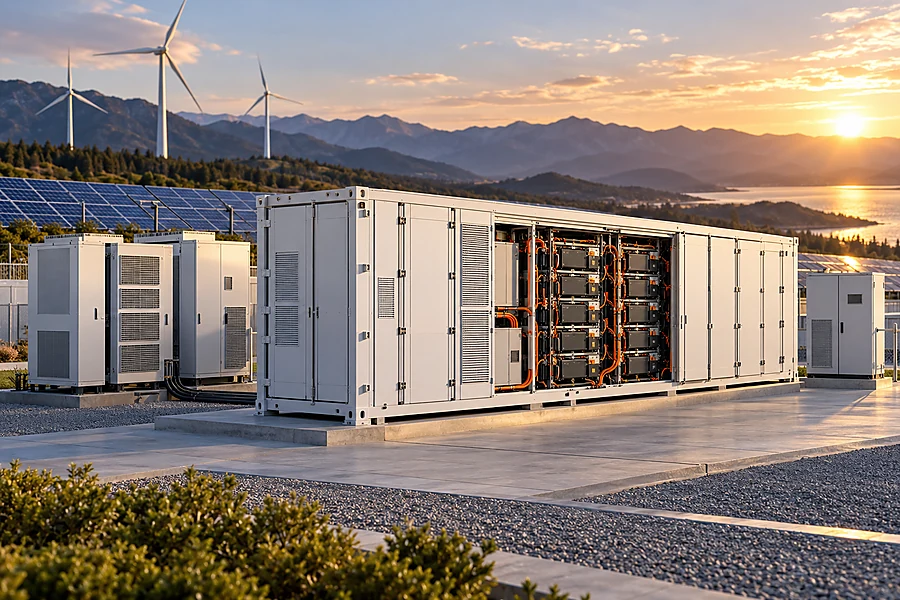
](https://voltcrave-battery.com/wp-content/uploads/2026/10/What-Is-the-Price-of-a-5-MWh-BESS-Container.webp)
A 5 MWh BESS container may look like one product, but quotations can include very different equipment, making apparently similar prices difficult to compare.
In 2026, a 5 MWh liquid-cooled BESS DC container can roughly cost $450,000–$700,000, while a more complete AC-integrated or installed project can approach $900,000–$1.2 million or more. Actual pricing depends on battery cells, PCS, transformer, EMS, fire protection, certification, freight, EPC, grid connection, power rating, and project location.
A 5 MWh battery container quote may cover only the DC block, while installed BESS pricing includes PCS, transformer, EMS, installation, commissioning, and grid connection.
How Much Does a 5 MWh BESS Container Cost in 2026?
Current market evidence suggests that the equipment price can vary substantially depending on scope and geography.
A reasonable 2026 budgeting range for a 5 MWh containerized DC battery block is approximately $450,000–$700,000, equivalent to roughly $90–$140/kWh. A complete AC-side system or installed project can move toward approximately $180–$230/kWh or higher, putting a 5 MWh project near $900,000–$1.15 million before unusually expensive interconnection or site work.
The basic calculation is straightforward.
A 5 MWh battery contains:
5 MWh = 5,000 kWh
At:
$90/kWh
the equipment value is:
5,000 × $90
= $450,000
At:
$110/kWh
it becomes:
5,000 × $110
= $550,000
At:
$140/kWh
it becomes:
5,000 × $140
= $700,000
But these calculations are meaningful only when the $/kWh figure refers to the same scope.
A low-cost quotation may represent:
DC battery container only.
A much higher quotation may represent:
turnkey AC BESS.
That scope difference can easily create hundreds of thousands of dollars of variation.
What Does a 5 MWh BESS Container Price Include?
Before comparing quotations, identify exactly what is inside the supplier's price.
A typical 5 MWh DC battery container can include LFP cells, battery packs or modules, racks, BMS, high-voltage DC protection, busbars, liquid cooling, sensors, fire detection or suppression equipment, enclosure systems, and internal electrical connections. PCS, transformers, MV switchgear, site installation, and grid interconnection may be quoted separately.
A simplified DC container architecture is:
LFP Cells
↓
Battery Packs
↓
Battery Racks
↓
BMS
↓
DC Bus
↓
HV Protection
↓
Container DC Output
Additional systems may include:
liquid cooling,
fire detection,
gas detection,
ventilation,
fire suppression,
temperature sensors,
smoke sensors,
and monitoring equipment.
But the battery still produces:
DC electricity.
To connect it to an AC facility or utility grid, additional equipment is normally required.
The broader architecture becomes:
5 MWh Battery Container
↓
PCS
↓
Transformer
↓
MV Switchgear
↓
Grid / Facility
That additional equipment explains much of the difference between container pricing and complete project CAPEX.
What Is the Price per kWh of a 5 MWh BESS Container?
Price per kWh is one of the easiest ways to compare battery containers, but only when equipment scope is identical.
A 5 MWh container priced at $500,000 equals $100/kWh, while a $650,000 container equals $130/kWh. Current 2026 procurement references show approximately $88–$115/kWh for some China-sourced 5 MWh containerized products delivered to international markets, while broader DC-system quotations can reach approximately $110–$140/kWh.
The equation is:
BESS Price per kWh = Total Equipment Price ÷ Battery Capacity
For example:
$450,000 ÷ 5,000 kWh
= $90/kWh
$500,000 ÷ 5,000
= $100/kWh
$600,000 ÷ 5,000
= $120/kWh
$700,000 ÷ 5,000
= $140/kWh
A useful indicative comparison is:
| Price per kWh | Approximate 5 MWh Cost |
|---|---|
| $90/kWh | $450,000 |
| $100/kWh | $500,000 |
| $110/kWh | $550,000 |
| $120/kWh | $600,000 |
| $130/kWh | $650,000 |
| $140/kWh | $700,000 |
| $180/kWh | $900,000 |
| $200/kWh | $1,000,000 |
| $230/kWh | $1,150,000 |
The lower part of this table is more representative of battery equipment.
The upper part increasingly moves toward integrated or installed system pricing.
What Is the Difference Between a 5 MWh DC Block and an AC BESS?
This distinction is critical when requesting supplier quotations.
A DC battery block primarily contains the battery energy-storage equipment and delivers DC power. An AC-integrated BESS adds the power conversion equipment required to exchange electricity with an AC electrical system. Depending on project scope, this can include PCS equipment, transformers, switchgear, controls, auxiliary power, and additional balance-of-system components.
Think of the DC block as:
Stored Energy
and the PCS as:
Power Conversion.
A 5 MWh container tells us:
how much energy is stored.
It does not automatically tell us:
how much power can be delivered.
For example, the same 5 MWh battery might be configured as:
5 MW / 5 MWh = 1-hour system
2.5 MW / 5 MWh = 2-hour system
1.25 MW / 5 MWh = 4-hour system
The energy remains:
5 MWh.
But the PCS power rating changes dramatically.
NREL emphasizes this distinction in its battery cost methodology. BESS costs depend on both energy capacity and power capacity, and the cost per kWh changes with storage duration.
Therefore, asking:
“How much does 5 MWh cost?”
is only the beginning.
A procurement-grade question is:
“What is the price of a 2.5 MW / 5 MWh, 2-hour BESS with defined equipment scope?”
How Much Does a Complete 5 MWh BESS Project Cost?
Turnkey project pricing can be substantially higher than the battery container itself.
A complete 5 MWh BESS project can reasonably approach roughly $900,000–$1.2 million or more under current market conditions, depending heavily on PCS power, transformer voltage, switchgear, fire protection, EMS, civil works, engineering, installation, certification, freight, commissioning, and interconnection. Difficult sites can push total project costs higher.
A project budget may contain:
Battery container
PCS
Transformer
MV switchgear
EMS/SCADA
Auxiliary power
Fire protection
Concrete foundation
Cabling
Grounding
Engineering
Permitting
Installation
Commissioning
Interconnection
Freight
Taxes/duties
Developer/EPC margin
This explains why a:
$500,000 battery container
does not mean:
$500,000 operating BESS project.
NREL's utility-scale cost methodology explicitly separates battery-pack costs from inverter and balance-of-system costs and notes that the battery pack represents only part of complete installed BESS CAPEX.
Why Does the Power Rating Affect the Price of a 5 MWh BESS?
Because MWh measures energy while MW measures power.
Two BESS projects can both contain 5 MWh of battery capacity while requiring very different PCS, transformer, cabling, switchgear, and thermal designs. A 5 MW/5 MWh one-hour system requires much greater power capability than a 1.25 MW/5 MWh four-hour system, so identical energy capacity does not imply identical project cost.
The basic relationship is:
Duration = Energy ÷ Power
For a:
5 MW / 5 MWh
system:
5 MWh ÷ 5 MW
= 1 hour
For:
2.5 MW / 5 MWh
5 ÷ 2.5
= 2 hours
For:
1.25 MW / 5 MWh
5 ÷ 1.25
= 4 hours
NREL's utility-scale model reflects exactly this relationship. It separates battery energy costs in $/kWh from power-related balance-of-system costs in $/kW.
This is why a serious RFQ should always specify:
MW + MWh + Duration
instead of MWh alone.
Can a 20-Foot Container Really Hold 5 MWh?
Yes. Modern LFP systems have pushed container energy density significantly higher.
Modern liquid-cooled LFP BESS designs can place approximately 5 MWh or more inside a 20-foot-class container. Current commercial architectures commonly use large prismatic LFP cells, high-voltage DC systems, integrated liquid cooling, BMS controls, and increasingly compact pack or cell-to-system designs to increase container-level energy density.
This is an important change from earlier BESS generations.
Older systems often required more containers for the same project energy.
Today, a supplier may offer:
approximately 5 MWh,
5.16 MWh,
5.9 MWh,
6.25 MWh,
or even higher capacity
within a 20-foot-class architecture, depending on product design.
That can reduce:
container quantity,
foundation count,
inter-container cabling,
site footprint,
transportation complexity,
and installation work.
However, greater energy density also makes:
thermal management,
fire propagation control,
cell consistency,
and safety engineering
increasingly important.
What Battery Cells Are Used in a 5 MWh BESS Container?
LFP prismatic cells dominate modern stationary battery-storage systems.
Most current 5 MWh-class BESS containers use large-format prismatic LFP cells because stationary storage prioritizes cycle performance, cost, safety characteristics, and space utilization. Modern container designs commonly use cells around the 300 Ah class or larger, although exact cell capacity and architecture vary significantly between manufacturers and product generations.
A typical architecture might look like:
LFP Cell
↓
Battery Pack
↓
Rack
↓
DC Container
↓
PCS
Increasing cell capacity can reduce the number of individual cells and electrical connections required for a given amount of stored energy.
However:
Larger Cell ≠ Automatically Better System.
The complete system still depends on:
cell consistency,
thermal uniformity,
BMS accuracy,
busbar design,
electrical isolation,
fire protection,
and manufacturing quality.
Therefore, procurement should evaluate the complete container rather than simply asking which Ah cell it uses.
How Much Does the PCS Add to a 5 MWh BESS?
PCS cost depends primarily on power rather than energy.
The PCS converts DC battery power into AC electricity and vice versa, so its size is determined largely by the BESS MW rating. A 5 MWh battery configured for one-hour operation requires approximately four times the PCS power of the same battery configured for four-hour operation, making duration an important project-cost variable.
Consider:
Option A: 5 MW / 5 MWh
PCS ≈ 5 MW
Option B: 2.5 MW / 5 MWh
PCS ≈ 2.5 MW
Option C: 1.25 MW / 5 MWh
PCS ≈ 1.25 MW
The battery energy is unchanged.
But the power electronics differ substantially.
NREL's commercial-storage benchmark, for example, models the battery component in $/kWh and the central inverter separately in $/kW, illustrating why power and energy should not be combined into a single purchasing metric.
Therefore, when a supplier says:
“5 MWh system price,”
ask immediately:
“At what MW rating?”
How Much Does the Transformer Add to BESS Cost?
Transformer requirements depend on PCS voltage and the facility or grid connection voltage.
A transformer may be required to raise the PCS output voltage to the site's medium-voltage distribution or grid-connection level. Its cost depends on MVA rating, primary and secondary voltage, insulation, cooling, efficiency, regional standards, and whether it is supplied separately or integrated into a power-conversion skid.
For example, a utility project may need to connect to:
11 kV,
13.8 kV,
22 kV,
33 kV,
or another distribution voltage.
The architecture might be:
1,500 V DC Battery
↓
PCS
↓
690 V AC
↓
Transformer
↓
33 kV
↓
Grid
The exact voltage values are product- and project-specific.
Transformer cost also interacts with:
MV switchgear,
protection relays,
metering,
cabling,
and interconnection requirements.
Therefore, quotations described as:
“AC Block”
need to be checked carefully.
One supplier's AC block may include the transformer.
Another may include only the PCS.
How Does Liquid Cooling Affect 5 MWh Container Pricing?
High-energy-density containers increasingly use liquid cooling to manage cell temperature.
Liquid cooling adds pumps, coolant circuits, heat exchangers, controls, sensors, and other components, increasing equipment complexity. However, it can improve temperature uniformity and support higher container energy density, which may reduce overall site footprint and the number of containers required for a large project.
Battery degradation is strongly influenced by temperature.
But average temperature is not the only concern.
Temperature difference between cells also matters.
If one section of a container consistently operates hotter than another, cells can age at different rates.
Liquid cooling can help control:
maximum temperature
and:
temperature uniformity.
However, it introduces:
pumps,
coolant,
seals,
hoses,
maintenance,
and potential leak-management requirements.
Therefore:
Liquid Cooling ≠ Free Efficiency.
It is an engineering trade-off that can support compact high-capacity systems.
Why Are Some 5 MWh BESS Quotes Much Cheaper Than Others?
Quotation scope, geography, certification, warranty, and commercial terms can create enormous differences.
A low 5 MWh BESS quote may cover only ex-factory DC battery equipment, while a higher quote may include freight, UL-related testing or certification, PCS, transformer, EMS, fire systems, warranty guarantees, commissioning, EPC, taxes, and grid connection. Buyers should normalize every quotation to identical technical and commercial scope before comparing $/kWh.
Consider two hypothetical quotations.
Supplier A: $480,000
Includes:
5 MWh battery container,
BMS,
liquid cooling,
internal fire system.
Excludes:
PCS,
transformer,
freight,
installation.
Supplier B: $950,000
Includes:
5 MWh battery,
PCS,
transformer,
EMS,
commissioning,
and installation.
Supplier A appears:
49% cheaper.
But the products being quoted are not equivalent.
The correct comparison requires a:
Bill of Materials + Scope of Supply + Incoterms + Warranty + Performance Guarantee
rather than headline price alone.
Does Shipping Significantly Affect a 5 MWh Container Price?
It can, particularly for international procurement.
Freight can materially change delivered BESS cost because battery containers are heavy, regulated energy-storage products requiring appropriate transportation procedures. Delivered pricing can also include marine freight, insurance, inland transportation, port charges, customs duties, tariffs, handling, and project-specific logistics.
Procurement prices can therefore be described as:
EXW
FOB
CIF
or:
Delivered Site
and these terms should not be treated as equivalent.
For example:
$500,000 EXW
may become substantially more expensive after:
ocean freight,
insurance,
duties,
port handling,
local transport,
and site delivery.
This becomes especially important for U.S. projects where trade policy, country of origin, and domestic-content requirements can influence project economics.
A purchasing team should therefore compare:
Delivered Cost
rather than simply:
Factory Price.
How Does Warranty Affect BESS Container Price?
A lower equipment price can become expensive if the warranty provides weak long-term performance protection.
BESS warranties can cover different combinations of years, cycles, energy throughput, remaining capacity, availability, and operating conditions. A higher-priced system may therefore provide greater long-term value if it includes stronger performance guarantees, local service, spare parts, augmentation support, and clearly defined degradation obligations.
Suppose Battery A costs:
$500,000
and Battery B:
$550,000.
Battery B costs:
$50,000 more.
But imagine Battery B provides significantly stronger:
capacity retention guarantees,
service response,
and spare-parts support.
The cheapest initial CAPEX may not produce the lowest:
lifetime cost.
A better procurement metric can include:
Cost per Lifetime Delivered MWh
rather than only:
Initial $/kWh.
This shifts attention toward:
cycle life,
degradation,
round-trip efficiency,
availability,
augmentation,
and warranty.
Is the Cheapest 5 MWh BESS Container the Best Choice?
Usually, purchase price alone is insufficient for a utility-scale energy asset.
The lowest-priced BESS container is not necessarily the lowest-cost project over its operating life. Buyers should evaluate usable energy, degradation, round-trip efficiency, cycle-life conditions, warranty, safety testing, thermal management, auxiliary consumption, availability, service support, cell traceability, and expected lifetime energy throughput alongside initial CAPEX.
Consider:
System A:
$90/kWh
System B:
$105/kWh
System B initially costs:
$15 × 5,000
= $75,000 more.
But if System B delivers:
better capacity retention,
higher availability,
lower auxiliary consumption,
or reduced augmentation,
its lifetime economics may be better.
This is why utility-scale storage procurement increasingly requires:
technical due diligence
alongside:
commercial comparison.
Price is important.
But the goal is not to purchase the cheapest container.
The goal is to purchase the required:
lifetime energy-storage service
at acceptable risk and cost.
What Safety Standards Should a 5 MWh BESS Project Consider?
Large battery systems require system-level safety engineering rather than reliance on cell chemistry alone.
A 5 MWh BESS project should evaluate applicable battery, system, fire, electrical, and installation requirements for its jurisdiction. In North America, procurement commonly considers standards and test methods such as UL 1973, UL 9540, UL 9540A, and installation requirements associated with NFPA 855, depending on project configuration and authority requirements.
A supplier saying:
“Our cells are LFP”
does not answer the complete safety question.
Safety needs to address:
cell faults,
thermal propagation,
gas generation,
fire detection,
ventilation,
electrical isolation,
emergency shutdown,
overcurrent,
ground faults,
spacing,
and emergency response.
For procurement, I would request the relevant:
test reports,
certificates,
installation documentation,
fire-safety design,
and emergency-response information
rather than accepting a certification logo alone.
The exact applicable requirements should be verified for the project jurisdiction and authority having jurisdiction.
How Should You Request a Quote for a 5 MWh BESS?
A good RFQ needs more than the phrase “5 MWh battery.”
A procurement-grade RFQ should specify energy capacity, usable energy, MW rating, storage duration, DC voltage, grid voltage, application, expected cycles, ambient temperature, cooling, PCS scope, transformer scope, EMS requirements, communication, fire protection, certification, warranty, delivery location, Incoterms, commissioning, and required expansion or augmentation strategy.
A useful technical specification might look like:
| Parameter | Example |
|---|---|
| Nominal energy | 5 MWh |
| Usable energy | Supplier to specify |
| Power | 2.5 MW |
| Duration | 2 hours |
| Chemistry | LFP |
| Cooling | Liquid |
| DC architecture | Supplier specification |
| PCS | Included |
| Transformer | Included / excluded |
| Grid voltage | Project-specific |
| EMS | Included |
| Fire system | Included |
| Certification | Project-specific |
| Warranty | Supplier specification |
| Delivery | Delivered site |
| Commissioning | Included |
| Application | Energy shifting / peak shaving |
This makes supplier quotations much easier to compare.
Without these specifications, a $500,000 quotation and a $900,000 quotation might both be technically correct.
They simply describe different systems.
My Insights: What Really Determines the Price of a 5 MWh BESS Container
I would never evaluate a 5 MWh BESS using a single $/kWh number without first defining the commercial boundary.
The biggest pricing mistake is comparing DC-container cost with turnkey project CAPEX. Battery energy determines much of the $/kWh cost, while PCS and other power equipment depend strongly on MW. Transformers, switchgear, fire protection, EPC, freight, certification, warranty, and interconnection then determine how a competitive container price becomes a complete project budget.
My First Insight: $/kWh Is Useful Only When Scope Is Identical
A:
$90/kWh DC block
cannot be directly compared with a:
$190/kWh installed AC project.
The first may contain the battery.
The second may contain the complete power plant.
Before comparing prices, normalize:
equipment scope,
delivery terms,
warranty,
performance,
and project location.
My Second Insight: Always Ask for MW Alongside MWh
A 5 MWh system can be:
5 MW / 5 MWh
or:
2.5 MW / 5 MWh
or:
1.25 MW / 5 MWh.
They are all 5 MWh batteries.
They are not equivalent projects.
NREL's BESS methodology explicitly separates energy-related $/kWh costs from power-related $/kW costs for this reason.
My Third Insight: Container Energy Density Can Reduce Project-Level Costs
Putting approximately 5 MWh into one 20-foot-class container can reduce the number of:
foundations,
containers,
DC connections,
communications connections,
and installation activities
required for a large project. Current procurement references show 5 MWh-class and larger 20-foot architectures are now commercially relevant.
Therefore, higher container energy density can create savings beyond the battery itself.
My Fourth Insight: Lifetime Cost Is More Important Than Purchase Price
A BESS is expected to operate for years.
Therefore, procurement should evaluate:
Initial CAPEX + Degradation + Efficiency + Auxiliary Energy + Maintenance + Augmentation + Availability
rather than:
Container Price Alone.
A slightly more expensive battery can be economically superior if it delivers substantially more usable lifetime energy.
My Fifth Insight: What Is the Price of a 5 MWh BESS Container?
In 2026, a 5 MWh liquid-cooled LFP BESS DC container can reasonably fall around $450,000–$700,000, or roughly $90–$140/kWh, depending on supplier, configuration, delivery terms, and market. A more complete AC-integrated or installed 5 MWh project can approach approximately $900,000–$1.2 million or more once PCS, transformer, switchgear, EMS, EPC, commissioning, and grid connection are included.
A practical budgeting framework is:
| Cost Level | Indicative 5 MWh Budget | What It May Represent |
|---|---|---|
| Low equipment level | $450,000–$550,000 | Competitive DC container procurement |
| Broader DC system | $550,000–$700,000 | Higher-specification battery equipment |
| Integrated AC system | $700,000–$1,000,000+ | Battery plus some power equipment |
| Installed project | $900,000–$1,200,000+ | Broader EPC/project scope |
These ranges are indicative rather than universal quotations.
The final price depends heavily on whether the RFQ asks for:
5 MWh DC Container
or:
2.5 MW / 5 MWh AC BESS
or:
2.5 MW / 5 MWh Turnkey Grid-Connected Project.
Those are three different products.
For early-stage budgeting, I would therefore use:
approximately $0.45–$0.70 million for a 5 MWh DC battery container
and:
approximately $0.9–$1.2 million or more for a broadly integrated/installed 5 MWh project
while obtaining project-specific supplier quotations before making an investment decision.
The key purchasing formula is:
Real BESS Cost = Battery Container + PCS + Transformer + Switchgear + EMS + Safety Systems + EPC + Freight + Interconnection + Commissioning
That number—not the advertised container price—is what ultimately determines project CAPEX.
Conclusion
A 5 MWh BESS container may cost roughly $450,000–$700,000 in 2026, while a complete installed system can approach $900,000–$1.2 million or more.
](https://voltcrave-battery.com/wp-content/uploads/2026/09/12V-vs-24V-vs-48V-Batteries-for-Solar-Systems-Whats-the-Difference-768x512.webp)
](https://voltcrave-battery.com/wp-content/uploads/2026/08/How-Can-We-Make-Energy-Storage-Systems-Denser-768x512.webp)
](https://voltcrave-battery.com/wp-content/uploads/2026/08/What-Determines-the-Lifespan-of-a-BESS-Battery-768x512.webp)







































