
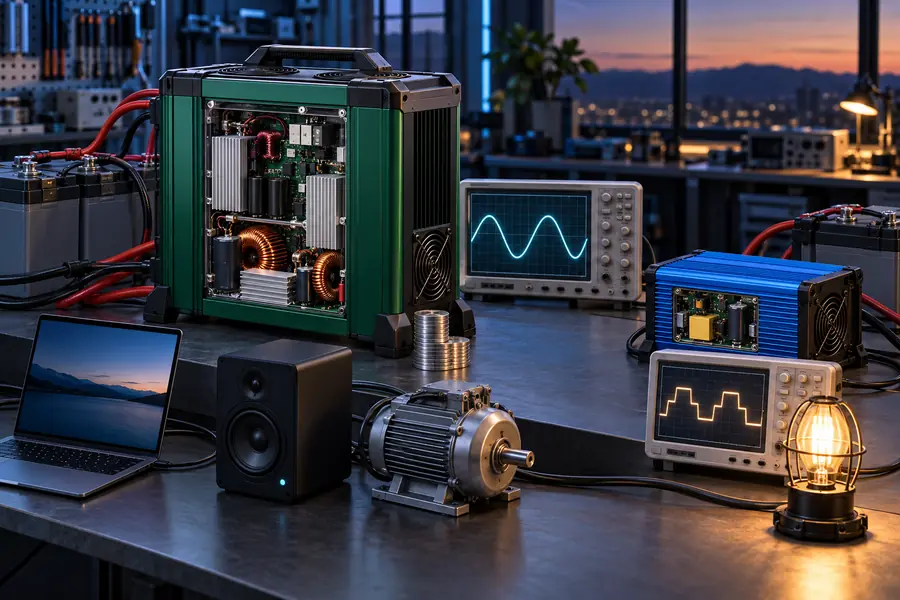
](https://voltcrave-battery.com/wp-content/uploads/2026/10/What-Are-the-Downsides-of-Using-a-Pure-Sine-Wave-Inverter.webp)
Pure sine wave inverters deliver clean AC power, but paying for premium waveform quality can add cost and complexity that some simple electrical loads do not need.
The main downsides of pure sine wave inverters are higher purchase cost, more complex electronics, standby power consumption, conversion losses, and potentially larger cooling or installation requirements at high power. However, they provide cleaner electricity and broader appliance compatibility, so these disadvantages usually matter most when budget is tight or loads are simple.
Pure sine wave delivers cleaner power and better compatibility but costs more, while modified sine wave offers a cheaper alternative for simple, less demanding applications.
Why Are Pure Sine Wave Inverters More Expensive?
Pure sine wave inverters need more sophisticated power electronics and control to reproduce AC power that closely resembles utility electricity.
Pure sine wave inverters generally cost more because they require additional switching electronics, waveform control, filtering, protection, and thermal design. Modified sine wave models can use simpler output stages, making them cheaper for basic loads. The extra cost of pure sine wave becomes worthwhile when powering motors, electronics, audio equipment, appliances, and sensitive devices.
A battery produces:
DC electricity.
Most household appliances expect:
AC electricity.
An inverter converts the DC input into alternating current.
The challenge is not simply changing DC into AC.
The inverter must also control:
voltage,
frequency,
waveform,
harmonic distortion,
and protection.
A pure sine wave output rises and falls smoothly, closely resembling grid power.
A modified sine wave inverter produces a more stepped waveform.
Renogy notes that modified sine wave inverters are generally less expensive, while their rougher waveform can create noise or reduced efficiency with certain appliances. Its pure sine models are designed to provide low-distortion, utility-like AC power.
That cleaner waveform requires more sophisticated electronics.
The price difference is therefore partly paying for:
better switching control,
output filtering,
lower harmonic distortion,
and broader load compatibility.
When Is the Extra Cost Unnecessary?
Suppose the inverter only powers:
simple incandescent lighting,
basic resistive heating,
or another tolerant load.
A lower-cost inverter may be able to operate that equipment adequately.
In that situation, paying significantly more for extremely clean AC may provide little visible benefit.
However, modern homes, RVs, workshops, and solar systems rarely power only simple resistive loads.
They often operate:
refrigerators,
microwaves,
computers,
chargers,
variable-speed motors,
audio equipment,
and electronically controlled appliances.
For those applications, pure sine wave output provides a stronger compatibility margin.
Therefore:
Higher Purchase Cost = Real Disadvantage
but:
Lower Purchase Price ≠ Better Lifetime Value
if a cheaper inverter creates noise, overheating, poor motor operation, or equipment compatibility problems.
Do Pure Sine Wave Inverters Waste Battery Power?
All inverters consume some energy during DC-to-AC conversion, and they can also draw power when connected but supplying little or no load.
Pure sine wave inverters are not 100% efficient. Modern models often achieve roughly 90% or better peak efficiency, but conversion losses and idle consumption still reduce usable battery runtime. The impact becomes especially noticeable when an oversized inverter remains switched on continuously while powering only small loads.
For example, Renogy lists its current 2,000W 24V pure sine wave inverter at:
up to 92% inverter efficiency
with:
89% full-load efficiency
and less than:
19.2W power consumption.
Its 3,000W 12V Pro pure sine model lists:
at least 90% peak efficiency
at least 87% full-load efficiency
and normal sleep-mode no-load consumption below:
10W.
Another current Renogy 3,000W design lists self-consumption below:
9.6W
and inverter efficiency around:
92%.
These numbers illustrate two separate losses.
Conversion Loss
Suppose a load needs:
900W AC.
If the inverter operates at:
90% efficiency
the battery must supply approximately:
900 ÷ 0.90
= 1,000W.
About:
100W
is lost in the conversion process.
The exact efficiency changes with:
load,
battery voltage,
temperature,
and inverter design.
Idle or Standby Loss
A second problem occurs when the inverter remains energized without a meaningful load.
Even a modest:
10W
continuous idle draw becomes:
10W × 24 hours
= 240Wh per day.
For a:
1kWh battery
that is a meaningful amount of energy.
This is why inverter sizing matters.
A:
3,000W inverter
may be unnecessary if the system normally powers only:
100–300W.
Power-saving or sleep modes can reduce these losses, but some very small loads may not wake an inverter correctly depending on how the standby threshold works.
The practical disadvantage is therefore not that pure sine wave is uniquely inefficient.
It is that:
a large, sophisticated inverter can consume unnecessary energy when poorly matched to the load.
Are Pure Sine Wave Inverters Larger or More Complicated to Install?
Higher-power pure sine wave inverters can require substantial cables, ventilation, fusing, battery capacity, and installation space.
Pure sine wave inverters become more demanding as power rises because high AC output requires high DC current, especially in 12V systems. Large models need thick battery cables, suitable fuses or breakers, strong connections, cooling airflow, grounding, and correct installation clearances. Their protection and communication features can also make system design more complex.
Consider a:
3,000W inverter
on a:
12V battery system.
Ignoring losses:
3,000W ÷ 12V
= 250A.
Once inverter losses and lower battery voltage under load are considered, actual input current can be higher.
Renogy's current 3,000W 12V pure sine inverter lists maximum continuous battery-side current around:
310A.
That is substantial current.
It requires appropriate:
battery cables,
terminations,
overcurrent protection,
disconnects,
and battery capability.
Poor DC wiring can create:
voltage drop,
heat,
nuisance shutdowns,
and safety problems.
Cooling Also Matters
Power electronics generate heat.
Higher-current models commonly use:
heat sinks
and:
thermally controlled fans.
Renogy's 2,000W 24V unit, for example, specifies cooling fans and installation clearances around the inverter for ventilation.
This means the inverter cannot simply be placed anywhere convenient.
It needs an environment that supports:
airflow,
acceptable temperature,
dry conditions,
and service access.
Larger Inverter Does Not Always Mean Better
One common mistake is selecting an inverter with far more capacity than the load requires.
A 3,000W inverter may sound superior to a:
1,000W inverter
but it can mean:
higher purchase price,
larger wiring,
more installation space,
and potentially greater idle consumption.
The better design rule is:
Continuous Load + Starting Surge + Reasonable Margin
rather than:
Buy the Largest Inverter Available.
For example, if expected continuous demand is:
600W
and the largest motor surge is:
1,200W
a properly selected inverter in the appropriate range may be more efficient and economical than a 3,000W unit.
Voltage matters too.
At the same power:
higher DC voltage means lower current.
That is why larger inverter systems often move toward:
24V,
48V,
or higher-voltage battery architectures.
When Is a Pure Sine Wave Inverter Not Worth It?
Pure sine wave is generally the safest universal choice for appliance compatibility, but not every application benefits enough to justify the premium.
A pure sine wave inverter may not be worth the additional cost when it powers only simple, tolerant loads and budget matters more than waveform quality. However, for refrigerators, pumps, microwaves, computers, variable-speed electronics, medical devices, audio equipment, and modern appliances, pure sine wave is usually the more appropriate long-term choice.
Renogy notes that modified sine wave output can cause some motors and inductive appliances to operate:
less efficiently,
with greater heat,
or with additional noise.
Sensitive electronics may also experience operational problems.
Pure sine wave output reduces these compatibility concerns.
Therefore, its disadvantages should be placed in context.
| Factor | Pure Sine Wave | Modified Sine Wave |
|---|---|---|
| Purchase cost | Higher | Lower |
| Waveform quality | Excellent | Rougher |
| Sensitive electronics | Strong compatibility | Product-dependent |
| Motor operation | Usually smoother | May create heat/noise |
| Audio interference | Lower risk | Higher risk |
| Electronics complexity | Higher | Lower |
| Conversion loss | Still present | Still present |
| Best general-purpose choice | Yes | Only for suitable loads |
Pure Sine Wave Does Not Guarantee High Efficiency
Another misconception is:
Pure Sine Wave = Highly Efficient Inverter
Waveform quality and efficiency are different specifications.
An inverter can produce an excellent sine wave while still operating inefficiently at certain load levels.
Buyers should compare:
peak efficiency,
full-load efficiency,
idle power,
sleep-mode consumption,
and real operating load.
Pure Sine Wave Does Not Guarantee Enough Power
Similarly:
waveform quality does not determine wattage.
A:
500W pure sine inverter
cannot power a:
1,500W appliance
simply because its waveform is excellent.
Buyers must check:
continuous watts,
surge watts,
surge duration,
battery voltage,
and load starting requirements.
Pure Sine Wave Does Not Fix an Undersized Battery
A high-quality inverter cannot compensate for a weak battery.
If a 2,000W AC load is supplied through an inverter operating at roughly 90% efficiency, battery input power may exceed:
2,200W.
At 12V, this means extremely high current.
The battery and BMS must be capable of supplying it.
Therefore, inverter selection should always consider:
Battery + BMS + Cabling + Inverter + Load
as one system.
My Insights: What Are the Downsides of Using a Pure Sine Wave Inverter
Choosing pure sine wave automatically can increase system cost and complexity, especially when simple loads do not need premium waveform quality or an oversized inverter wastes battery energy.
The main downsides of using a pure sine wave inverter are higher upfront cost, more complex electronics, conversion losses, idle power consumption, and potentially greater cooling, wiring, and installation requirements. However, these disadvantages are usually outweighed by cleaner AC output and better appliance compatibility when powering modern household electronics, motors, refrigerators, computers, or sensitive equipment.
I would not describe pure sine wave technology as having a major performance disadvantage.
Its biggest weakness is really:
cost relative to the application.
If a system powers only basic tolerant loads, the additional electronics may be unnecessary.
But once the load includes:
motors,
compressors,
audio systems,
computers,
chargers,
microwaves,
or sophisticated electronic controls,
the cleaner waveform becomes much easier to justify.
I would therefore compare inverter options in this order:
Load Type → Continuous Watts → Surge Watts → Battery Voltage → Efficiency → Idle Consumption → Waveform → Price
For most modern home, solar, RV, mobile, and backup systems, I would still choose:
Pure Sine Wave
despite its disadvantages.
The main reason is that the inverter may eventually need to power equipment that was not considered when the system was originally designed.
A pure sine wave inverter gives the system much greater flexibility.
The practical takeaway is:
Pure sine wave costs more, but modified sine wave can cost more later if it limits appliance compatibility.
Conclusion
Pure sine wave inverters cost more and still consume standby and conversion energy, but their cleaner output and broad compatibility usually justify the premium for modern electrical systems.
](https://voltcrave-battery.com/wp-content/uploads/2026/09/What-Are-the-Common-Problems-With-Sine-Wave-Inverters-768x512.webp)
](https://voltcrave-battery.com/wp-content/uploads/2026/09/What-Is-an-Electrical-Cabinet-768x512.webp)
](https://voltcrave-battery.com/wp-content/uploads/2026/10/What-Is-the-Best-Portable-Power-Station-for-Home-Backup-768x512.webp)







































