

](https://voltcrave-battery.com/wp-content/uploads/2026/08/What-Are-Stacked-Batteries-and-How-Do-They-Work.webp)
Battery capacity often needs to grow with energy demand, but replacing an entire storage system every time more capacity is needed is inefficient.
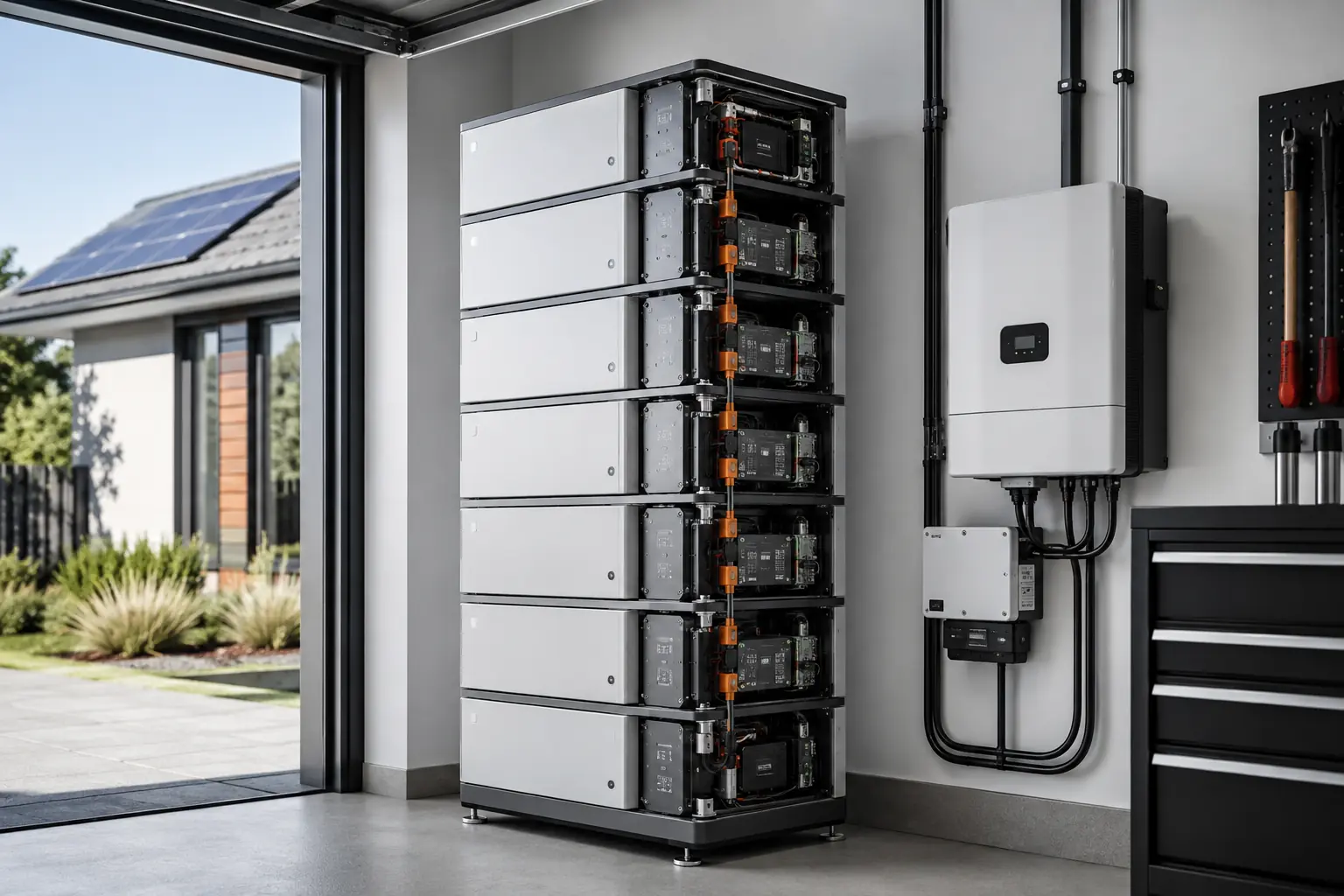
Stacked batteries are modular energy storage systems built from multiple battery modules assembled into one stack or tower. Depending on the design, modules may be connected in series to raise voltage, while multiple complete stacks may be connected in parallel to increase capacity and power. A BMS monitors and protects the complete battery system.
I think the most important point is that “stacked” describes the modular physical architecture, not one universal electrical connection method. Some stacked batteries are high-voltage systems with modules connected in series. Others use different configurations. I therefore look at voltage, capacity, BMS architecture, inverter compatibility, and manufacturer expansion rules before deciding how a stack actually works.
What Does a Stacked Battery Mean?
The term can sound more complicated than it is. A stacked battery is usually a battery storage system made from repeatable modules that are physically placed together to form a larger energy-storage unit.
A stacked battery uses modular battery sections that can be assembled into a tower or stack instead of relying on one large fixed battery enclosure. Each module contains battery cells, while the complete stack normally includes a battery management or control unit. Adding approved modules can increase total energy capacity and, in many high-voltage designs, also increases stack voltage.
I Think of It as Building Energy Storage in Layers
A basic stacked battery architecture may look like:
Battery cells
↓
Battery module
↓
Multiple modules
↓
Battery stack
↓
Battery control unit / BMS
↓
Hybrid inverter or PCS
Each battery module contains a group of cells.
Several modules are then mechanically and electrically combined.
The complete tower becomes the battery that the inverter sees.
BYD's current Battery-Box architecture provides a clear real-world example. Its high-voltage HVS product uses two to five modules connected in series, while HVM uses three to eight series-connected modules. BYD also allows approved identical towers to be connected in parallel for additional capacity.
GoodWe uses a similar modular concept in its current Lynx Home FH-US high-voltage storage range. It describes the modules as stackable and self-recognizing, with individual stacks offering different capacities depending on how the system is configured.
This modular construction is different from a fixed battery where the usable capacity is essentially determined at the factory and cannot easily be changed.
“Stacked” Does Not Automatically Mean “High Voltage”
This distinction matters.
I sometimes see the terms:
stacked battery
and
high-voltage battery
used as though they mean exactly the same thing.
They do not.
A battery can be physically stackable without necessarily being a high-voltage series system.
The word stacked mainly tells me how the battery is physically modular.
The electrical architecture tells me whether those modules are:
- Connected in series
- Connected in parallel
- Combined in series-parallel
- Managed as separate battery strings
So when I evaluate a stackable battery, I immediately ask:
How are the modules electrically connected?
That answer tells me much more about how the system actually behaves.
How Do Stacked Batteries Work?
The operating principle is the same as other lithium battery energy storage systems: the cells store energy electrochemically, while the BMS and inverter control how that energy enters and leaves the battery.
During charging, the inverter or PCS supplies controlled DC energy to the stacked battery. The BMS monitors individual cell voltages, temperatures, current, and operating limits. During discharge, the stack supplies DC energy back to the inverter, which converts it into AC electricity for household, commercial, backup, or grid-connected loads.
Charging the Stack
Suppose I have solar panels and a hybrid inverter.
During strong solar production:
PV panels → hybrid inverter → stacked battery
The battery stores some of the solar electricity.
Later:
Stacked battery → inverter → home or business loads
If the installation permits grid charging, the direction can also be:
Grid → inverter → battery
The battery itself normally remains a DC energy source.
The inverter or PCS performs the power conversion needed to interact with AC loads or the utility grid.
The Modules Work as One Managed Battery
The individual modules are not normally controlled as completely independent household batteries.
The system BMS coordinates the stack.
NXP's high-voltage BMS architecture illustrates the major functions used in sophisticated high-voltage battery systems. Its architecture includes a Battery Management Unit, Cell Monitoring Units, and a Battery Junction Box.
The cell-monitoring system can measure cell voltage and temperature and perform cell balancing. NXP's current CMU architecture specifically monitors individual cell voltages and battery temperatures while supporting cell balancing.
I can simplify the control structure as:
Cells → cell monitoring → BMS → inverter/PCS
The BMS decides how much charge or discharge the battery can safely accept.
The inverter follows those limits.
Why Cell Balancing Is Important
Imagine a stack containing many series-connected cells.
If one cell becomes more charged than the rest, it may reach its maximum voltage first.
The BMS may then need to stop charging even though the other cells still have room.
The same problem occurs in reverse during discharge.
One weaker cell can reach its minimum voltage before the others.
Cell balancing helps keep the cells closer together in state of charge.
This allows the complete stack to use its capacity more consistently while protecting individual cells.
That becomes increasingly important as the number of series-connected cells increases.
Are Stacked Batteries Connected in Series or Parallel?
This is one of the most important questions because series and parallel connections change the battery in different ways.
Many high-voltage stacked batteries connect modules in series so their voltages add together. Multiple complete stacks can then sometimes be connected in parallel so capacity and available current increase while stack voltage remains similar. However, the exact configuration is manufacturer-specific, so modules should never be added or rewired outside the approved system design.
Series Connection Raises Voltage
Suppose each simplified battery module operates at 50 V and stores 5 kWh.
If I connect two identical modules in series:
50 V + 50 V = 100 V
The system now operates at approximately 100 V.
With four:
50 V × 4 = 200 V
With eight:
50 V × 8 = 400 V
The real operating voltage varies with SOC and cell chemistry, but the principle remains the same.
Series connection increases voltage.
This is how many modular high-voltage home batteries create their required DC operating range.
BYD, for example, states that its HVS modules are connected in series within a battery tower. The current HVS range uses two to five modules, while HVM uses three to eight.
Series Connection Also Adds Energy
There is a useful nuance here.
When I add identical battery modules in series, I am not only increasing voltage.
I am also adding more cells, which means total stored energy increases.
If each module stores 2.5 kWh:
| Modules | Example Energy |
|---|---|
| 2 | 5 kWh |
| 3 | 7.5 kWh |
| 4 | 10 kWh |
| 5 | 12.5 kWh |
So a modular high-voltage stack can increase voltage and kWh together as modules are added.
Parallel Connection Expands the Complete System Differently
Once one tower reaches the required voltage, some manufacturers allow another identical tower to be connected in parallel.
A simplified example:
Stack A: 400 V, 10 kWh
plus
Stack B: 400 V, 10 kWh
can produce a system with approximately:
400 V, 20 kWh
rather than 800 V.
BYD currently allows up to three identical HVS or HVM Battery-Box towers to be connected in parallel under its supported architecture, increasing maximum system capacity without simply doubling or tripling the operating voltage.
GoodWe likewise offers stackable high-voltage products where multiple towers can be used for larger energy-storage configurations on supported systems.
This gives me a useful rule:
Series modules → primarily build stack voltage and energy
Parallel stacks → primarily expand total system energy and current capability
But I always verify the actual manufacturer documentation before applying that rule to a product.
Why Are High-Voltage Stacked Batteries Popular?
Stacked battery architecture solves several practical problems at the same time: capacity needs vary between installations, inverter voltage requirements differ, and future energy consumption is difficult to predict perfectly.
High-voltage stacked batteries are popular because modular series connections let manufacturers create different battery capacities and voltage ranges from one module platform. Higher system voltage can also reduce current for a given power level, while modular construction can simplify transport, installation, servicing, and future capacity expansion when the manufacturer supports it.
High Voltage Reduces Current for the Same Power
The basic equation is:
Power = Voltage × Current
Therefore:
Current = Power ÷ Voltage
Suppose I need 10 kW.
At 50 V:
10,000 W ÷ 50 V = 200 A
At 200 V:
10,000 W ÷ 200 V = 50 A
At 400 V:
10,000 W ÷ 400 V = 25 A
The actual current will vary with efficiency and operating voltage, but the relationship is useful.
Higher voltage means lower current for the same power.
Lower current can reduce resistive losses because:
Power loss = I²R
This is one reason high-voltage battery architecture is attractive for larger residential and commercial storage.
Modularity Makes Sizing Easier
Imagine one customer needs 7 kWh.
Another needs 12 kWh.
Another expects to expand later because an EV or heat pump will increase electricity consumption.
A modular platform can use different numbers of the same battery module rather than requiring completely different battery designs.
BYD explicitly markets its Battery-Box architecture around this modular expansion approach, allowing approved capacity to be increased by adding modules or supported parallel stacks.
GoodWe similarly describes its stackable modules as a way to provide different battery capacities within one product family.
Individual Modules Can Be Easier to Handle
A 15 or 20 kWh battery assembled as one solid enclosure can be heavy.
Dividing the system into smaller modules can make:
- Transportation easier
- Installation more manageable
- Site access simpler
- Module-level servicing more practical
The installer assembles the battery at the site rather than moving one extremely heavy complete unit.
However, I do not confuse easy mechanical stacking with electrical simplicity.
High-voltage battery installation still requires appropriate safety procedures.
What Does the BMS Do in a Stacked Battery?
I consider the BMS one of the most important parts of a stacked battery because increasing the number of modules also increases the number of cells that must operate together.
The BMS monitors cell voltage, temperature, current, state of charge, and fault conditions across the battery stack. It balances cells, controls charging and discharging limits, communicates with the inverter, and can disconnect the high-voltage battery if operating conditions become unsafe. A properly matched BMS is essential for both usable capacity and protection.
Cell Monitoring Happens at Module Level
A stack can contain dozens or hundreds of series-connected cells.
I need to know more than total battery voltage.
For example:
Total stack voltage = normal
does not guarantee:
Every cell voltage = normal
One cell could be unusually high while another is unusually low.
The total can still appear acceptable.
This is why cell monitoring is necessary.
NXP's current high-voltage battery architecture uses Cell Monitoring Units to accurately measure individual cell voltages and temperatures and support balancing.
Pack-Level Monitoring Adds Another Layer
The high-voltage system also needs to understand conditions outside individual cells.
NXP's Battery Junction Box architecture measures high voltage and battery current and monitors battery isolation and the connection of contactors to external equipment.
A simplified high-voltage battery might therefore include:
Cell monitoring
↓
Module monitoring
↓
Main BMS
↓
Contactors / high-voltage junction
↓
Inverter
This layered architecture allows the system to make decisions at both cell and pack level.
BMS Communication Must Match the Inverter
This is another important point.
A battery may have a CAN port.
An inverter may also have a CAN port.
That does not mean they automatically communicate correctly.
The actual protocol and firmware must be compatible.
Fronius's current battery compatibility list demonstrates how specific the relationship can be. Different BYD HVS and HVM battery capacities are approved with different inverter models rather than every battery size being treated as universally compatible.
So I never select a stacked battery based only on:
voltage
or
connector type.
I want the exact battery configuration on the inverter manufacturer's compatibility list.
What Is the Difference Between Stacked, Wall-Mounted, and Rack-Mounted Batteries?
These terms mainly describe mechanical architecture, although each format tends to be associated with certain applications.
Stacked batteries use modules assembled vertically or into a modular tower. Wall-mounted batteries use a fixed enclosure attached to a wall, while rack-mounted batteries place modules in a cabinet or equipment rack. All three can use similar lithium battery chemistry, so form factor alone does not determine voltage, performance, or lifespan.
Stacked Batteries
A stacked system often looks like:
Control unit
Battery module
Battery module
Battery module
Base
Advantages can include:
- Modular sizing
- Compact floor footprint
- Easier module handling
- Cleaner installation
- High-voltage series architecture in many products
GoodWe specifically markets its Lynx high-voltage residential batteries around stackable modules and simplified installation.
Wall-Mounted Batteries
A wall battery is typically one complete enclosure.
Its advantages may include:
- Minimal floor use
- Clean residential appearance
- Simple packaged installation
But expansion often requires another complete battery rather than placing another internal module on top.
Rack-Mounted Batteries
Rack batteries are common in:
- Commercial storage
- Telecom
- Server rooms
- Industrial energy storage
- Larger low-voltage systems
The batteries slide into a cabinet or rack.
Several rack batteries may be connected to busbars.
Rack architecture can be extremely scalable, but it normally requires more cabinet and wiring infrastructure.
I Do Not Choose Based on Appearance
I compare:
| Feature | Stacked | Wall-Mounted | Rack-Mounted |
|---|---|---|---|
| Modular capacity | Often strong | Model dependent | Strong |
| Floor footprint | Compact | Minimal | Larger cabinet |
| Installation style | Vertical modules | Wall installation | Rack/cabinet |
| High-voltage options | Common | Common | Available |
| Low-voltage options | Available | Available | Very common |
| Future expansion | Often supported | Model dependent | Often supported |
| Residential appearance | Strong | Strong | More technical |
| Commercial scalability | Moderate to strong | Limited/moderate | Strong |
There is no universal winner.
The best form factor depends on the application.
Are Stacked Batteries Safe?
Stacking modules is not inherently unsafe, but I treat the complete battery as an engineered energy storage system rather than a set of battery blocks that can be freely rearranged.
Stacked batteries can be designed for safe stationary energy storage when cells, modules, BMS, electrical protection, enclosure, inverter, thermal design, and installation are properly integrated. I verify manufacturer-approved configurations and relevant safety certifications because adding modules changes the electrical characteristics of the complete battery system.
I Never Add Modules Beyond the Approved Configuration
If the manufacturer specifies:
2–5 modules
I do not install six.
Why?
Adding another series module can increase:
- Maximum DC voltage
- Operating voltage
- Stored energy
- Insulation requirements
- Inverter input voltage
The BMS and inverter may not support the new configuration.
BYD's current HVS/HVM architecture, for example, specifies defined module ranges for each tower and states that different module types cannot simply be mixed within one stack.
That is why stackability should mean:
expandable within manufacturer rules
not:
unlimited user-configurable batteries.
System Certification Matters
For North American stationary storage, I also distinguish between battery and complete-system certification.
UL explains that UL 9540 evaluates energy storage systems as systems, covering charging, discharging, protection, controls, communication, enclosure-related issues, and other integrated functions.
That system-level perspective is especially relevant for modular batteries because:
battery module + BMS + inverter + enclosure + controls
must operate together safely.
I therefore check certification for the complete configuration and the market where the battery will actually be installed.
How Do I Choose the Right Stacked Battery?
I begin with the electrical requirement rather than choosing the stack with the most modules.
I choose a stacked battery by matching usable kWh, required kW, battery voltage range, inverter compatibility, BMS communication, module limits, expansion capability, chemistry, safety documentation, environmental rating, and warranty. I also verify whether future modules can actually be added later and under what installation conditions.
Step 1: Determine Required Energy
If my home uses 12 kWh overnight, I might start by looking for roughly that amount of usable storage.
If I need only 6 kWh, installing 20 kWh may be unnecessary.
Step 2: Determine Required Power
Energy and power are different.
Suppose the battery stores:
15 kWh
but can deliver only:
5 kW continuously
It cannot suddenly supply a 10 kW load simply because enough kWh are stored.
So I check:
kWh = how much energy
kW = how quickly I can use it
Step 3: Match the Inverter
This is essential for high-voltage stacks.
I compare:
- Minimum battery voltage
- Maximum battery voltage
- Supported module count
- BMS communication
- Charge power
- Discharge power
- Approved firmware
Fronius's current compatibility tables show why exact configurations matter: not every battery capacity within a product family is approved with every inverter model.
Step 4: Verify the Expansion Rules
I ask:
- Can modules be added later?
- Is there a maximum time between installations?
- Must new modules have similar SOC?
- Can I add another tower?
- Must parallel towers have identical capacity?
- Does the inverter support the expanded configuration?
A product being marketed as “expandable” does not mean every expansion is technically permitted.
My Basic Selection Checklist
| Question | Why It Matters |
|---|---|
| How many usable kWh do I need? | Determines capacity |
| How many kW must I supply? | Determines power capability |
| What voltage does the inverter support? | Determines stack configuration |
| Is the exact battery approved? | Ensures system compatibility |
| How are modules connected? | Determines voltage and scaling |
| What does the BMS monitor? | Determines protection and control |
| Can I add modules later? | Determines future scalability |
| Which certifications apply? | Supports safe/legal installation |
| What temperature range applies? | Affects installation and performance |
| What does the warranty cover? | Determines long-term value |
That approach gives me a much better answer than selecting a battery because its tower looks compact or because the marketing page says “stackable.”
My Insights: What Are Stacked Batteries and How Do They Work
My main insight is that stacked battery architecture is valuable because it separates battery capacity from one fixed enclosure size while still keeping the complete battery under one coordinated management system.
Stacked batteries are modular energy storage systems built by combining battery modules into a controlled stack. In many high-voltage designs, modules are connected in series to build voltage and capacity, while approved complete stacks can sometimes be paralleled for further expansion. Their effectiveness depends on BMS coordination, inverter compatibility, and strict manufacturer-defined configuration limits.
My First Insight: Stacked Is a Mechanical Description Before It Is an Electrical One
This is the misunderstanding I would correct first.
A battery tower may look like several batteries sitting on top of one another.
That does not tell me exactly how they are electrically connected.
I need the circuit architecture.
The modules might be:
series connected
or
parallel connected
or part of a more complicated configuration.
So I never use the word “stacked” to calculate voltage.
I use the product's electrical diagram and specification.
My Second Insight: Series Stacking Explains Why Many Modular Batteries Become High Voltage
When modules are connected in series:
voltage adds.
This is a useful architecture because a system can create a several-hundred-volt battery from smaller standardized modules.
BYD is a clear current example: its HVS and HVM towers use multiple modules connected in series, with the permitted module count defining the resulting capacity and voltage configuration.
This creates an elegant relationship:
more approved modules = more cells = more stored energy + higher stack voltage
until the manufacturer's maximum configuration is reached.
My Third Insight: Parallel Expansion Is Different From Adding Another Module
If I place another module inside a series stack, I change the series architecture.
If I add another complete compatible tower in parallel, I expand the battery differently.
That distinction matters when planning future storage.
For example, I may reach the maximum permitted number of modules in one stack.
At that point, further expansion may require another complete tower.
BYD currently allows approved identical HVS or HVM towers to be paralleled, while GoodWe offers product families with multi-tower expansion on supported configurations.
This means there are potentially two levels of scalability:
module-level expansion
and
stack-level expansion.
My Fourth Insight: The BMS Is What Turns Modules Into One Battery
Without coordinated monitoring, a stack would simply be a collection of cells connected together.
The BMS transforms that collection into a managed battery system.
It monitors:
- Cell voltage
- Temperature
- Current
- State of charge
- Faults
- Cell balance
- Pack voltage
NXP's high-voltage architecture illustrates how those functions can be divided between cell-monitoring, battery-management, and battery-junction layers.
I therefore consider BMS quality and inverter communication just as important as battery-cell chemistry.
My Fifth Insight: What Are Stacked Batteries and How Do They Work in a Real Energy Storage System?
This is the core question behind What Are Stacked Batteries and How Do They Work?
My practical answer is:
A stacked battery is a modular battery system in which several approved battery modules are physically assembled into a tower and electrically coordinated as one energy-storage unit.
In a common high-voltage design:
Cells form modules
↓
Modules connect in series
↓
Series connection creates the required battery voltage
↓
BMS monitors and balances the complete stack
↓
High-voltage contact and protection equipment connects the stack safely
↓
Inverter or PCS charges and discharges the battery
↓
Additional compatible stacks may be paralleled when more capacity is required
That is the complete operating concept.
A real example makes this easier to understand.
BYD's current HVS architecture can use two to five modules in one series-connected tower. The system can also use supported parallel towers for larger capacity.
GoodWe's current Lynx FH-US platform similarly uses stackable high-voltage modules and specifies compatibility with particular inverter families.
Fronius's compatibility database shows why the inverter side must be checked just as carefully: specific battery capacities are approved with particular inverter models.
So I do not see stacked batteries as interchangeable battery bricks.
I see them as modular parts of a predefined electrical system.
The modular design gives me flexibility.
The electrical limits keep that flexibility controlled.
The BMS keeps the cells coordinated.
The inverter turns the stored DC energy into usable electrical power.
And the manufacturer's approved series and parallel architecture determines how far the system can expand.
That combination—modularity plus controlled electrical integration—is what makes stacked batteries useful for modern residential and commercial energy storage.
Conclusion
Stacked batteries combine modular battery units into one managed energy-storage system. Their main advantages are scalable capacity, compact installation, and flexible high-voltage architecture when the BMS and inverter are correctly matched.
](https://voltcrave-battery.com/wp-content/uploads/2026/06/What-is-the-Best-Portable-Outdoor-Power-Station-768x512.jpg)
](https://voltcrave-battery.com/wp-content/uploads/2026/09/Why-Are-LiFePO4-Batteries-Becoming-the-Standard-for-Energy-Storage-768x512.webp)
](https://voltcrave-battery.com/wp-content/uploads/2026/08/What-Are-the-Disadvantages-of-a-Solar-Inverter-768x512.webp)