
](https://voltcrave-battery.com/wp-content/uploads/2026/09/Lead-Acid-vs.-Lithium-Ion-Batteries-Which-Is-Better-for-Residential-and-Commercial-BESS.webp)
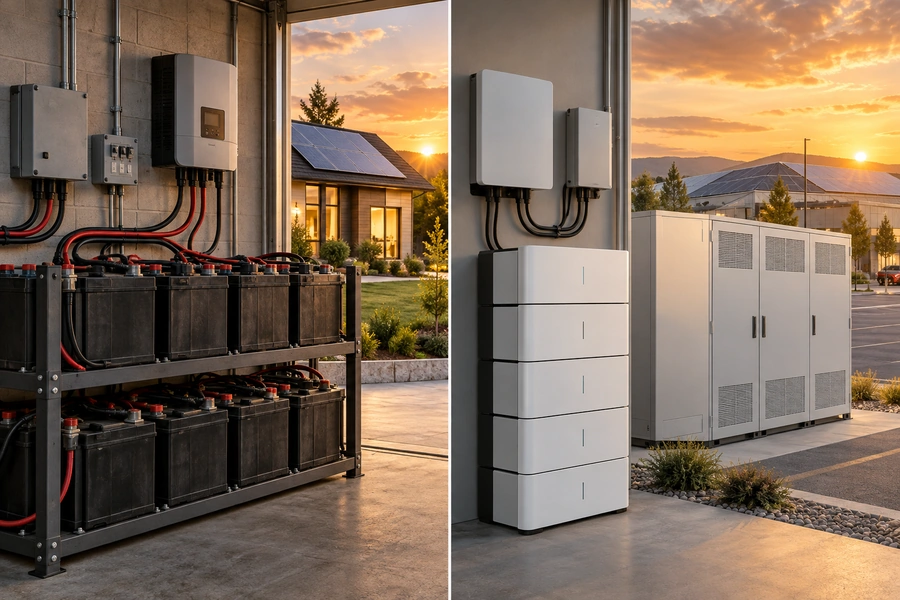
Lead-acid batteries can reduce initial costs, while lithium-ion promises higher performance and longer cycling. Choosing only by purchase price can therefore produce the wrong BESS decision.
For most modern residential and commercial BESS applications, lithium-ion—particularly LFP—offers advantages in energy density, usable capacity, cycling, efficiency, and compact system design. Lead-acid remains relevant where low upfront cost, mature recycling, simple standby operation, or established infrastructure matters more than frequent cycling, space, weight, and long-term energy throughput.
The comparison is therefore more nuanced than “cheap battery versus expensive battery.” A battery that costs less initially may need more capacity, occupy more space, or require earlier replacement. For BESS, I prefer to compare the complete lifetime energy-storage system rather than battery purchase price alone.
What Is the Difference Between Lead-Acid and Lithium-Ion Batteries?
Lead-acid and lithium-ion batteries both store electricity electrochemically, but they use fundamentally different chemistries and have different operating characteristics.
Lead-acid batteries use lead-based electrodes and a sulfuric-acid electrolyte, while lithium-ion batteries move lithium ions between electrode materials during charging and discharging. Lead-acid is a mature, widely recycled technology, while modern lithium-ion offers substantially higher energy density and generally longer cycle life, making it increasingly dominant in new stationary storage.
Lead-acid has been used for:
automotive starting,
UPS systems,
telecommunications,
off-grid power,
and:
stationary backup
for decades.
Lithium-ion is a family of chemistries rather than one battery type.
For BESS, an especially important chemistry is:
LiFePO4 / LFP — Lithium Iron Phosphate
Other lithium-ion chemistries include NMC and NCA.
For stationary energy storage, LFP has become particularly important. NREL's residential and commercial storage modeling identifies LFP as the primary stationary lithium-ion chemistry in recent years.
That means the practical comparison for a new BESS project is often:
Lead-Acid vs. LFP
rather than simply:
Lead-Acid vs. Lithium-Ion.
Why Is Lithium-Ion Becoming More Common in BESS?
Stationary storage increasingly needs to cycle regularly rather than simply wait for an occasional outage.
Lithium-ion has become dominant in new BESS deployments because falling costs, higher energy density, longer lifetime, and strong cycling characteristics make it well suited to applications such as solar self-consumption, peak shaving, energy arbitrage, renewable integration, and grid services. LFP has become particularly prominent in stationary storage.
The market shift is significant.
The IEA reports that battery storage was the fastest-growing power technology in 2025, when approximately:
108 GW
of new battery storage capacity was deployed globally.
That represented around:
40% growth from 2024.
Installed battery-storage capacity was approximately:
11 times its 2021 level.
Most importantly for this comparison, LFP represented around:
90% of deployments in 2025.
That does not mean lead-acid has disappeared.
It means the requirements of modern BESS increasingly favor lithium-ion.
A traditional backup battery may spend most of its life waiting.
A modern BESS might charge and discharge:
daily.
That difference changes which battery characteristics matter most.
Which Has Better Energy Density: Lead-Acid or Lithium-Ion?
Energy density determines how much battery energy can fit into a given amount of mass or space.
Lithium-ion has substantially higher energy density than lead-acid, allowing the same amount of stored energy to fit into a smaller and lighter battery system. This can be particularly valuable for residential battery walls, commercial buildings, containerized BESS, rooftop installations, and other applications where floor space or structural loading matters.
Sandia describes conventional lead-acid as having low volumetric and mass energy density, while lithium-ion offers higher energy and power density.
Why does this matter?
Suppose two systems both need:
20kWh
of nominal storage.
System A occupies:
one compact battery cabinet.
System B requires:
multiple larger battery units and additional floor space.
Even if System B batteries are cheaper individually, the complete project may need:
more floor area,
more racks,
more cabling,
more installation labor,
and:
greater structural support.
For a large commercial system, the same principle scales up.
Energy density affects:
BESS Footprint = Battery Energy ÷ Packaging Density
This is one reason modern commercial storage can package several MWh into highly optimized enclosures.
Which Battery Has Better Cycle Life?
Cycle life becomes particularly important when a BESS charges and discharges frequently.
Lithium-ion batteries generally offer longer cycling capability than conventional lead-acid batteries, although exact life depends on chemistry, depth of discharge, temperature, C-rate, SOC range, and battery design. Traditional lead-acid batteries are particularly sensitive to repeated deep discharge, while advanced lead-acid designs can perform better than conventional versions.
Sandia's storage overview gives a useful historical benchmark for conventional lead-acid:
approximately 500–1,000 cycles
with degradation associated with deep discharge beyond approximately 50% DOD. It also notes that advanced lead-carbon systems can substantially exceed conventional lead-acid cycling performance.
This distinction matters.
Not all lead-acid batteries are identical.
And not all lithium-ion batteries are identical.
Battery lifetime depends on:
Chemistry + Temperature + DOD + SOC + C-rate + Calendar Aging
Suppose a battery completes:
1 equivalent full cycle/day.
Annual cycles:
365
Over 10 years:
365 × 10 = 3,650 cycles
A battery designed primarily for occasional standby use faces a very different duty cycle from one used every day for solar shifting.
This is why frequent-cycling BESS applications tend to favor lithium-ion.
How Does Depth of Discharge Affect Lead-Acid vs. Lithium-Ion?
Nominal battery capacity does not necessarily equal the energy designers want to use during every cycle.
Lead-acid batteries are commonly operated with more conservative depth-of-discharge limits because repeated deep cycling can accelerate degradation. Lithium-ion systems can generally use a larger proportion of nominal capacity, although their exact usable SOC window is controlled by the manufacturer and BMS to balance energy availability, safety, and battery lifetime.
Consider a simplified example.
Two batteries both have:
20kWh nominal capacity.
If the lead-acid design allows:
50% routine usable capacity,
then usable energy is:
20 × 0.50 = 10kWh
If a lithium-ion system provides:
90% usable capacity,
then:
20 × 0.90 = 18kWh
These percentages are illustrative rather than universal specifications.
But they show why comparing only:
$/nominal kWh
can be misleading.
The more useful metric is:
Cost per Usable kWh
and, over the life of the system:
Cost per Lifetime Delivered kWh.
A cheaper nominal battery may not remain cheaper when usable capacity and replacement frequency are considered.
Which Is More Efficient: Lead-Acid or Lithium-Ion?
Every storage cycle loses some energy.
Lithium-ion systems generally offer higher round-trip efficiency than conventional lead-acid batteries, meaning a larger share of the electricity used to charge the battery can later be recovered. Actual BESS efficiency also depends on the inverter, wiring, auxiliary consumption, thermal management, operating power, and battery SOC—not battery chemistry alone.
Sandia's overview gives conventional lead-acid round-trip efficiency at approximately:
80%.
For comparison, NREL uses:
85%
as a representative round-trip efficiency assumption for its modeled residential lithium-ion BESS, although actual modern products and operating conditions vary.
Suppose:
100kWh
is sent into storage.
At:
80% round-trip efficiency:
100 × 0.80 = 80kWh returned
At:
90%:
100 × 0.90 = 90kWh returned
The difference is:
10kWh per 100kWh cycled.
Across thousands of cycles, efficiency can have a meaningful impact on project economics.
This matters especially for commercial applications involving:
daily peak shaving,
solar shifting,
or:
energy arbitrage.
Is Lead-Acid Cheaper Than Lithium-Ion?
Lead-acid can still have an initial-cost advantage, but upfront price is only one part of BESS economics.
Lead-acid batteries can offer lower initial acquisition cost, especially for smaller or standby applications. However, lithium-ion's higher usable capacity, longer cycling capability, greater energy density, and lower maintenance requirements can make it more competitive over the complete system life. The correct comparison is therefore total lifetime cost rather than battery purchase price alone.
A simplified comparison is:
Initial Cost
versus:
Lifetime Cost.
Lifetime cost can include:
Battery Purchase
*
Installation
*
Energy Losses
*
Maintenance
*
Replacement Batteries
*
Labor
*
Downtime
*
Disposal/Recycling
Suppose:
Lead-acid requires replacement:
twice
during the project life.
Lithium-ion requires:
one battery installation
under the same hypothetical duty.
Even if the lead-acid battery costs less initially, its total lifetime cost can move closer to—or exceed—the lithium system.
The actual result depends on the application.
This is why I would never conclude:
Lead-acid is cheaper
simply from a battery catalog price.
Which Battery Requires More Maintenance?
Maintenance requirements can significantly influence commercial storage economics.
Traditional flooded lead-acid batteries generally require more maintenance than modern sealed lithium-ion systems, including attention to electrolyte condition, corrosion, ventilation, connections, and battery health. Valve-regulated lead-acid reduces some maintenance requirements, while lithium-ion BESS relies more heavily on electronic monitoring through its BMS and system controls.
Lead-acid technology is mature and well understood.
That is an advantage.
Technicians have decades of experience with:
battery testing,
charging systems,
ventilation,
and:
replacement procedures.
But certain lead-acid architectures can require ongoing physical inspection and maintenance.
Lithium-ion shifts much of battery management into electronics.
The BMS continuously monitors parameters such as:
cell voltage,
temperature,
current,
SOC,
and:
fault conditions.
That does not make lithium-ion:
maintenance-free.
A complete BESS still requires:
inspection,
thermal-system maintenance,
electrical testing,
software monitoring,
and:
periodic service.
The maintenance model is simply different.
Which Is Better for Residential BESS?
Residential storage increasingly focuses on solar self-consumption, outage backup, time-of-use management, and compact installation.
Lithium-ion, especially LFP, aligns strongly with modern residential BESS requirements because it offers compact size, high usable capacity, regular cycling capability, automated battery management, and integration with hybrid inverters and smart energy controls. Lead-acid can still work for budget-sensitive or simple backup applications where space and frequent cycling are less important.
Consider a home battery installed in:
a garage,
utility room,
or:
outdoor enclosure.
Space matters.
The homeowner may also want the battery to cycle every day:
Morning → Solar Generation
Midday → Battery Charging
Evening → Battery Discharging
Then repeat tomorrow.
That favors a battery designed for regular cycling.
Modern residential storage is also becoming integrated.
A home system may combine:
Battery + BMS + Hybrid Inverter + EMS + Backup + Monitoring
NREL's residential BESS modeling now focuses on lithium-ion systems, including LFP and NMC, with LFP becoming the primary stationary chemistry in its model.
This reflects the direction of the modern residential market.
Which Is Better for Commercial BESS?
Commercial systems frequently cycle more aggressively and must justify their economics through repeated energy services.
Lithium-ion, particularly LFP, aligns with many modern commercial BESS applications because commercial storage often requires frequent cycling, compact footprint, high usable energy, automated monitoring, and predictable performance for peak shaving, solar self-consumption, tariff management, EV charging support, or backup. Lead-acid remains relevant for selected standby and cost-sensitive applications.
Consider a factory with:
Normal demand = 1MW
Peak demand = 1.5MW
Target grid demand = 1.2MW
Battery power required:
1.5 – 1.2 = 0.3MW
or:
300kW
If the peak lasts:
2 hours
the theoretical energy requirement is:
300kW × 2h = 600kWh
before accounting for losses and reserve.
If this happens every working day, the battery experiences regular cycling.
Commercial storage can also perform multiple functions:
Solar Shifting
Peak Shaving
Time-of-Use Management
EV Charging Support
Backup Power
A chemistry with strong cycling performance becomes increasingly valuable as utilization increases.
NREL's commercial battery-storage modeling focuses on lithium-ion systems and identifies LFP as the primary stationary chemistry in recent years.
Is Lead-Acid Still Useful for BESS?
Lithium-ion dominance does not mean lead-acid has no useful stationary applications.
Lead-acid remains useful for stationary applications where low initial cost, mature technology, widespread service expertise, established recycling, and standby reliability are important. It can remain appropriate for UPS, telecommunications, emergency backup, and low-cycle applications where weight, footprint, deep cycling, and maximum lifetime energy throughput are less critical.
This is an important distinction.
Imagine a battery used:
five times per year
for emergency backup.
Now compare it with a battery used:
365 days per year
for solar energy shifting.
The two systems have completely different duty cycles.
For the first application, low upfront cost may matter more.
For the second, cycling performance and efficiency become much more important.
Sandia notes that lead-acid is highly mature, field-proven, supported by an established manufacturing and service network, and highly recyclable, while also identifying its lower energy density and shorter cycling life as limitations.
So lead-acid should not simply be described as:
obsolete.
Its competitiveness is application-dependent.
Which Battery Is Better for Solar Energy Storage?
Solar storage commonly involves charging during the day and discharging later, potentially producing frequent cycles.
Lithium-ion, particularly LFP, is well matched to solar energy storage because the battery can charge from surplus daytime PV and discharge during evening or nighttime demand repeatedly. Its cycling characteristics, compact footprint, usable capacity, and system integration make it particularly suitable for regular solar shifting in residential and commercial applications.
The operating cycle is:
Morning: Solar → Loads
Midday: Solar → Loads + Battery
Evening: Battery → Loads
Then:
Repeat
Suppose a battery shifts:
10kWh/day.
Annual energy throughput:
10 × 365 = 3,650kWh
Over ten years:
3,650 × 10 = 36,500kWh
before considering degradation and changing operating conditions.
For a:
100kWh commercial system
shifting:
80kWh/day
annual throughput becomes:
80 × 365 = 29,200kWh
or:
29.2MWh/year.
High utilization changes battery economics.
This is why solar-plus-storage decisions should consider:
Lifetime Energy Throughput
rather than only:
Battery Purchase Price.
Which Battery Is Better for Backup Power?
Backup applications can range from rare emergency use to frequent operation in unreliable-grid environments.
For occasional standby backup, lead-acid can remain practical because of its mature technology and potentially lower initial cost. For backup combined with daily solar cycling, peak management, or time-of-use operation, lithium-ion generally becomes more attractive because the battery performs both resilience and everyday energy-management functions.
Consider two systems.
Backup-Only System
Battery waits most of the year.
Its job is:
Grid Failure → Battery → Critical Loads
Multi-Purpose BESS
Every day:
Solar → Battery → Evening Loads
During peak prices:
Battery → Loads
During an outage:
Battery → Critical Loads
The second battery is a much more active asset.
It is not simply:
insurance.
It is:
daily energy infrastructure + backup.
As battery utilization increases, cycle life and efficiency become more economically important.
That distinction can determine whether lead-acid or lithium-ion makes more sense.
How Do Lead-Acid and Lithium-Ion Compare in Safety?
Both technologies have safety considerations, but the hazards and mitigation strategies differ.
Lead-acid batteries can involve corrosive electrolyte, hydrogen evolution, electrical faults, and ventilation requirements, while lithium-ion systems require careful management of electrical, thermal, and cell-failure risks including thermal runaway. Neither chemistry is inherently risk-free, so complete BESS safety depends on system design, protection, installation, monitoring, and maintenance.
For lead-acid, Sandia identifies risks including:
hydrogen evolution during overcharging
and:
sulfation during prolonged storage.
For lithium-ion, the system relies heavily on:
BMS,
temperature monitoring,
overcurrent protection,
electrical isolation,
thermal management,
and:
fault detection.
LFP is often selected for stationary storage partly because of its favorable thermal characteristics compared with some other lithium-ion chemistries.
However:
LFP ≠ fire-proof.
A battery cell is only one part of BESS safety.
The complete safety chain is:
Cell → Module → Rack → BMS → Thermal System → Enclosure → Protection → Installation
Which Battery Is Easier to Recycle?
Lead-acid has one of the most mature recycling infrastructures among battery technologies.
Lead-acid has a major advantage in recycling maturity because established collection and recycling systems have operated at large scale for decades. Lithium-ion recycling is expanding rapidly as deployment grows, but economics and recovery processes vary by chemistry, battery design, material value, regulation, and regional recycling infrastructure.
This is one area where lead-acid remains particularly strong.
Its mature circular supply chain can recover battery materials and return them to manufacturing.
Lithium-ion recycling is developing as EV and stationary-storage volumes increase.
However, LFP presents an interesting economic challenge.
It does not contain high-value nickel or cobalt.
That is advantageous for:
material cost
and:
supply-chain exposure.
But it can change the economics of recycling because fewer high-value metals are available for recovery.
As LFP reaches around 90% of current battery-storage deployment, recycling infrastructure will increasingly need to adapt to the chemistry that actually dominates stationary systems.
Does Lithium-Ion Always Cost More Than Lead-Acid?
The answer depends on whether cost means purchase price or lifetime storage cost.
Lithium-ion can require a higher initial investment than some lead-acid alternatives, but battery costs have declined dramatically. The IEA reports lithium-ion battery prices fell by about 90% between 2010 and 2023, helping lithium-ion dominate new storage applications. Lifetime economics depend on cycling, usable capacity, efficiency, replacement frequency, installation, and maintenance.
This creates an important distinction:
CAPEX ≠ Lifetime Cost
I would compare:
Cost per Usable kWh
and:
Cost per Lifetime Delivered kWh
rather than:
Cost per Nominal kWh
alone.
A simplified conceptual equation is:
Lifetime Storage Cost = Initial Cost + Replacement + Maintenance + Losses + Operating Cost
divided by:
Lifetime Delivered Energy
This approach better reflects the economics of a battery that may cycle thousands of times.
It also explains why lithium-ion's falling costs have transformed stationary storage.
The IEA reported lithium-ion battery prices declining from approximately:
$1,400/kWh in 2010
to:
below $140/kWh in 2023.
How Do Lead-Acid and Lithium-Ion Compare for Space and Weight?
Space can become a major constraint in both homes and commercial facilities.
Lithium-ion provides substantially more energy per unit of weight and volume than lead-acid, making it better suited to applications where floor area, wall space, structural loading, or container footprint matters. Lead-acid's lower energy density may be acceptable where inexpensive space is available and system weight is not a major concern.
For a home, this could determine whether the battery can fit neatly into:
a garage,
utility area,
or:
dedicated outdoor enclosure.
For commercial storage, it affects:
equipment-room area,
container count,
foundation requirements,
and:
site footprint.
This becomes increasingly important as storage capacity grows.
A:
10kWh
difference may seem small.
A:
1MWh
commercial installation magnifies the physical consequences.
Higher energy density can therefore create value beyond the battery itself by reducing:
space requirements,
structural requirements,
and:
balance-of-system complexity.
What Should You Consider Before Choosing a BESS Battery?
Chemistry should be selected after defining the actual operating duty.
Before choosing a BESS battery, evaluate usable energy, power, cycling frequency, expected lifetime, depth of discharge, efficiency, footprint, weight, operating temperature, maintenance, safety architecture, warranty, recycling, inverter compatibility, expansion requirements, and total lifetime cost. The appropriate chemistry depends on how the storage system will actually operate.
I would begin with five questions:
How often will the battery cycle?
Daily cycling favors different economics from emergency standby.
How much usable energy is required?
Nominal kWh is not enough.
How much space is available?
Energy density may become important.
How long must the project operate?
Replacement cost matters.
What is the battery expected to do?
Backup only?
Solar shifting?
Peak shaving?
EV charging?
Grid services?
Once those questions are answered, the chemistry decision becomes much clearer.
My Insights: Lead-Acid vs. Lithium-Ion Batteries-Which Is Better for Residential and Commercial BESS
The answer depends on the duty cycle, but today's market direction strongly reflects the requirements of modern BESS: frequent cycling, compact systems, high usable capacity, automated control, and long-term energy throughput.
For most new residential and commercial BESS projects, lithium-ion—especially LFP—better matches regular cycling, solar storage, peak shaving, compact installation, and smart energy management. Lead-acid remains a valid option for selected low-cycle, standby, cost-sensitive applications where mature recycling and established technology outweigh footprint, efficiency, and cycling limitations.
My First Insight: Upfront Price Is the Wrong Metric by Itself
Battery economics should not stop at:
$/Nominal kWh.
A better progression is:
$/Nominal kWh
↓
$/Usable kWh
↓
$/Lifetime Delivered kWh
That final metric begins to capture the effect of:
cycle life,
DOD,
efficiency,
and:
replacement.
My Second Insight: Duty Cycle Determines the Value of Lithium-Ion
For:
occasional emergency backup
lead-acid can remain practical.
For:
daily solar shifting
the battery may cycle hundreds of times each year.
For:
commercial peak shaving
it may also cycle frequently and process large amounts of energy.
The more frequently storage is used, the more important:
efficiency,
cycling capability,
and:
usable capacity
become.
My Third Insight: Residential and Commercial BESS Are Moving Beyond Backup
Traditional batteries often performed:
Grid Failure → Battery Backup
Modern BESS can perform:
Solar Shifting + Peak Shaving + TOU Management + Backup + EV Support + Monitoring
This transforms the battery from:
standby equipment
into:
an actively managed energy asset.
That transition helps explain the growth of lithium-ion and LFP.
My Fourth Insight: LFP Has Changed the Lithium-Ion Comparison
It is increasingly misleading to treat all lithium-ion batteries as one category.
For stationary BESS, LFP has become extremely important.
The IEA reports that it represented around:
90% of global battery-storage deployments in 2025.
So a modern stationary-storage comparison should increasingly ask:
Lead-Acid vs. LFP
rather than only:
Lead-Acid vs. Generic Lithium-Ion.
My Fifth Insight: Lead-Acid vs. Lithium-Ion Batteries: Which Is Better for Residential and Commercial BESS?
This directly answers the H1.
| Factor | Lead-Acid | Lithium-Ion / LFP | Practical BESS Implication |
|---|---|---|---|
| Initial Cost | Can be lower | Can be higher depending on system | Lead-acid can suit budget-sensitive standby use |
| Energy Density | Low | Higher | Lithium-ion needs less space and weight |
| Usable Capacity | Often more conservatively limited | Generally larger usable SOC window | Lithium can provide more usable energy from similar nominal capacity |
| Cycle Life | Lower for conventional designs | Generally stronger for regular cycling | Important for daily BESS operation |
| Deep Cycling | Can accelerate degradation | Better suited to regular cycling within design limits | Favors lithium for solar shifting |
| Efficiency | Generally lower | Generally higher | Matters when cycling frequently |
| Maintenance | Can be higher, depending on type | More electronically managed | Lithium suits automated systems |
| Footprint | Larger | Smaller | Important for homes and commercial sites |
| Weight | Higher per kWh | Lower per kWh | Important for installation and structures |
| Backup-Only Use | Strong established application | Also suitable | Lead-acid remains relevant |
| Solar Self-Consumption | Possible | Strong fit | Frequent cycling favors lithium |
| Peak Shaving | Possible but duty matters | Strong fit | Lithium aligns with commercial cycling |
| Smart EMS Integration | Possible | Common in modern systems | Important for integrated BESS |
| Recycling Maturity | Very mature | Rapidly developing | Lead-acid retains an advantage |
| Market Direction | Mature niche/legacy applications | Dominant in new BESS | LFP now leads stationary deployments |
The core comparison can be summarized as:
Lead-Acid
Low Initial Cost
- Mature Technology
- Established Recycling
- Strong Standby History
− Lower Energy Density
− More Limited Conventional Cycling
− Larger Footprint
− Lower Efficiency
versus:
Lithium-Ion / LFP
Higher Energy Density
- Strong Regular Cycling
- Higher Usable Capacity
- Compact Footprint
- Smart BESS Integration
- Lower Maintenance Model
− More Complex Electronic/Safety Management
− Recycling Ecosystem Still Developing
− Initial System Cost Can Remain Significant
For a residential system used for:
Solar → Battery → Evening Loads
every day, lithium-ion/LFP aligns well with the duty cycle.
For a commercial system performing:
Solar Shifting + Peak Shaving + TOU Management + Backup
frequent cycling again makes lithium-ion/LFP attractive.
For a battery whose main purpose is:
Wait → Emergency Happens → Provide Short Backup
lead-acid can still be a rational technology to evaluate.
That is why I would not say that one chemistry is universally superior.
Instead, the engineering decision should follow:
Application → Duty Cycle → Required kWh/kW → Space → Lifetime → Economics → Chemistry
rather than:
Chemistry → Application.
The market provides useful evidence of where those requirements are leading. The IEA reports that LFP now accounts for around 90% of battery-storage deployments, while NREL's residential and commercial BESS cost models focus on lithium-ion and identify LFP as the primary stationary chemistry.
For modern residential and commercial BESS, that reflects the growing importance of:
frequent cycling + compact design + usable energy + efficiency + integrated controls.
Lead-acid remains relevant where:
low-cycle standby + mature technology + recycling + initial affordability
carry more weight.
The best battery is therefore the one whose lifetime operating characteristics match the actual BESS duty cycle, not simply the battery with the lowest purchase price.
Conclusion
Lithium-ion/LFP fits most modern cycling-intensive residential and commercial BESS applications, while lead-acid remains useful for selected low-cycle, standby, and cost-sensitive storage.
](https://voltcrave-battery.com/wp-content/uploads/2026/09/Navigating-the-Benefits-Challenges-and-Innovations-in-Energy-Storage-Systems-768x512.webp)
](https://voltcrave-battery.com/wp-content/uploads/2026/09/12V-vs-24V-vs-48V-Batteries-for-Solar-Systems-Whats-the-Difference-768x512.webp)
](https://voltcrave-battery.com/wp-content/uploads/2026/08/What-Is-Commercial-Energy-Storage-768x512.webp)







































