](https://voltcrave-battery.com/wp-content/uploads/2026/10/Six-Temporary-Power-Applications-for-Mobile-Battery-Energy-Storage-Systems.webp)
Six Temporary Power Applications for Mobile Battery Energy Storage Systems
Temporary power demand is increasing across construction, events, and emergency operations. Traditional generators create noise, consume fuel, and may operate inefficiently when electrical loads change.
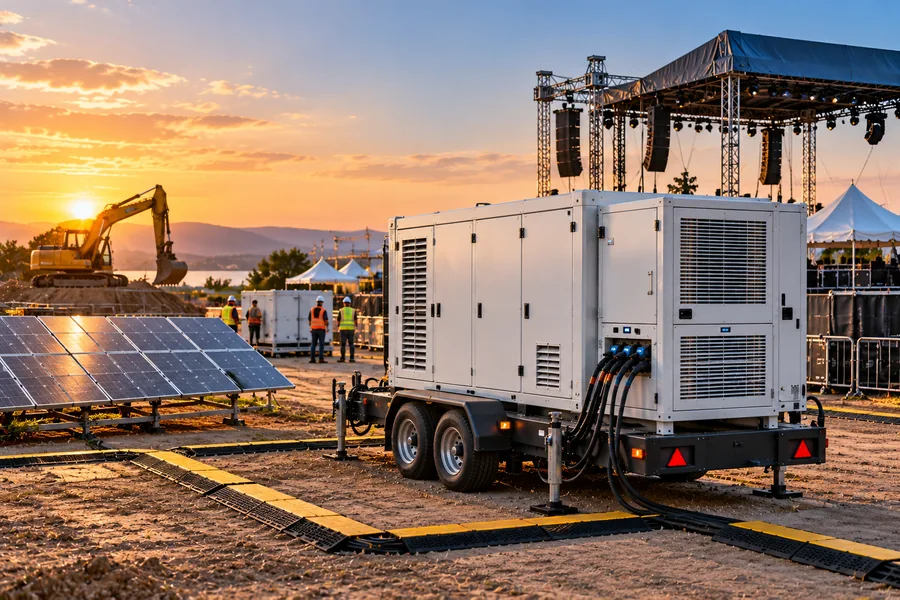
Mobile Battery Energy Storage Systems (BESS) provide flexible temporary electricity for six major applications: construction sites, outdoor events, emergency response, film production, temporary EV charging, and utility maintenance. These transportable systems store electricity from the grid, solar panels, or generators and deliver power when needed, supporting quieter operation and more efficient energy management.
I consider mobile BESS particularly useful for projects that need electricity for a limited period or at locations with insufficient grid infrastructure.
The six main temporary power applications are:
Construction Sites → Temporary electricity for equipment and site facilities
Outdoor Events → Quiet power for concerts, festivals, and exhibitions
Emergency Response → Backup electricity during disasters and outages
Film Production → Low-noise energy for filming and broadcasting
Temporary EV Charging → Flexible charging where grid infrastructure is limited
Utility Maintenance → Temporary electricity during planned electrical work
These applications have different energy requirements, but they share one important advantage: electricity can be stored, transported, and delivered without depending entirely on continuous generator operation.
How Can Mobile BESS Power Construction Sites and Outdoor Events?
Construction projects and outdoor events often operate without permanent electrical infrastructure. Diesel generators can provide temporary electricity, but changing loads may result in unnecessary fuel consumption and operating noise.
Mobile BESS systems can supply temporary electricity to construction equipment, site offices, lighting, event stages, and commercial facilities. They can operate independently when enough stored energy is available or work alongside generators and grid connections. Hybrid systems are particularly useful when electrical demand changes throughout the day.
Application 1: Temporary Power for Construction Sites
Construction sites require electricity for many different activities.
Power tools, lighting systems, site offices, security equipment, ventilation, and electric construction machinery may all operate on different schedules.
I believe mobile BESS is especially useful when the site has limited grid capacity or needs electricity before permanent electrical connections become available.
A battery system can store electricity during periods of low demand and release it when additional power is required.
For example, a construction site may require relatively little electricity overnight to support security equipment and essential services.
During working hours, its electricity consumption may increase significantly.
A battery-generator hybrid system can supply low-demand periods from stored electricity and operate the generator when necessary.
This arrangement can reduce generator runtime and improve the efficiency of temporary power supply.
United Rentals has reported a construction project in which a 500 kW battery system operated alongside a diesel generator to power 24 temporary site trailers.
The company reported that this project reduced generator runtime by more than 85% and saved over 54,000 gallons of diesel during seven months of operation.
These results are specific to that deployment, but they demonstrate the potential of hybrid battery storage for construction applications.
Application 2: Outdoor Events and Festivals
Outdoor concerts, exhibitions, sporting events, and festivals often require substantial electricity for short periods.
Common electrical loads include stage lighting, sound equipment, video displays, refrigeration, ticketing equipment, and temporary commercial facilities.
Mobile BESS can support these requirements while reducing the need for continuously operating generators.
I consider operating noise particularly important for concerts and community events.
Battery systems can deliver electricity without diesel engine noise, although cooling fans and auxiliary equipment may still produce some sound.
For large events, multiple mobile battery systems may operate in separate power distribution zones.
A suitable installation can combine grid electricity, battery storage, solar generation, and generators.
The energy management system can coordinate these resources according to actual demand.
I would not assume that every event can operate entirely on batteries. Long operating hours and large power peaks may still require additional energy sources.
How Does Mobile BESS Support Emergency Response and Film Production?
Emergency operations and film production have very different objectives, but both can benefit from transportable electricity and reduced dependence on conventional generators.
Mobile BESS can support disaster response by providing temporary electricity for communications, lighting, and essential equipment. In film production, battery systems can power cameras, lighting, and production facilities with less operating noise. Both applications require careful planning for energy capacity, reliability, and available charging sources.
Application 3: Emergency Response and Disaster Recovery
Power outages caused by storms, wildfires, and other emergencies can interrupt essential electricity services.
Temporary battery systems can provide electricity where permanent infrastructure is unavailable or damaged.
Potential applications include emergency communication equipment, temporary medical facilities, shelters, lighting, and mobile coordination centers.
I consider transportation flexibility a major advantage in these situations.
A mobile battery trailer can be charged at one location and transported to another location where electricity is needed.
Compatible solar panels may help recharge the system when sunlight is available.
However, emergency energy requirements must be evaluated carefully.
Some equipment may require continuous electricity, while other loads operate only at certain times.
Critical equipment may also require an appropriate uninterruptible power supply or a verified backup transfer system.
Not every mobile BESS can provide seamless power transfer.
A practical example comes from the California Energy Commission's Intelli-Trailers project.
The project developed and tested mobile solar-plus-battery trailers for emergency backup electricity during public safety power shutoffs, wildfires, and other grid disruptions.
I believe this type of deployment shows how transportable energy storage can support emergency preparedness.
Application 4: Film and Television Production
Film production frequently takes place in locations without sufficient electrical infrastructure.
Lighting equipment, cameras, monitors, communication systems, and production facilities all require electricity.
Traditional generators can provide this energy, but their operating noise may interfere with sound recording.
Mobile BESS provides an alternative by supplying stored electricity during filming.
I consider this particularly useful for nighttime filming, outdoor locations, and productions that require quiet operating conditions.
A battery system can power selected equipment while a generator remains switched off.
The generator may recharge the battery between filming sessions or during planned breaks.
This allows production teams to reduce engine noise when recording is taking place.
The battery system must still provide suitable voltage, frequency, and output power for production equipment.
I would also check how the electrical system handles sudden load changes from lighting equipment.
A mobile battery system should be selected according to the actual production schedule rather than the total duration of the filming project alone.
Can Mobile BESS Support Temporary EV Charging and Utility Maintenance?
Electric vehicle charging and utility infrastructure projects often require substantial electrical power. However, permanent grid connections may not be available when the electricity is needed.
Mobile BESS can support temporary EV charging by storing electricity and supplying compatible charging equipment. It can also provide temporary power during utility maintenance, commissioning, and planned outages. These applications require suitable inverter or DC conversion capacity, electrical protection, and coordination with the existing power infrastructure.
Application 5: Temporary Electric Vehicle Charging
Electric vehicle adoption has increased the need for charging infrastructure in locations where permanent electrical connections may be limited.
Examples include vehicle testing locations, temporary fleet depots, construction sites, roadside assistance, and public events.
Mobile BESS can provide stored electricity to compatible EV charging equipment.
For example, a battery trailer may be transported to a temporary parking area and connected to an appropriate charging system.
The battery supplies electricity without requiring a large permanent grid connection at that location.
However, charging performance depends on two separate specifications.
Battery Capacity (kWh) → Determines the total energy available for vehicle charging
Charging Power (kW) → Determines how quickly electricity can be delivered
A 200 kWh mobile battery may contain substantial energy, but it cannot automatically deliver 150 kW charging power unless its electrical conversion and charging equipment support that output.
I also evaluate charging losses and the energy required to recharge the mobile battery.
Battery-supported EV charging can reduce short-term infrastructure constraints, but it does not eliminate the need for a practical long-term electricity supply.
Application 6: Utility Maintenance and Temporary Grid Support
Electric utilities periodically need to repair, replace, or upgrade electrical infrastructure.
These activities may involve temporary power requirements during planned outages, equipment commissioning, and maintenance work.
Mobile BESS can support selected loads while permanent infrastructure is unavailable.
For example, a properly engineered system may provide temporary electricity to equipment at a maintenance site or support an isolated facility during planned electrical work.
Some systems can also provide grid-support functions when their control equipment and interconnection arrangements are designed for that purpose.
I believe mobility is particularly valuable for utility projects because equipment requirements change between sites.
A transportable battery system can potentially be deployed at different locations rather than remaining permanently installed at one facility.
However, utility applications demand careful electrical engineering.
The system must match the required voltage, phase configuration, fault protection, synchronization requirements, and operating conditions.
Connecting a mobile BESS directly to utility infrastructure requires appropriate authorization and qualified personnel.
I would never treat a standard temporary power battery as automatically suitable for grid support without confirming its capabilities.
How Do You Choose the Right Mobile BESS for Temporary Power Applications?
Mobile BESS systems are available in different sizes and configurations. Choosing equipment based only on battery capacity can cause power shortages, unnecessary costs, or electrical compatibility problems.
I select a mobile BESS by evaluating peak electrical demand, required energy capacity, operating duration, charging availability, and site conditions. Battery energy is measured in kilowatt-hours, while output power is measured in kilowatts. Both specifications are essential because the system must store enough energy and deliver sufficient power to operate connected equipment.
Understand the Difference Between kW and kWh
Kilowatts (kW) measure the rate at which electrical power is delivered.
Kilowatt-hours (kWh) measure the quantity of electrical energy stored or consumed.
For example, consider a temporary facility that requires an average of 40 kW for five hours.
Its estimated electrical energy requirement would be:
40 kW × 5 hours = 200 kWh
However, a nominal 200 kWh battery may not deliver the full 200 kWh to AC equipment.
The calculation must account for usable battery capacity and electrical conversion losses.
Calculate Battery Capacity for Temporary Applications
I use the following simplified formula:
Required Battery Capacity (kWh) = AC Energy Demand ÷ (Usable Discharge Fraction × Delivery Efficiency)
Suppose the temporary facility requires 200 kWh of AC electricity.
Assume:
Battery usable discharge fraction = 90%
Energy delivery efficiency = 90%
The required nominal capacity would be:
200 ÷ (0.90 × 0.90) = 246.9 kWh
I would therefore consider approximately 250 kWh or more as an initial planning capacity.
The final requirement may be higher if the project needs additional backup reserves.
I would also verify the maximum simultaneous power demand and any starting currents from motors or other equipment.
A battery with sufficient energy capacity may still be unsuitable if its inverter cannot deliver the required instantaneous power.
Match the System to Its Application
| Temporary Application | Main Power Requirement | Important Selection Factor |
|---|---|---|
| Construction Sites | Tools, lighting, machinery | Peak power and load variation |
| Outdoor Events | Audio, lighting, displays | Reliability and operating noise |
| Emergency Response | Essential temporary equipment | Backup duration and charging access |
| Film Production | Cameras and lighting | Noise and power quality |
| Temporary EV Charging | Compatible vehicle chargers | Charging power and stored energy |
| Utility Maintenance | Temporary electrical loads | Grid compatibility and protection |
Evaluate Safety and Installation Requirements
Mobile batteries require suitable electrical and fire safety measures.
I recommend checking the complete system's certification status, battery protection equipment, thermal management, and installation requirements.
UL 9540 is an important U.S. product safety standard for energy storage systems, including mobile systems within its scope.
UL 9540A provides a method for evaluating thermal runaway and fire propagation behavior.
The two standards serve different purposes. UL 9540A testing alone should not be represented as equivalent to complete system certification.
Applicable installation requirements may include local electrical and fire codes, permits, operating clearances, emergency access, and manufacturer instructions.
Transportation requirements should also be reviewed before moving lithium battery equipment between locations.
Compare Total Operating Costs
I do not evaluate mobile BESS economics based only on equipment rental or purchase prices.
The total cost depends on several factors.
These include battery transportation, installation labor, charging electricity, generator fuel, maintenance, operating hours, and any required electrical infrastructure.
Hybrid systems can reduce generator runtime and fuel consumption under suitable load conditions.
However, savings are not guaranteed.
A battery system that requires frequent long-distance transportation or expensive charging may have higher operating costs than expected.
I recommend comparing the complete project cost against an equivalent generator-only solution.
My Insights: Six Temporary Power Applications for Mobile Battery Energy Storage Systems
Temporary electricity is often supplied by equipment designed for maximum demand, even when actual consumption remains low. This mismatch can increase fuel consumption and operating costs.
I believe the greatest value of mobile BESS across these six temporary power applications is its ability to separate electricity generation from electricity consumption. Stored energy can be transported, managed, and delivered according to actual demand. This creates opportunities to reduce generator runtime, support limited grid connections, and improve operational flexibility.
Different Applications Need Different Energy Strategies
I do not believe one mobile BESS configuration is ideal for every temporary power application.
Construction sites may require high surge power for machinery.
Outdoor events may prioritize low noise and dependable electricity for production equipment.
Emergency operations may require longer backup duration and reliable charging access.
Film production often prioritizes quiet power delivery.
Temporary EV charging may require high output power over relatively short periods.
Utility projects may require specialized electrical compatibility and protection.
I therefore evaluate each application according to its actual load profile rather than selecting equipment based only on its industry category.
Hybrid Power Is Often More Practical Than Battery-Only Operation
I believe hybrid energy systems provide significant value when temporary projects operate for extended periods.
A battery can supply electricity during low-demand periods while a generator remains switched off.
When battery energy becomes low, the generator can recharge the system.
This allows electricity generation and consumption to occur at different times.
The generator may operate closer to an efficient loading range instead of running continuously at a low load.
However, the actual result depends on the generator, battery capacity, charging power, and site demand.
I also distinguish between reduced on-site emissions and zero lifecycle emissions.
Battery discharge produces no on-site combustion exhaust, but the electricity used to charge the battery may come from fossil-fuel generation.
Mobility Can Improve Equipment Utilization
I see equipment mobility as another important advantage.
A permanently installed battery serves a specific location.
A mobile BESS can potentially support construction projects, outdoor events, temporary commercial facilities, and emergency operations at different times.
For rental companies and project operators, this creates opportunities to distribute equipment across multiple customers or sites.
However, equipment transportation, inspection, charging logistics, and installation costs must be included in the business case.
A mobile system provides economic value only when its deployment schedule and operating requirements are managed effectively.
Proper Sizing Determines Long-Term Performance
I always evaluate mobile BESS through four connected factors:
Peak Power → Energy Capacity → Operating Duration → Charging Availability
Peak power determines whether the equipment can operate safely.
Energy capacity determines how long stored electricity can support the connected loads.
Operating duration affects how much storage or additional generation is required.
Charging availability determines whether the system can sustain repeated operation.
I believe a system designed around these factors will generally provide more predictable performance than one selected only by its advertised battery size.
For temporary power projects, the most suitable solution is not necessarily the largest battery. It is the system that matches the electrical requirements, deployment conditions, and operating schedule.
Conclusion
Mobile BESS provides flexible temporary electricity for construction, events, emergencies, filming, EV charging, and utility maintenance while supporting quieter operation and more efficient power management.
](https://voltcrave-battery.com/wp-content/uploads/2026/08/What-Is-the-Best-Whole-House-Battery-768x512.webp)
](https://voltcrave-battery.com/wp-content/uploads/2026/10/What-Is-the-Best-Option-for-Home-Power-Backup-768x512.webp)