
](https://voltcrave-battery.com/wp-content/uploads/2026/09/How-Can-a-Containerized-Battery-Energy-Storage-System-Improve-Grid-Stability-Renewable-Integration-and-Backup-Power.webp)
Solar and wind generation fluctuate, grid demand changes constantly, and power outages can interrupt critical operations. A containerized BESS creates flexibility between generation and consumption.
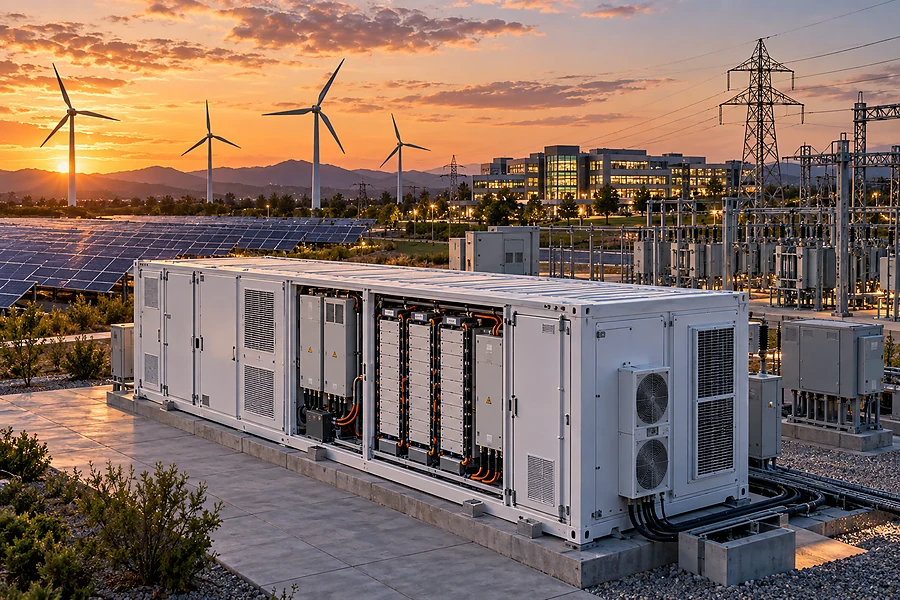
A containerized battery energy storage system can improve grid stability by rapidly balancing power, support renewable integration by storing surplus solar and wind energy, and provide backup power by discharging stored energy during outages. Its modular architecture combines batteries, BMS, thermal management, protection, controls, and power conversion into a scalable energy-storage solution.
This flexibility is becoming increasingly important. The IEA describes utility-scale batteries as one of the most versatile sources of short-term power-system flexibility, capable of supporting solar and wind integration, system balancing, grid services, capacity provision, and renewable energy shifting.
What Is a Containerized Battery Energy Storage System?
A containerized BESS is much more than a collection of lithium batteries placed inside a metal enclosure.
A containerized battery energy storage system is a modular energy-storage solution that integrates battery cells, modules, racks, a battery management system, thermal management, electrical protection, monitoring, and safety equipment inside a purpose-built enclosure. It works with a PCS and EMS to control charging, discharging, grid interaction, renewable integration, and backup operation.
A simplified architecture looks like this:
Battery Cells → Modules → Racks → BMS → DC Bus → PCS → Transformer → Grid/Load
Above this physical power architecture sits the:
EMS — Energy Management System
The components have different responsibilities.
The battery stores energy.
The BMS monitors battery operating conditions and manages protection.
The PCS controls bidirectional conversion between battery DC and grid/load AC.
The EMS determines when the battery should charge, discharge, or maintain reserve.
Thermal management controls operating temperature.
Protection and safety systems address electrical and battery-related hazards.
This integrated architecture is important because an energy storage system must control both:
energy
and:
power.
UL 9540, for example, covers energy storage systems and equipment as complete systems, including areas such as charging, discharging, protection, controls, communications, enclosures, and utility-grid interaction.
How Does a Containerized BESS Improve Grid Stability?
Electric grids require supply and demand to remain balanced continuously. Battery storage adds a rapidly controllable power resource.
A containerized BESS can improve grid stability by rapidly charging when electricity supply is excessive and discharging when additional power is needed. Depending on the system design and grid requirements, batteries can support frequency regulation, renewable smoothing, ramp-rate control, capacity management, congestion relief, and other ancillary services.
Consider a simplified example.
Grid demand suddenly increases by:
5MW
while generation cannot immediately respond.
A sufficiently sized BESS could temporarily discharge:
5MW
to help cover the imbalance.
Now consider the opposite situation.
Solar generation rises quickly while electricity demand remains relatively low.
The battery can:
charge
rather than add more immediate power to the grid.
The fundamental control loop becomes:
Excess Power → Charge BESS
Power Shortage → Discharge BESS
This bidirectional capability makes batteries different from traditional loads or generators that operate primarily in one direction.
The IEA notes that battery storage can respond quickly to provide system balancing and grid-support services. It also identifies storage as one of the tools available to power systems dealing with increasing shares of variable solar and wind generation.
Why Does Fast Response Matter?
Grid conditions can change quickly.
Clouds can reduce PV output.
Wind generation can rise or fall.
Large industrial loads can switch on.
EV charging can create concentrated demand.
A battery does not need to wait for additional sunlight or wind.
If sufficient stored energy and power capacity are available, its PCS can change output according to the control command.
That makes BESS particularly useful for short-duration flexibility.
How Does BESS Help Integrate Solar and Wind Energy?
Renewable generation does not always occur when electricity demand is highest.
A containerized BESS improves renewable integration by charging when solar or wind production is abundant and discharging stored electricity later when renewable output decreases or demand increases. This energy-shifting capability can increase the useful delivery of renewable electricity, reduce some curtailment, smooth plant output, and make variable generation more controllable.
Solar provides the easiest example.
Imagine a solar farm producing:
50MW
at midday.
The grid or local demand can accept:
40MW.
Potential surplus is:
50 – 40 = 10MW
If a BESS has sufficient charging capacity, it can absorb part of that surplus.
Suppose it charges at:
10MW
for:
3 hours.
Energy charged is approximately:
10MW × 3h = 30MWh
before losses and operating constraints.
Later, after sunset:
BESS → Grid
can return some of that stored electricity.
The process becomes:
Midday Solar → BESS → Evening Demand
The battery has not generated additional renewable energy.
Instead, it has moved existing renewable energy from one period to another.
The IEA identifies this ability to shift renewable generation into periods of higher demand as an important battery-storage function. It also reports that storage duration is gradually increasing, with more projects reaching four hours or longer as systems incorporate higher shares of solar PV.
How Can a BESS Reduce Renewable Energy Curtailment?
Curtailment occurs when available renewable generation cannot be fully delivered, but storage can sometimes capture part of that energy.
A BESS can reduce some renewable curtailment by charging when solar or wind output exceeds immediate demand, export capability, or other operating limits. The stored energy can then be discharged later. However, storage cannot eliminate all curtailment because its charging power, energy capacity, state of charge, and grid connection are limited.
Suppose:
Solar output = 100MW
Grid export limit = 80MW
Potential excess = 20MW
A BESS capable of charging at:
20MW
could potentially absorb that excess.
But duration matters.
If the excess lasts:
1 hour,
the energy involved is:
20MW × 1h = 20MWh
If it lasts:
4 hours,
the energy becomes:
20MW × 4h = 80MWh
A:
20MW / 20MWh
BESS cannot absorb four continuous hours of 20MW excess from an empty starting point.
A:
20MW / 80MWh
system has substantially more energy capacity for that scenario.
This demonstrates why renewable projects must consider both:
MW
and:
MWh.
The IEA notes that systems with high solar and wind output can experience periods of overproduction and that storage for energy shifting and ancillary services can help manage these low-net-load conditions.
How Does a Containerized BESS Provide Backup Power?
Stored battery energy can be reserved so it remains available when the normal electricity source fails.
A containerized BESS can provide backup power by maintaining an energy reserve and discharging it to selected loads when grid supply is interrupted. With appropriate PCS, controls, switchgear, protection, and system architecture, a BESS can support critical facilities, commercial operations, industrial loads, microgrids, and other applications requiring improved power resilience.
Consider a facility with:
Critical load = 500kW
Required backup duration = 4 hours
The theoretical AC energy requirement is:
500kW × 4h = 2MWh
But I would not simply specify:
2MWh of nominal battery capacity.
The actual system must account for:
usable SOC,
PCS efficiency,
battery losses,
reserve,
temperature,
degradation,
auxiliary consumption,
and:
future capacity requirements.
Suppose the facility also has solar.
During a daytime outage:
Solar → Critical Loads
while surplus energy can potentially follow:
Solar → BESS
At night:
BESS → Critical Loads
This creates a resilient solar-plus-storage architecture.
Backup duration ultimately depends on available battery energy and average critical-load demand.
Is a BESS the Same as a UPS for Backup Power?
They overlap in some applications, but they are not automatically interchangeable.
Both BESS and UPS systems can provide stored electrical energy during power interruptions, but their design objectives may differ. A UPS commonly emphasizes immediate short-duration continuity for critical equipment, while a BESS can be designed for longer-duration backup while also performing renewable integration, energy shifting, peak management, and grid-support functions.
The distinction becomes especially important for:
data centers,
industrial facilities,
hospitals,
telecommunications,
and:
critical infrastructure.
The IEA reported strong growth in battery-based UPS capacity during 2025, while noting that UPS systems generally provide short-duration backup until another backup source starts. By contrast, utility-scale storage increasingly includes multi-hour systems designed for broader power-system flexibility.
A BESS might therefore serve:
daily energy shifting
and still maintain:
emergency reserve.
However, this creates a control challenge.
If the battery is discharged for energy arbitrage immediately before an outage, little energy may remain for backup.
The EMS must therefore manage:
economic operation vs. backup reserve.
How Can a BESS Support Peak Shaving and Load Management?
Battery storage can reduce the maximum power a facility draws from the grid.
A containerized BESS supports peak shaving by discharging when facility demand approaches a defined threshold and charging when demand is lower or renewable generation is abundant. This can reduce peak grid import, increase solar self-consumption, and help commercial and industrial sites manage power demand more strategically.
Suppose a factory normally consumes:
2MW
but experiences a daily peak of:
3.5MW.
The target grid-import limit is:
2.5MW.
Required battery power during the peak is:
3.5 – 2.5 = 1MW
If that peak lasts:
2 hours,
the approximate energy requirement is:
1MW × 2h = 2MWh
before losses and reserve.
Now add solar generation.
At midday:
Solar → Factory Loads
and:
Solar → BESS
Later:
BESS → Factory Peak
The battery therefore moves locally generated renewable energy into a period when it creates additional operational value.
This also illustrates why battery storage can help manage network constraints. The IEA identifies utility-scale battery expansion and other flexibility resources as tools for managing increasingly constrained grids.
What Is the Difference Between MW and MWh in a Containerized BESS?
Understanding power and energy is essential when comparing BESS projects.
MW measures how much power a BESS can charge or discharge at one moment, while MWh measures how much energy the battery can store. A 10MW/40MWh system has approximately four hours of nominal duration at 10MW, while a 10MW/10MWh system has approximately one hour before accounting for operating limits and losses.
The basic formula is:
Duration = Energy Capacity ÷ Power
Examples:
| BESS Rating | Nominal Duration | Possible Focus |
|---|---|---|
| 10MW / 5MWh | 0.5 hour | Fast power support |
| 10MW / 10MWh | 1 hour | Short balancing |
| 10MW / 20MWh | 2 hours | Peak management |
| 10MW / 40MWh | 4 hours | Renewable shifting |
| 10MW / 80MWh | 8 hours | Longer energy delivery |
These applications are illustrative, not fixed rules.
A four-hour battery does not have to discharge at full power for four hours.
A:
10MW / 40MWh
system could theoretically deliver:
10MW for 4 hours,
5MW for 8 hours,
or:
another supported power profile
subject to equipment and operating limitations.
The appropriate ratio depends on what problem the project needs to solve.
How Does an EMS Coordinate Grid Stability, Renewables, and Backup?
One battery may be expected to perform several services, but its stored energy is finite.
An EMS coordinates BESS operation by using battery SOC, load demand, renewable generation, grid conditions, forecasts, operating limits, and reserve requirements to determine when the battery should charge or discharge. Effective control is particularly important when one BESS must balance renewable shifting, peak management, grid services, and emergency backup.
Imagine a:
20MWh battery.
The project could reserve:
5MWh
for emergency backup.
That leaves up to:
15MWh
for other functions, subject to SOC and operating constraints.
During high solar production:
charge.
During the evening peak:
discharge.
When grid support is requested:
adjust power.
When backup reserve approaches its minimum threshold:
stop discretionary discharge.
This shows why BESS value depends on more than battery cells.
The physical battery provides:
energy capacity.
The PCS provides:
power control.
The EMS provides:
operating intelligence.
As the number of BESS applications increases, software strategy becomes increasingly important.
Why Is Containerization Useful for Large Battery Storage Projects?
Utility and commercial storage projects often require many megawatt-hours, making modular architecture attractive.
Containerized BESS designs package battery racks and supporting equipment into standardized modular enclosures, helping simplify factory integration, transportation, site deployment, expansion, and maintenance planning. Projects can combine multiple storage blocks to reach the required MW and MWh while coordinating them through site-level power conversion and energy-management systems.
Suppose one hypothetical battery enclosure provides:
5MWh.
A project requiring:
100MWh
might use approximately:
100 ÷ 5 = 20 battery enclosures
before accounting for project-specific design factors.
This modularity can make capacity expansion easier.
A project may begin at:
50MWh
and later expand if:
land,
interconnection,
PCS,
transformer,
controls,
and:
other infrastructure
were designed to support expansion.
However, a BESS plant includes much more than battery containers.
It may also require:
PCS units,
medium-voltage transformers,
switchgear,
cabling,
communications,
fire protection,
SCADA,
foundations,
and:
grid-interconnection equipment.
Therefore, the container is a building block rather than the entire storage plant.
What Safety Systems Does a Containerized BESS Need?
Large battery systems store significant electrical and chemical energy, making safety engineering a fundamental part of system design.
A containerized BESS requires coordinated battery monitoring, electrical protection, thermal management, fault detection, emergency controls, and fire-risk management. Applicable certification, testing, installation codes, separation requirements, and fire-protection measures depend on jurisdiction and project configuration, so safety must be addressed at both equipment and installation levels.
In North America, two commonly discussed standards have different roles.
UL 9540 is the foundational product safety standard for energy storage systems and equipment.
UL 9540A is a test method used to evaluate thermal runaway and fire propagation behavior.
They are not the same standard.
UL states that UL 9540 covers complete ESS considerations including charging, discharging, protection, control, communication, enclosure design, and utility interaction.
UL 9540A addresses thermal-runaway fire propagation testing at relevant levels. UL also notes that the 2026 edition of NFPA 855 places increased emphasis on fire and large-scale fire testing for representative ESS installations.
This is why I do not describe an LFP battery as simply:
“fire-safe.”
Battery chemistry is only one element.
Safe BESS deployment depends on:
cell behavior,
system architecture,
BMS,
thermal management,
enclosure design,
installation,
separation,
detection,
fire protection,
and:
operating procedures.
Can One BESS Provide Grid Stability, Renewable Integration, and Backup at the Same Time?
Yes, but the battery's finite power and energy must be allocated carefully.
One containerized BESS can support multiple applications, including renewable energy shifting, peak management, grid services, and backup reserve. However, the same MW and MWh cannot be fully committed to every service simultaneously. The EMS must prioritize services and maintain sufficient SOC and power headroom for the functions considered most important.
Suppose a project has:
10MW / 40MWh BESS.
The operator wants:
solar shifting,
grid support,
and:
backup.
It might maintain an energy reserve for backup while using the remaining operating window for daily solar shifting.
At the same time, some power capacity may need to remain available for rapid grid response.
This is commonly described as:
value stacking.
But value stacking has physical limits.
A full battery cannot absorb additional energy.
An empty battery cannot provide prolonged discharge.
A PCS already operating at its maximum output cannot simultaneously provide additional discharge power.
Therefore, the most effective multi-use BESS is not necessarily the one with the largest number of applications.
It is the one whose:
MW + MWh + SOC strategy + EMS controls
are correctly matched to the project's priorities.
My Insights: How Can a Containerized Battery Energy Storage System Improve Grid Stability, Renewable Integration, and Backup Power
The central value of containerized storage is flexibility: it separates when electricity is generated from when it must be consumed while also providing controllable power.
A containerized BESS improves grid stability through rapid bidirectional power control, renewable integration through energy shifting and curtailment management, and backup power through stored-energy reserves. The greatest benefits appear when battery MW, MWh, PCS capability, EMS controls, safety systems, and project operating objectives are designed as one coordinated system.
My First Insight: Grid Stability Is Mainly a Power-Control Problem
For fast grid response, the key question is:
How quickly and how strongly can the BESS respond?
That makes:
MW
and PCS performance particularly important.
The IEA identifies batteries as a rapidly expanding source of short-term power-system flexibility and grid support.
My Second Insight: Renewable Integration Is Mainly an Energy-and-Time Problem
Solar electricity at noon may be much more useful several hours later.
BESS changes:
when
the electricity can be delivered.
That makes:
MWh
and discharge duration particularly important for renewable shifting.
The IEA reports that storage durations are gradually lengthening as the value of flexibility increases in systems with more PV.
My Third Insight: Backup Power Is a Reserve-Management Problem
Having a large battery does not guarantee backup power.
Stored energy must still be available when the outage occurs.
That means the EMS may need to protect:
minimum backup SOC.
A system optimized exclusively for daily energy trading could otherwise discharge valuable emergency reserve shortly before a grid failure.
My Fourth Insight: Containerization Makes BESS Scalable, but Controls Make It Useful
Battery containers make storage modular.
But containers alone do not decide:
when to charge,
when to discharge,
how much backup reserve to maintain,
or:
which service gets priority.
The EMS and PCS turn stored battery energy into a controllable grid resource.
My Fifth Insight: How Can a Containerized Battery Energy Storage System Improve Grid Stability, Renewable Integration, and Backup Power?
This directly answers the H1.
| Objective | What the Containerized BESS Does | Main Benefit |
|---|---|---|
| Grid Stability | Rapidly charges or discharges | Helps balance changing supply and demand |
| Frequency/Grid Support | Adjusts power through the PCS | Provides short-term system flexibility |
| Renewable Integration | Stores surplus solar and wind energy | Moves renewable energy to later periods |
| Curtailment Management | Charges during excess renewable production | Captures some energy that might otherwise be curtailed |
| Peak Shaving | Discharges during high demand | Reduces peak grid import |
| Congestion Management | Shifts power across time | Can reduce pressure during constrained periods |
| Backup Power | Maintains and releases stored reserve | Supports critical loads during outages |
| Microgrid Operation | Balances local generation and loads | Improves resilience and renewable self-consumption |
The complete logic can be summarized as:
When electricity is excessive → Store it.
When electricity is insufficient → Release it.
When renewable production is mistimed → Shift it.
When grid conditions change quickly → Adjust power.
When the grid fails → Use reserved energy for critical loads.
That is why containerized BESS is increasingly important as power systems add more variable renewable generation. The IEA expects the share of solar PV and wind in global electricity generation to rise from about 17% currently to 27% by 2030, increasing the importance of grid and system flexibility.
The battery, however, should not be viewed in isolation.
A successful system depends on the relationship:
Battery Energy (MWh) + PCS Power (MW) + EMS Control + Grid Connection + Safety Architecture
For grid stability, I prioritize:
response and power capability.
For renewable integration, I prioritize:
energy capacity and duration.
For backup, I prioritize:
usable stored energy, reserve strategy, and critical-load requirements.
When these functions are designed together, a containerized BESS becomes more than an energy-storage device. It becomes a flexible power-system resource capable of helping balance the grid, making renewable electricity more dispatchable, and maintaining essential power when normal supply is interrupted.
Conclusion
Containerized BESS improves grid stability, renewable integration, and backup power by combining fast power control, multi-hour energy storage, intelligent management, and scalable modular architecture.
](https://voltcrave-battery.com/wp-content/uploads/2026/08/What-Is-the-Difference-Between-a-PCS-and-an-Inverter-768x512.webp)
](https://voltcrave-battery.com/wp-content/uploads/2026/09/What-Is-the-Best-Portable-Car-Jump-Starter-768x512.webp)
](https://voltcrave-battery.com/wp-content/uploads/2026/10/Which-Is-Better-LiFePO4-or-Lithium-Battery-768x512.webp)







































