

](https://voltcrave-battery.com/wp-content/uploads/2026/08/What-Is-Commercial-Energy-Storage.webp)
Businesses often face high electricity costs, demand peaks, solar-energy waste, and outage risk even when their total energy consumption appears manageable.
Commercial energy storage is an energy storage system installed at businesses, factories, offices, warehouses, hospitals, data centers, retail sites, and other commercial or industrial facilities. It stores electricity or thermal energy for later use. Battery energy storage systems are the most common electrical option, supporting peak shaving, solar self-consumption, backup power, and energy-cost optimization.
I usually use the term commercial energy storage to describe behind-the-meter battery energy storage systems, or BESS, serving commercial and industrial customers. However, commercial storage can also include thermal storage, and some larger commercial systems may participate directly in utility or wholesale electricity programs.
What Is a Commercial Energy Storage System?
Commercial energy storage sits between small residential batteries and large utility-scale storage plants. It is designed around the electricity demand and operating requirements of a business or facility.
A commercial energy storage system captures energy when electricity is inexpensive, renewable generation is available, or grid demand is low. It releases that energy when electricity becomes more valuable or when the facility needs backup power. Commercial BESS installations commonly combine lithium-ion batteries, inverters, battery management, thermal controls, protection equipment, and energy-management software.
Commercial Storage Is Usually Behind the Meter
A commercial battery is commonly installed behind the utility meter.
This means the battery operates on the customer side of the electricity connection. Its first purpose may be to reduce the facility's electricity bill rather than sell power directly into the wholesale electricity market.
The National Renewable Energy Laboratory's storage modeling distinguishes distributed commercial storage from front-of-meter systems. Behind-the-meter commercial storage uses battery power to reduce a customer's electricity bill, while front-of-meter systems generally sell electricity or grid services into power markets.
Commercial installations can be found at:
- Manufacturing plants
- Warehouses
- Shopping centers
- Office buildings
- Hotels
- Hospitals
- Schools and universities
- Data centers
- Cold-storage facilities
- EV charging stations
- Farms and agricultural facilities
- Telecom sites
The system size depends on the facility rather than one universal commercial-storage definition.
NREL's 2024 commercial battery-storage benchmark models commercial and industrial lithium-ion systems across approximately 100–2,000 kW of battery power and storage durations ranging from one to eight hours. Real projects can be smaller or considerably larger.
Commercial Energy Storage Is Not Limited to Batteries
I distinguish energy storage from battery storage.
Commercial energy storage can include:
| Technology | Stored form | Common commercial use |
|---|---|---|
| Lithium-ion battery | Electrochemical energy | Peak shaving, solar shifting, backup |
| Flow battery | Electrochemical energy | Longer-duration cycling |
| Lead-acid battery | Electrochemical energy | Backup and reserve power |
| Thermal storage | Heat or cold | HVAC and cooling-load shifting |
| Ice storage | Cooling energy | Reducing afternoon air-conditioning demand |
| Hot-water storage | Thermal energy | Heating and process-energy management |
DOE notes that organizations can use battery or thermal storage to hold renewable energy for later use or shift building energy demand to smoother periods.
However, when a commercial solar installer, BESS integrator, or facility manager discusses a modern commercial energy storage project, the system is often an LFP lithium-ion BESS.
How Does Commercial Battery Energy Storage Work?
A commercial BESS charges when electricity is available and later discharges according to facility demand, utility prices, solar generation, or grid-service commands.
Commercial battery storage works by converting AC electricity into DC energy for storage in battery cells. When the facility needs energy, the power conversion system changes battery DC power back into AC electricity. An energy management system determines when to charge or discharge, while the BMS protects the battery from unsafe voltage, current, temperature, and operating conditions.
The Battery Stores Energy
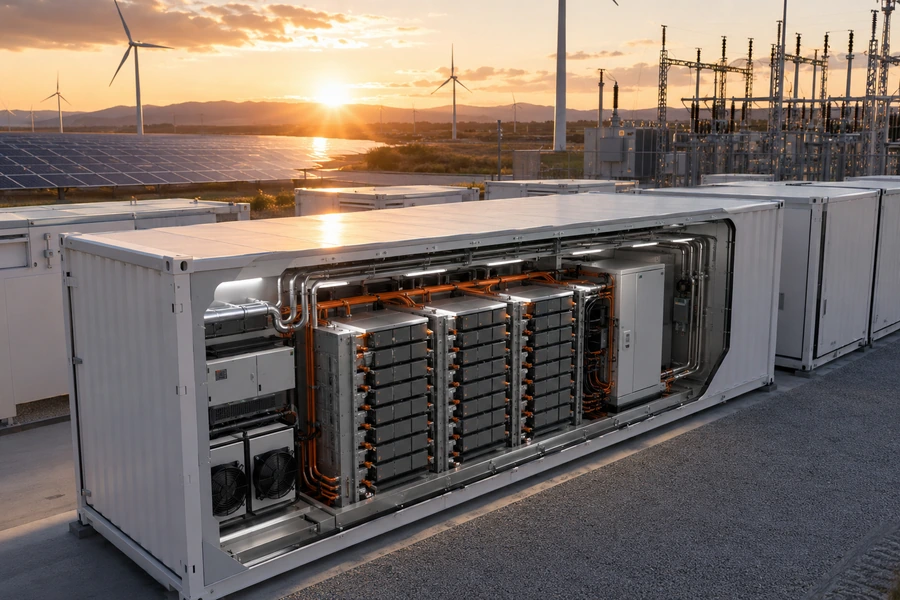
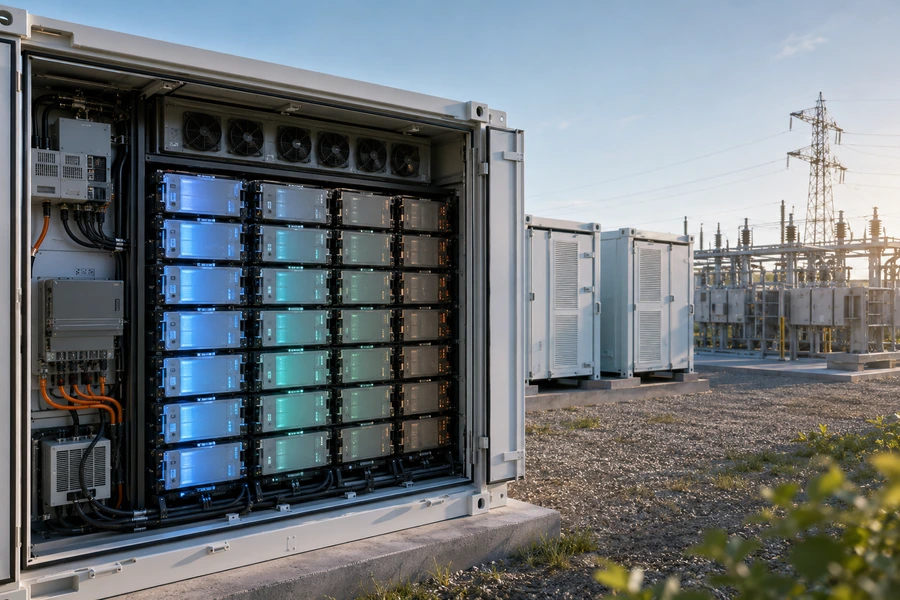
Battery cells are arranged into modules, racks, cabinets, or containers.
During charging, electricity is stored electrochemically. During discharge, the process reverses and electricity becomes available to the facility.
Modern commercial BESS projects often use lithium iron phosphate, or LFP, batteries because stationary applications value cycle life, cost, and thermal stability.
NREL's commercial-storage benchmark represents lithium-ion systems with storage durations from one to eight hours and identifies LFP as the primary stationary lithium-ion chemistry since 2021.
The Inverter Controls Power Flow
The battery stores DC electricity, while most commercial buildings use AC electricity.
The power conversion system, or PCS, performs the conversion.
When charging:
Grid or solar AC → PCS → battery DC
When discharging:
Battery DC → PCS → building AC
The PCS also controls how quickly the battery charges and discharges.
A 500 kW/1,000 kWh BESS, for example, has approximately:
- 500 kW of rated power
- 1,000 kWh of energy capacity
- A two-hour nominal discharge duration at full power
Power and energy must therefore be sized separately.
The EMS Decides When the Battery Should Operate
The energy management system provides the commercial intelligence.
It may monitor:
- Facility demand
- Electricity prices
- Solar generation
- Battery state of charge
- Demand-charge thresholds
- Weather forecasts
- EV charging demand
- Utility demand-response signals
- Backup reserve requirements
It then determines when battery energy creates the greatest value.
A basic commercial system may simply discharge whenever facility demand rises above a predetermined limit. A more sophisticated system may continuously forecast demand and electricity prices.
DOE has supported commercial-building projects that integrate BESS with building energy controls, solar, HVAC, and EV charging through distributed-energy management systems.
What Is Commercial Energy Storage Used For?
Commercial storage can perform several jobs from the same physical battery. The economic value often comes from combining these applications.
Commercial energy storage is mainly used for peak shaving, demand-charge reduction, time-of-use optimization, solar-energy shifting, backup power, demand response, EV charging support, and grid services. The best application depends on the facility's load profile, electricity tariff, outage cost, solar production, and utility-program eligibility.
Peak Shaving and Demand-Charge Reduction
Peak shaving is one of the most important commercial BESS applications.
A utility bill may include both:
- An energy charge based on total kWh consumed.
- A demand charge based on the facility's highest kW demand during a billing period.
Suppose a factory normally consumes around 400 kW but briefly rises to 750 kW when several machines start at the same time.
The battery can discharge during that peak and reduce grid demand to perhaps 550 kW.
The facility still operates normally, but the utility sees a lower peak.
NREL research has found that demand charges can be a major driver of commercial battery economics and that the customer's load shape strongly affects optimal battery size.
Older NREL tariff research also found that demand charges could represent a substantial portion of commercial electricity bills in some tariffs, which helped create an economic opportunity for behind-the-meter storage.
Time-of-Use Energy Shifting
Some businesses pay different electricity prices at different times.
The battery can charge when electricity is relatively inexpensive and discharge when electricity becomes expensive.
A simplified schedule could look like this:
| Time | Electricity condition | Battery action |
|---|---|---|
| 2 a.m. | Low demand and low price | Charge |
| 8 a.m. | Business begins operating | Hold or discharge lightly |
| 2 p.m. | High demand | Discharge |
| 5 p.m. | Expensive peak period | Discharge |
| 10 p.m. | Demand falls | Prepare for next cycle |
This strategy is commonly called time-of-use optimization or energy arbitrage.
The financial benefit depends on the difference between charging and discharging prices. Battery efficiency losses and degradation must also be included.
Solar Energy Storage
Commercial solar panels may produce their highest output around midday when facility demand does not fully use the available solar electricity.
A battery can store the excess.
Later, the business can discharge that energy during the evening or another period of high demand.
DOE explains that energy storage allows solar electricity to be used at a different time from when it is generated and can improve resilience and power quality.
Commercial solar-plus-storage can therefore increase on-site consumption of solar generation rather than exporting all excess electricity to the grid.
Backup Power and Resilience
Commercial batteries can also provide emergency electricity during grid outages when the system is designed for backup operation.
A backup-capable BESS may support:
- Servers
- Communications equipment
- Security systems
- Refrigeration
- Medical equipment
- Lighting
- Critical manufacturing processes
- Pumps
- Building controls
A commercial BESS must have suitable islanding and transfer controls if it is expected to operate when the utility grid is unavailable.
DOE notes that distributed generation combined with local storage can allow commercial buildings and critical facilities to continue operating during wider grid disruptions.
The value of backup depends on the business.
One hour without electricity may have limited consequences for a small office. The same one-hour interruption can destroy refrigerated inventory, interrupt a manufacturing line, or affect critical data-center operations.
Demand Response and Grid Services
A commercial battery may also participate in utility programs.
During periods of high grid demand, the utility or program operator can request lower facility consumption or battery discharge.
Possible revenue streams include:
- Demand response
- Capacity programs
- Frequency regulation
- Virtual power plants
- Local grid-support programs
DOE has supported projects in which distributed commercial solar and BESS assets are aggregated into virtual power plants that can provide grid services while also creating value for individual property owners.
This creates a form of revenue stacking, where one battery provides several services rather than relying on one source of savings.
What Is the Difference Between Commercial, Residential, and Utility Energy Storage?
The technologies can look similar, but the applications, scale, electrical connections, and financial objectives are different.
Residential storage primarily serves individual homes. Commercial storage serves businesses and industrial facilities, usually behind the meter. Utility-scale storage is normally connected in front of the meter and supports the wider electricity system. Commercial BESS occupies the middle ground, combining customer bill savings, resilience, renewable integration, and sometimes grid-service revenue.
Commercial Systems Are Larger Than Typical Home Batteries
A home battery might store around 10–30 kWh.
A commercial installation may store hundreds or thousands of kilowatt-hours.
A large industrial facility may use several megawatt-hours.
| Storage market | Typical purpose | Representative scale |
|---|---|---|
| Residential | Home backup and solar self-consumption | Tens of kWh |
| Commercial | Peak shaving, solar, backup, demand response | Hundreds of kWh to several MWh |
| Utility scale | Grid energy shifting and system services | Tens to thousands of MWh |
These are broad ranges rather than formal boundaries. A large commercial campus can have a battery larger than a small utility project.
Commercial Storage Has More Complex Tariff Economics
Residential customers often focus on:
- Backup
- Solar self-consumption
- Time-of-use savings
Commercial customers may also have significant demand charges.
This changes battery sizing.
A commercial battery can sometimes create strong value by supplying a relatively short burst of power during one monthly demand peak. That means the required power rating may be more important than installing a very large energy capacity.
NREL research emphasizes that commercial battery economics are highly customer-specific because tariff structure and load profiles determine demand-charge savings.
Utility Batteries Usually Earn Market Revenue
A utility-scale battery normally supplies the electrical grid rather than one commercial building.
It may earn revenue from:
- Wholesale energy markets
- Capacity
- Frequency regulation
- Ancillary services
- Renewable-energy shifting
A commercial battery may provide some of these services through aggregation, but its primary economic relationship often begins with the facility's electricity bill.
How Is a Commercial Energy Storage System Sized?
Buying the largest battery does not automatically produce the best economic result.
I size commercial energy storage by analyzing the facility's interval load data, electricity tariff, peak demand, solar production, backup requirements, required discharge duration, and expected operating schedule. The BESS power rating determines how much load it can offset at one moment, while its energy rating determines how long it can continue.
Power and Energy Solve Different Problems
Consider a building with a 1 MW grid peak.
If the owner wants to reduce that peak to 700 kW for one hour, the battery may need roughly:
- 300 kW of discharge power
- At least 300 kWh of usable energy
If the same 300 kW reduction must continue for four hours, approximately 1,200 kWh would be needed before adjusting for operating reserves and system losses.
This is why BESS specifications include both kW and kWh.
Duration Has a Major Effect on Cost
NREL's commercial storage benchmark analyzes durations from one to eight hours and notes that accurately estimating required duration is critical to total system cost. The battery pack is important, but it is not the entire BESS cost because the inverter and balance-of-system equipment also contribute significantly.
For peak shaving, a one- or two-hour system may sometimes be enough.
For longer backup requirements, the business may need several hours of storage or a hybrid microgrid using:
- Solar
- BESS
- Generator
- Demand management
The economically correct duration therefore depends on the problem being solved.
What Are the Main Components of Commercial Battery Storage?
A BESS is not simply a box of cells.
A commercial BESS includes battery cells, racks or cabinets, a battery management system, power conversion equipment, thermal management, fire detection, an energy management system, switchgear, meters, communications, and protection devices. Larger projects may also require medium-voltage transformers, SCADA, site controllers, and dedicated interconnection equipment.
Core BESS Components
| Component | Main function |
|---|---|
| Battery cells | Store energy |
| Battery racks | Organize cells into manageable electrical groups |
| BMS | Monitors and protects the battery |
| PCS/inverter | Converts DC and AC power |
| EMS | Optimizes charging and discharging |
| HVAC or liquid cooling | Controls temperature |
| Fire and gas detection | Monitors abnormal battery conditions |
| Switchgear | Provides electrical protection and isolation |
| Transformer | Matches facility or grid voltage |
| Metering | Measures electricity and system performance |
| SCADA/HMI | Provides monitoring, alarms, and operator controls |
DOE's BESS procurement guidance recommends evaluating commercial-scale lithium-ion systems as complete engineered projects rather than purchasing the battery cells independently.
Controls Determine Much of the Economic Value
I pay particular attention to the EMS.
Imagine a 500 kWh battery that discharges at the wrong time. It may be empty when the facility reaches its monthly peak.
The hardware is functioning correctly, but the project can still fail to achieve its economic objective.
NREL peak-shaving research has shown that battery-control set points can materially affect performance and utilization.
Commercial energy storage is therefore both an electrical system and a software-controlled energy-management asset.
When Does Commercial Energy Storage Make Financial Sense?
A battery does not save money simply because it is installed.
Commercial energy storage makes the strongest economic case when a facility has expensive demand peaks, strong time-of-use price differences, valuable backup requirements, excess solar generation, demand-response opportunities, or several of these conditions together. The correct evaluation compares lifetime savings and revenue with installation, financing, degradation, maintenance, and replacement costs.
Load Profile Matters
Two warehouses with the same annual electricity consumption can need completely different batteries.
Warehouse A may have smooth electricity consumption throughout the day.
Warehouse B may experience one sharp 30-minute peak every afternoon.
A relatively small, high-power battery could have significant value for Warehouse B because it can reduce that peak.
NREL research identifies the shape of the building's load profile as an important predictor of battery size and identifies demand charges as a major factor in project economics.
Solar Can Add Another Value Stream
Solar and batteries can complement one another.
The solar array produces inexpensive electricity. The battery controls when part of that energy is used.
NREL research on commercial customers found consistent synergies between solar and storage for demand-charge management, while emphasizing that the actual savings depend heavily on the specific customer and tariff.
I therefore model the battery with actual interval load and solar data instead of relying only on annual electricity consumption.
Resilience Has Economic Value Too
Some battery benefits do not appear directly as utility-bill savings.
A hospital, data center, grocery store, cold-storage warehouse, or factory may lose significant money during an outage.
In this case, I include the avoided cost of interruption in the investment analysis.
The business case can become stronger even when the battery does not produce enough electricity-bill savings by itself.
My Insights: What Is Commercial Energy Storage
I view commercial storage as an energy-management system rather than simply a large rechargeable battery.
Commercial energy storage is a system that allows businesses to control when they purchase, store, and use energy. Modern commercial BESS installations can reduce demand peaks, move solar energy to more valuable hours, provide backup power, support EV charging, and participate in grid programs. Their real value comes from matching battery operation to the facility's load and electricity tariff.
The Best Commercial BESS Solves a Specific Business Problem
I first ask why the facility needs storage.
If the problem is a short monthly demand peak, I may prioritize battery power over long duration.
If the problem is a four-hour outage, I need enough energy capacity to support critical loads.
If the goal is solar self-consumption, I size the battery around surplus solar generation and evening demand.
If the goal is EV charging support, I examine the relationship between charger power, grid-connection capacity, vehicle arrival patterns, and charging duration.
This prevents over-sizing.
Commercial Storage Is Becoming Part of Building Energy Management
I expect commercial batteries to become increasingly integrated with:
- Solar PV
- EV chargers
- HVAC
- Building automation
- Smart panels
- Microgrids
- Utility programs
- Virtual power plants
A 2026 DOE-supported project specifically explores integration of commercial-building BESS with HVAC, solar, EV charging, and a distributed energy-resource management system. This reflects the broader direction of commercial energy management: the battery increasingly operates as one controllable resource within a connected building rather than as an isolated device.
Revenue Stacking Can Improve Economics
A battery may have difficulty paying for itself when it performs only one task.
The economics can improve when one system provides several compatible services.
For example, the same battery might:
- Store solar electricity at midday.
- Reduce the facility's afternoon peak.
- Avoid high time-of-use prices.
- Maintain a backup reserve.
- Participate in a demand-response event.
I still make sure that these revenue sources do not conflict.
A battery cannot discharge its full capacity for peak shaving while simultaneously keeping all of that energy reserved for an outage.
The EMS must prioritize the services according to their value and operational requirements.
Commercial Storage Should Be Evaluated Over Its Full Lifecycle
I do not compare systems only by purchase price per kWh.
I also review:
- Battery degradation
- Round-trip efficiency
- Warranty terms
- Energy-throughput limits
- Augmentation
- Maintenance
- Cooling energy
- Software fees
- Insurance
- Safety requirements
- Replacement parts
- Recycling
- Supplier stability
A more expensive system can create better lifetime economics if it maintains more usable energy, experiences less downtime, or receives stronger long-term service.
Conclusion
Commercial energy storage lets businesses control when energy is stored and used. Its strongest value comes from reducing peaks, managing solar, improving resilience, and optimizing electricity costs.
](https://voltcrave-battery.com/wp-content/uploads/2026/08/How-Can-We-Make-Energy-Storage-Systems-Denser-768x512.webp)
](https://voltcrave-battery.com/wp-content/uploads/2026/08/What-Is-the-Lifespan-of-a-BESS-Battery-768x512.webp)
](https://voltcrave-battery.com/wp-content/uploads/2026/06/What-is-the-Best-Portable-Outdoor-Power-Station-768x512.jpg)