
](https://voltcrave-battery.com/wp-content/uploads/2026/10/What-Advantages-Do-All-in-One-Energy-Storage-Systems-Offer-Compared-to-Traditional-Solutions.webp)
Traditional energy storage can require separate batteries, inverters, controls, protection, communications, and installation work, increasing system interfaces and project complexity.
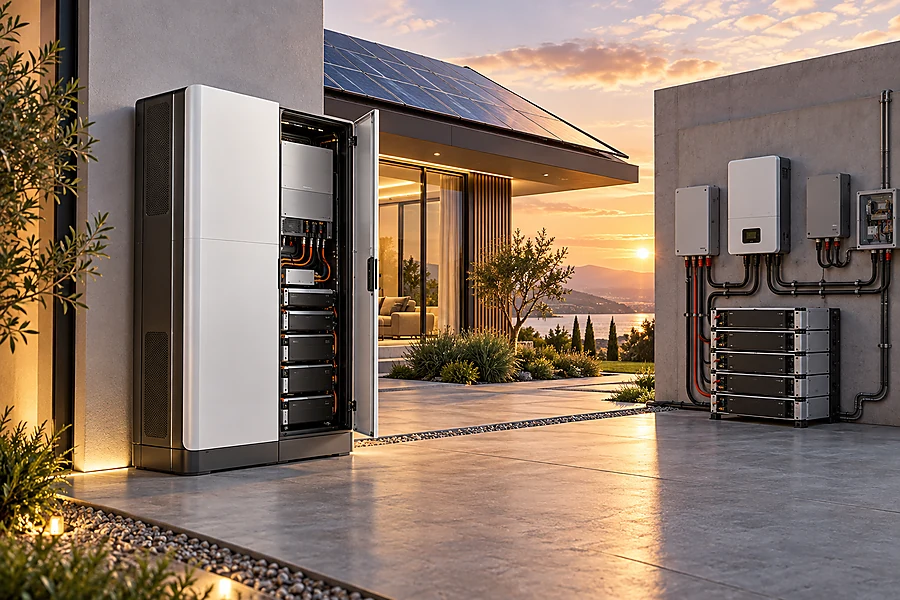
All-in-one energy storage systems can simplify installation, reduce equipment interfaces, save space, centralize monitoring, shorten commissioning, and improve component coordination by integrating batteries, power electronics, controls, and protection into one matched platform. Compared with traditional multi-component solutions, they can also reduce balance-of-system complexity, although serviceability, expansion flexibility, and vendor dependence require careful evaluation.
All-in-one systems reduce complexity by factory-integrating engineering, matching, testing, connections, and controls, shifting work from site integration while still requiring project-specific evaluation for each application.
What Is an All-in-One Energy Storage System?
The phrase “all-in-one energy storage system” generally describes a battery-storage product that integrates several functions normally supplied as separate pieces of equipment.
An all-in-one ESS combines multiple battery-storage functions within one coordinated platform. Depending on the product, this may include battery modules, BMS, bidirectional PCS or inverter, EMS, solar inverter functions, electrical protection, thermal management, communications, and backup controls. The exact definition varies by manufacturer, so buyers should always verify what is actually integrated.
A traditional energy-storage architecture may look like:
Battery
↓
BMS
↓
Separate PCS/Inverter
↓
Separate EMS
↓
Separate Gateway
↓
Protection/Switchgear
↓
Building/Grid
An all-in-one architecture may simplify this to:
Integrated Battery + BMS + PCS/Inverter + EMS + Protection
↓
Building/Grid
Some products integrate even more.
For example, Sigenergy describes its SigenStor platform as integrating a solar inverter, battery PCS, battery pack, EMS, and optional EV DC charging functions into a coordinated platform.
Tesla's Powerwall 3 similarly integrates a solar inverter into the battery platform, although external equipment such as a Backup Gateway, Backup Switch, or Gateway 3 may still be necessary depending on the installation.
This illustrates an important point:
All-in-One Does Not Necessarily Mean No External Equipment.
Electrical panels, disconnects, utility metering, backup switching, breakers, transformers, or other site-specific equipment may still be required.
UL 9540 also recognizes that an energy storage system may be constructed either as one unitary piece of equipment or as matched assemblies connected according to manufacturer instructions.
Therefore, “all-in-one” is best understood as an integration strategy, not simply an enclosure style.
How Do All-in-One Energy Storage Systems Reduce Installation Complexity?
Traditional BESS projects require multiple components to be selected, mounted, wired, configured, and tested together.
All-in-one energy storage systems can reduce installation complexity because more battery, inverter, control, protection, and communication interfaces are integrated at the factory. Installers may have fewer separate enclosures, field communication links, DC connections, configuration steps, and compatibility checks to complete, reducing the amount of site-specific integration work required.
This difference becomes clearer when comparing two approaches.
Traditional Architecture
A traditional installation may require separate:
battery cabinets,
battery BMS,
PCS,
solar inverter,
EMS controller,
gateway,
meters,
communications equipment,
disconnects,
and electrical protection.
Each connection becomes an engineering interface.
For example:
Battery ↔ PCS
needs electrical compatibility.
BMS ↔ PCS
needs communication compatibility.
PCS ↔ EMS
needs control compatibility.
EMS ↔ Meter
needs data compatibility.
PCS ↔ Grid
needs interconnection compatibility.
Every interface may require:
cables,
connectors,
communication protocols,
software configuration,
testing,
and troubleshooting.
Integrated Architecture
An all-in-one supplier can resolve more of those interfaces during product development.
Sigenergy, for example, states that its stackable battery architecture uses guided quick connectors rather than requiring conventional hand wiring between battery modules. It also integrates the EMS into the energy controller.
That does not mean every installation becomes plug-and-play.
Electrical codes, grid requirements, load calculations, protection, backup architecture, and permitting still matter.
But integration can reduce the number of decisions that must be made independently at the job site.
This can be especially valuable for projects that need to be:
repeatable,
standardized,
and deployed in volume.
Can All-in-One ESS Reduce Installation and Balance-of-System Costs?
The battery itself is only one part of an installed energy-storage project's total cost.
Integrated ESS designs can potentially reduce balance-of-system and installation costs by reducing separate hardware, enclosures, wiring, communications interfaces, engineering, and field labor. The savings are project-specific, however, because permitting, electrical upgrades, interconnection, switchgear, foundations, backup equipment, and other site requirements may remain even when the battery and power electronics are integrated.
NREL's bottom-up BESS cost models demonstrate why this matters.
The complete cost of a storage system includes not only the lithium-ion battery pack but also:
the inverter,
balance-of-system equipment,
installation labor,
engineering,
permitting,
inspection,
and interconnection.
This gives us a useful equation:
Installed ESS Cost ≠ Battery Cost
Instead:
Installed ESS Cost = Battery + Power Conversion + BOS + Labor + Engineering + Interconnection + Other Project Costs
An integrated product may reduce some of these categories.
For example, combining the battery and inverter can potentially eliminate:
one separate enclosure,
some external DC cabling,
some communication wiring,
and some commissioning work.
But it does not automatically eliminate:
service-panel upgrades,
conduit,
site wiring,
permits,
utility approval,
backup-switching equipment,
or switchgear.
Tesla's Powerwall documentation illustrates this clearly. Powerwall 3 integrates the solar inverter, but Tesla still identifies additional electrical hardware such as panels, conduit, disconnects, meters, and site-dependent components.
So the correct claim is:
All-in-One Can Reduce BOS Complexity.
It is not:
All-in-One Eliminates BOS.
Do All-in-One Energy Storage Systems Save Space?
Integration can significantly reduce the number of separate devices installed around a battery system.
All-in-one ESS products can reduce physical footprint by combining batteries, power electronics, controls, communications, and sometimes solar or backup functions into fewer enclosures. This can be particularly valuable in homes, commercial buildings, retail sites, telecom installations, and other applications where wall space, equipment-room space, or outdoor installation area is limited.
Consider a conventional residential solar-plus-storage installation.
It might require:
Solar Inverter
+
Battery
+
Battery Inverter
+
Energy Controller
+
Backup Gateway
+
Disconnect Equipment
An integrated design could combine several of these functions.
Tesla Powerwall 3, for example, includes an integrated solar inverter.
SigenStor takes integration further by combining solar inverter, battery PCS, battery pack, and EMS functions, with EV charging integration also supported within the broader platform.
The space benefit is not limited to appearance.
Fewer enclosures can also reduce:
mounting locations,
equipment clearances,
cable routing,
wall penetrations,
and communication wiring.
However, space requirements still need to account for:
service access,
thermal management,
code-required clearances,
fire-safety requirements,
and electrical working space.
NFPA 855 addresses stationary ESS installation issues including location, separation, detection, ventilation, fire protection, and emergency considerations.
Therefore:
Compact ≠ Install Anywhere.
An integrated system still needs a compliant installation environment.
Do Integrated Energy Storage Systems Simplify Commissioning?
Commissioning becomes increasingly complex as the number of independently sourced components grows.
An all-in-one ESS can simplify commissioning because the battery, PCS, BMS, EMS, metering, and communications are designed to operate as a coordinated system. This can reduce protocol configuration, parameter matching, firmware compatibility issues, and troubleshooting between independent suppliers, especially compared with systems assembled from separately sourced batteries, inverters, and controllers.
Imagine a traditional system using:
Battery Supplier A,
PCS Supplier B,
EMS Supplier C,
Meter Supplier D,
and Gateway Supplier E.
If communication fails, the installer may need to determine whether the problem involves:
CAN communication,
RS-485,
Modbus,
Ethernet,
firmware,
register mapping,
baud rate,
network configuration,
or control logic.
Now consider a system in which one manufacturer has already designed the internal control architecture.
The commissioning process can become more standardized.
Sigenergy, for example, markets guided module connections, integrated control, rapid commissioning, OTA upgrades, and system-level diagnostics as features of its integrated platform. The exact installation times it publishes are product-specific and should not be generalized to every all-in-one ESS.
This distinction is important.
The real advantage is not that:
Every all-in-one system installs in a few minutes.
The advantage is:
Fewer Independent Interfaces Can Mean Fewer Integration Problems.
For installers deploying the same platform repeatedly, this may also improve:
training,
installation consistency,
troubleshooting,
documentation,
and commissioning workflow.
How Can All-in-One ESS Improve System Communication and Control?
Battery storage is no longer simply a battery connected to an inverter.
Integrated energy-storage systems can improve control coordination because the BMS, PCS, EMS, metering, and communications are developed as parts of the same operating architecture. This can simplify energy scheduling, state-of-charge management, solar charging, backup reserve, power limits, diagnostics, and remote monitoring compared with systems requiring multiple third-party control interfaces.
A modern ESS may need to decide:
when to charge,
when to discharge,
how much backup reserve to maintain,
whether to export power,
whether to charge from solar,
how to respond to grid conditions,
and how to protect the battery.
The responsibilities can be divided roughly as:
BMS → Protects and manages the battery
PCS/Inverter → Controls electrical power conversion
EMS → Decides when and why energy moves
The U.S. Department of Energy notes that modern inverter-based systems can provide monitoring, communications, grid support, and—in suitable architectures—operation during grid outages.
Integrating these layers does not necessarily improve the theoretical efficiency of every component.
But it can make the system easier to coordinate.
For example, an integrated controller can know simultaneously:
solar production,
home load,
battery SOC,
grid status,
and power limits.
That information can support decisions such as:
Solar Surplus → Charge Battery
High Tariff → Discharge Battery
Grid Failure → Preserve Critical Loads
Low SOC → Protect Battery Reserve
The advantage is therefore partly about:
information flow.
Better-coordinated devices can reduce the number of external control layers needed to make the energy system behave as one system.
Do All-in-One Systems Improve Reliability?
Integration can remove some failure points, but it can also concentrate functions into fewer components.
All-in-one systems can improve system-level reliability by reducing external connectors, field wiring, communication links, and mismatched components. However, integration can also increase dependence on one platform, so a failure of a central controller or power-electronics module may affect multiple functions. Reliability therefore depends on architecture, redundancy, component quality, diagnostics, and service strategy.
Consider a traditional ESS with:
10 external communication connections,
multiple DC cables,
separate power supplies,
and several independent controllers.
Each connection represents a potential:
loose terminal,
communication fault,
configuration error,
or environmental failure point.
Reducing interfaces can help.
But integration creates another question:
What happens when the integrated component fails?
Suppose one enclosure contains:
battery control,
inverter,
communications,
and energy management.
A failure may require replacing or servicing a proprietary assembly rather than an individual generic component.
This creates a trade-off:
Fewer Interfaces ↔ Greater Platform Dependence
That is why I would evaluate:
module-level serviceability,
replaceable components,
spare-parts availability,
local technical support,
remote diagnostics,
firmware support,
and warranty procedures.
The strongest architecture is not necessarily the one with the fewest boxes.
It is the one that balances:
integration + serviceability + reliability.
Are All-in-One Energy Storage Systems Easier to Expand?
Many integrated systems are designed around modular battery expansion, but scalability varies significantly by platform.
All-in-one systems can simplify expansion when the manufacturer provides modular battery units, validated electrical interfaces, automatic configuration, and a defined maximum system size. However, expansion is never unlimited. Buyers must verify maximum battery modules, inverter power, usable voltage range, age-mixing rules, firmware compatibility, and whether additional power capacity requires another inverter or controller.
Energy expansion and power expansion are different.
Suppose an all-in-one system provides:
10 kW power + 10 kWh battery.
Adding another battery might produce:
10 kW + 20 kWh.
Runtime increases.
Power does not necessarily increase.
This is the familiar distinction:
kW = Power
kWh = Energy
Tesla's current Powerwall architecture illustrates this principle. Powerwall 3 supports energy expansion through additional expansion units while power scalability involves adding additional Powerwall units according to the supported architecture.
SigenStor similarly uses stackable battery modules and defines the number of modules supported by its controller.
Therefore:
Modular ≠ Unlimited.
Before choosing an integrated system for future growth, check:
maximum kWh,
maximum kW,
maximum modules,
maximum controllers,
communication limits,
and expansion rules.
Planning this at the beginning is much easier than discovering later that the original inverter cannot support the desired expansion.
Can All-in-One ESS Improve Energy Efficiency?
Integration can reduce some conversion and wiring losses, but it does not guarantee higher overall efficiency.
An all-in-one ESS may improve efficiency by reducing unnecessary power conversions, cable runs, and interface losses, particularly when solar generation, battery storage, and power electronics share a coordinated DC architecture. However, total round-trip efficiency still depends on battery chemistry, PCS performance, operating power, temperature, auxiliary loads, wiring, and system design.
Suppose solar energy follows:
Solar DC → Inverter AC → Battery Inverter DC → Battery
and later:
Battery DC → Inverter AC → Home
Multiple conversions create losses.
A more direct DC-coupled route might be:
Solar DC → Battery DC
and later:
Battery DC → AC Load
This can eliminate some conversion stages under certain operating conditions.
But system efficiency cannot be judged from the word:
integrated.
Tesla, for example, publishes an 89% solar-to-battery-to-home/grid round-trip efficiency for Powerwall 3 under specified test conditions, while solar-to-home/grid efficiency is listed separately.
That illustrates why efficiency needs a defined energy path.
When comparing systems, ask:
Battery-to-AC efficiency?
Solar-to-battery efficiency?
AC round-trip efficiency?
Solar-to-battery-to-load efficiency?
These are not always the same measurement.
The correct conclusion is:
Integration Can Reduce Conversion Complexity.
It does not automatically mean:
Highest Efficiency.
Are All-in-One Systems Easier to Maintain?
A single platform can simplify monitoring and diagnostics, but physical repair may be either easier or harder depending on the design.
All-in-one ESS platforms can simplify maintenance by centralizing system data, alarms, firmware, diagnostics, and technical support. Instead of troubleshooting multiple independent manufacturers, installers may work with one platform. However, proprietary integrated assemblies can be harder to repair individually, making module replacement, spare parts, warranty response, and long-term manufacturer support important buying criteria.
A traditional architecture may allow:
Battery Supplier A to service batteries,
Inverter Supplier B to replace the PCS,
EMS Supplier C to update controls.
That offers flexibility.
It also creates:
multiple warranties,
multiple support contacts,
and potential disagreement over which component caused a failure.
An integrated platform can reduce this problem.
One supplier may provide:
system diagnostics,
firmware,
monitoring,
and warranty support.
This creates what I call:
One-System Accountability.
But it also creates:
One-Vendor Dependency.
If the manufacturer later:
changes product generations,
stops supporting software,
discontinues replacement modules,
or limits third-party service,
the owner may have fewer alternatives.
Therefore, long-term serviceability matters especially for systems expected to operate for:
10,
15,
or more years.
What Are the Main Disadvantages of All-in-One Energy Storage Systems?
Integration creates simplicity, but simplicity always comes with architectural trade-offs.
The main disadvantages of all-in-one ESS products can include greater vendor dependence, less freedom to mix components, potentially higher replacement costs for integrated modules, platform-specific expansion limits, reduced customization, and the possibility that one central failure affects several functions. Traditional systems can provide greater component-level flexibility for complex or highly customized projects.
A useful comparison is:
| Factor | All-in-One ESS | Traditional Multi-Component ESS |
|---|---|---|
| Installation | Usually simpler | Usually more interfaces |
| Equipment footprint | Often smaller | Often larger |
| Commissioning | More standardized | More cross-vendor integration |
| Monitoring | Usually centralized | May require multiple systems |
| Compatibility | Factory coordinated | Engineer must verify |
| Customization | More limited | More flexible |
| Component choice | Platform dependent | Broad supplier choice |
| Expansion | Easy if platform supports it | Potentially flexible but complex |
| Service | One-vendor simplicity | Component-level flexibility |
| Vendor lock-in | Often higher | Potentially lower |
| Troubleshooting | Centralized | More interfaces to diagnose |
| Replacement | May require proprietary parts | More component choices |
Traditional architectures still make sense for:
large utility projects,
complex microgrids,
specialized C&I facilities,
projects requiring custom protection,
multi-vendor procurement,
or sites where independent replacement of major components is important.
All-in-one systems are particularly compelling where:
speed,
standardization,
compactness,
repeatability,
and ease of integration
matter more.
Are All-in-One Energy Storage Systems Safer?
Integration can simplify system-level safety engineering, but safety depends on certification and design rather than product packaging.
An integrated ESS can benefit from factory-coordinated protection, communication, thermal management, battery controls, and power electronics. However, an all-in-one enclosure is not automatically safer than a traditional system. Buyers should evaluate applicable system certification, battery protection, thermal-runaway mitigation, installation requirements, electrical protection, and fire-safety documentation.
UL 9540 is particularly relevant because it evaluates energy storage at the system level.
The current UL 9540 scope covers ESS that may be built as a unitary complete piece of equipment or as matched assemblies and evaluates compatibility and safety between system components.
This is important.
A certified battery alone does not automatically establish the safety of:
battery + inverter + controls + enclosure + communications.
System integration matters.
NFPA 855 addresses stationary ESS installation considerations such as:
fire protection,
ventilation,
detection,
separation,
and emergency operations.
Therefore, I would use this hierarchy:
Cell Safety
↓
Battery Safety
↓
System Safety
↓
Installation Safety
All four matter.
Integrated design may simplify the relationships between them, but it cannot replace proper engineering and code compliance.
When Is an All-in-One Energy Storage System the Better Choice?
The strongest use cases are projects where standardization and installation simplicity create real value.
All-in-one ESS solutions are especially attractive for residential solar storage, small and medium commercial sites, EV charging, backup power, distributed energy, and standardized multi-site deployments. Traditional architectures remain attractive when projects require unusual power ratings, specialized controls, independent component sourcing, extensive redundancy, or highly customized electrical integration.
I would consider an integrated system when the priorities are:
faster deployment,
smaller footprint,
simpler installer training,
centralized monitoring,
modular expansion,
fewer supplier interfaces,
and repeatable project design.
I would consider a traditional architecture when the priorities are:
maximum customization,
supplier independence,
component-level replacement,
specialized PCS selection,
complex microgrid controls,
or large-scale infrastructure integration.
The decision can be summarized as:
All-in-One → Standardization
Traditional → Customization
Neither is universally superior.
The better architecture depends on the project.
How Should You Compare All-in-One and Traditional Energy Storage Systems?
Do not compare battery capacity alone.
A meaningful ESS comparison should evaluate usable kWh, continuous and peak kW, battery chemistry, inverter architecture, round-trip efficiency, backup capability, expansion, installation requirements, safety certification, communications, EMS functions, warranty, serviceability, expected degradation, and total installed cost. The system with fewer components is not necessarily the one with the lowest lifetime cost.
A practical comparison table is:
| Parameter | Question to Ask |
|---|---|
| Energy | How many usable kWh are available? |
| Power | What continuous and peak kW can it deliver? |
| Battery | What chemistry and operating limits apply? |
| PCS | Is the inverter integrated? |
| Solar | Is solar conversion integrated? |
| EMS | Is energy management built in? |
| Backup | What external switching equipment is needed? |
| Scalability | Can kWh and kW be expanded independently? |
| Efficiency | Which energy path does the efficiency figure describe? |
| Installation | What external hardware remains? |
| Safety | What system-level certifications apply? |
| Monitoring | Is there one platform or several? |
| Service | Can individual modules be replaced? |
| Warranty | Is there one system warranty or several? |
| Vendor dependence | Can third-party components be substituted? |
| Cost | What is the total installed cost? |
NREL's BESS modeling reinforces the importance of looking beyond the battery itself: battery packs, inverters, balance-of-system equipment, installation, engineering, and interconnection all contribute to project cost.
That is why I prefer:
Total System Value
over:
Battery Price Alone.
My Insights: What Really Makes an All-in-One ESS Different
The biggest benefit is not simply fitting several components into one attractive cabinet.
The deeper advantage of an all-in-one ESS is reducing the number of independently engineered interfaces between storage, power conversion, controls, communications, and protection. This can move complexity from the installation site into a standardized factory-designed platform, improving repeatability and ease of deployment while creating new trade-offs around customization, serviceability, and vendor dependence.
My First Insight: Integration Reduces Interfaces More Than It Reduces Components
An integrated system still needs:
battery cells,
power electronics,
protection,
communications,
and controls.
Those functions do not disappear.
They are simply packaged and engineered together.
So the real transition is:
Many External Interfaces → More Internal Integration
That distinction explains much of the installation advantage.
My Second Insight: Lower BOS Complexity Can Matter as Much as Battery Cost
NREL cost models treat the battery, inverter, BOS, installation, engineering, and interconnection as separate contributors to installed ESS cost.
Therefore, reducing battery price is only one path toward lower storage costs.
Reducing:
equipment count,
field wiring,
engineering,
and commissioning
can also create value.
My Third Insight: One-Vendor Simplicity Creates One-Vendor Dependence
An integrated platform can simplify:
warranty,
software,
monitoring,
diagnostics,
and support.
But that same integration may make the project more dependent on:
proprietary hardware,
firmware,
replacement modules,
and long-term manufacturer support.
This trade-off should be evaluated before purchase, not after a component fails.
My Fourth Insight: Modular Energy Expansion Does Not Always Increase Power
Adding more battery modules usually increases:
kWh.
It does not necessarily increase:
kW.
For future expansion, buyers need to understand both:
Energy Scalability
and:
Power Scalability.
They are different.
My Fifth Insight: What Advantages Do All-in-One Energy Storage Systems Offer Compared to Traditional Solutions?
All-in-one energy storage systems can offer simpler installation, fewer external interfaces, smaller footprints, faster and more standardized commissioning, centralized monitoring, coordinated battery and inverter control, easier modular deployment, and potentially lower balance-of-system costs compared with traditional multi-component solutions. Their main trade-offs are reduced component flexibility, greater vendor dependence, platform-specific expansion limits, and potentially more complex replacement of proprietary integrated parts.
The comparison can be summarized as:
Traditional ESS
Battery + Separate PCS + Separate EMS + Separate Controls + More Field Integration
versus:
All-in-One ESS
Integrated Battery + PCS + BMS + EMS + Protection + Coordinated Controls
The most important advantage is therefore:
System Integration.
The most important caution is:
System Dependence.
A good purchasing decision balances both.
Conclusion
All-in-one ESS platforms simplify integration, installation, control, and deployment, while traditional solutions retain advantages in customization, supplier flexibility, and component-level serviceability.
](https://voltcrave-battery.com/wp-content/uploads/2026/09/What-Can-You-Run-Off-a-2000W-Pure-Sine-Wave-Inverter-768x512.webp)
](https://voltcrave-battery.com/wp-content/uploads/2026/10/Which-Portable-Power-Station-Is-the-Most-Recommended-768x512.webp)
](https://voltcrave-battery.com/wp-content/uploads/2026/06/What-Are-the-Negatives-With-Battery-Storage-Facilities-768x512.jpg)







































