
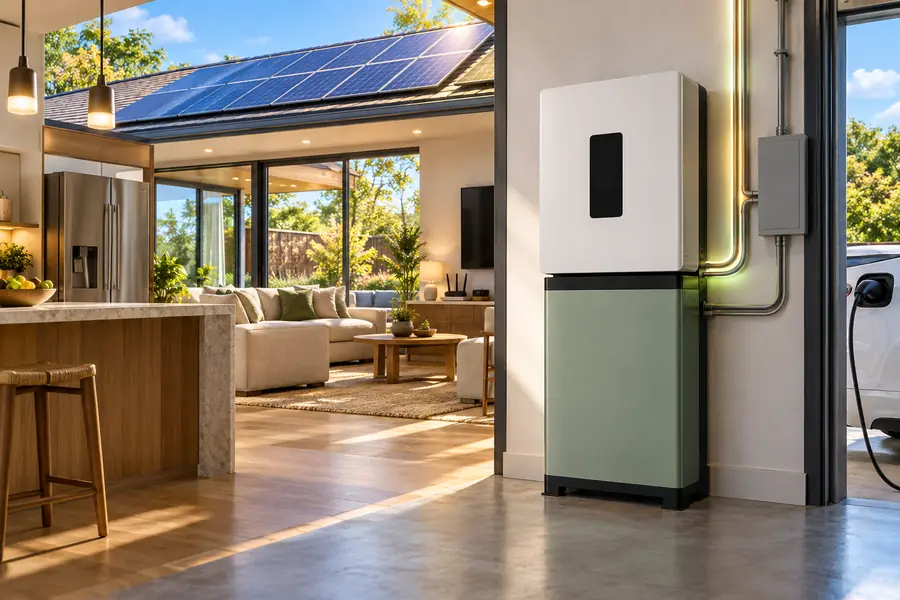
](https://voltcrave-battery.com/wp-content/uploads/2026/10/Why-Is-an-All-in-One-Solar-Battery-System-So-Efficient-and-Energy-Saving.webp)
Why Is an All-in-One Solar Battery System So Efficient and Energy-Saving?
Separate solar, inverter, battery, and control components can create extra conversions, wiring, communication complexity, and poorly coordinated energy flows that waste otherwise usable solar electricity.
For many homes, an all-in-one solar battery system can improve efficiency by integrating solar conversion, battery storage, power electronics, and energy management in one coordinated architecture. DC-coupled designs can avoid unnecessary AC/DC conversions, while smart controls prioritize direct solar use, battery charging, load shifting, and backup, reducing avoidable energy losses.
All-in-one solar systems improve efficiency through fewer conversions, integrated controls, smart scheduling, and increased solar self-consumption, reducing energy losses and electricity costs without generating more power.
How Does an All-in-One Solar Battery System Improve Efficiency?
Solar panels, batteries, inverters, and household appliances operate with different electrical requirements, so every additional conversion and interface can introduce some energy loss.
An all-in-one solar battery system can improve overall efficiency by coordinating the solar inverter, battery, BMS, energy-management software, and backup controls as one system. This can reduce unnecessary power conversions, simplify energy paths, improve component matching, and allow software to decide whether solar electricity should power loads, charge the battery, or be exported.
A conventional solar-plus-storage system may be assembled from several independent products.
The architecture could include:
solar panels,
a solar inverter,
a battery inverter,
a battery,
a BMS,
an energy meter,
a backup controller,
and separate monitoring systems.
Each device can work perfectly well.
However, the overall system still needs to coordinate all of them.
An integrated system can reduce some of this complexity.
Tesla, for example, describes Powerwall 3 as a fully integrated solar and battery system that converts energy from the solar array while storing excess production for self-consumption, load shifting, or off-grid operation.
This integration matters because the system can make energy decisions continuously.
During strong sunlight:
Solar → Home Loads
If solar generation exceeds household demand:
Solar → Battery
If the battery reaches its target state of charge:
Solar → Grid or Other Controlled Loads
After sunset:
Battery → Home
During an outage:
Solar + Battery → Backup Loads
The U.S. Department of Energy notes that solar-plus-storage systems allow solar energy to be stored for later use and can help balance electricity generation with demand. Properly configured advanced inverters also allow solar-plus-battery systems to operate independently from the grid during outages.
Integration Reduces System-Level Complexity
A well-designed all-in-one platform can combine functions that otherwise require separate equipment.
These may include:
PV conversion,
battery charging,
battery discharge,
energy monitoring,
backup control,
load management,
and communications.
That can reduce:
duplicate equipment,
longer wiring paths,
configuration conflicts,
and communication problems.
However, the biggest efficiency advantage usually does not come simply from having fewer boxes on the wall.
It comes from:
how electricity flows between those boxes.
The conversion architecture is therefore more important than the physical appearance of the system.
Why Does DC Coupling Reduce Solar Battery Energy Losses?
Solar panels and batteries naturally operate with DC electricity, while most household appliances and the utility grid use AC.
DC-coupled solar storage can be more efficient because solar electricity can charge the battery without first being converted from DC to AC and then back to DC. Avoiding unnecessary conversion stages reduces cumulative losses. However, actual system efficiency still depends on inverter design, battery efficiency, operating power, temperature, wiring, and control strategy.
Consider a simplified AC-coupled energy path.
Solar panels produce:
DC
The solar inverter converts it:
DC → AC
To store that electricity, the battery system may then convert it:
AC → DC
Later, when the battery supplies the home:
DC → AC
So solar energy stored in the battery may experience several conversion stages.
A DC-coupled design can instead use a path closer to:
Solar DC → Battery DC → Inverter → Home AC
That can eliminate an unnecessary AC-to-DC conversion during solar charging.
Tesla explicitly states that it strongly prefers DC-coupled solar with Powerwall 3 where feasible because DC coupling requires less equipment and provides higher efficiency than an AC-coupled configuration.
NREL uses the same underlying principle in its PV-plus-battery modeling. Its assumptions give coupled PV charging a higher round-trip efficiency than grid charging because the coupled configuration avoids additional AC/DC conversion losses.
What Does Round-Trip Efficiency Mean?
Round-trip efficiency, or RTE, compares the energy recovered from a battery with the energy originally used to charge it.
If:
10 kWh enters the storage process
and:
9 kWh returns
then the simplified round-trip efficiency is:
90%.
No real battery-storage system is 100% efficient.
DOE explains that some electricity is always lost during energy storage and retrieval because of conversion and storage processes.
Current products illustrate the range.
SolarEdge lists up to 94.5% round-trip efficiency for its 400V home battery using direct DC coupling, while its 48V architecture lists up to 95.4% under its specified direct-DC-coupled configuration.
Tesla lists Powerwall 3 at approximately:
97.5% Solar-to-Home/Grid efficiency
and:
89% Solar-to-Battery-to-Home/Grid round-trip efficiency
under its published conditions.
Enphase, using an AC-coupled architecture for IQ Battery 5P, discusses approximately 90% AC round-trip efficiency and emphasizes that efficiency numbers must be interpreted according to where measurements are taken.
That last point is extremely important.
A manufacturer may measure:
battery-cell efficiency,
DC battery efficiency,
AC battery efficiency,
or complete solar-to-battery-to-home efficiency.
Therefore:
94% RTE from one datasheet may not be directly comparable with 94% from another.
Always check the measurement boundary.
How Do Smart Controls Make an All-in-One Solar Battery System More Energy-Saving?
Reducing conversion loss is only part of the advantage. Intelligent control can influence when electricity is generated, stored, consumed, imported, or exported.
An integrated energy-management system can increase solar self-consumption by directing surplus PV into the battery, using stored energy when grid electricity is expensive, preserving backup reserve, and coordinating household demand with available solar production. These strategies may reduce grid purchases and electricity costs even when the battery itself does not become physically more efficient.
This distinction is important:
Energy Efficiency ≠ Electricity-Bill Savings
They are related, but they are not identical.
A battery can lose some energy during charging and discharging while still saving money.
Imagine solar electricity is available at noon when household consumption is low.
Without storage:
Excess Solar → Grid
Later in the evening:
Grid → Home
With storage:
Excess Solar → Battery → Evening Loads
Some energy is lost in the battery cycle.
But more locally generated solar electricity can be used by the household.
DOE explains that storage helps solar electricity be used at times different from when it was generated, improving the ability to match supply with demand.
Smart Energy Management Can Optimize Timing
An integrated system may monitor:
solar production,
household demand,
battery SOC,
electricity tariffs,
grid status,
and backup reserve.
Its controller can then determine when charging or discharging provides the greatest value.
For example, a home on a time-of-use electricity plan might experience:
Low Grid Price → Morning
High Solar Production → Midday
High Grid Price → Evening
An intelligent operating strategy might prioritize:
Midday Solar → Home
then:
Excess Midday Solar → Battery
then:
Evening Battery → Home
This reduces expensive evening grid purchases.
A conventional battery could perform the same task if correctly configured.
The all-in-one advantage is that the inverter, battery, meter, and energy-management software are designed to communicate within one coordinated platform.
Direct Solar Use Is Usually Better Than Storing Everything
One misconception is that the most energy-efficient system should send as much solar electricity as possible into the battery.
Usually, that is incorrect.
If the home needs electricity while solar is available, the most efficient route is often:
Solar → Home
rather than:
Solar → Battery → Home
because battery storage adds an additional charge-and-discharge cycle.
Tesla's published Powerwall 3 figures illustrate this difference: it lists 97.5% solar-to-home/grid efficiency versus 89% solar-to-battery-to-home/grid round-trip efficiency.
Therefore, intelligent control generally prioritizes direct solar consumption first when appropriate.
Storage is valuable because it moves energy through time.
It should not be assumed that routing electricity through a battery is always the most efficient physical pathway.
Load Shifting Can Create Financial Savings
An all-in-one system can also save money by deciding when to discharge.
For example:
Cheap electricity → Charge
Expensive electricity → Discharge
This strategy is known as:
time-of-use arbitrage or load shifting.
The battery may also preserve a minimum SOC for:
backup protection.
Therefore, the controller is balancing several objectives:
Efficiency + Savings + Backup + Battery Life
The best algorithm does not necessarily maximize only one of these.
When Is an All-in-One Solar Battery System Not More Efficient?
Integration can improve system design, but the term “all-in-one” is not itself an efficiency rating.
An all-in-one system is not automatically more efficient than a carefully engineered modular system. Poor inverter efficiency, excessive standby consumption, incorrect battery sizing, unnecessary cycling, high temperatures, weak solar production, or unsuitable operating settings can reduce its advantage. Efficiency should therefore be verified using complete energy paths and real manufacturer specifications.
There are several reasons this distinction matters.
An All-in-One Label Does Not Guarantee DC Coupling
Some integrated systems are:
DC-coupled.
Others are:
AC-coupled.
Both architectures can perform well.
Enphase's current documentation, for example, explains that its IQ Battery 5P uses an AC-coupled architecture while still achieving about 90% AC round-trip efficiency under its stated conditions.
Therefore:
All-in-One ≠ Automatically DC-Coupled
and:
AC-Coupled ≠ Automatically Inefficient.
AC coupling can be particularly attractive when adding storage to an existing solar installation because it may allow the original PV inverter to remain in place.
DC coupling can be especially attractive for:
new installations,
direct solar charging,
and minimizing conversion stages.
The best architecture depends on the project.
Oversizing the Battery Can Waste Money
A household using:
5 kWh each evening
does not automatically need:
30 kWh of battery capacity.
If most of the battery remains unused, the homeowner has paid for equipment that creates little additional value.
The correct system should balance:
solar production,
evening consumption,
backup duration,
and tariff structure.
Efficiency should therefore be considered together with:
battery utilization.
Battery Cycling Always Has Losses
If electricity can be used directly from solar, sending it through a battery unnecessarily creates additional loss.
Therefore, the ideal strategy is usually:
Direct Solar First
then:
Store Useful Surplus
rather than:
Cycle Everything Through the Battery.
Temperature and Standby Consumption Also Matter
Batteries and inverters consume some electricity to operate:
BMS electronics,
communications,
cooling equipment,
heaters,
fans,
and standby controls.
These losses can matter more when loads are very small.
A large system operating continuously at only a tiny fraction of rated output may not operate at its peak conversion efficiency.
This is why system sizing remains important even with highly integrated equipment.
A practical comparison is:
| Design Factor | Why It Can Save Energy |
|---|---|
| DC coupling | Avoids unnecessary conversion stages |
| Integrated inverter | Coordinates PV and battery power flow |
| EMS | Chooses when to charge, discharge, or export |
| Direct solar consumption | Avoids unnecessary battery cycling |
| Load shifting | Moves stored energy to higher-value periods |
| Solar charging | Increases use of locally generated electricity |
| Correct sizing | Reduces unused capacity and standby overhead |
| Modular expansion | Lets capacity grow with actual demand |
The key is not simply:
Integration
but:
well-designed integration.
My Insights: Why Is an All-in-One Solar Battery System So Efficient and Energy-Saving
Separate solar, battery, inverter, and control systems can create unnecessary conversions and poorly coordinated energy flows, reducing how effectively homeowners use their available solar electricity.
An all-in-one solar battery system can be efficient and energy-saving because it coordinates solar generation, battery storage, inverter operation, and energy management in one architecture. DC coupling can reduce unnecessary conversions, while intelligent controls prioritize direct solar consumption, surplus battery charging, load shifting, and backup reserves to improve overall energy utilization.
In my view, the biggest benefit is not simply placing the inverter and battery inside one enclosure. The real advantage comes from shortening and optimizing the complete energy path:
Solar → Home
when electricity is needed immediately,
Solar → Battery
when generation exceeds demand,
and:
Battery → Home
when solar production falls or grid electricity becomes more expensive.
DOE's guidance supports this core principle: energy storage allows solar electricity to be captured and used when generation and demand occur at different times.
DC integration can further improve that pathway by reducing repeated conversions. Current residential systems demonstrate round-trip efficiencies around the 90% range or above depending on architecture and measurement boundary, with some direct DC-coupled battery products publishing values above 94%.
The practical hierarchy is therefore:
Use Solar Directly When Possible → Store Useful Surplus → Discharge When Solar Is Unavailable or Electricity Is Expensive → Maintain Backup Reserve
That is what makes a well-designed all-in-one solar battery system genuinely energy-saving.
It does not generate extra energy.
It simply wastes less of the energy already available and uses that energy at more valuable times.
Conclusion
All-in-one solar battery systems save energy through fewer conversions, coordinated controls, direct solar use, smart storage, and load shifting—but good system design matters more than the label itself.
](https://voltcrave-battery.com/wp-content/uploads/2026/09/Electric-Battery-Storage-System-2026-Technology-Costs-Applications-768x512.webp)
](https://voltcrave-battery.com/wp-content/uploads/2026/09/What-Is-a-Power-Battery-768x512.webp)
](https://voltcrave-battery.com/wp-content/uploads/2026/10/High-Voltage-LiFePO4-Battery-The-Perfect-Balance-Between-Energy-Density-and-Safety-768x512.webp)







































