
](https://voltcrave-battery.com/wp-content/uploads/2026/10/What-Size-Solar-Battery-Is-Needed-to-Power-a-House.webp)
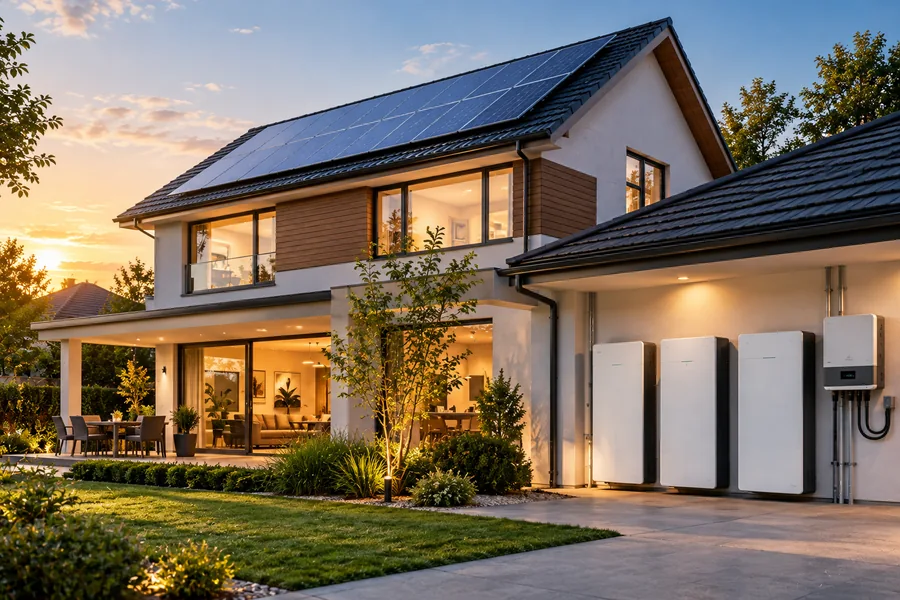
Choosing the wrong solar battery can leave a home without power during an outage. An undersized battery runs out quickly, while an oversized system increases installation costs.
Most homes need approximately 10–15 kWh of solar battery storage for essential backup loads, 20–30 kWh for broader household coverage, and 30–60 kWh or more for extended whole-home backup. The correct size depends on daily electricity consumption, peak power demand, backup duration, and available solar charging.
Residential battery sizing depends on both energy capacity and output power. Smaller systems cover essentials; larger batteries support whole-home backup, heavy loads, and longer outages.
How Much Solar Battery Capacity Does a Typical House Need?
Many homeowners assume that one solar battery can power an entire house. However, household electricity consumption varies significantly with home size, appliances, climate, and daily routines.
A typical residential solar battery system may provide 10–30 kWh of storage for backup power and daily solar energy use. Homes that require continuous air conditioning, electric heating, or extended backup may need 30–60 kWh or more. The ideal capacity depends on how much electricity the household consumes during the intended operating period.
Understanding Daily Household Electricity Consumption
The first step is to understand how much electricity a house actually uses.
According to the U.S. Energy Information Administration, the average American residential utility customer purchased approximately 865 kWh of electricity per month in 2024.
That equals approximately:
865 kWh ÷ 30 days = 28.8 kWh per day
However, this figure represents average electricity purchased from the grid. It does not necessarily equal the energy that a solar-powered home needs from its battery.
A household may use solar electricity directly during daylight hours and rely on stored electricity only after sunset.
For this reason, I prefer to calculate the energy required during the period when solar generation is unavailable or insufficient.
Recommended Solar Battery Capacity by Household Requirements
| Household Requirement | Estimated Battery Capacity |
|---|---|
| Essential appliances only | 5–10 kWh |
| Essential loads with longer backup | 10–15 kWh |
| Moderate household electricity use | 15–20 kWh |
| Broader household backup | 20–30 kWh |
| High-consumption whole-home backup | 30–60 kWh |
| Extended off-grid operation | 60+ kWh |
These figures are starting points for system planning, not guaranteed runtimes.
I would never determine battery capacity based only on the number of bedrooms or the floor area of a house.
Two houses with similar dimensions can have completely different electricity requirements.
For example, a home using gas for heating and cooking may require much less battery storage than a fully electrified home.
The battery system must also support the appliances that will operate simultaneously.
This is why energy capacity and power output must be evaluated separately.
How Do You Calculate the Right Solar Battery Size for Your Home?
Homeowners often estimate battery capacity from monthly electricity bills. This provides a useful starting point, but it does not account for backup duration, conversion losses, and peak electrical loads.
To calculate solar battery size, multiply the average electrical load by the required backup hours. Then divide the resulting energy requirement by the battery's usable discharge fraction and the estimated delivery efficiency. This calculation provides an initial capacity estimate that must be checked against inverter power, surge demand, and charging conditions.
Step 1: Calculate Your Daily Electricity Consumption
I start with the household's electricity bills or smart meter records.
For example, suppose a home consumes 900 kWh of electricity each month.
The average daily consumption would be:
900 kWh ÷ 30 days = 30 kWh per day
This does not mean the homeowner must automatically install a 30 kWh battery.
If solar panels supply electricity directly during daylight hours, the battery may only need to cover evening and nighttime demand.
A homeowner who needs emergency power for essential equipment may require even less energy.
Step 2: Determine Which Appliances Need Backup Power
I recommend making a list of essential electrical equipment.
The following table gives illustrative energy consumption estimates rather than fixed appliance ratings.
| Appliance | Example Average Power | Operating Time | Energy Use |
|---|---|---|---|
| Refrigerator | 100 W | 12 equivalent hours | 1.2 kWh |
| LED lighting | 100 W | 6 hours | 0.6 kWh |
| Wi-Fi and router | 20 W | 24 hours | 0.48 kWh |
| Television | 100 W | 4 hours | 0.4 kWh |
| Fans | 120 W | 8 hours | 0.96 kWh |
| Laptop and electronics | 80 W | 5 hours | 0.4 kWh |
| Total | 4.04 kWh |
The refrigerator estimate uses equivalent compressor-running hours. Actual power consumption depends on appliance efficiency, temperature, and operating conditions.
In this example, the listed appliances consume approximately 4.04 kWh per day.
Additional loads, such as water pumps, heating, cooking, or air conditioning, could increase the requirement substantially.
Step 3: Include Battery Discharge Limits and Energy Losses
A battery's rated capacity is not always equal to the amount of AC electricity available to the home.
Some capacity may be unavailable because of discharge limits, inverter conversion losses, reserve settings, and temperature conditions.
I use the following simplified formula for an initial calculation:
Battery Capacity (kWh) = Required AC Energy (kWh) ÷ (Usable Discharge Fraction × Delivery Efficiency)
Suppose a household needs 18 kWh of AC electricity during an outage.
Assume:
- Required AC energy: 18 kWh
- Usable discharge fraction: 90%
- Delivery efficiency: 90%
The required nominal battery capacity would be:
18 ÷ (0.90 × 0.90) = 22.2 kWh
I would therefore consider a system of approximately 25 kWh or more, subject to the household's desired contingency reserve.
These efficiency assumptions are illustrative. The final calculation should use the manufacturer's actual specifications.
Step 4: Check the Inverter Power Rating
Battery capacity is measured in kilowatt-hours (kWh), but inverter output is measured in kilowatts (kW).
A 20 kWh battery may contain enough stored energy to run several appliances for many hours.
However, if its inverter can deliver only 5 kW continuously, the system cannot support an 8 kW simultaneous load without another power source or suitable load management.
I always check both continuous output power and surge capability.
This is particularly important for air conditioners, refrigerators, pumps, and other motor-driven equipment.
How Long Can a 10 kWh, 20 kWh, or 30 kWh Solar Battery Power a House?
Battery manufacturers often describe storage capacity in kilowatt-hours. However, homeowners want to know how long that battery will actually keep their electricity running.
A 10 kWh battery could supply a constant 1 kW household load for approximately nine hours, assuming 90% of its rated energy reaches the appliances. A 20 kWh battery could provide about 18 hours, while a 30 kWh battery could provide about 27 hours under the same conditions. Actual runtime depends on appliance usage, discharge limits, and system efficiency.
Estimated Solar Battery Runtime
The table below assumes 90% of the rated battery capacity becomes available as AC energy.
| Battery Size | 0.5 kW Load | 1.5 kW Load | 3 kW Load |
|---|---|---|---|
| 10 kWh | 18 hours | 6 hours | 3 hours |
| 15 kWh | 27 hours | 9 hours | 4.5 hours |
| 20 kWh | 36 hours | 12 hours | 6 hours |
| 30 kWh | 54 hours | 18 hours | 9 hours |
| 40 kWh | 72 hours | 24 hours | 12 hours |
These are simplified theoretical runtimes with a constant load and no solar recharging. They do not include additional reserve requirements or all potential system losses.
Can a 10 kWh Solar Battery Power a Whole House?
A 10 kWh battery can support many essential household appliances.
For example, it may provide electricity for refrigeration, lighting, internet access, television, and selected electrical outlets.
However, large air conditioning systems, electric water heaters, cooking equipment, and EV chargers can consume substantial amounts of energy.
If several high-power appliances operate together, a 10 kWh battery may discharge within a few hours.
I generally consider this capacity more suitable for essential backup circuits than unrestricted whole-home operation.
Is a 20 kWh Battery Enough for a House?
A 20 kWh battery offers greater flexibility.
It may support more appliances, longer overnight operation, or additional energy use during an outage.
For a home that consumes approximately 15 kWh between sunset and sunrise, a suitably configured 20 kWh system may provide enough stored energy to cover that period.
The actual result depends on usable capacity, system losses, and the power demands of connected appliances.
I also consider future electricity consumption.
If a homeowner plans to install an electric vehicle charger, heat pump, or additional air conditioning equipment, a modular battery system may provide more flexibility.
Can a 30 kWh Battery Run a House for 24 Hours?
A 30 kWh battery does not guarantee 24 hours of whole-home operation.
If the house consumes an average of 1 kW, a system delivering 27 kWh of usable AC energy could theoretically operate for approximately 27 hours.
If average demand increases to 3 kW, the same system would provide approximately nine hours.
The difference is significant.
I recommend using actual household load data instead of relying on advertised battery capacity alone.
Homes with high heating or cooling requirements may need additional batteries, solar generation, or another backup power source.
What Factors Should You Consider Before Choosing a Home Solar Battery?
Battery capacity is only one part of residential energy storage design. A poorly matched battery, inverter, or solar array can reduce system performance and increase ownership costs.
When selecting a home solar battery, I evaluate usable storage capacity, continuous output power, battery chemistry, solar inverter compatibility, charging performance, expected lifespan, and installation safety. I also consider whether the homeowner wants emergency backup, daily energy savings, or off-grid independence, because each objective requires a different system design.
Battery Chemistry and Cycle Life
Lithium iron phosphate (LiFePO4 or LFP) batteries are widely used in residential energy storage systems.
They are valued for their cycle-life potential, thermal stability, and suitability for repeated charging and discharging.
Other lithium-ion chemistries are also used in residential applications.
I do not select batteries based on chemistry alone.
I also review the manufacturer's cycle-life test conditions, warranty terms, allowable operating temperatures, usable capacity, and battery management system.
Solar Panel and Inverter Compatibility
A solar battery must be compatible with the electrical architecture of the home.
For new installations, a hybrid inverter may integrate solar generation and battery operation into one coordinated system.
Existing rooftop solar installations may use AC-coupled storage or other compatible retrofit arrangements.
I check the battery voltage range, supported communication protocols, inverter charging limits, and backup operating functions.
A grid-connected solar system does not automatically continue operating during a power outage.
It needs compatible equipment that can safely isolate the home from the utility grid and support backup operation.
Solar Charging and Weather Conditions
Solar generation determines how much energy can be replenished during daylight hours.
For example, a 6 kW solar array receiving four equivalent peak sun hours could theoretically produce:
6 kW × 4 hours = 24 kWh
Actual delivered energy will be lower after losses and may vary considerably with weather, season, shading, and temperature.
A battery cannot provide indefinite backup power if the available solar generation is consistently lower than household consumption.
For off-grid applications, I place particular importance on seasonal solar production and the number of consecutive days with limited sunlight.
Installation Safety and Future Expansion
Home energy storage installations must satisfy applicable electrical, building, and fire safety requirements.
Depending on the market and installation, relevant standards may include UL 9540 for energy storage systems and UL 1973 for stationary battery applications.
I also evaluate the following factors:
| Selection Factor | Main Consideration |
|---|---|
| Usable capacity | How much energy can actually be delivered |
| Continuous output | Whether the inverter supports normal appliance loads |
| Surge capability | Whether motors and compressors can start |
| Battery chemistry | Safety characteristics and service life |
| Charging power | How quickly the battery can recharge |
| Scalability | Whether additional batteries can be connected |
| Warranty | Coverage period and retained capacity conditions |
| Certifications | Compliance with applicable market requirements |
| Environmental protection | Suitable indoor or outdoor installation conditions |
I prefer a properly sized system with verified compatibility over a larger battery installation that has not been engineered for the home's electrical requirements.
My Insights: What Size Solar Battery Is Needed to Power a House
I believe the right solar battery size should be determined by how a household uses electricity, not simply by its total monthly consumption. For many homes, a 10–15 kWh battery can provide valuable essential backup, while 20–30 kWh offers more flexibility. Larger systems become more important when continuous heating, cooling, or extended off-grid power is required.
I Focus on Backup Requirements Before Battery Capacity
The first question I ask is whether the homeowner wants to power essential appliances or the entire house.
These are two different design objectives.
Essential backup focuses on refrigeration, lighting, communication equipment, and other important circuits.
Whole-home backup may involve air conditioning, electric cooking, water heating, and other high-power loads.
The second option often requires much greater battery capacity and inverter output.
I believe this distinction prevents many unnecessary sizing mistakes.
Reducing Electricity Consumption Can Reduce Battery Costs
One important insight is that energy efficiency can have a direct effect on battery requirements.
A household that reduces its electrical demand during an outage may operate for significantly longer on the same battery system.
For example, reducing average demand from 2 kW to 1 kW approximately doubles the operating time when the available battery energy remains unchanged.
Practical measures include using efficient lighting, limiting unnecessary electrical equipment, and managing heating and cooling demand.
Research on residential solar-plus-storage resilience has also shown that home efficiency and flexible appliance operation can substantially influence storage requirements.
I therefore consider energy management an important part of battery sizing.
Modular Battery Systems Offer Greater Flexibility
I also see value in modular residential storage systems.
A homeowner may begin with enough capacity for essential backup and expand the system as electricity demand increases.
For example, additional storage may become useful after installing a heat pump or adding more household electrical equipment.
Modular systems can simplify this approach when the battery architecture, inverter limits, and manufacturer specifications support expansion.
However, not all batteries or inverters support unrestricted parallel installation.
I always verify expansion limits before recommending future upgrades.
Battery Capacity and Solar Generation Must Work Together
A large battery without enough solar charging capacity may not provide the expected energy independence.
Likewise, a large solar array with very limited battery storage may produce excess daytime electricity without providing sufficient nighttime backup.
The objective is to balance generation, storage, and consumption.
I evaluate the system through four connected factors:
Daily Electricity Use → Required Battery Capacity → Inverter Power → Available Solar Charging
This approach helps prevent both insufficient capacity and unnecessary equipment investment.
Ultimately, I believe the best residential solar battery is not necessarily the largest available system. It is the system that matches the household's actual electricity demand, backup expectations, safety requirements, and future energy plans.
Conclusion
Most homes need 10–30 kWh for common backup requirements, while extended whole-home operation may require 30–60 kWh or more, depending on electrical demand and solar charging.
](https://voltcrave-battery.com/wp-content/uploads/2026/09/The-Complete-Guide-to-Solar-PV-System-with-Battery-Storage-in-2026-Benefits-Costs-and-How-It-Works-768x512.webp)
](https://voltcrave-battery.com/wp-content/uploads/2026/08/How-Much-Does-a-1-MW-BESS-Cost-768x512.webp)
](https://voltcrave-battery.com/wp-content/uploads/2026/08/What-Is-a-Simple-Definition-of-a-Solar-Panel-768x512.webp)







































