
](https://voltcrave-battery.com/wp-content/uploads/2026/10/What-Is-the-Best-Small-Battery-Backup-for-a-Home.webp)
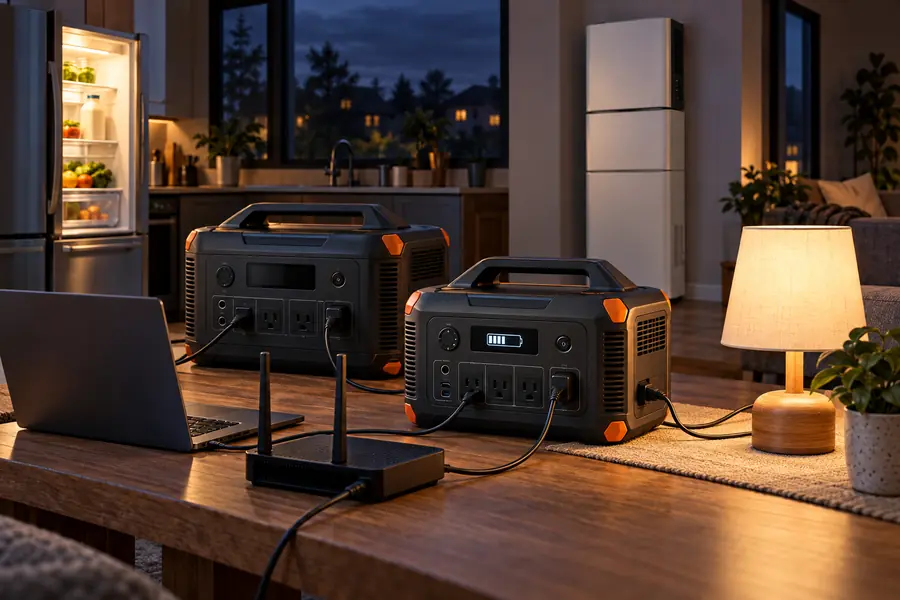
Large whole-house batteries can be expensive and unnecessary when a homeowner only needs refrigeration, internet, lighting, computers, and other essential devices during an outage.
For most small home-backup needs, a 1–2 kWh LFP portable power station with roughly 1,500–2,000W output is the best practical choice. If automatic circuit-level backup is required, a modular 5 kWh fixed home battery is better. The right choice depends mainly on load power, required runtime, portability, and installation needs.
A 1 kWh battery suits essential loads, 2 kWh extends runtime, and 5 kWh fixed storage enables automatic backup; prioritize critical devices over whole-home power.
What Size Battery Backup Is Best for a Small Home Backup System?
Battery size should be determined by the loads you actually want to protect, not by the square footage of the house.
For refrigerators, routers, lights, laptops, phones, CPAP equipment, and selected electronics, roughly 1–2 kWh is often the most practical small-backup range. Homeowners wanting automatic backup through household circuits should consider a fixed system around 5 kWh or larger, depending on continuous power and outage-duration requirements.
A 1 kWh battery is small enough to:
carry,
store in a closet,
move between rooms,
take camping,
or use during an emergency.
Modern products in this class can also deliver substantial AC power.
For example, the Anker SOLIX C1000 Gen 2 combines:
1,024Wh capacity
with:
2,000W continuous AC output
and:
3,000W peak output.
It weighs about:
24.9 lb
and provides a 10 ms UPS transfer function. Anker also rates the battery for 4,000 cycles before retaining at least 80% capacity.
EcoFlow's DELTA 3 Plus takes a similar approach with:
1,024Wh
1,800W AC output
3,600W surge
and approximately:
27.6 lb
of weight.
It uses LFP cells and supports expansion up to approximately 5 kWh with compatible extra batteries.
These numbers illustrate why the 1 kWh class is useful.
It is large enough to operate many essential household devices while remaining reasonably portable.
Why 1 kWh Works Well for Essential Loads
Suppose your outage loads average:
100W.
A 1,024Wh battery theoretically provides:
1,024Wh ÷ 100W
= 10.24 hours
before accounting for inverter losses, standby consumption, temperature, and operating reserve.
At:
300W
the theoretical figure becomes:
1,024 ÷ 300
≈ 3.4 hours.
At:
800W
it falls to roughly:
1.3 hours.
This leads to the most important sizing principle:
Battery Capacity Does Not Determine Runtime by Itself.
Runtime depends on:
Battery Wh ÷ Average Load W.
That is why a small battery can provide excellent overnight backup for a router and several lights but very short backup for electric heating or a large cooking appliance.
When 5 kWh Is More Appropriate
A homeowner wanting a permanently installed small battery should look at a different product category.
The Enphase IQ Battery 5P provides:
5.0 kWh usable energy
and:
3.84 kW continuous output.
It also provides short-duration peak power and can deliver backup when installed with the appropriate Enphase system controller. Enphase currently supports it with a 15-year limited warranty subject to applicable warranty terms.
This makes 5 kWh a more realistic starting point when the battery must support actual household circuits automatically instead of serving as a portable power source.
Which Small Battery Backup Is Best for Home Use in 2026?
There is no single winner because compact batteries optimize different combinations of power, weight, solar charging, portability, and expandability.
For a compact 1 kWh home-emergency battery, the Anker SOLIX C1000 Gen 2 is one of the strongest choices because it combines 1,024Wh with 2,000W output in a roughly 25-pound package. EcoFlow DELTA 3 Plus is especially attractive when solar input and expansion matter, while BLUETTI and Jackery provide compelling alternatives.
Anker SOLIX C1000 Gen 2: Strong Small All-Around Backup
The C1000 Gen 2 has a particularly strong power-to-size balance.
Its current official specifications include:
| Specification | Anker C1000 Gen 2 |
|---|---|
| Capacity | 1,024Wh |
| Continuous AC output | 2,000W |
| Peak output | 3,000W |
| Weight | 24.9 lb |
| Solar input | Up to 600W |
| UPS transfer | 10 ms |
| Battery cycling | 4,000 cycles to ≥80% |
| Fast AC recharge | About 49 minutes |
For small-home backup, that combination is useful because 2,000W can operate many ordinary appliances without moving into a much heavier 2–4 kWh battery.
EcoFlow DELTA 3 Plus: Better for Solar and Expansion
The DELTA 3 Plus also stores:
1,024Wh
and provides:
1,800W
of rated AC output.
Its major advantages are solar charging and expansion.
EcoFlow specifies two solar inputs supporting up to:
500W each
for up to:
1,000W combined solar input.
It can also work with compatible expansion batteries and scale toward approximately:
5 kWh.
Therefore:
Anker → Excellent compact power
while:
EcoFlow → Excellent solar and expansion flexibility.
BLUETTI Elite 100 V2: Compact 2026 Alternative
BLUETTI's Elite 100 V2 is another strong current option.
It provides:
1,024Wh
1,800W AC output
and approximately:
25.3 lb
of weight according to its documentation.
It also supports up to:
1,000W solar input
and a UPS switchover of no more than:
10 ms.
BLUETTI rates the LFP battery at more than 4,000 cycles in its current product information.
This makes it particularly competitive for buyers wanting:
compact size,
high solar input,
and UPS-style operation.
Jackery Explorer 1000 v2: Simple and Lightweight
Jackery's Explorer 1000 v2 provides:
1,070Wh
and:
1,500W output.
Jackery markets it as a relatively lightweight compact system and currently lists it with a multi-year warranty arrangement.
It offers less AC output than the Anker but remains attractive for lighter everyday emergency use.
A simplified comparison is:
| Product | Capacity | Output | Best Use |
|---|---|---|---|
| Anker C1000 Gen 2 | 1,024Wh | 2,000W | Compact high-power backup |
| EcoFlow DELTA 3 Plus | 1,024Wh | 1,800W | Solar + expansion |
| BLUETTI Elite 100 V2 | 1,024Wh | 1,800W | Solar + compact backup |
| Jackery Explorer 1000 v2 | 1,070Wh | 1,500W | Simple portable backup |
| Enphase IQ Battery 5P | 5,000Wh | 3,840W | Fixed automatic backup |
The Enphase is not directly comparable with portable units because it is a permanently installed residential ESS.
That distinction is important.
How Long Will a Small Home Battery Backup Last?
Runtime depends far more on household load than on the battery's marketing category.
A 1 kWh battery may run a router and lights for many hours, a refrigerator plus electronics for several hours, or a high-power heating or cooking appliance for a very short period. To estimate backup duration, divide usable battery energy by the average power demand of the connected devices.
A useful approximate formula is:
Runtime ≈ Usable Wh ÷ Average Watts
Imagine the following simplified loads:
| Device Group | Approximate Average Load | 1 kWh Theoretical Runtime |
|---|---|---|
| Router + phones + LED lights | 50W | ~20 hours |
| Small electronics setup | 100W | ~10 hours |
| Refrigerator average + router | 200W | ~5 hours |
| Refrigerator + electronics + lights | 300W | ~3.3 hours |
| Larger appliance load | 1,000W | ~1 hour |
These are mathematical illustrations rather than guaranteed appliance runtimes.
Actual battery runtime is lower because of:
DC-to-AC conversion losses,
battery reserve,
standby consumption,
temperature,
load cycling,
and battery condition.
Power Output Matters Too
A 1 kWh battery might store enough energy for a device but still fail to operate it if the inverter cannot provide sufficient power.
This is the difference between:
Wh = Energy
and:
W = Power.
A 1,024Wh / 2,000W battery can theoretically support a 1,500W appliance.
A 1,024Wh / 500W battery cannot, even though the two batteries store the same energy.
Motor-driven appliances add another challenge because they may need much more power while starting.
Examples include:
refrigerators,
freezers,
pumps,
and air conditioners.
Therefore, I would check both:
continuous output
and:
surge output
before buying.
Critical Loads Are the Key
The U.S. Department of Energy notes that batteries can provide backup power during outages and can store solar energy for later use.
The most efficient strategy for a small battery is therefore to reserve it for:
refrigeration,
communications,
lighting,
medical equipment where compatible,
laptops,
phones,
and selected outlets.
A 1 kWh power station is generally not intended to provide normal whole-house consumption.
Trying to run:
electric resistance heating,
large water heaters,
electric dryers,
EV charging,
and central HVAC
can consume small-battery capacity extremely quickly.
What Should You Check Before Choosing a Small Home Battery Backup?
Battery capacity is only one part of a safe and useful backup system.
Before buying, compare usable Wh, continuous watts, surge power, LFP cycle life, charging speed, solar input, UPS transfer behavior, output ports, noise, warranty, and expansion options. For permanently installed residential storage, verify appropriate system certification and professional installation rather than treating a portable power station as a substitute for a listed stationary ESS.
LFP Is a Strong Choice for Small Backup
Most current high-quality compact power stations now use:
LiFePO4 / LFP
cells.
That includes the Anker C1000 Gen 2, EcoFlow DELTA 3 Plus, and BLUETTI Elite 100 V2 product families discussed above.
LFP is attractive because it offers:
strong cycle performance,
useful power capability,
and favorable thermal characteristics.
However:
LFP Chemistry ≠ Complete System Safety.
Battery safety also depends on:
BMS design,
electrical protection,
charging controls,
enclosure,
thermal management,
and manufacturing quality.
Portable and Permanent Systems Are Different
A portable power station should not automatically be hardwired into a home simply because it has enough watts.
UL notes that portable power packs are not automatically certified to the same requirements as stationary residential energy-storage systems. UL 9540 is the relevant complete-system standard referenced by residential ESS installation codes.
For permanently installed storage, local:
electrical,
fire,
building,
and permitting
requirements also matter.
This is why a 5 kWh wall battery and a 1 kWh portable station should be viewed as different products even if both contain LFP cells.
Solar Can Extend Small-Battery Runtime
Solar can significantly improve the usefulness of a small battery.
DOE explains that battery storage can save solar production for later and that properly configured solar-plus-storage can provide power during outages. Solar panels alone generally cannot provide normal outage backup unless the system has the appropriate inverter and storage architecture.
For a portable system, the concept is simple:
Solar → Loads + Battery Recharge
A 1 kWh station that can be meaningfully recharged each day may provide much more practical resilience than a larger battery with no available recharge source.
Small Batteries and Generators Solve Different Problems
A small battery is ideal for:
silent indoor operation,
instant electricity,
electronics,
and short outages.
A generator is more appropriate when a household needs large amounts of electricity for several days and fuel is available.
However, portable generator safety is critical.
CPSC says portable generators should never operate inside homes or garages and recommends using them outdoors at least 20 feet from the home with the exhaust directed away from buildings because of carbon-monoxide risk.
So for small indoor backup:
Battery power is usually far simpler.
My Insights: What Is the Best Small Battery Backup for a Home
Small outages can still spoil food, disconnect Wi-Fi, and interrupt essential devices, while oversized backup systems add unnecessary cost, weight, and installation complexity.
For most households, a 1–2 kWh LFP portable power station with 1,500–2,000W continuous output is the best small battery backup. It can support refrigerators, routers, lights, computers, and other essentials. Homeowners needing automatic circuit-level backup should instead consider a professionally installed modular battery around 5 kWh or larger for resilience.
My First Insight: 1 kWh Is the Sweet Spot for Truly Portable Home Backup
Below roughly 500Wh, emergency runtime can become restrictive.
Above 2 kWh, weight rises quickly.
The current 1 kWh class can combine approximately:
25 lb weight
with:
1,500–2,000W output.
That makes it practical for both household emergencies and portable use.
My Second Insight: I Would Choose Power Before Extra Capacity
For a small backup system, a 1 kWh battery capable of:
2,000W
can be more useful than a larger battery with a weak inverter.
A refrigerator, microwave, coffee maker, or other appliance can create significant instantaneous demand.
Therefore:
Check W first, then Wh.
My Third Insight: Solar Input Is More Valuable During Long Outages
Once the battery is empty, its original capacity stops mattering until it can recharge.
A compact system with:
600–1,000W solar-input capability
can therefore become much more useful during extended grid failures if suitable solar panels and sunlight are available.
My Fourth Insight: Small Backup Is Best When the Load Is Small Too
The best way to extend runtime is often not buying another battery.
It is reducing demand.
Keeping:
refrigeration,
internet,
lighting,
phones,
and critical electronics
running requires far less energy than maintaining normal whole-house consumption.
My Fifth Insight: What Is the Best Small Battery Backup for a Home?
For most users, a 1 kWh-class LFP portable power station is the best small home battery backup because it balances portability, output, runtime, safety-oriented battery chemistry, and cost. The Anker SOLIX C1000 Gen 2 is particularly strong when compact size and 2,000W output matter, while EcoFlow DELTA 3 Plus is better suited to users prioritizing solar charging and expansion. For automatic circuit-level backup, a modular 5 kWh residential ESS such as the Enphase IQ Battery 5P is the more appropriate category.
The practical decision is:
| Need | Best Small Backup Format |
|---|---|
| Router, phones, lights | 500Wh–1kWh portable battery |
| Refrigerator + electronics | ~1kWh LFP station |
| More appliances / longer outage | 1–2kWh portable battery |
| Automatic household circuits | ~5kWh fixed battery |
| Solar emergency backup | High-solar-input portable or fixed ESS |
| Multi-day high-energy backup | Larger battery, solar, or generator hybrid |
The most useful question is therefore not:
“What is the smallest battery I can buy?”
It is:
“What critical loads must remain powered, how many watts do they require, and how many hours must they run?”
That information determines the correct small backup far more reliably than battery capacity alone.
Conclusion
For essential household loads, a 1–2 kWh LFP portable station is usually the best small backup. Choose a 5 kWh fixed ESS when automatic circuit-level operation is required.

](https://voltcrave-battery.com/wp-content/uploads/2026/08/What-Is-the-Overview-of-BESS-768x512.webp)
](https://voltcrave-battery.com/wp-content/uploads/2026/08/Why-Are-Overseas-Energy-Storage-Projects-Difficult-to-Deploy-768x512.webp)