
](https://voltcrave-battery.com/wp-content/uploads/2026/08/What-Are-Solar-Panels-in-Simple-Words.webp)
Solar panels may look complicated because they contain many cells, wires, glass layers, and electrical components. But their basic job is actually very simple.
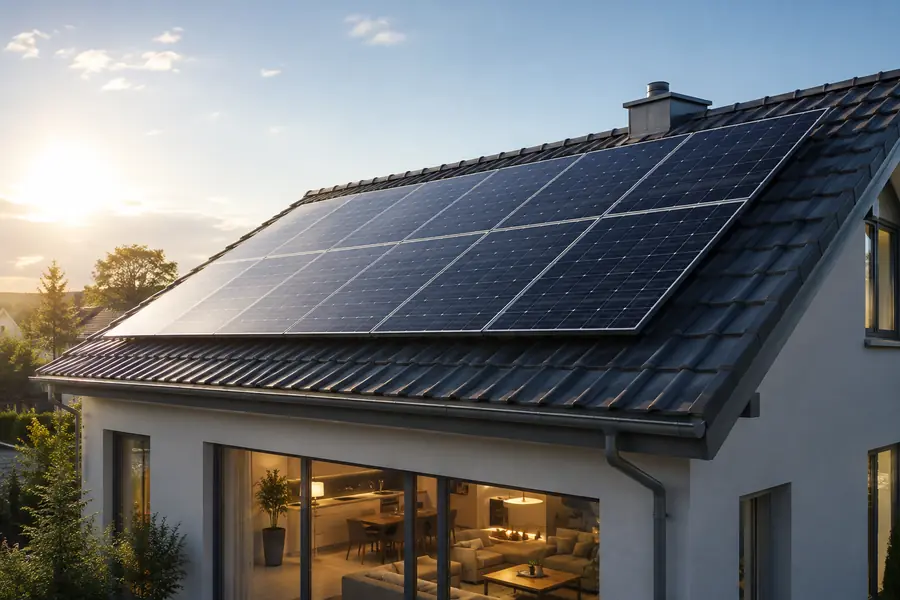
In simple words, solar panels are devices that take energy from sunlight and turn it into electricity. They are made from many small solar cells connected together. When sunlight hits these cells, they produce direct-current electricity, which can then be used by electrical equipment or converted by an inverter for use in a home.
I like to think of a solar panel as an electricity-making surface powered by sunlight. It does not store electricity like a battery, and it does not need fuel like a conventional generator. It simply converts light energy into electrical energy whenever suitable sunlight reaches its photovoltaic cells.
What Is a Solar Panel?
The technical term for the familiar rooftop solar panel is a photovoltaic module, often shortened to a PV module.
A solar panel is a group of photovoltaic cells connected together inside a protective structure. Each cell converts sunlight directly into electrical energy. Connecting many cells increases the useful power output, and multiple panels can then be connected together to create a larger solar array capable of supplying electricity to a home, business, or power plant.
Solar Cells Are the Small Building Blocks
A single solar cell is quite small.
DOE explains that an individual photovoltaic cell typically produces only a small amount of power. Manufacturers therefore connect cells together to form larger units known as modules or panels. Several panels can then be connected to form an array.
The basic structure is:
Solar cell
↓
Solar panel / module
↓
Solar array
↓
Complete solar power system
This distinction helps me avoid mixing up several related terms.
| Term | Simple Meaning |
|---|---|
| Solar cell | Small device that converts light into electricity |
| Solar panel | Group of connected solar cells |
| Solar array | Group of connected solar panels |
| Solar system | Panels plus inverter, wiring, mounting, protection, and other equipment |
A solar panel is therefore not the entire solar system.
It is the part that actually captures sunlight and creates DC electricity.
How Do Solar Panels Work in Simple Words?
Solar panels work through the photovoltaic effect, but I do not need advanced semiconductor physics to understand the basic idea.
When sunlight reaches a solar cell, the semiconductor material inside the cell absorbs some of the light's energy. That energy allows electrically charged particles called electrons to move. The cell collects this movement as electrical current, creating DC electricity that can be sent through wires to an inverter, battery, or other electrical equipment.
Sunlight Carries Energy
Sunlight contains tiny packets of energy called photons.
When photons reach a solar cell, several things can happen.
Some light may:
- Reflect away
- Pass through
- Be absorbed
The absorbed light is the part that can contribute to electricity generation.
EIA explains that photovoltaic cells contain semiconductor material. When enough solar energy is absorbed, electrons become energized and can move through an electrical circuit.
A simplified process looks like this:
Sunlight
↓
Solar cell absorbs light
↓
Electrons begin moving
↓
Electrical current is created
↓
Electricity flows through wires
That is the basic photovoltaic process.
The Panel Produces DC Electricity
Solar cells naturally produce:
DC electricity
or:
direct current
But most homes and utility grids use:
AC electricity
or:
alternating current.
That means another device is usually required.
The electricity path becomes:
Sunlight
↓
Solar panels
↓
DC electricity
↓
Inverter
↓
AC electricity
↓
Home appliances
DOE and EIA both explain that inverters are used to convert the DC electricity produced by photovoltaic modules into AC electricity suitable for ordinary electrical systems.
The inverter is therefore an essential part of most home solar systems, but it is not part of the solar panel itself.
What Are Solar Panels Made Of?
A solar panel may appear to be mostly glass, but the electricity-producing components are the photovoltaic cells beneath that protective surface.
Most conventional solar panels contain many semiconductor solar cells protected by glass and other durable materials. Silicon is the most commonly used semiconductor in solar cells. The finished panel also contains electrical conductors and protective layers that allow the fragile cells to operate outdoors for many years.
Silicon Is Commonly Used
DOE identifies silicon as the most widely used semiconductor material in photovoltaic cells.
A simplified solar panel may contain:
- Front glass
- Encapsulating material
- Solar cells
- Electrical conductors
- Protective rear layer or rear glass
- Metal frame
- Junction box
- Cables
The solar cells do the electricity conversion.
The other materials mainly help:
- Protect the cells
- Connect them electrically
- Keep moisture away
- Support the panel mechanically
- Allow outdoor installation
This is why a finished solar panel can remain outdoors through sunlight, wind, rain, heat, and cold rather than behaving like an exposed semiconductor wafer.
Do Solar Panels Store Electricity?
This is one of the most common misunderstandings about solar energy.
No. Solar panels generate electricity, but they normally do not store it. A solar battery is the component that stores electricity for later use. Without a battery, solar electricity is generally used immediately by connected loads or sent elsewhere through the electrical system while the panels are producing power.
Panel and Battery Have Different Jobs
I separate the two functions like this:
Solar panel = generates electricity
Solar battery = stores electricity
For example:
During sunny hours:
Sunlight → solar panels → electricity
If the home is using electricity:
Solar electricity → home
If a battery is installed:
Extra solar electricity → battery
Later at night:
Battery → home
EIA notes that DC electricity from photovoltaic cells can be used to charge batteries.
This makes solar panels and batteries complementary technologies.
But one is not a substitute for the other.
A Solar Panel Cannot Make Electricity Normally at Night
Because photovoltaic panels depend on light, normal solar production stops when sunlight is unavailable.
That is why a home that needs solar electricity after sunset may rely on:
- Battery storage
- Utility grid power
- Another energy source
The battery does not make the panel generate at night.
Instead, it stores electricity that was generated earlier.
What Is the Difference Between a Solar Cell and a Solar Panel?
The two terms are related, but they are not interchangeable.
A solar cell is the individual semiconductor device that converts sunlight into electricity. A solar panel is a larger product made by electrically connecting many solar cells and protecting them inside a durable module. Panels can then be connected together to form a solar array.
Think of Cells as Building Blocks
A useful analogy is:
Cell = one building block
Panel = collection of building blocks
Array = collection of panels
DOE describes this modular structure clearly: individual photovoltaic cells are connected into modules or panels, and panels can then be connected into arrays.
This modular structure is one reason solar systems can be used at very different scales.
A few small cells can power:
- Calculators
- Sensors
- Small electronics
Several panels can help power:
- A house
- A shop
- A farm
Thousands of panels can form:
- Utility-scale solar farms
The basic photovoltaic principle remains the same.
The scale changes.
What Is the Difference Between a Solar Panel and a Solar System?
People often call the complete rooftop installation “solar panels,” but technically the panels are only one part of the system.
A solar panel generates DC electricity from sunlight. A complete solar power system includes the panels plus other equipment needed to make that electricity useful and safe, such as an inverter, mounting structure, wiring, electrical protection, monitoring equipment, and sometimes battery storage.
A Typical Home Solar System
A simplified system may look like:
Solar panels
↓
DC wiring
↓
Inverter
↓
AC electrical panel
↓
Home appliances
If battery storage is added:
Solar panels
↓
Inverter / battery power electronics
↓
Battery
↓
Home / grid
The exact architecture depends on whether the storage system is AC-coupled, DC-coupled, hybrid, or designed differently.
But the basic point remains:
Panel ≠ complete solar system.
Mounting Is Also Part of the System
DOE notes that complete photovoltaic systems include mounting structures that position panels toward the sun along with equipment that converts DC electricity to AC.
That means even though the panel receives most of the visual attention, other components are essential for:
- Electrical safety
- Energy conversion
- Structural support
- Monitoring
- Grid connection
This distinction becomes important when comparing solar-system prices because the cost of the panels alone is not the same as the cost of an installed solar system.
Do Solar Panels Need Direct Sunlight?
Solar panels work best when they receive strong sunlight, but they do not necessarily stop producing electricity whenever conditions become cloudy.
Solar panels can still generate electricity from available light on cloudy days, although output usually decreases because less useful solar energy reaches the cells. Their electricity production changes with sunlight intensity, orientation, shading, temperature, location, time of day, season, and panel characteristics.
More Useful Sunlight Usually Means More Production
EIA explains that solar electricity production depends strongly on the amount of available sunlight, which changes with:
- Time of day
- Location
- Season
- Weather
DOE also notes that photovoltaic output depends on characteristics of the incoming light and the performance of the solar cell.
So I do not assume that a:
400 W panel
will continuously produce:
400 W
all day.
The rated power is measured under defined test conditions.
Real-world output varies.
Shade Can Matter
If trees, buildings, chimneys, or other objects block sunlight, the affected panel or cells may produce less power.
This is why good solar design considers:
- Roof orientation
- Tilt
- Shading
- Local climate
- Available roof area
The number of solar panels a house needs therefore cannot be calculated correctly from house size alone.
Actual electricity consumption and local solar conditions matter much more.
What Can Solar Panels Power?
Solar panels can power anything from tiny electronics to entire buildings when enough photovoltaic capacity and supporting equipment are installed.
Solar panels can supply electricity for homes, businesses, farms, remote equipment, small electronic devices, and utility-scale power systems. The amount they can power depends on how much electricity the panels produce, how many panels are installed, and whether supporting equipment such as inverters and batteries is included.
Small and Large Systems Use the Same Basic Idea
EIA explains that photovoltaic cells can be used in very small devices, while groups of panels can form arrays large enough to supply houses or large solar power plants.
A few examples:
| Solar Application | Typical Purpose |
|---|---|
| Small solar cell | Calculator or sensor |
| Small panel | Lights or battery charging |
| Several panels | Cabin or RV |
| Residential array | House |
| Commercial array | Business facility |
| Large solar farm | Utility electricity generation |
The principle is always:
light → photovoltaic cells → electricity
Only the scale changes.
Are Solar Panels the Same as Solar Thermal Panels?
No. Both use energy from the sun, but they produce different forms of useful energy.
Photovoltaic solar panels generate electricity directly from sunlight. Solar thermal collectors capture solar energy mainly as heat, which can be used for applications such as heating water. Therefore, “solar panel” usually means a photovoltaic electricity-generating panel in modern residential solar discussions, but solar thermal technology is a different system.
PV Means Electricity
Photovoltaic technology:
Sunlight → electricity
Solar thermal technology:
Sunlight → heat
EIA distinguishes photovoltaic systems from solar thermal systems, which can be used to heat water, air, buildings, swimming pools, or fluids in thermal power systems.
This distinction matters when someone says:
“I want solar panels for my house.”
They may mean:
- Solar electricity
- Solar water heating
Those are not the same technology.
My Insights: What Are Solar Panels in Simple Words
The technical science behind photovoltaics can become complex, but the basic definition should remain easy to understand.
In simple words, solar panels are devices that use sunlight to make electricity. They contain many small photovoltaic cells that absorb light energy and create DC electrical current. An inverter can then convert that DC electricity into AC electricity for a home or business, while an optional battery can store some of the electricity for later use.
My First Insight: A Solar Panel Is an Energy Converter
The simplest way I think about a solar panel is:
Sunlight goes in.
Electricity comes out.
The panel is therefore an:
energy converter
rather than an energy storage device.
It converts:
light energy → electrical energy
DOE defines photovoltaic technology in essentially this way: PV materials and devices convert sunlight into electrical energy.
That is the core concept.
My Second Insight: The Solar Cell Does the Real Conversion
The large rectangular object on a roof is the panel.
But the photovoltaic conversion happens inside its individual solar cells.
Those cells contain semiconductor materials that absorb light energy and allow electrical current to form.
So the hierarchy is:
Solar cell = converts light
Solar panel = connects and protects many cells
That makes the terminology much easier to understand.
My Third Insight: Solar Panels Generate; Inverters Convert; Batteries Store
Three components are often confused:
| Component | Main Job |
|---|---|
| Solar panel | Generates DC electricity |
| Inverter | Converts DC into AC |
| Battery | Stores electricity |
I find this three-part distinction especially useful for beginners.
A solar panel does not normally contain enough functionality by itself to supply a conventional house exactly as household appliances expect.
The inverter handles the electricity conversion.
The battery is optional and handles storage.
My Fourth Insight: More Panels Mean More Potential Solar Power
One photovoltaic cell produces relatively little power.
Connecting cells creates a panel.
Connecting panels creates an array.
DOE specifically describes this modular structure as the method used to increase photovoltaic power output.
That is why solar technology scales so easily:
few cells → tiny device
few panels → small energy system
many panels → house
thousands of panels → solar farm
The same physical principle works across all of them.
My Fifth Insight: What Are Solar Panels in Simple Words?
This is the central question behind What Are Solar Panels in Simple Words?
My simplest answer is:
Solar panels are devices that catch sunlight and turn part of its energy into electricity.
If I want to explain the complete process in one simple chain, I use:
Sun
↓
Sunlight
↓
Solar panel
↓
DC electricity
↓
Inverter
↓
AC electricity
↓
Home or business
And when battery storage is included:
Solar panel
↓
Electricity
↓
Battery stores extra energy
↓
Electricity can be used later
That explanation also shows what a solar panel does not do.
A solar panel does not:
- Store electricity by itself
- Create electricity from nothing
- Produce normal full output at all times
- Replace the inverter in most home systems
- Automatically provide nighttime power
Instead, it performs one essential job very well:
It converts sunlight directly into electricity.
EIA uses the same fundamental definition, describing a photovoltaic cell as a device that converts sunlight directly into electricity.
So if a child, homeowner, customer, or first-time solar buyer asks me:
“What is a solar panel?”
I would not begin with semiconductor junctions, band gaps, electron-hole pairs, or complicated electrical terminology.
I would simply say:
A solar panel catches energy from sunlight and turns it into electricity we can use.
Everything else is a deeper explanation of that one idea.
Conclusion
Solar panels are devices made from connected solar cells that turn sunlight into electricity. Panels generate power, inverters make it usable for homes, and batteries can store it for later.
](https://voltcrave-battery.com/wp-content/uploads/2026/08/How-to-Choose-a-High-Voltage-Battery-for-Home-Energy-Storage-768x512.webp)
](https://voltcrave-battery.com/wp-content/uploads/2026/08/How-Can-We-Make-Energy-Storage-Systems-Denser-768x512.webp)
](https://voltcrave-battery.com/wp-content/uploads/2026/08/How-to-Choose-the-Right-High-Voltage-LiFePO4-Battery-for-Your-Needs-768x512.webp)