
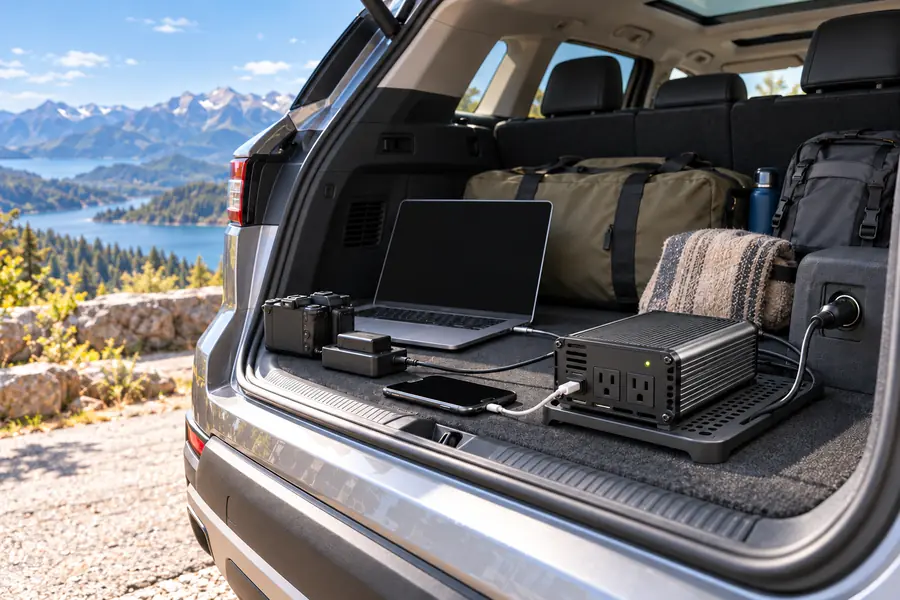
](https://voltcrave-battery.com/wp-content/uploads/2026/10/Is-It-Okay-to-Use-a-Power-Inverter-in-a-Car.webp)
A car inverter is convenient, but excessive power, incorrect wiring, or prolonged use with the engine off can drain the battery, blow fuses, or overheat wiring.
Yes, using a sized power inverter in a car is generally okay when it matches the vehicle’s electrical limits and is connected correctly. Small inverters can use an approved 12V outlet, while higher-power units usually require direct fused battery wiring. Avoid exceeding outlet ratings or draining the battery while parked.
Small inverters suit light electronics, while larger units need direct fused battery connections. Engine-off use depends on battery capacity; engine-running use depends on alternator capacity.
Is It Safe to Use a Power Inverter in a Car?
A car inverter converts low-voltage DC electricity into AC power, but safe operation depends on the vehicle, inverter size, wiring, ventilation, and connected appliance.
It is generally safe to use a power inverter in a car when the inverter is designed for the vehicle’s DC voltage, remains within the outlet or wiring limits, has appropriate overcurrent protection, and receives adequate ventilation. Small electronics are relatively easy to power, while large appliances require substantially heavier wiring and greater electrical-system capacity.
Most conventional passenger vehicles use a nominal:
12V electrical system.
A typical inverter converts:
12V DC → 120V AC
in North American vehicles.
The important point is that converting voltage does not create additional energy.
A 120W AC load may require more than:
10A from the 12V side
after inverter losses are considered.
This is why the DC side of a car inverter can carry surprisingly large currents.
For example:
120W ÷ 12V = 10A
before losses.
At:
600W
the theoretical DC current becomes:
600 ÷ 12
= 50A
before inverter losses.
At:
1,200W
it becomes:
100A.
This explains why a small cigarette-lighter plug can be suitable for a laptop but not for a large 1,000W inverter running near full output.
Vehicle outlet ratings must always be respected.
Toyota, for example, specifies a 12V/10A, 120W limit for the 12V outlets in some vehicles and warns owners not to exceed the limit because the fuse can blow. Toyota also warns against prolonged outlet use while the hybrid system is off because it can discharge the 12V battery.
That 120W figure is an example, not a universal automotive standard.
Some vehicles have different limits.
Therefore:
Always check the owner's manual for the exact vehicle.
A separate consideration is ventilation.
Inverters generate heat because conversion is not 100% efficient.
They should not be buried under:
blankets,
clothes,
seat cushions,
or other materials
that prevent cooling.
For normal use, the inverter should remain:
dry,
secure,
ventilated,
and away from locations where it could interfere with vehicle controls.
How Many Watts of Inverter Can You Use in a Car?
The wattage printed on the inverter does not determine how much power the car can safely supply.
A small inverter around 100–150W may work from many 12V accessory outlets when the vehicle permits it. Higher-power inverters usually need a direct battery connection with properly sized cables and fusing. At 12V, a 1,000W inverter can draw roughly 80–100A, making accessory-socket wiring completely unsuitable for that load.
The basic relationship is:
Power = Voltage × Current
or:
P = V × I
At a nominal 12V:
| Inverter Load | Approximate DC Current Before Losses |
|---|---|
| 60W | 5A |
| 120W | 10A |
| 300W | 25A |
| 600W | 50A |
| 1,000W | 83A |
| 1,500W | 125A |
Actual current will normally be higher because the inverter itself consumes energy.
This illustrates why the connection method changes as power increases.
Low-Power Inverters
A small inverter may be suitable for:
laptops,
camera chargers,
small monitors,
phone chargers,
and other low-power electronics.
Renogy's small automotive inverter instructions, for example, describe connecting the inverter directly to a vehicle's 12V accessory socket before connecting the AC or USB load.
But that does not mean every 12V outlet can supply every small inverter at its maximum rating.
The:
vehicle outlet rating
is the real limit.
If the outlet is rated for:
120W,
connecting a:
300W inverter
does not magically make 300W available.
Higher-Power Inverters
As inverter power rises, large DC current requires:
thick cable,
short cable runs,
secure battery connections,
and appropriate fusing.
Victron's inverter installation guidance demonstrates how dramatically wiring requirements increase with power. Its 12V inverter models require progressively larger cable cross-sections and fuse ratings as inverter capacity rises; for example, some 12V 800–1,600VA products require heavy battery cabling and DC fuse protection.
For substantially larger systems, this becomes a professional electrical design problem rather than an accessory-socket problem.
A high-power inverter should not simply be connected using:
thin extension wire,
an undersized cigarette-lighter adapter,
or improvised battery clips.
The rule is:
Small Load → Accessory Outlet if Vehicle Allows
Large Load → Dedicated Fused DC Connection
Starting Surge Matters
Appliances containing motors or compressors may briefly draw more power while starting.
Examples include:
small refrigerators,
compressors,
pumps,
and some power tools.
A device labeled:
500W
could have a considerably higher startup requirement.
Therefore, check both:
continuous inverter power
and:
surge capability.
Will a Power Inverter Drain or Damage the Car Battery?
A power inverter cannot distinguish between electricity you intended to use and electricity needed to start the engine later.
Yes, an inverter can discharge the vehicle’s starter battery when used with the engine off. With the engine running, the charging system can replace some inverter demand, but high continuous loads can still exceed the vehicle’s available electrical capacity. Battery condition, alternator output, engine speed, factory loads, and inverter efficiency all affect the safe limit.
The main risk while parked is simple:
Battery → Inverter → Appliance
with no charging source replacing the energy.
Suppose the inverter supplies a:
120W load
for:
3 hours.
Ignoring losses, that represents:
120 × 3
= 360Wh
of energy.
At 12V, that is theoretically around:
30Ah.
A starter battery is not designed to behave like a deep-cycle house battery.
Its primary purpose is to provide high current for:
engine starting.
Repeated deep discharge can therefore be undesirable.
Toyota specifically advises owners not to use its 12V outlets longer than necessary with the vehicle system off because doing so can discharge the 12V battery.
Does Running the Engine Solve Everything?
No.
With the engine running, the alternator supplies electricity and charges the battery in a conventional combustion vehicle.
However, the alternator also has to supply the vehicle's normal electrical loads, such as:
lights,
fans,
fuel systems,
computers,
heated windows,
audio,
and HVAC electronics.
The inverter gets whatever electrical capacity remains.
Therefore:
Alternator Rating ≠ Available Inverter Power.
A high-power inverter can place significant continuous demand on the charging system.
If a larger inverter is required regularly, the system should be designed around:
alternator capability,
battery capacity,
cable size,
fusing,
and duty cycle.
For very large inverter systems, a better architecture can involve a separate:
service or house battery
rather than depending directly on the starter battery.
Victron specifically notes for some vehicle-oriented inverter/charger installations that a dedicated service or house battery with appropriate fusing and cable gauge should be used rather than directly connecting the equipment to the vehicle's electrical system.
This approach is common in:
RVs,
camper vans,
service vehicles,
and mobile workshops.
It separates:
Vehicle Starting
from:
Household/Equipment Power.
What Should You Check Before Using a Power Inverter in a Car?
The safest inverter is not necessarily the smallest or most expensive. It is the one correctly matched to the vehicle and appliance.
Before using an inverter, check the vehicle outlet rating, inverter input voltage, appliance continuous and startup watts, connection method, DC fuse, cable size, ventilation, battery condition, and manufacturer instructions. Use direct battery wiring for higher-power systems, avoid prolonged engine-off operation, and choose pure sine wave output for equipment that requires cleaner AC power.
The first check should always be:
Vehicle Manual → 12V Outlet Rating
Do not assume every cigarette-lighter socket supplies:
150W,
180W,
or:
300W.
For example, Toyota specifies 120W maximum for the 12V outlets in multiple models.
Some vehicles also have factory AC outlets.
These should be treated according to their own ratings rather than assuming an aftermarket inverter is necessary.
Certain Toyota hybrid models, for example, have factory 120V AC outlets rated as high as 1,500W, while other models have much smaller factory AC limits.
This demonstrates why:
Vehicle-Specific Information Matters.
Check the Connection Method
For low loads:
12V socket → Small inverter
may be appropriate.
For larger loads:
Battery → Fuse → Heavy Cable → Inverter
is the normal architecture.
Victron emphasizes that appropriate battery capacity, cable cross-section, and DC fuse protection are necessary for inverter installations.
The fuse should protect the DC wiring from excessive current.
It should not be omitted simply because the inverter has electronic protection.
Check the Waveform
A modified sine wave inverter may work with many simple devices.
However, some:
audio equipment,
motors,
chargers,
precision electronics,
and sensitive power supplies
may operate better with pure sine wave power.
Samlex notes that modified sine wave inverter output contains harmonic components that can create greater electromagnetic interference and may cause buzzing or other issues in some audio systems.
For general modern electronics, I prefer:
pure sine wave
when practical.
It does not increase the vehicle's available power, but it improves AC waveform quality.
Secure the Inverter
An inverter should not become a projectile during:
hard braking,
a collision,
or sudden steering.
The unit and connected devices should therefore be positioned securely.
Avoid placing powered heating appliances loosely inside the vehicle.
Toyota's factory AC-outlet guidance specifically warns about unsecured heat-producing equipment such as kettles, toasters, microwaves, heaters, and coffee makers because sudden braking or accidents can create burn or fire hazards.
Do Not Confuse an Inverter With Extra Battery Capacity
An inverter changes:
DC → AC.
It does not create additional stored energy.
A:
2,000W inverter
connected to a small starter battery does not create a:
2,000W portable power station.
The battery and charging system must actually supply the power.
This distinction is critical.
My Insights: Is It Okay to Use a Power Inverter in a Car
Using an inverter incorrectly can drain the starter battery, blow an accessory fuse, overheat wiring, or overload the charging system, especially when high-wattage appliances are involved.
Yes, it is okay to use a power inverter in a car when its input voltage, wattage, wiring, fuse protection, and connected load match the vehicle’s electrical system. Small loads can often use an approved 12V socket, while higher-power inverters require dedicated fused battery wiring and careful consideration of battery and alternator capacity.
For normal travel, I would divide car inverter use into three categories:
| Application | Recommended Approach |
|---|---|
| Phones, cameras, small laptop loads | USB/DC first, or small inverter |
| Laptop, small electronics, light AC loads | Low-power pure sine inverter within outlet rating |
| Larger appliances / tools | Direct fused battery connection |
| Regular high-power mobile operation | Dedicated auxiliary battery system |
| Very large inverter loads | Professionally designed vehicle power system |
My preference is to avoid unnecessary conversion.
If a device can charge directly from:
USB-C
or:
12V DC,
that is often simpler than converting:
12V DC → 120V AC → Device DC
through an inverter and another power adapter.
Use an inverter when AC power is actually required.
For small loads, the vehicle's accessory outlet limit should determine the inverter size.
For higher loads, the design must shift toward:
proper cable sizing + fusing + battery connection + charging-system assessment.
And if the inverter will run for substantial periods while the engine is off, a separate deep-cycle or auxiliary battery is generally a better architecture than repeatedly draining the starter battery.
Conclusion
A car inverter is safe and useful when correctly sized and connected. Respect outlet limits, protect high-current wiring, avoid unnecessary battery discharge, and use dedicated systems for large loads.
](https://voltcrave-battery.com/wp-content/uploads/2026/08/Benefits-of-Energy-Storage-Systems-for-Industrial-and-Commercial-Users-768x512.webp)
](https://voltcrave-battery.com/wp-content/uploads/2026/09/How-Much-Battery-Storage-Do-You-Need-for-a-Solar-System-768x512.webp)
](https://voltcrave-battery.com/wp-content/uploads/2026/09/Navigating-the-Benefits-Challenges-and-Innovations-in-Energy-Storage-Systems-768x512.webp)