
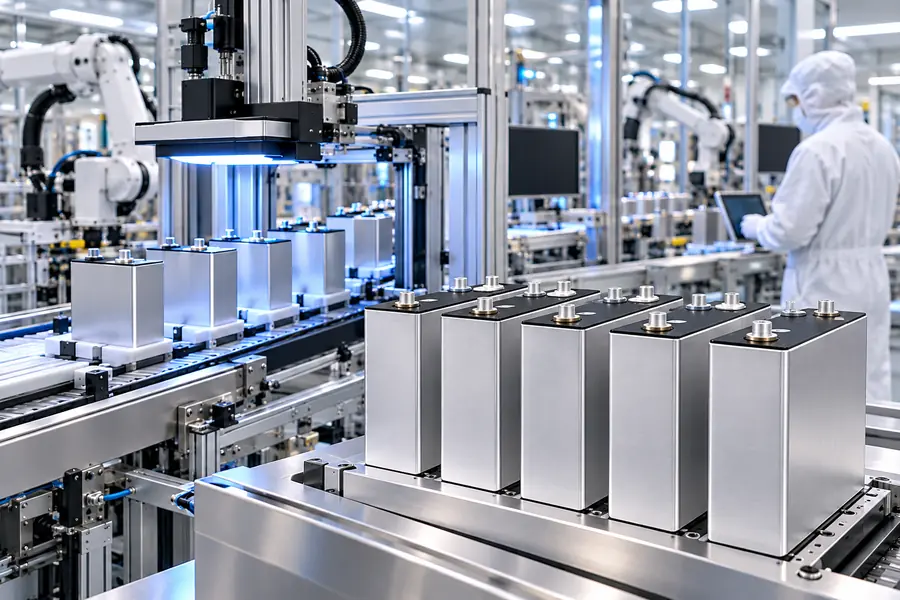
](https://voltcrave-battery.com/wp-content/uploads/2026/10/Who-Is-the-Best-Lithium-Cell-Manufacturer.webp)
Who Is the Best Lithium Cell Manufacturer in 2026?
Finding a reliable lithium cell manufacturer is difficult. Many brands promise excellent performance, but poor cell consistency, uncertain quality, and weak after-sales support can create serious problems.
CATL is the strongest overall candidate for the best lithium cell manufacturer in 2026, based on its leading global EV battery market share and major position in energy storage. BYD, EVE Energy, Hithium, LG Energy Solution, and Panasonic are also strong manufacturers. The best choice depends on battery chemistry, application, safety, and supply requirements.
I believe buyers should compare lithium battery manufacturers by application rather than reputation alone. A cell designed for an electric vehicle may not be the best option for a residential solar battery or commercial energy storage system. Manufacturing quality, cycle life, technical support, and product traceability can matter more than a company's overall market ranking.
Who Are the Leading Lithium Cell Manufacturers in 2026?
The lithium battery industry includes many established manufacturers. However, production volume, cell technology, and market specialization differ significantly between companies.
CATL, BYD, LG Energy Solution, Panasonic, EVE Energy, Hithium, and Samsung SDI are important names in the global lithium battery industry. CATL leads worldwide EV battery usage, while CATL, Hithium, EVE Energy, BYD, and CALB are among the leading energy storage cell suppliers in the first half of 2026.
Leading Global Lithium Battery Cell Manufacturers
I compare these companies by their main technical strengths and target markets.
| Manufacturer | Country | Main strengths | Typical applications |
|---|---|---|---|
| CATL | China | Large-scale LFP and nickel-based lithium-ion production | EVs, utility-scale ESS, industrial batteries |
| BYD | China | LFP Blade Battery technology and integrated battery manufacturing | EVs, stationary energy storage |
| EVE Energy | China | LFP prismatic cells and diversified lithium battery production | Residential ESS, C&I storage, industrial applications |
| Hithium | China | Specialized stationary energy storage cells | Utility-scale and long-duration ESS |
| LG Energy Solution | South Korea | Automotive battery engineering and global manufacturing | EVs, industrial and energy storage batteries |
| Panasonic Energy | Japan | Cylindrical lithium-ion cell manufacturing | EVs, consumer and industrial applications |
| Samsung SDI | South Korea | High-performance prismatic and cylindrical cell technology | Premium EV and industrial battery applications |
These are application-based comparisons, not independent quality rankings.
How Does CATL Compare With Other Manufacturers?
According to SNE Research, CATL accounted for approximately 39.4% of global EV battery usage between January and August 2026. BYD followed with 15.1%, while LG Energy Solution held 8.1%.
These numbers demonstrate manufacturing scale and market adoption. They do not prove that every CATL cell has better performance than every competing cell.
The stationary storage market tells a different story.
InfoLink Consulting ranked CATL, Hithium, EVE Energy, BYD, and CALB as the five leading global energy storage cell suppliers in the first half of 2026.
I consider this distinction important for anyone buying lithium cells for battery energy storage systems.
A manufacturer may lead the automotive market but have a different product range, supply arrangement, or support capability for stationary storage customers.
Which Manufacturer Makes the Best LiFePO4 Battery Cells?
LiFePO4 battery cells are widely used in modern energy storage systems. However, not every LFP cell offers the same cycle life, quality consistency, or operating performance.
CATL, EVE Energy, BYD, Hithium, Great Power, and REPT BATTERO are strong manufacturers to evaluate for LiFePO4 applications. CATL has major utility-scale experience, while EVE Energy, Great Power, and REPT BATTERO are especially relevant in smaller stationary storage markets. Actual cell selection should depend on verified product specifications and test results.
Why Is LiFePO4 Popular for Energy Storage?
Lithium iron phosphate, also called LFP, belongs to the lithium-ion battery family.
I generally consider LFP a strong starting point for stationary applications where long cycle life, thermal stability, and cost are important.
The International Energy Agency reported that LFP batteries accounted for around 90% of global battery storage deployments in 2025.
LFP technology offers several advantages:
- Thermal stability: LFP chemistry has a lower tendency toward thermal runaway than many nickel-rich lithium-ion chemistries, although it still needs proper protection.
- Cycle life: Many LFP cells are designed for frequent charging and discharging.
- Cost efficiency: LFP generally uses less expensive cathode materials than nickel-based alternatives.
- Energy storage suitability: LFP is commonly used in residential, commercial, and utility-scale battery systems.
The actual performance depends on cell design, temperature, charging conditions, depth of discharge, and battery management.
Which LFP Supplier Fits Each Storage Application?
| Application | Manufacturers to evaluate | Main purchasing priorities |
|---|---|---|
| Residential solar batteries | EVE Energy, Great Power, REPT BATTERO | Cell consistency, cycle life, availability |
| Commercial & Industrial ESS | CATL, EVE Energy, Hithium, BYD | Reliability, system compatibility, documentation |
| Utility-scale BESS | CATL, Hithium, BYD, CALB, EVE Energy | Large-volume supply, lifetime performance, safety |
| Industrial battery packs | EVE Energy, CATL, other qualified cell makers | Format, operating temperature, discharge requirements |
In the first half of 2026, InfoLink identified EVE Energy, Great Power, and REPT BATTERO as the leading group in small-scale energy storage cell shipments.
I would not select a supplier based only on the highest advertised cycle count.
A claim of 6,000 or 8,000 cycles means little without the test temperature, depth of discharge, charge and discharge rate, and remaining capacity threshold.
For long-term procurement, I would also check whether the manufacturer can supply the same approved cell model and revision consistently.
Are Panasonic and LG Energy Solution Better Than Chinese Lithium Cell Makers?
Many buyers assume Japanese and South Korean batteries always offer higher quality. Others believe Chinese manufacturers are automatically the most cost-effective option. Neither assumption works for every project.
Panasonic and LG Energy Solution are established lithium-ion battery manufacturers with strong automotive expertise. However, Chinese companies such as CATL, BYD, and EVE Energy are major competitors in manufacturing scale and LFP technology. Battery quality depends on the specific cell, production controls, application, and independent verification rather than the manufacturer's country alone.
Different Manufacturers Focus on Different Cell Technologies
Panasonic has extensive experience manufacturing cylindrical lithium-ion cells for automotive applications.
LG Energy Solution produces several cell formats and chemistries for vehicle and energy storage customers.
CATL and BYD have developed significant LFP manufacturing capabilities. EVE Energy also offers battery cells for a wide range of markets, including stationary storage.
I compare these technologies according to the intended battery system.
| Factor | LFP cells | NMC/NCA cells |
|---|---|---|
| Energy density | Generally lower | Generally higher |
| Thermal stability | Generally more favorable | Often requires tighter thermal controls |
| Material cost | Generally lower | Generally higher |
| Cycle-life potential | Often favorable for frequent cycling | Depends strongly on cell design and use |
| Common applications | ESS, industrial batteries, many EVs | EVs, compact high-energy applications |
LFP and nickel-based lithium-ion batteries can both perform well when they are designed, tested, and integrated correctly.
Why Application Matters More Than Brand Nationality
A stationary battery does not have the same design priorities as an electric vehicle.
An EV manufacturer may prioritize high energy density, fast charging, and low battery weight.
A solar energy storage installer may focus more on daily cycling, safety, service life, and long-term replacement availability.
The IEA Global EV Outlook 2026 explains how these differences influence battery chemistry and manufacturing decisions.
I would therefore avoid judging all lithium cells through one general quality ranking.
A premium automotive cell may be an excellent product but still be less suitable for a low-cost stationary storage system than a properly qualified LFP cell.
I also consider local technical support, logistics, warranty administration, and replacement inventory when comparing international suppliers.
How Can Buyers Choose a Reliable Lithium Cell Manufacturer?
Choosing a lithium battery supplier requires more than comparing prices and capacity ratings. Weak quality control or missing documentation can create costly problems after installation.
A reliable lithium cell manufacturer should provide consistent cell specifications, verifiable safety testing, production traceability, transparent cycle-life data, and dependable supply. Buyers should also examine the manufacturer's technical capabilities, application experience, warranty terms, and support for system integration before placing large orders.
Check Cell Specifications and Quality Consistency
I would begin with the cell datasheet.
Important parameters include nominal voltage, rated capacity, operating voltage range, charge and discharge current, internal resistance, cell dimensions, operating temperature, and expected cycle life.
For example, two suppliers may both advertise a 314 Ah LFP cell, but their allowable charging rates, test conditions, and performance tolerances may differ.
I would request the same test protocol from each supplier before comparing their results.
A reliable supplier should also explain how it controls production batches and identifies individual cells.
Verify Safety Standards and Test Documentation
Different standards apply to different batteries and markets.
| Standard or document | Why it matters |
|---|---|
| IEC 62619 | Safety requirements for industrial lithium cells and batteries |
| UN 38.3 test summary | Evidence relating to required lithium battery transport testing |
| UL 1973 | Safety evaluation for applicable stationary battery products |
| UL 9540 | Certification of complete energy storage systems, where required |
| Cell datasheet | Electrical, mechanical, and operating specifications |
| Batch test reports | Evidence of production quality and cell consistency |
I would verify that each document applies to the exact model being purchased.
A supplier's factory certificate does not automatically mean every cell model or assembled battery system has the required certification.
UL 9540, for example, covers energy storage systems rather than serving as a general approval for every individual lithium cell.
Test Samples Before Bulk Orders
Before approving a new supplier, I would use a qualification process that matches the project's risks.
For a large energy storage order, my evaluation would include capacity testing, internal resistance measurement, temperature performance, and cycling data.
I would also examine the battery management system's operating limits and whether the cell is suitable for the planned thermal design.
The purchasing checklist should include:
- Confirm the original cell manufacturer and authorized supply channel.
- Compare datasheets and test conditions.
- Request applicable certification and transport documents.
- Inspect sample cells and batch traceability.
- Review production capacity and delivery commitments.
- Verify warranty conditions and technical support.
- Approve the exact cell model before mass production.
I would pay particular attention to unusually low quotations.
Low prices may reflect genuine manufacturing efficiency, but they can also indicate older inventory, unauthorized distribution, mixed production batches, or cells with a different quality classification.
A transparent supplier should be able to explain its pricing and provide the supporting product records.
My Insights: Who Is the Best Lithium Cell Manufacturer in 2026
I believe CATL is the strongest overall choice when the question concerns worldwide manufacturing scale, market adoption, and broad lithium battery capability.
However, I would not describe any manufacturer as the best for every lithium battery application.
The Best Manufacturer Depends on the Project
For large electric vehicle production, I would place CATL, BYD, and LG Energy Solution among the first companies to evaluate.
For utility-scale energy storage, I would also consider Hithium, EVE Energy, and CALB because of their positions in the stationary cell market.
For residential solar energy storage, I would pay close attention to EVE Energy, Great Power, and REPT BATTERO.
For cylindrical cells used in applications where energy density is important, I would evaluate Panasonic alongside other qualified manufacturers offering compatible models.
These are practical supplier shortlists, not universal rankings of product quality.
Manufacturing Scale Does Not Guarantee Every Cell's Performance
I see a difference between a company with large production capacity and a cell model with verified long-term performance.
A manufacturer can produce hundreds of gigawatt-hours of batteries while offering multiple cell generations with different specifications.
I would therefore evaluate the exact cell model, manufacturing batch, testing history, and integration requirements.
I would also separate the cell manufacturer from the battery pack manufacturer and energy storage system integrator.
A company that makes excellent cells does not automatically manufacture the best complete energy storage system.
Long-Term Reliability Matters More Than the Lowest Price
For B2B procurement, I consider total lifecycle value more useful than the initial purchase price.
A less expensive cell can become costly if it causes capacity inconsistency, warranty claims, integration problems, or early replacement.
A slightly more expensive supplier may provide better value through stable quality, verified documentation, reliable delivery, and engineering support.
I would also prefer a manufacturer or authorized supplier that can explain product revisions and support repeat purchases over several years.
Conclusion
CATL is my overall leading candidate for the best lithium cell manufacturer in 2026. However, EVE Energy, Hithium, BYD, Great Power, Panasonic, and LG Energy Solution may be better choices for specific applications. The final decision should depend on verified cell performance, safety, cost, and long-term supply reliability.
](https://voltcrave-battery.com/wp-content/uploads/2026/08/What-Are-the-Risks-and-Challenges-of-Installing-a-100kW-Solar-Battery-768x512.webp)
](https://voltcrave-battery.com/wp-content/uploads/2026/08/What-Safety-Related-Designs-Are-Used-in-Energy-Storage-Systems-768x512.webp)
](https://voltcrave-battery.com/wp-content/uploads/2026/08/What-Are-Some-of-the-Challenges-to-Rail-Energy-Storage-768x512.webp)







































