
](https://voltcrave-battery.com/wp-content/uploads/2026/10/What-Is-the-Best-Backup-Solution-for-Home-Use.webp)
A power outage can stop refrigeration, internet, lighting, HVAC, pumps, and medical equipment, so choosing the wrong backup system can quickly become expensive and inconvenient.
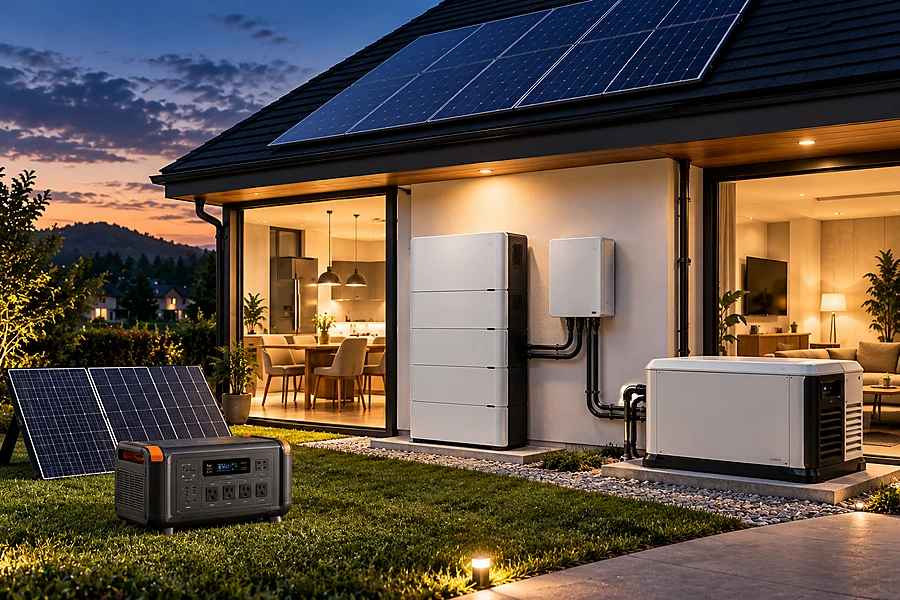
For most homeowners, a professionally installed LFP home battery with automatic backup switching is the best all-around solution for short-to-medium outages. Adding solar improves long-duration resilience by recharging the battery during daylight. For frequent multi-day outages, a battery-plus-standby-generator system usually provides stronger backup because stored battery energy is supplemented by fuel-based generation.
Home backup choices depend on outage duration and critical loads. Batteries suit short outages, generators long ones, solar supports recharging, and hybrid systems maximize resilience.
What Is the Best Overall Backup Solution for a Home?
There is no universal backup system because a home experiencing two-hour outages has very different requirements from one exposed to multi-day storms.
For many households, a fixed LFP battery system offers the strongest overall combination of automatic operation, quiet backup, low routine maintenance, rapid transfer, and compatibility with solar. If outages regularly last several days, however, adding a standby generator can overcome the battery's finite energy capacity and significantly improve long-duration resilience.
The U.S. Department of Energy notes that battery storage can provide backup power during outages and can store solar energy for later use. Solar paired with storage can also operate in an islanded configuration when properly designed for outage operation.
This makes batteries especially attractive for normal residential outages.
A home battery can operate without:
fuel delivery,
engine noise,
exhaust,
or manual startup.
It can also provide value when the grid is operating by storing solar energy or shifting electricity use.
However, every battery contains a finite amount of energy.
A:
15 kWh battery
cannot continuously support a:
5 kW load
for days.
Ignoring losses and reserve:
15 kWh ÷ 5 kW
= 3 hours
That is why backup-system selection begins with:
Load + Duration
rather than simply:
Battery Size.
Is a Home Battery the Best Backup Option?
A home battery is particularly strong when outages are relatively short and homeowners want automatic, silent backup.
Home batteries are excellent for outages lasting minutes to hours and can support longer periods when loads are carefully managed. Their main advantages are automatic operation, quiet performance, no local combustion emissions, solar compatibility, and fast power transfer. Their main limitation is finite stored energy, so runtime depends directly on battery capacity and household load.
A modern home battery typically contains:
battery cells,
BMS,
bidirectional inverter,
control electronics,
protection,
communications,
and automatic backup functions.
During normal operation:
Grid / Solar → Home + Battery
During an outage:
Battery → Backup Loads
If solar is available and the system supports islanded operation:
Solar → Home
and:
Solar → Battery Recharge
DOE explains that ordinary grid-connected solar by itself generally shuts down during a grid outage for safety. Solar needs the appropriate inverter and storage architecture to continue supporting the home independently.
Therefore:
Solar Panels Alone ≠ Backup Power
while:
Properly Configured Solar + Battery = Backup-Capable Energy System
Is a Standby Generator Better Than a Battery?
A generator has one major advantage over a battery: it can keep creating electricity while fuel remains available.
A standby generator is often better for long-duration outages or homes with large continuous loads. It automatically starts after grid failure and can operate using natural gas or propane. Unlike a battery, it is not limited to a fixed number of stored kilowatt-hours, although it introduces fuel dependence, engine maintenance, noise, and emissions.
Generac states that permanently installed standby generators can automatically detect an outage and begin supplying the home within seconds. Its systems operate on natural gas or liquid propane and transfer back to utility service after the grid returns.
This creates a fundamental difference:
Battery = Stores Energy
Generator = Produces Energy From Fuel
Imagine a home averaging:
3 kW
during an outage.
A:
15 kWh battery
theoretically provides:
15 ÷ 3
= 5 hours
before accounting for reserve and losses.
A standby generator may keep supplying that load much longer if:
natural gas remains available
or:
the propane supply is sufficient.
Therefore, a generator becomes especially attractive when the design objective is:
days of backup
rather than:
hours of backup.
Is Solar Plus Battery the Best Home Backup System?
For homes with adequate solar resources, solar plus storage can significantly improve resilience.
Solar plus battery is one of the strongest backup architectures because the battery can support loads when sunlight is unavailable while solar can support daytime loads and recharge the battery. This can extend backup beyond the battery's original stored energy, although actual performance depends on solar production, weather, season, battery size, and household consumption.
DOE specifically notes that pairing solar with storage can make solar energy available during outages. Properly configured systems can disconnect from the utility and operate in an islanded mode.
Without solar, the outage energy flow is:
Battery → Home → Battery SOC Falls
With solar:
Solar → Home
and potentially:
Solar → Battery
This is extremely important during longer outages.
Suppose a home consumes:
15 kWh overnight.
A 20 kWh battery might cover that overnight consumption.
If solar produces enough surplus energy the next day to recharge the battery, the household may repeat the cycle.
But solar is variable.
Clouds,
winter,
shade,
smoke,
snow,
and high daytime consumption
can all reduce charging.
So:
Solar + Battery ≠ Unlimited Backup
but it can substantially improve resilience.
Is Battery Plus Generator the Best Solution for Long Power Outages?
For homes where continuous power is extremely important, combining technologies can reduce dependence on any single energy source.
A battery-plus-generator system is one of the strongest choices for extended outages. The battery can handle immediate transfer, overnight loads, and short interruptions quietly, while the generator supplies energy when battery state of charge becomes low. Adding solar can further reduce generator runtime and fuel consumption.
This produces a layered architecture:
Grid
↓
Solar + Battery + Generator
↓
Home
A short outage might use only the battery.
A longer outage might use:
battery overnight
and:
solar during daylight.
If battery SOC remains low:
the generator can support loads or recharge storage, depending on the equipment architecture.
NREL's resilience guidance emphasizes that technology choice depends strongly on:
critical load
and:
anticipated outage duration.
For long outages, it notes that fuel availability becomes an important limitation and that solar-plus-storage can be combined with generation to improve resilience.
This is why the highest-resilience answer is often not:
Buy the Largest Battery Possible
but:
Use Multiple Energy Sources.
Are Portable Power Stations Good for Home Backup?
Portable power stations can be practical when permanent installation is unnecessary or too expensive.
Portable power stations are well suited to renters, apartments, essential-load backup, emergency kits, and users who want portable electricity without installing a permanent home battery. They can support refrigerators, communications, lights, electronics, and selected appliances, but smaller models generally cannot provide long whole-home backup.
Portable storage works particularly well for:
Wi-Fi routers,
phones,
laptops,
CPAP equipment,
small medical devices,
lights,
refrigerators,
and selected outlets.
NREL has discussed lightweight residential backup approaches focused specifically on critical loads such as:
communications,
refrigerators,
security devices,
medical equipment,
and selected lighting.
This reflects a useful principle:
You Do Not Always Need to Back Up the Entire House.
A smaller system can be much more economical when the actual objective is:
Keep Essential Devices Running.
However, running:
central air conditioning,
electric heat,
large water heaters,
electric dryers,
or EV charging
can quickly exceed the capabilities or stored energy of a portable system.
Should You Back Up the Entire Home or Only Critical Loads?
Critical-load backup can dramatically reduce battery capacity and generator size.
For many homes, backing up only critical circuits is more economical than supporting every electrical load. Refrigeration, lighting, internet, medical equipment, well pumps, and limited HVAC may be essential, while EV charging, dryers, pool pumps, electric ovens, and other large loads can often be temporarily reduced or disabled.
Suppose normal home consumption during an outage is:
4 kW average.
A 20 kWh battery theoretically provides:
20 ÷ 4
= 5 hours
Now suppose nonessential loads are removed and demand falls to:
1.5 kW.
Runtime becomes:
20 ÷ 1.5
≈ 13.3 hours
before losses and reserve.
Same battery.
Much longer outage coverage.
This is why load management can sometimes deliver more resilience per dollar than buying additional batteries.
The design process should therefore identify:
Critical Loads
before selecting:
Backup Capacity.
How Many kWh of Battery Backup Does a Home Need?
There is no universal battery size because homes consume electricity differently.
A typical critical-load backup system may use roughly 10–20 kWh of storage, while longer whole-home backup can require 20–40 kWh or substantially more. The correct battery capacity should be based on average backup load multiplied by desired outage duration, with additional allowance for reserve, conversion losses, temperature, and aging.
The basic calculation is:
Required Battery Energy ≈ Average Backup Load × Backup Hours
Example:
Critical loads = 1.5 kW
Desired runtime = 10 hours
1.5 × 10
= 15 kWh
If you need:
24 hours
then:
1.5 × 24
= 36 kWh
before accounting for losses and reserve.
This explains why reducing load is powerful.
If average load falls from:
1.5 kW
to:
0.75 kW
the required energy for 24 hours falls from:
36 kWh
to:
18 kWh.
Sizing should therefore consider:
Battery Capacity + Load Management
together.
What Is the Difference Between kW and kWh in Home Backup?
Power and energy answer two different questions.
Kilowatts measure how much electrical power the backup system can deliver at one moment, while kilowatt-hours measure how much energy is stored. A backup battery therefore needs enough kW to run or start appliances and enough kWh to maintain those loads for the required outage duration.
The simple distinction is:
kW = Can It Run the Load?
kWh = How Long Can It Run the Load?
Consider:
Battery A:
20 kWh
but only:
5 kW output
Battery B:
15 kWh
but:
10 kW output
Battery A stores more energy.
Battery B can support larger simultaneous loads.
This distinction becomes important for:
air conditioners,
well pumps,
compressors,
electric motors,
and other loads with high starting requirements.
A good backup design must satisfy both:
Energy Requirement
and:
Power Requirement.
Can a Home Battery Run Air Conditioning?
Yes, provided the battery and inverter have enough continuous and starting power.
Some modern residential battery systems can operate central air conditioning, but the system must be sized for both normal compressor demand and startup surge. A battery with enough kWh for overnight operation may still fail to start a large HVAC compressor if its inverter does not provide sufficient short-duration power.
This is why installers evaluate:
continuous load,
starting current,
surge duration,
and simultaneous household loads.
The same principle applies to:
well pumps,
pool pumps,
refrigeration compressors,
and workshop equipment.
Therefore:
Enough Energy ≠ Enough Starting Power.
When planning whole-home backup, both should be measured.
Which Battery Chemistry Is Best for Home Backup?
LFP is now particularly attractive for stationary residential energy storage.
Lithium iron phosphate, or LFP, is widely suited to home backup because it combines good cycling performance, thermal stability, long service potential, and competitive cost. Its lower energy density compared with some nickel-rich chemistries is less important in stationary applications where battery weight has relatively little effect on daily use.
For home storage, the battery normally stays:
on a wall,
on a pad,
or:
inside a fixed enclosure.
Unlike an EV or e-bike, it does not need to carry its own weight.
This means residential storage can prioritize:
cycle life,
thermal behavior,
safety,
cost,
and long-term reliability
over maximum:
Wh/kg.
However:
LFP Chemistry Alone Does Not Guarantee Safety.
The complete energy-storage system still requires appropriate:
BMS,
inverter,
protection,
enclosure,
installation,
thermal design,
and compliance.
What Safety Standards Matter for Home Battery Backup?
Battery backup should be treated as a complete electrical and fire-safety system.
In the United States, residential ESS selection should consider UL 9540 system certification and applicable installation requirements. UL 9540A evaluates thermal-runaway propagation behavior, while current fire and installation requirements can depend on NFPA 855, the International Fire Code, residential codes, and local authorities having jurisdiction.
UL Solutions describes UL 9540 as the foundational product-safety standard for ESS and UL 9540A as a method for evaluating thermal runaway and fire propagation behavior.
UL's updated guidance notes that the 2026 edition of NFPA 855 and the 2024 International Fire Code include fire-testing requirements in certain ESS installations, and that the sixth edition of UL 9540A was published in March 2026.
UL also provides the residential-specific UL 9540B test approach for certain residential ESS fire-propagation evaluations; UL 9540B does not replace UL 9540A.
For homeowners, the practical rule is:
Choose certified equipment + Use qualified installation + Follow local code requirements.
How Should You Choose the Best Home Backup Solution?
Start with the outage scenario, not the brand.
The best backup system should be selected by identifying critical loads, maximum simultaneous power, expected outage duration, available solar, fuel access, desired automation, available installation space, safety requirements, and budget. Battery storage is strongest for quiet automatic backup, while generators and hybrid systems become increasingly useful as required outage duration grows.
A practical comparison is:
| Home Backup Solution | Best For | Main Strength | Main Limitation |
|---|---|---|---|
| Fixed LFP battery | Typical residential outages | Quiet and automatic | Finite energy |
| Solar + battery | Solar homes | Daytime recharging | Weather dependent |
| Portable power station | Renters / critical loads | Flexible and simple | Limited whole-home capability |
| Standby generator | Long outages | Long runtime with fuel | Noise, emissions, maintenance |
| Battery + generator | High resilience | Combines fast backup and duration | Higher cost and complexity |
| Solar + battery + generator | Maximum resilience | Multiple energy sources | Most complex system |
I would use this sizing sequence:
1. Define Critical Loads
2. Measure Peak kW
3. Estimate Average Backup kW
4. Select Required Hours
5. Calculate Required kWh
6. Check Solar Recharge Potential
7. Decide Whether Generator Support Is Needed
8. Verify Safety, Installation, and Expansion
This gives a much more reliable answer than choosing the largest advertised battery.
My Insights: What Really Makes a Good Home Backup Solution
A reliable home backup system must solve both short-term power interruptions and longer-term energy availability.
I would evaluate home backup in layers: instant power, stored energy, recharge capability, and long-duration energy supply. Batteries are excellent for immediate backup, solar can replenish energy, and generators can provide sustained production. The strongest system architecture is the one that covers the home's actual outage profile without unnecessarily backing up every load.
My First Insight: Critical Loads Should Determine the System Size
Most homes do not need every circuit operating normally during an outage.
Reducing backup demand can dramatically reduce required:
battery capacity,
inverter power,
generator size,
and total project cost.
Therefore:
Size Around Essential Loads First.
My Second Insight: kW and kWh Must Be Designed Together
A backup battery needs enough:
kW
to start and run appliances.
It also needs enough:
kWh
to keep those appliances running.
A system with only one of these qualities is incomplete.
My Third Insight: Solar Is Valuable Because It Adds Energy During the Outage
A battery begins with a fixed energy reserve.
Solar can potentially add energy every daylight period.
DOE notes that properly configured solar-plus-storage can support power during grid outages and operate independently from the grid.
That makes solar especially valuable when outages extend beyond one battery discharge.
My Fourth Insight: A Generator and Battery Solve Different Problems
A battery is excellent at:
automatic switching,
silent operation,
and short-duration energy.
A generator excels at:
long-duration energy production.
Combining them can therefore be more effective than dramatically oversizing either one.
My Fifth Insight: What Is the Best Backup Solution for Home Use?
For most homes, a professionally installed LFP battery sized around critical loads is the best all-around backup solution because it provides quiet, automatic power without requiring fuel. Adding solar improves resilience by recharging the battery during daylight. For homes facing frequent multi-day outages, combining battery storage with a standby generator usually provides the strongest long-duration backup.
The selection can be simplified to:
Normal Short Outages → Battery
Solar Home → Solar + Battery
Small Essential Loads → Portable Power Station
Multi-Day Outages → Generator
High Resilience → Battery + Generator
Maximum Energy Resilience → Solar + Battery + Generator
The most useful question is not:
“What is the biggest backup system I can buy?”
It is:
“How many kW do I need, for how many hours, and how will I replace the energy once the battery is depleted?”
That question leads directly to the correct architecture.
Conclusion
For most homes, LFP battery backup offers the best overall balance. Add solar for recharging and a generator when dependable multi-day backup is required.
](https://voltcrave-battery.com/wp-content/uploads/2026/08/What-Is-the-Overview-of-BESS-768x512.webp)
](https://voltcrave-battery.com/wp-content/uploads/2026/06/What-Are-the-Pros-and-Cons-of-Solar-Energy-Storage-768x512.jpg)
](https://voltcrave-battery.com/wp-content/uploads/2026/09/What-Is-the-Best-Portable-Car-Jump-Starter-768x512.webp)







































