
](https://voltcrave-battery.com/wp-content/uploads/2026/10/What-Is-a-Mobile-BESS-and-How-Does-It-Work.webp)
What Is a Mobile BESS and How Does It Work?
Temporary power shortages can interrupt construction, outdoor events, and emergency operations. Diesel generators create noise, require fuel, and may operate inefficiently when electricity demand changes.
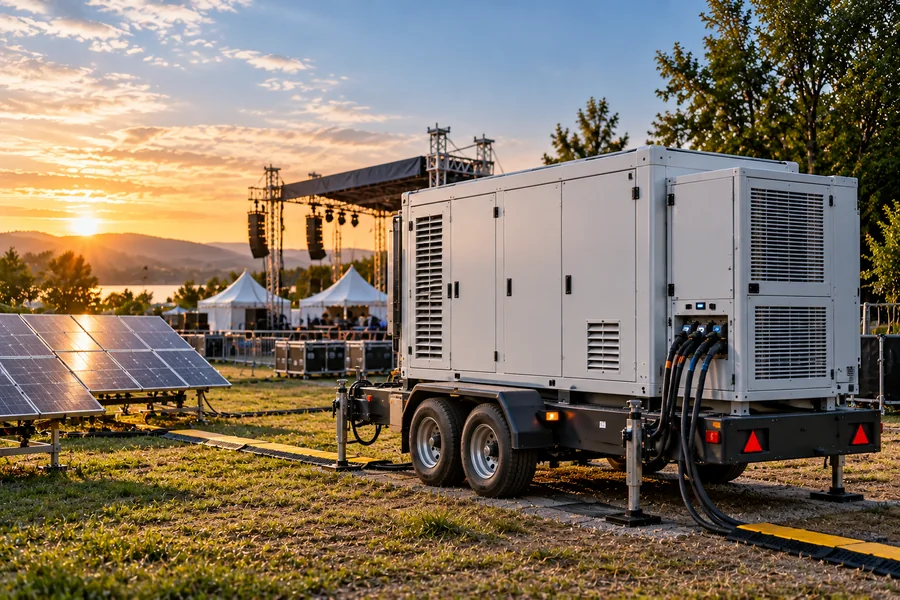
A Mobile BESS (Mobile Battery Energy Storage System) is a transportable energy storage solution that stores electricity in rechargeable batteries and delivers it when needed. It can charge from the grid, solar panels, or generators. Through battery management and power conversion equipment, mobile BESS provides flexible electricity for temporary, off-grid, and backup applications.
Mobile BESS combines battery storage, power conversion, energy management, and mobility to deliver flexible electricity, operating independently or alongside solar, grids, and generators when configured.
What Is a Mobile BESS and What Are Its Main Components?
Traditional battery energy storage systems are commonly installed in fixed locations. However, construction projects, emergency operations, and temporary facilities often require electricity in different locations.
A mobile BESS is a battery energy storage system designed for transportation and temporary deployment. It combines rechargeable battery storage with monitoring, protection, and power management equipment. Depending on the design, it may include an integrated inverter or connect to an external power conversion system. Mobile BESS units can be mounted on wheels, trailers, skids, or transportable containers.
Main Components of a Mobile BESS
A complete mobile battery energy storage system typically contains several connected components.
| Component | Main Function |
|---|---|
| Battery Cells and Modules | Store electrical energy |
| Battery Management System (BMS) | Monitors battery voltage, temperature, and operating limits |
| Power Conversion System (PCS) | Converts electricity between DC and AC |
| Energy Management System (EMS) | Coordinates charging, discharging, and power distribution |
| Thermal Management System | Maintains suitable operating temperatures |
| Electrical Protection | Helps manage faults, overloads, and electrical hazards |
| Mobile Enclosure | Supports transportation and equipment protection |
I consider the interaction between these components more important than battery capacity alone.
The batteries store energy, but the power conversion equipment determines how that energy can be supplied to electrical loads.
The BMS monitors battery operating conditions and can limit charging or discharging when necessary.
The EMS coordinates system-level operation, including the use of available charging sources.
Different Types of Mobile Battery Systems
Mobile BESS equipment comes in several forms.
Wheeled Battery Storage: Compact or modular battery systems designed for flexible positioning, residential backup, and small commercial applications.
Trailer-Mounted BESS: Integrated storage equipment transported to construction sites, outdoor events, or temporary industrial facilities.
Containerized Mobile BESS: Larger transportable storage systems designed for industrial, commercial, and grid-support applications.
Vehicle-Mounted Energy Storage: Battery systems transported on specialized vehicles for temporary power supply and emergency deployment.
Some wheeled battery products require separate compatible inverters and electrical equipment. They should not be confused with complete mobile AC power stations.
I always verify the actual system configuration before evaluating its applications.
How Does a Mobile BESS Store and Supply Electricity?
Mobile power applications often experience changes in electricity demand. A temporary facility may require relatively little electricity overnight but substantially more power during operating hours.
A mobile BESS works by charging rechargeable battery cells from an available electricity source, storing that energy as chemical energy, and releasing it when electricity is required. Its power conversion system delivers suitable electrical output, while the BMS and EMS monitor battery conditions and coordinate energy flow to maintain the system's operating limits.
Step 1: Charging the Battery System
A mobile BESS can charge from different electricity sources, depending on its configuration.
Common charging sources include the utility grid, solar photovoltaic systems, and diesel generators.
When charging from an AC source, suitable charging or conversion equipment converts the incoming electricity into the DC power required by the batteries.
When using solar panels, a compatible solar charge controller or DC conversion system manages the charging process.
I always check charging voltage, maximum charging power, battery compatibility, and available electrical infrastructure.
Step 2: Storing Electrical Energy
During charging, electrical energy is stored as chemical energy inside rechargeable battery cells.
Many commercial and residential mobile BESS designs use lithium iron phosphate (LiFePO4 or LFP) batteries.
LFP batteries are commonly selected for their cycle-life potential and thermal stability.
However, battery chemistry alone does not determine complete system safety.
The BMS monitors the battery's operating conditions and supports protection against excessive voltage, current, and temperature.
Step 3: Converting and Delivering Electricity
When electrical equipment requires power, the battery releases stored DC energy.
For an AC-powered site, the PCS converts this energy into AC electricity at the required voltage and frequency.
The system can then supply connected electrical loads within its rated power limits.
The electricity flow can be summarized as:
Grid / Solar / Generator → Charging Equipment → Battery Storage → PCS → Electrical Loads
In a hybrid configuration, the battery system may operate alongside a generator or grid connection.
Step 4: Managing Energy Automatically
The EMS coordinates the overall power strategy.
It can monitor battery charge levels, available sources, and site demand.
For example, a hybrid system may supply electricity from the battery during low-load periods and operate the generator when additional energy is required.
This approach can reduce unnecessary generator runtime.
I also distinguish battery backup from uninterrupted power supply. Not every mobile BESS provides seamless switching during a power interruption.
Critical applications require verification of transfer performance and electrical compatibility.
What Are the Main Applications and Benefits of Mobile BESS?
Temporary power users often face limited grid access, increasing fuel expenses, and noise restrictions. Traditional generators remain useful, but they are not always the most efficient solution for changing electrical loads.
Mobile BESS systems provide flexible stored electricity for construction sites, outdoor events, emergency response, temporary facilities, and EV charging. Their main benefits include quieter operation, reduced generator runtime in hybrid systems, flexible deployment, and improved energy management. Battery systems also produce no on-site combustion exhaust while discharging stored electricity.
Common Mobile BESS Applications
| Application | How Mobile BESS Is Used |
|---|---|
| Construction Sites | Powers tools, lighting, and temporary facilities |
| Outdoor Events | Supplies electricity for stages, lighting, and sound equipment |
| Emergency Backup | Supports selected electrical loads during outages |
| Temporary Commercial Sites | Provides flexible electricity where grid capacity is limited |
| EV Charging | Supports temporary charging infrastructure |
| Industrial Operations | Helps manage peak electricity demand |
| Remote Solar Systems | Stores renewable electricity for later use |
| Utility Maintenance | Provides temporary support during planned electrical work |
I believe construction sites and temporary events are particularly suitable for battery-generator hybrid systems.
These applications often experience significant changes in electricity demand during the day.
Reduced Noise and Generator Runtime
Diesel generators produce engine noise and exhaust while operating.
Battery systems can supply electricity without operating an internal combustion engine.
Cooling fans and auxiliary equipment may still create some sound, but battery operation is generally quieter than running a diesel generator.
In hybrid applications, operators can use stored electricity during periods of lower demand.
The generator may then operate for shorter periods or recharge the battery when required.
This can reduce fuel consumption, generator operating hours, and maintenance requirements.
Actual savings depend on the load profile, generator efficiency, charging strategy, and operating schedule.
Flexible Installation and Deployment
A major benefit of mobile BESS is the ability to relocate stored energy.
Unlike permanently installed battery systems, transportable units can support different sites as project requirements change.
I consider this particularly valuable for rental companies, contractors, event organizers, and temporary infrastructure providers.
However, transportation flexibility does not eliminate installation requirements.
Large systems may require lifting equipment, site preparation, grounding, electrical protection, and qualified personnel.
Mobile BESS vs. Diesel Generators
| Feature | Mobile BESS | Diesel Generator |
|---|---|---|
| Energy source | Stored electricity | Diesel fuel |
| Operating noise | Generally low | Engine noise |
| On-site exhaust during operation | None during battery discharge | Yes |
| Operating duration | Limited by stored energy and charging | Limited by fuel availability |
| Power management | Battery and inverter controls | Generator control system |
| Solar integration | Possible with compatible equipment | Requires additional equipment |
| Relocation | Depends on mobile design | Depends on generator configuration |
I do not consider mobile BESS a universal replacement for diesel generators.
Long-duration remote applications may still require a generator or another charging source.
In many cases, a hybrid arrangement offers a practical balance between operational flexibility and energy availability.
How Do You Choose the Right Mobile BESS for Your Project?
Selecting a mobile BESS based only on battery size can lead to unexpected problems. A system may have enough stored energy but insufficient output power to operate connected equipment.
To select a mobile BESS, I evaluate battery capacity in kilowatt-hours, output power in kilowatts, operating duration, charging requirements, electrical compatibility, and installation conditions. I also review system safety, transport requirements, inverter capabilities, and the availability of backup charging sources before choosing a configuration.
Understand the Difference Between kW and kWh
Two technical specifications are essential.
Kilowatts (kW) measure how much electrical power the system can deliver at a particular moment.
Kilowatt-hours (kWh) measure how much energy the battery can store.
For example, a 100 kWh battery can theoretically supply a constant 20 kW load for five hours before accounting for losses and operating limits.
However, the system must also have an inverter capable of delivering at least 20 kW continuously.
I always evaluate both measurements together.
Calculate the Required Battery Capacity
Consider a temporary construction facility with an average electrical load of 20 kW for four hours.
The required AC energy would be:
20 kW × 4 hours = 80 kWh
The nominal battery capacity must account for usable discharge limits and system losses.
Suppose the following assumptions apply:
- Required AC electricity: 80 kWh
- Usable battery discharge fraction: 90%
- Energy delivery efficiency: 90%
The estimated battery capacity would be:
80 kWh ÷ (0.90 × 0.90) = 98.8 kWh
A system with approximately 100 kWh of nominal storage might meet this simplified energy requirement.
However, I would also check the actual load profile, peak power demand, reserve requirements, and manufacturer specifications.
Evaluate Charging and Power Compatibility
Battery capacity does not determine how quickly a mobile BESS can recharge.
Charging time depends on the battery's available charging power, state of charge, charging losses, and the electricity source.
I recommend checking the following factors.
| Selection Factor | Main Consideration |
|---|---|
| Battery Capacity | Total stored energy |
| Continuous Output | Maximum sustained electrical power |
| Peak Output | Ability to support temporary power surges |
| Charging Power | Battery recharge capability |
| AC Voltage and Frequency | Compatibility with connected equipment |
| Battery Chemistry | Cycle life and operating characteristics |
| Thermal Management | Suitable operating temperature range |
| Enclosure Protection | Environmental protection for the site |
| Communication System | Monitoring and control compatibility |
| Mobility Design | Transport, positioning, and installation requirements |
Review Safety and Certification Requirements
Mobile battery equipment must be evaluated for both electrical operation and transportation safety.
Applicable requirements depend on the battery chemistry, equipment architecture, installation location, and jurisdiction.
Relevant standards may include UL 9540 for complete energy storage systems, UL 9540A for evaluating thermal runaway fire propagation, and IEEE 2030.2.1 for engineering guidance covering stationary and mobile energy storage.
Transported lithium batteries may also require evidence of compliance with applicable UN 38.3 transport testing requirements.
I would never assume that compliance with one standard automatically satisfies every requirement.
I recommend reviewing the exact certification scope, system protection design, installation instructions, and local regulations before deployment.
My Insights: What Is a Mobile BESS and How Does It Work
Temporary power systems often waste energy when supply does not match demand. This creates unnecessary generator runtime, higher operating costs, and inefficient equipment use.
I see mobile BESS as a flexible energy storage solution that changes how temporary electricity is managed. It stores energy from available sources and delivers it when needed. Its value comes from combining battery storage, power conversion, monitoring, and mobility to support changing electrical loads without relying entirely on continuous generator operation.
Mobile BESS Is an Energy Management Solution, Not Just a Battery
I believe the most important difference between a mobile BESS and a conventional battery pack is the integration of power management equipment.
A battery pack stores electrical energy, but a complete energy storage system must also control how that energy is charged and delivered.
The BMS monitors battery limits.
The PCS converts electricity into the form required by connected equipment.
The EMS coordinates energy movement across the system.
These components allow mobile BESS to serve more demanding applications than a simple battery pack.
I also consider the distinction between a battery module and an integrated AC power system important when reviewing product specifications.
Hybrid Operation Often Provides the Best Practical Value
I do not believe battery-only operation is always the best solution.
A remote construction site may require electricity continuously for several days.
If there is no grid connection and solar generation is insufficient, the battery must eventually be recharged from another source.
A generator-supported hybrid system can address this limitation.
The battery can supply low-demand periods, manage short power peaks, and allow the generator to operate according to actual energy needs.
I see this as a practical way to reduce inefficient generator operation without sacrificing the availability of backup power.
Battery Capacity Should Match the Load Profile
I also believe that many mobile power projects place too much emphasis on total battery capacity.
A larger battery does not automatically provide better performance if its inverter cannot support peak demand.
For example, a site with relatively low average consumption may still experience large starting currents from motors and pumps.
I therefore evaluate mobile BESS through four connected factors:
Load Demand → Required Output Power → Battery Capacity → Charging Strategy
This approach helps identify whether a project needs greater storage capacity, a higher-power inverter, or additional charging support.
Mobility Creates Opportunities for Better Equipment Utilization
A stationary battery normally serves one installation.
A mobile BESS can potentially support multiple projects over its service life.
Rental companies and contractors may move the same equipment between temporary sites as electricity requirements change.
However, I would include transportation expenses, installation labor, equipment inspection, charging logistics, and battery degradation when evaluating the overall economics.
The flexibility of mobile storage provides value only when it is supported by a realistic deployment plan.
Conclusion
Mobile BESS stores and delivers electricity through integrated battery and power management systems, offering flexible, quieter temporary power for construction, events, emergency backup, and hybrid applications.
](https://voltcrave-battery.com/wp-content/uploads/2026/10/What-Advantages-Do-All-in-One-Energy-Storage-Systems-Offer-Compared-to-Traditional-Solutions-768x512.webp)
](https://voltcrave-battery.com/wp-content/uploads/2026/10/Portable-Power-Station-vs-Mobile-Energy-Storage-System-The-Real-Boundary-768x512.jpg)
](https://voltcrave-battery.com/wp-content/uploads/2026/09/Sun-Storage-Power-on-Demand-The-PV-Storage-Diesel-Hybrid-Unit-Revolution-Begins-768x512.webp)







































