
](https://voltcrave-battery.com/wp-content/uploads/2026/10/How-Mobile-Battery-Energy-Storage-Systems-Are-Transforming-Event-Power.webp)
Outdoor events need dependable electricity. Diesel generators create noise, consume fuel, and produce exhaust. Unexpected power interruptions can disrupt performances, broadcasting, lighting, and essential equipment.
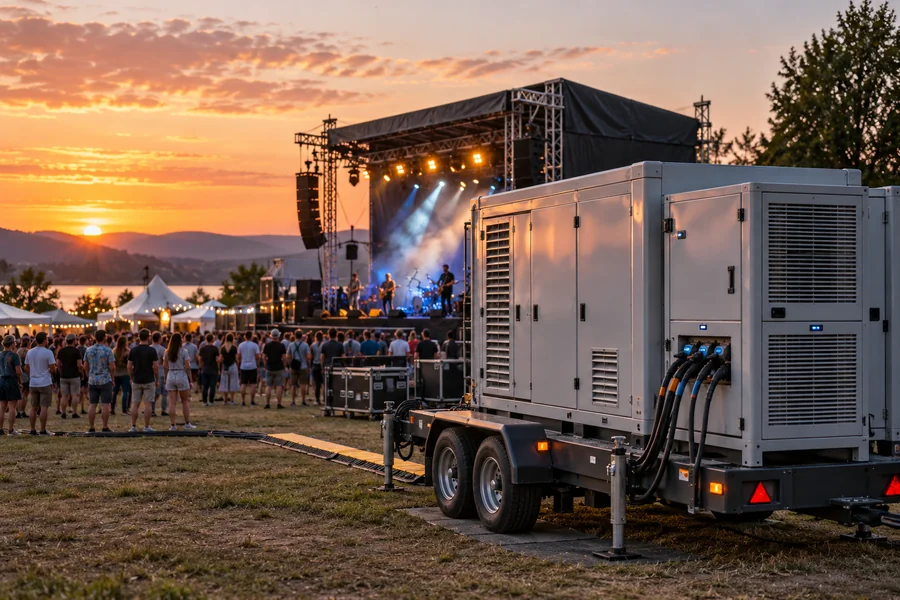
Mobile battery energy storage systems are transforming event power by supplying quiet, flexible electricity for concerts, festivals, sporting events, and temporary venues. These systems store electricity from the grid, solar panels, or generators and release it when needed. Hybrid configurations can reduce generator runtime, fuel consumption, noise, and on-site emissions.
Mobile battery storage transforms event power by delivering quiet electricity, integrating solar and generators, reducing fuel consumption, managing demand peaks, and improving reliability and flexibility.
How Do Mobile Battery Energy Storage Systems Work for Outdoor Events?
Outdoor events often require electricity in locations without sufficient grid access. Traditional generators can supply this electricity, but they may operate inefficiently when demand changes significantly.
A mobile battery energy storage system stores electrical energy in rechargeable batteries and delivers AC electricity through a power conversion system. For outdoor events, it can operate independently or alongside the utility grid, solar panels, and generators. Its control system manages charging and discharging to match changing electricity demand.
What Are the Main Components of Mobile BESS?
Most commercial mobile battery energy storage systems combine several important components.
| Component | Main Function |
|---|---|
| Battery modules | Store electrical energy for later use |
| Battery Management System (BMS) | Monitors battery voltage, temperature, and operating conditions |
| Power Conversion System (PCS) | Converts electrical power between AC and DC |
| Energy Management System (EMS) | Controls charging, discharging, and power distribution |
| Thermal management | Keeps batteries within their operating temperature range |
| Protection systems | Support electrical and battery safety |
The battery provides stored energy, while the PCS determines how much power the system can deliver at a particular moment.
I always distinguish between these two characteristics because a large battery capacity does not automatically mean that the system can support high instantaneous power demand.
How Does Electricity Flow During an Event?
The operating process depends on the available power sources.
For a grid-connected outdoor festival, the batteries can charge before the event or during periods of lower electricity demand.
During performances, the batteries can release stored energy to support stage lighting, sound systems, and other electrical equipment.
If the site has insufficient grid capacity, the battery can supplement the available grid connection during peak periods.
For remote events, operators can combine mobile BESS with generators. The generator supplies electricity when required and can recharge the batteries under suitable operating conditions.
This allows the generator to operate for shorter periods rather than running continuously.
Why Is Energy Management Important?
Event electricity demand is rarely constant.
Stage lighting, audio equipment, food vendors, refrigeration, and temporary infrastructure operate on different schedules.
An EMS helps coordinate these changing requirements and manage the battery's state of charge.
This flexibility makes mobile BESS particularly useful for temporary venues with unpredictable or fluctuating electrical loads.
Why Are Mobile Battery Systems Better Than Traditional Diesel Generators?
Diesel generators have supported outdoor events for decades. However, continuous operation can waste fuel, create noise, and increase maintenance requirements, especially when electricity demand is low.
Mobile battery systems offer several advantages over diesel-only power solutions, including quieter operation, no on-site exhaust emissions during battery discharge, flexible power distribution, and reduced generator operating hours. Hybrid systems combine these advantages with generator support, making them suitable for events with changing loads or limited charging access.
Reduced Noise and On-Site Emissions
Noise is an important concern for concerts, weddings, outdoor exhibitions, and community events.
Diesel generators produce engine noise and vibration throughout their operating periods.
Battery systems operate much more quietly because they do not require an internal combustion engine to produce electricity. Cooling equipment may still generate some sound.
I consider this particularly useful for events where background noise can interfere with performances or disturb nearby residents.
Battery discharge also produces no on-site combustion exhaust.
However, I would not describe every battery-powered event as completely emission-free. The total environmental impact depends on how the battery was charged, how it was manufactured, and whether generators are still used.
Lower Generator Runtime and Fuel Consumption
One of the strongest advantages comes from combining battery storage with an existing diesel generator.
When electricity demand is low, the batteries can supply the load while the generator remains off.
When additional power is required, the generator can restart or operate alongside the battery system.
This approach can reduce inefficient low-load generator operation.
A real example comes from Lollapalooza. According to REVERB's 2025 announcement, the festival's 2024 hybrid battery-powered main-stage deployment reduced fuel use by 67%, saving more than 3,000 gallons.
These results are project-specific, but they demonstrate the potential benefits of well-designed hybrid event power.
Comparing Three Event Power Solutions
| Feature | Diesel Generator | Mobile BESS | Hybrid BESS + Generator |
|---|---|---|---|
| Operating noise | High | Low | Reduced during battery operation |
| On-site exhaust | Yes | None during discharge | Reduced when generator use decreases |
| Fuel consumption | Continuous when running | None during discharge | Depends on generator runtime |
| Energy storage | No | Yes | Yes |
| Remote operation | Fuel-dependent | Charge-dependent | Fuel and battery support |
| Peak load support | Generator rating | PCS and battery limits | Coordinated system capacity |
Mobile BESS is not automatically the lowest-cost solution for every application.
Battery rental, transportation, charging infrastructure, and installation can increase initial project costs.
I recommend comparing total event power costs rather than focusing only on equipment rental prices.
A suitable comparison should include fuel, maintenance, electrical distribution, logistics, labor, and generator operating hours.
Can Mobile Battery Storage Reliably Power Concerts and Large Festivals?
Large events need more than basic electrical capacity. They also require dependable power quality, predictable operation, and suitable backup arrangements.
Mobile battery storage can reliably support concerts and festivals when engineers correctly match battery capacity, inverter output, load characteristics, and charging arrangements. These systems can power stage equipment, lighting, vendor areas, and event infrastructure. Larger events often use multiple battery units, grid connections, or generator-supported hybrid configurations.
Supporting Different Event Applications
Mobile BESS can support several types of temporary electrical loads.
| Event Application | Typical Electrical Requirements |
|---|---|
| Concert stages | Audio systems, lighting, video displays |
| Food festivals | Refrigeration, cooking equipment, vendor outlets |
| Sporting events | Scoreboards, broadcasting, lighting |
| Outdoor exhibitions | Display equipment, temporary booths, electronics |
| Film production | Cameras, lighting, production equipment |
| Emergency facilities | Communications, essential temporary infrastructure |
I find that dividing an event into separate electrical zones makes power planning easier.
For example, organizers can provide dedicated battery capacity for lighting and audio equipment while managing food vendors and auxiliary facilities through separate distribution circuits.
This arrangement can improve load management and reduce the consequences of a fault affecting one circuit.
What Do Real Festival Projects Demonstrate?
Large-scale event deployments show that battery technology has moved beyond small portable power applications.
At Lollapalooza in 2025, the festival announced the return of a hybrid-powered main stage supported by more than 1.5 MWh of battery storage.
The system was designed to support audio, lighting, video, and stage production while reducing biodiesel generator runtime.
Another example is the 2026 Tortuga Music Festival.
REVERB reported that the festival expanded to 30 battery systems and achieved:
- 3,136 hours of avoided generator runtime
- 43% lower fuel consumption
- A broader hybrid battery deployment across the festival site
These examples show how battery systems can support large events when properly integrated with other electrical equipment.
What Determines Power Reliability?
I focus on four practical areas when evaluating event power reliability.
First, the system must support peak power demand. Some audio equipment, motors, and lighting systems create short periods of high electrical demand.
Second, the system needs sufficient energy capacity. A battery that handles peak power may still discharge before the performance ends.
Third, the installation requires suitable protection and distribution. Circuit breakers, grounding, cable sizing, and protection coordination are essential.
Fourth, the operating plan needs contingency capacity. Operators should prepare for delayed performances, charging interruptions, unexpected loads, and equipment faults.
I also distinguish between normal battery backup functions and true uninterruptible power supply performance. Not every mobile BESS provides seamless transfer under all operating conditions.
Equipment specifications and transfer performance must be verified before connecting critical production systems.
How Do You Choose the Right Mobile Battery Energy Storage System for an Event?
Selecting the wrong battery system can create operational problems. A system with insufficient output may trip during peak demand, while insufficient storage capacity can cause an early shutdown.
I select mobile battery storage by evaluating peak power in kilowatts, required energy in kilowatt-hours, event duration, charging availability, equipment compatibility, and safety requirements. The system must provide enough usable energy for the scheduled operating period while maintaining sufficient power capacity and contingency reserves.
Understand the Difference Between kW and kWh
Two measurements are especially important.
Kilowatts (kW) describe how much electrical power a system can deliver at one time.
Kilowatt-hours (kWh) describe how much electrical energy a system can store or deliver over time.
For example, consider an outdoor event with an average electrical load of 30 kW over six hours.
The estimated electrical energy requirement would be:
30 kW × 6 hours = 180 kWh
However, I would not automatically select a 180 kWh battery.
Actual usable energy depends on the permitted depth of discharge, conversion losses, operating temperature, battery condition, and required reserves.
If only 80% of the nameplate capacity is usable and the DC-to-AC delivery efficiency is assumed to be 90%, the theoretical nameplate requirement becomes:
180 kWh ÷ (0.80 × 0.90) = 250 kWh
This is a simplified planning example, not a final equipment specification.
I would also check the peak kW requirement and add an appropriate contingency margin.
Evaluate Charging and Operating Conditions
Battery capacity alone does not determine whether a mobile system is suitable.
I also evaluate the following considerations.
| Selection Factor | Why It Matters |
|---|---|
| Peak output power | Determines whether simultaneous loads can be supported |
| Battery energy capacity | Determines expected operating duration |
| Charging power | Affects battery recharge time |
| AC voltage and frequency | Ensures compatibility with event equipment |
| Parallel operation | Allows compatible systems to support larger loads |
| Weather protection | Supports safe outdoor deployment |
| Transport dimensions | Affects delivery, positioning, and site access |
| Monitoring capability | Supports battery and electrical system supervision |
Check Electrical and Battery Safety
Temporary event installations must follow applicable electrical and fire safety requirements.
For battery systems, relevant technical references may include UL 9540 for complete energy storage system safety and UL 9540A for evaluating thermal runaway fire propagation behavior.
These standards serve different purposes. UL 9540A testing alone should not be represented as equivalent to UL 9540 system certification.
I recommend checking the applicable local requirements, the equipment's actual certification scope, emergency isolation procedures, fire access, and manufacturer installation instructions.
A properly selected mobile battery system should support both the electrical requirements of the event and the practical conditions of temporary deployment.
My Insights: How Mobile Battery Energy Storage Systems Are Transforming Event Power
I believe mobile battery energy storage systems are transforming event power because they change electricity supply from continuous generator operation into flexible, demand-based energy management. The greatest advantage is not simply replacing diesel equipment. It is coordinating stored energy, generators, grid connections, and renewable electricity around the actual operating schedule of an event.
The Biggest Change Is Smarter Power Management
Traditional temporary power systems often depend on generators running for long periods, even when electrical demand is relatively low.
Battery storage provides another option.
An event operator can charge batteries before peak demand, discharge them when required, and use a generator only when additional energy is necessary.
I see this as a more flexible approach to managing temporary electrical infrastructure.
It also creates opportunities to use limited grid capacity more effectively.
For example, a venue with insufficient grid power for peak activity may still have enough available electricity to charge batteries during quieter periods.
The battery can then support peak demand without requiring a larger continuous grid connection.
Hybrid Power Is Often More Practical Than Battery-Only Power
I do not believe every large outdoor event should immediately replace all generators with batteries.
Remote festivals may require many hours of continuous power without access to reliable charging.
In these situations, a hybrid configuration can provide a practical balance.
The battery can supply quieter electricity during low-load periods, while a generator provides additional energy or recharges the battery when necessary.
Solar generation may provide another charging source when weather, available space, and system design permit.
However, solar panels alone cannot guarantee sufficient electricity during nighttime events or poor weather.
The overall design must account for these limitations.
Reliability Must Remain the First Priority
I also believe event organizers should evaluate battery storage using the same reliability standards they apply to conventional power equipment.
Lower noise and fuel consumption are valuable, but they cannot compensate for insufficient power capacity or unsafe installations.
Successful projects require accurate load calculations, suitable electrical protection, appropriate redundancy, and trained operators.
I would also measure actual energy consumption, generator runtime, fuel consumption, and operating costs after each event.
These records can help improve system sizing and dispatch strategies for future projects.
Ultimately, mobile battery storage is changing event power by making electricity delivery more adaptable, measurable, and compatible with cleaner energy sources.
Conclusion
Mobile battery energy storage systems can make event power quieter, more flexible, and less dependent on diesel generators when properly sized, integrated, and operated.
](https://voltcrave-battery.com/wp-content/uploads/2026/06/A-Complete-Guide-to-the-Lifespan-of-Lithium-Ion-Solar-Batteries-768x512.jpg)
](https://voltcrave-battery.com/wp-content/uploads/2026/08/10-Best-Battery-Energy-Storage-Companies-in-2026-768x512.webp)
](https://voltcrave-battery.com/wp-content/uploads/2026/10/What-Is-the-Best-Power-Bank-for-Outdoor-Use-in-2026-768x512.webp)







































