
](https://voltcrave-battery.com/wp-content/uploads/2026/10/Why-Are-E-Bike-Batteries-So-Expensive.webp)
Why Are E-Bike Batteries So Expensive?
E-bike batteries can cost hundreds or even more than a thousand dollars, making replacement surprisingly expensive compared with other bicycle components.
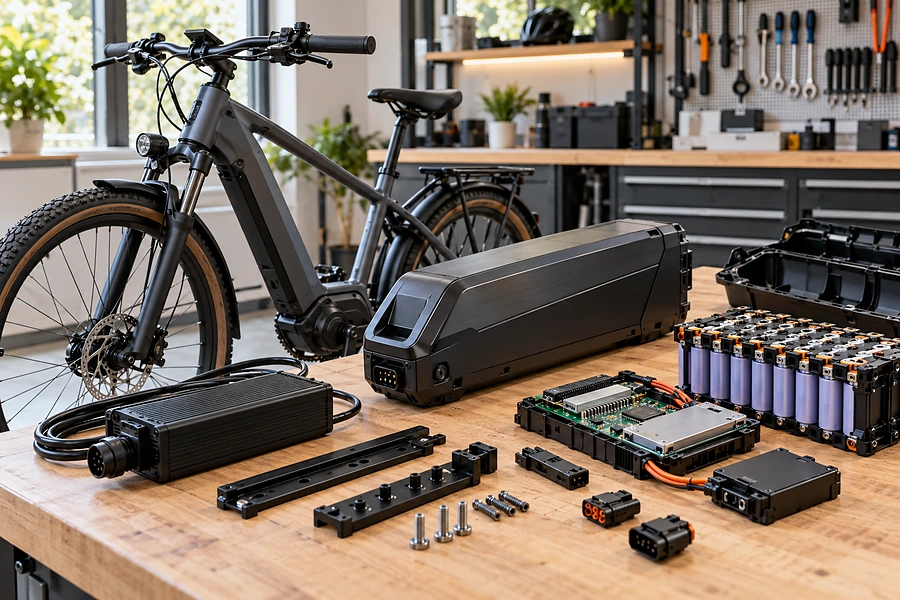
E-bike batteries are expensive because buyers are paying for more than lithium-ion cells. A complete pack includes high-quality cells, a BMS, protective electronics, enclosure, connectors, mounting hardware, waterproofing, thermal and mechanical design, safety testing, transport compliance, software compatibility, warranty, and manufacturer support. Larger-capacity and proprietary OEM batteries usually cost more.
E-bike battery prices include more than cells, covering BMS, engineering, enclosures, safety, compatibility, logistics, warranties, and distribution, so falling costs do not guarantee cheaper replacements.
Why Are E-Bike Batteries So Expensive Compared With Regular Batteries?
An e-bike battery is a high-energy rechargeable power system, not simply a larger household battery.
E-bike batteries cost more because dozens of lithium-ion cells must operate safely as one high-voltage pack while delivering enough power for propulsion. Manufacturers must add battery management, electrical protection, structural protection, weather resistance, connectors, mounting systems, charging compatibility, testing, and quality control around the cells before the battery can be used on a bicycle.
A typical household AA battery is essentially:
Cell → Device
An e-bike battery looks more like:
Cells → Series/Parallel Pack → BMS → Protection → Enclosure → Connector → Controller → Motor
Consider a common 500 Wh-class battery.
Shimano's BT-EN805 is rated around 504 Wh and 36 V. Shimano also specifies a second-generation battery management system, integrated mounting architecture, charge-level functions, error signaling, water resistance, and compatibility with defined mounts and chargers.
Those components and engineering functions add cost.
The battery must also survive conditions that an ordinary consumer battery rarely experiences, including:
road vibration,
repeated impacts,
rain,
temperature changes,
high discharge current,
charging cycles,
and years of repeated mounting and removal.
So the correct comparison is not:
Lithium Cells vs E-Bike Battery Price
It is:
Raw Cells vs Complete Engineered Mobility Battery System.
How Much Do E-Bike Replacement Batteries Cost?
Replacement prices vary dramatically according to capacity, brand, integration, and whether the battery is an original manufacturer product.
E-bike replacement batteries commonly cost several hundred dollars, while premium proprietary packs can exceed $1,000. Current examples show how wide the range can be: Specialized lists a 700 Wh M2/M3 replacement battery at $1,699.99, while another 504 Wh Specialized battery carried a $899.99 original list price before being discounted.
This is an important reality.
A battery with more watt-hours generally requires:
more cells,
more pack volume,
more structural material,
and potentially greater cooling or current capability.
But capacity is not the only reason for price differences.
Two batteries can both contain:
500 Wh
yet have very different retail prices.
One may use:
a generic enclosure,
basic connectors,
and minimal communications.
Another may include:
a custom frame-integrated housing,
proprietary locking hardware,
Bluetooth,
CAN communication,
advanced BMS functions,
firmware,
branded dealer support,
and safety certification.
Therefore:
Same Wh ≠ Same Battery Cost
The total product architecture matters.
Are Lithium-Ion Cells the Main Reason E-Bike Batteries Cost So Much?
Cells are a major cost component, but they do not explain the entire retail price.
Lithium-ion cells contribute significantly to an e-bike battery's cost, particularly when manufacturers use high-quality cells optimized for energy density, current capability, consistency, and cycle performance. However, pack-level electronics, mechanical engineering, certification, logistics, compatibility, warranty, and distribution can make the finished replacement battery much more expensive than the underlying cells alone.
Global lithium-ion battery prices have been falling.
The International Energy Agency reported that average battery prices declined about 8% in 2025, helped by manufacturing improvements, chemistry changes, competition, and lower material costs.
Yet the same IEA analysis also found strong regional price differences. Battery pack prices in China were approximately 30% lower than in North America during 2025.
That matters because an e-bike battery sold through a U.S. dealer is not purchased at an abstract global cell-factory price.
Its retail price can include:
pack manufacturing,
importing,
testing,
distribution,
dealer margin,
warranty reserves,
inventory,
and after-sales support.
This is why:
Falling Cell Cost ≠ Proportional Retail Battery Price Reduction
Why Do High-Quality Battery Cells Cost More?
An e-bike battery needs cells that can repeatedly supply significant current without unacceptable heating, voltage drop, or degradation.
Higher-quality cells generally cost more because manufacturers need consistent capacity, internal resistance, current capability, dimensional quality, and long-term performance across many individual cells. A battery pack is only as reliable as the cells and connections inside it, so established manufacturers often pay more for cell consistency and quality control rather than selecting only the cheapest available cell.
Cell consistency matters because cells are electrically connected.
Suppose a pack contains many parallel and series groups.
If one cell group has:
lower capacity,
higher internal resistance,
or faster self-discharge,
it can limit the usable performance of the entire pack.
This leads to a simple principle:
Pack Quality Depends on Cell Consistency
not merely:
Cell Capacity.
Shimano specifically describes its current 504 Wh e-bike battery as using high-quality cells and states that it retains more than 60% of its initial maximum capacity after 1,000 full charges under its specified conditions.
That kind of long-term performance requires more than simply buying cells with the correct voltage.
It requires:
cell selection,
pack matching,
manufacturing control,
BMS management,
and validated operating conditions.
Why Does the BMS Make an E-Bike Battery More Expensive?
A modern lithium-ion battery cannot be treated like a passive fuel tank.
The Battery Management System adds cost because it monitors and controls the battery pack rather than simply connecting cells to the motor. Depending on the design, it can monitor voltage, current, temperature, state of charge, balancing, charging conditions, discharge limits, faults, and communications with the bicycle or charger.
Shimano explicitly lists a battery management system in its current integrated e-bike batteries.
The BMS can conceptually monitor:
Cell Voltage
Pack Voltage
Current
Temperature
State of Charge
Fault Conditions
and potentially:
Communication With the Bike
A simplified architecture is:
Battery Cells
↓
BMS
↓
Battery Output
↓
Motor Controller
↓
Motor
Without appropriate battery management, a lithium-ion pack could potentially be exposed to undesirable:
overvoltage,
undervoltage,
overcurrent,
temperature,
or imbalance conditions.
UL also treats the battery pack and battery-management functions as important parts of micromobility safety evaluation.
Therefore, part of the battery price is really the price of:
electronic protection and control.
Why Does Battery Safety Increase the Price?
E-bike batteries contain substantial stored energy close to the rider, inside a product exposed to vibration, impacts, charging, and varying temperatures.
Safety adds cost because manufacturers must design against electrical, thermal, mechanical, and charging hazards. Battery packs need appropriate cells, insulation, BMS protection, reliable welds and connections, structural protection, compatible charging, and testing. Third-party certification also requires engineering, testing, documentation, manufacturing controls, and ongoing compliance.
UL 2271 addresses batteries for light electric vehicle applications.
UL 2849 takes a broader system approach to e-bikes by examining the electrical drivetrain, battery system, and charger combination.
This distinction is useful:
UL 2271 → Battery
UL 2849 → E-Bike Electrical System
Safety testing is not simply a sticker added after manufacturing.
A supplier may need to consider:
electrical abuse,
charging faults,
temperature,
vibration,
impact,
component failures,
and functional protection.
UL notes that lithium-ion failures can be associated with factors including excessive heat, physical damage, manufacturing defects, bad welds, contamination, and inadequate electrical design.
Engineering those risks down adds cost.
But for a high-energy battery stored inside a home or attached to a bicycle, this is not an area where the lowest possible manufacturing cost should automatically be the goal.
Why Are OEM E-Bike Batteries More Expensive?
Original equipment batteries frequently include proprietary mechanical and electronic integration.
OEM e-bike batteries can cost more because they are designed for a specific bicycle platform rather than functioning as universal battery boxes. The price may include custom frame geometry, mounting rails, locks, connectors, BMS firmware, charger compatibility, motor-system communication, displays, software integration, dealer service, replacement support, and manufacturer warranty.
Consider an integrated downtube battery.
It must fit a specific:
frame opening,
mount,
electrical connector,
locking mechanism,
and bicycle design.
Shimano's current integrated batteries list exact compatible battery mounts and chargers rather than claiming universal compatibility.
Specialized's 700 Wh replacement battery is similarly designed for specified generations of Levo and Kenevo bicycles rather than as a universal 700 Wh pack.
This creates:
Platform-Specific Value
but also:
Platform-Specific Cost.
The consumer is not simply purchasing:
700 Wh of lithium-ion.
They are purchasing:
700 Wh + Mechanical Compatibility + Electrical Compatibility + Software Compatibility + Support
That is why comparing an OEM battery with a generic pack solely on:
$/Wh
can be misleading.
Why Does Battery Capacity Increase E-Bike Battery Price?
More energy generally requires more battery material.
Higher-capacity e-bike batteries normally cost more because they contain more energy-storage cells and require a pack structure capable of supporting those cells. Capacity is measured in watt-hours, and a battery with greater Wh can usually support longer riding range when other conditions remain comparable. However, capacity alone does not determine retail price.
The basic equation is:
Wh = V × Ah
For example:
36V × 14Ah ≈ 504Wh
A larger:
36V × 20Ah
battery contains approximately:
720Wh.
More Wh usually means:
more cells
or:
larger-capacity cells.
That generally increases material cost.
But it may also change:
weight,
enclosure dimensions,
mounting requirements,
current capability,
and thermal behavior.
Therefore, comparing two products only by Ah is also incomplete.
A:
20Ah 36V
battery contains less nominal energy than a:
20Ah 48V
battery.
Use:
Wh
when comparing energy.
Why Can a Small E-Bike Battery Cost More per kWh Than an EV Battery?
Large-scale manufacturing economics strongly influence battery cost.
An e-bike pack can cost far more per kWh at retail than a large EV pack because it is a relatively small, highly integrated consumer component sold through lower-volume product and replacement channels. Large automotive battery factories spread engineering, automation, procurement, and production costs across enormous manufacturing volumes that small mobility packs cannot always match.
IEA data shows that battery prices vary considerably by:
application,
chemistry,
and region.
This makes direct comparisons difficult.
Suppose a 500 Wh e-bike battery sells for:
$600.
Its retail price per kWh would be:
$600 ÷ 0.5 kWh
= $1,200/kWh.
That does not mean its battery cells cost $1,200/kWh.
The number contains:
packaging,
BMS,
electronics,
mount,
certification,
shipping,
retail distribution,
inventory,
warranty,
and profit margins.
This is the same reason a smartphone battery cannot be compared directly with a utility-scale battery-storage container purely using $/kWh.
Scale changes economics.
Why Does Shipping an E-Bike Battery Cost More?
Lithium-ion batteries are regulated during transportation because of their energy and fire hazards.
Shipping adds cost because lithium batteries are regulated hazardous materials in the United States. Packaging, labeling, documentation, handling, carrier procedures, and testing requirements can apply, especially when batteries are shipped separately from the bicycle. These requirements make battery logistics more complicated than shipping an ordinary bicycle component.
The U.S. Department of Transportation's PHMSA states that lithium batteries are regulated as hazardous materials under the Hazardous Materials Regulations.
Lithium battery designs offered for transportation must also meet applicable UN 38.3 testing requirements, and manufacturers must make test-summary documentation available under applicable rules.
For an e-bike replacement battery, this matters because the battery may be shipped:
separately from the bicycle.
PHMSA specifically notes that uninstalled e-bike lithium batteries must meet applicable lithium-battery packaging, marking, and labeling requirements.
So part of the final replacement price can come from:
Hazmat Logistics
rather than battery materials.
Does Waterproofing Make an E-Bike Battery More Expensive?
An e-bike battery must survive a much harsher environment than many consumer electronics.
Weather protection adds cost because battery housings, seals, connectors, vents, mounts, and electronics must continue working despite rain, dust, vibration, temperature variation, and bicycle washing. Better environmental protection requires more careful enclosure design, sealing, material selection, validation, and manufacturing control.
Shimano's current BT-EN805 family, for example, specifies IPX5 water resistance.
Achieving this requires more than placing cells inside a plastic box.
Designers need to consider:
housing joints,
charge ports,
electrical connectors,
buttons,
displays,
seals,
drainage,
and pressure changes.
At the same time, a battery cannot simply be permanently sealed without thinking about:
heat,
service,
pressure,
and safety.
This mechanical engineering becomes part of the retail price.
Does Battery Cycle Life Affect Price?
A battery designed to retain useful capacity after many cycles may require better cells and tighter system control.
Cycle performance can affect battery price because long-life packs require cell chemistry, quality control, BMS limits, charging algorithms, thermal management, and mechanical construction that support repeated use. Published cycle-life numbers should always be read together with their test conditions because temperature, charge rate, discharge rate, depth of discharge, and end-of-life definition affect the result.
Shimano states that its current 504 Wh BT-EN805 battery retains more than:
60%
of initial maximum capacity after:
1,000 full charges
under its specified conditions.
This does not mean every e-bike battery lasts exactly 1,000 cycles.
It illustrates why battery quality can affect value.
Imagine:
Battery A costs $300
but degrades quickly.
Battery B costs $600
but provides much greater lifetime energy throughput.
Battery B is twice the purchase price.
It may not be twice the lifetime cost.
A useful long-term comparison is:
Lifetime Cost = Purchase Price ÷ Useful Lifetime Energy
not simply:
Initial Price.
Are Cheap Replacement E-Bike Batteries Safe?
Price alone cannot establish safety, but unusually cheap replacement packs deserve careful scrutiny.
A low-cost battery is not automatically unsafe, and an expensive battery is not automatically safe. However, replacement batteries should match the bike's voltage, BMS, charger, connectors, mounting, current requirements, and system specifications. UL advises users to obtain the correct replacement battery and compatible charger rather than substituting unapproved components.
This is especially important because two batteries may both be labeled:
48V lithium-ion
but still differ in:
maximum voltage,
current capability,
connector,
polarity,
communication,
mount,
BMS,
and charger requirements.
Therefore:
Same Voltage ≠ Compatible Battery
A low-priced aftermarket pack may be attractive.
But before purchasing, check:
manufacturer compatibility,
relevant certification,
seller traceability,
charger requirements,
warranty,
and replacement support.
Battery purchasing should begin with:
Compatibility + Safety
before:
Price.
Is LFP Cheaper Than NMC for E-Bikes?
LFP and NMC have different cost and performance characteristics, but the cheapest chemistry does not automatically create the cheapest e-bike pack.
LFP cells are generally less expensive per unit of energy than NMC cells, while NMC retains an energy-density advantage that can be valuable in lightweight mobility applications. For e-bikes, a lower-cost chemistry may require more size or weight for equivalent energy, so manufacturers balance cell price against range, packaging, handling, and total bicycle design.
IEA reported that LFP battery packs were more than 40% cheaper on average than NMC alternatives per kWh in 2025 across the applications it tracks, although application mix influences that difference.
NMC still provides a higher energy-density advantage.
IEA's analysis has noted lower gravimetric and volumetric energy density for LFP compared with NMC.
That difference matters on an e-bike.
A stationary battery can tolerate additional weight relatively easily.
An e-bike carries its battery:
up hills,
through turns,
onto bike racks,
and sometimes up stairs.
Therefore:
Lowest Cell Cost ≠ Best E-Bike Chemistry
Manufacturers must balance:
cost,
weight,
size,
range,
power,
cycle performance,
and safety.
Why Are Replacement Batteries Sometimes More Expensive Than Expected?
Replacement parts operate under different economics from original mass production.
Replacement batteries may be expensive because manufacturers must continue producing, storing, certifying, distributing, and supporting platform-specific packs after the bicycle was originally sold. Lower replacement volumes, dealer distribution, inventory carrying costs, warranty support, and proprietary housings or electronics can increase the retail price compared with commodity cells.
Consider a battery designed for one generation of bicycle.
The manufacturer may need to maintain:
tooling,
suppliers,
firmware compatibility,
service documentation,
spare inventory,
dealer systems,
and transport compliance
for years.
A replacement buyer sees:
one battery.
The manufacturer is supporting:
an installed fleet of bicycles.
This is one reason proprietary batteries can command large prices even when general lithium-ion battery costs decline.
Is an Expensive E-Bike Battery Worth It?
The answer depends on what the higher price actually buys.
A higher-priced e-bike battery can be worthwhile when it provides verified compatibility, high-quality cells, appropriate safety certification, reliable BMS protection, correct mounting, weather resistance, strong cycle performance, warranty support, and dependable service. Paying more only for branding provides less value than paying for measurable performance, safety, and compatibility.
I would compare:
| Factor | Why It Matters |
|---|---|
| Voltage | Must match the bike |
| Wh capacity | Determines stored energy |
| Current capability | Must support motor demand |
| Cell quality | Affects performance and aging |
| BMS | Protects and manages the pack |
| Mount | Must fit correctly |
| Connector | Must be compatible |
| Charger | Must match battery requirements |
| Communication | May be required by integrated systems |
| Water resistance | Important for outdoor use |
| Safety certification | Supports independent safety evaluation |
| Cycle performance | Influences long-term value |
| Warranty | Reduces ownership risk |
| Dealer support | Important for proprietary systems |
| Shipping compliance | Supports legitimate distribution |
A cheap battery that does not communicate with the bicycle has little value.
A large battery that does not fit the frame has no value.
A powerful battery that requires the wrong charger can create a safety problem.
Therefore:
Best Value ≠ Lowest Price.
My Insights: What Really Makes E-Bike Batteries Expensive
The battery cell is only the starting point of an e-bike battery's cost structure.
I see e-bike battery pricing as a systems-engineering problem rather than a raw-material problem. Cells create the stored energy, but BMS electronics, enclosure design, safety testing, weather protection, frame integration, logistics, software compatibility, warranty, distribution, and replacement support turn those cells into a practical mobility product.
My First Insight: Retail $/kWh Is Not Cell $/kWh
A 500 Wh e-bike battery sold for $600 equals:
$1,200/kWh retail.
That does not mean the cells cost $1,200/kWh.
Retail pricing includes the entire finished battery and supply chain.
This distinction explains why consumers may see falling global battery prices while replacement e-bike batteries still feel expensive.
My Second Insight: Proprietary Integration Can Cost More Than Capacity
A custom 500 Wh battery can cost more than a generic 700 Wh battery.
Why?
Because the custom product may need:
specific mounting,
proprietary connectors,
communication protocols,
firmware,
charger compatibility,
and manufacturer support.
For integrated e-bikes:
Compatibility Is Part of the Product.
My Third Insight: Safety Is a Real Part of Battery Cost
E-bike batteries combine:
high energy,
high current,
repeated charging,
outdoor use,
and close proximity to people.
UL 2271 and UL 2849 illustrate the level of battery- and system-level engineering involved in micromobility safety.
PHMSA transportation requirements add another layer because lithium batteries are regulated hazardous materials during shipping.
These costs are part of producing and distributing a legitimate battery product.
My Fourth Insight: A More Expensive Battery Can Still Have Lower Lifetime Cost
Initial price is only one metric.
Suppose:
Battery A costs $350
and:
Battery B costs $600.
If Battery B delivers substantially more reliable cycles, better capacity retention, and stronger warranty support, its cost per useful ride or lifetime kWh may be competitive.
That is why I would evaluate:
Purchase Cost + Expected Life + Reliability + Support
rather than purchase price alone.
My Fifth Insight: Why Are E-Bike Batteries So Expensive?
E-bike batteries are expensive because they are complete engineered energy systems rather than collections of lithium cells. Their price includes high-quality cells, BMS electronics, electrical protection, custom enclosures, weather resistance, mounting and connectors, charger and motor compatibility, safety testing, regulated transportation, software integration, warranty, inventory, and dealer support. High-capacity and proprietary OEM batteries usually add further cost.
The cost structure can be summarized as:
Cells
+
BMS
+
Pack Assembly
+
Enclosure
+
Connectors and Mount
+
Safety Engineering
+
Certification
+
Software and Compatibility
+
Transportation
+
Warranty
+
Distribution
Retail E-Bike Battery Price
That also explains why a premium 700 Wh OEM replacement battery can cost well above $1,000 even while global battery-cell and pack prices are generally declining. Specialized currently lists one 700 Wh replacement battery at $1,699.99, demonstrating how much complete OEM integration can affect retail pricing.
The most useful buying question is therefore not:
“Why is this lithium battery so expensive?”
It is:
“What engineering, compatibility, safety, lifespan, and support am I receiving for this price?”
Conclusion
E-bike batteries are expensive because cells are only part of the product. BMS, safety, integration, enclosure, logistics, compatibility, warranty, and support significantly increase final cost.
](https://voltcrave-battery.com/wp-content/uploads/2026/08/What-Are-Industrial-Energy-Storage-Devices-What-Are-Some-768x512.webp)
](https://voltcrave-battery.com/wp-content/uploads/2026/09/Is-a-Pure-Sine-Wave-Inverter-Better-768x512.webp)
](https://voltcrave-battery.com/wp-content/uploads/2026/06/How-Can-You-Build-Reliable-Base-Station-Power-Solutions-for-Telecom-Networks-768x512.jpg)







































