
](https://voltcrave-battery.com/wp-content/uploads/2026/10/What-Is-the-Best-Portable-Power-Station-for-2026.webp)
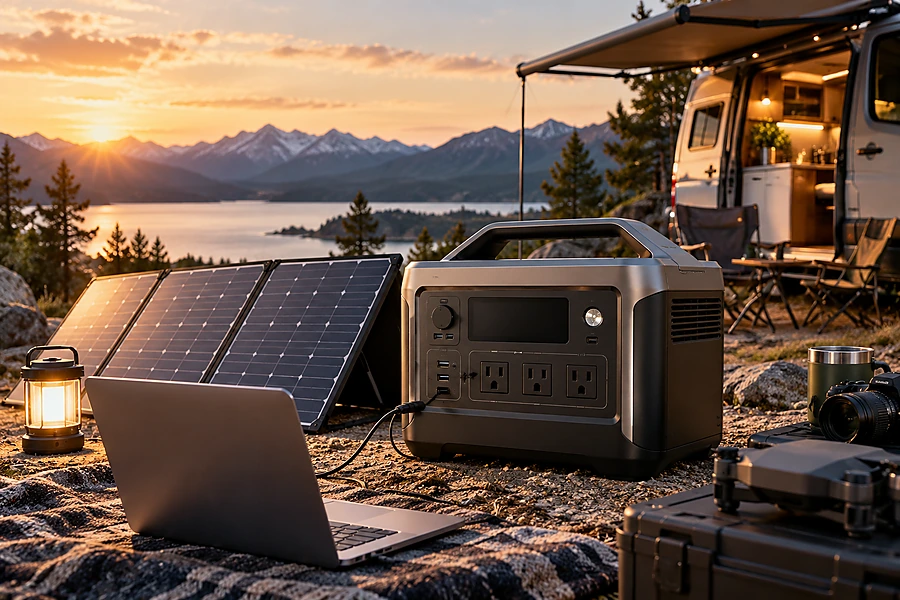
Portable power stations now range from lightweight camping batteries to multi-kWh home-backup systems, making capacity alone a poor way to identify the best model.
For most buyers in 2026, the EcoFlow DELTA 3 Plus is one of the strongest all-around portable power stations, combining 1,024Wh capacity, 1,800W rated AC output, 1,000W solar input, LFP cells, fast charging, a sub-10ms UPS, and expansion to 5kWh. However, Anker, BLUETTI, and Jackery offer better fits for specific priorities.
1kWh balances portability and backup; 2kWh extends camping and outage runtime; 4kWh+ suits RVs and homes. Choose based on energy, power, portability, solar charging, expansion.
What Is the Best Portable Power Station Overall in 2026?
Independent testers do not all choose the same winner, which is useful because portable power stations serve very different applications.
For a broad mix of home backup, camping, road trips, mobile work, and solar charging, the EcoFlow DELTA 3 Plus is my strongest all-around 2026 choice. Its 1,024Wh LFP battery, 1,800W rated output, up to 1,000W solar input, fast AC charging, expandable capacity, and fast UPS transfer create an unusually balanced package without moving into heavy 2–4kWh territory.
TechRadar's August 2026 guide also selected the DELTA 3 Plus as its best overall portable power station after testing more than 50 power stations. Its reviewers highlighted fast charging, quiet operation, compact design, expansion capability, port selection, and a 10ms UPS transfer.
The official specifications include:
| Specification | EcoFlow DELTA 3 Plus |
|---|---|
| Capacity | 1,024Wh |
| Rated AC output | 1,800W |
| Surge output | 3,600W |
| Solar input | Up to 1,000W |
| Battery chemistry | LFP |
| Cycle life | 4,000 cycles to 80%+ |
| Weight | About 27.6 lb |
| Expansion | Up to 5kWh |
| UPS transfer | <10ms |
| Warranty | 5 years |
EcoFlow states that the unit can recharge from AC in about 56 minutes under its specified fast-charge mode.
This combination matters because many 1kWh stations force users to compromise between:
portability,
AC power,
solar input,
UPS performance,
and expansion.
The DELTA 3 Plus performs reasonably strongly in all five categories.
That does not mean it wins every individual metric.
Is the Anker SOLIX C1000 Gen 2 Better Than the EcoFlow DELTA 3 Plus?
For users prioritizing output per pound and very fast AC charging, the Anker is extremely competitive.
The Anker SOLIX C1000 Gen 2 is arguably the stronger 1kWh option when compact size, 2,000W continuous output, low weight, and rapid AC charging matter most. It stores 1,024Wh, weighs about 24.9 pounds, delivers 2,000W, supports a 3,000W peak, and can recharge in about 49 minutes using its UltraFast mode.
Its main specifications are:
| Specification | Anker SOLIX C1000 Gen 2 |
|---|---|
| Capacity | 1,024Wh |
| AC output | 2,000W |
| Peak output | 3,000W |
| Solar input | 600W |
| Weight | 24.9 lb |
| UPS | 10ms |
| Cycle life | 4,000 cycles to 80% |
| Fast AC recharge | About 49 minutes |
GearJunkie's May 2026 testing selected the Anker SOLIX C1000 V2/Gen 2 as its best overall portable power station, emphasizing its combination of power, portability, and new-generation features.
So the comparison is close.
I would summarize it as:
Anker → More AC output in a lighter 1kWh package
EcoFlow → Much higher solar-input ceiling and broader expansion flexibility
For camping with high-power appliances, I would strongly consider the Anker.
For a mixed solar, home-backup, and expansion strategy, I prefer the EcoFlow.
Is the BLUETTI Elite 200 V2 Better for Longer Runtime?
Yes, particularly when roughly 2kWh is more useful than maximum portability.
The BLUETTI Elite 200 V2 is one of the strongest 2kWh-class portable power stations in 2026. It provides 2,073.6Wh capacity, 2,600W AC output, up to 1,000W solar input, and a claimed 6,000+ cycles to 80% capacity, making it attractive for extended outages, RV use, off-grid work, and longer camping trips.
Popular Mechanics named the Elite 200 V2 its best overall portable power station in its September 2026 guide.
In testing, it measured about 92% of listed watt-hour capacity, which the publication reported was above the roughly 85% average it observed among many portable power stations. It also handled multiple high-demand appliances simultaneously in its tests.
Its basic profile is:
| Specification | BLUETTI Elite 200 V2 |
|---|---|
| Capacity | 2,073.6Wh |
| AC output | 2,600W |
| High-load mode | Up to 3,900W |
| Solar input | 1,000W |
| Weight | About 53.4 lb |
| Chemistry | LFP |
| Claimed cycle life | 6,000+ cycles to 80% |
The trade-off is obvious.
At more than:
53 lb
it is much harder to treat as a grab-and-go battery than a 25-pound 1kWh station.
So I would choose the BLUETTI when:
runtime matters more than carrying comfort.
Is the Jackery Explorer 2000 v2 Good for Portable Backup?
The Jackery is particularly interesting because it places roughly 2kWh into a relatively light package.
The Jackery Explorer 2000 v2 combines 2,042Wh with 2,200W rated AC output while weighing about 39.5 pounds. That is unusually portable for the 2kWh class. It uses LFP cells, offers a 4,400W surge rating, and is rated for 4,000 cycles before retaining at least 70% of original capacity.
The major specifications are:
| Specification | Jackery Explorer 2000 v2 |
|---|---|
| Capacity | 2,042Wh |
| AC output | 2,200W |
| Surge | 4,400W |
| Weight | 39.5 lb |
| Chemistry | LFP |
| Cycle life | 4,000 cycles to 70%+ |
| Maximum solar input | 400W |
| Standard AC charge | About 1.75 hours |
For comparison, BLUETTI's Elite 200 V2 gives you more:
output
and:
solar input,
while Jackery provides similar stored energy at substantially lower weight.
That makes the Jackery attractive for users who frequently move a 2kWh station between:
home,
vehicle,
camp,
and:
worksite.
Its main compromise is solar input.
At:
400W maximum
it is much lower than the:
1,000W
available on some competing 2kWh-class systems.
What Is the Best Portable Power Station for Camping?
A 1kWh station usually offers the best balance for general camping.
For most vehicle-based camping, a 1,000–1,100Wh LFP station weighing roughly 24–28 pounds is a practical sweet spot. It provides enough energy for phones, laptops, lighting, portable refrigerators, fans, cameras, and occasional cooking appliances without becoming difficult to carry. The Anker C1000 Gen 2, EcoFlow DELTA 3 Plus, and Jackery Explorer 1000 v2 all fit this category well.
The Jackery Explorer 1000 v2 deserves particular attention for portability.
It provides:
1,070Wh
1,500W rated AC output
3,000W surge
and weighs only:
23.8 lb.
TechRadar selected the Explorer 1000 v2 as its best portable power station for camping in its 2026 guide.
However, the Anker C1000 Gen 2 provides:
2,000W
at only:
24.9 lb, making it especially attractive for campsite appliances with higher instantaneous demand.
Therefore:
Jackery → Excellent lightweight camping option
Anker → More AC power
EcoFlow → Stronger solar and expansion flexibility
What Is the Best Portable Power Station for Home Backup?
Home backup changes the definition of portable.
For refrigerator, internet, lighting, electronics, and selected appliances, a 1–2kWh station can be useful. For larger household loads or longer outages, 4kWh-class systems such as the EcoFlow DELTA Pro 3 become more appropriate, although their size and weight make them transportable rather than genuinely lightweight.
The EcoFlow DELTA Pro 3 provides:
4,096Wh rated capacity
4,000W continuous AC output
8,000W surge
and:
120/240V output.
It supports up to:
2,600W of solar input
and can scale significantly using additional batteries and system components.
Popular Mechanics selected it as its best whole-home-backup option in its 2026 portable-power-station testing. The publication's test setup with an expansion battery delivered 8,096Wh, and testers measured particularly high usable-energy efficiency.
The key distinction is:
Portable ≠ Lightweight
A 4kWh battery system may have wheels and handles but is fundamentally a home/RV backup product.
For true grab-and-go backup, I prefer:
1–2kWh.
For larger emergency loads:
4kWh+ becomes more useful.
How Much Portable Power Station Capacity Do You Need?
The correct capacity depends on your load and required runtime.
Portable power station capacity is measured in watt-hours, while appliance demand is measured in watts. A simple runtime estimate divides usable battery Wh by average load watts. Real runtime will be lower than the theoretical value because inverter losses, standby consumption, temperature, and battery operating limits reduce usable energy.
The basic relationship is:
Runtime ≈ Usable Battery Energy ÷ Average Load
Suppose you have a:
1,024Wh
power station.
At an average:
100W
load, theoretical runtime is:
1,024 ÷ 100
≈ 10.2 hours.
At:
500W
theoretical runtime falls to:
1,024 ÷ 500
≈ 2 hours.
A 2,048Wh-class battery approximately doubles the stored energy.
This is why I would classify portable stations approximately as:
| Capacity | Practical Use |
|---|---|
| 200–500Wh | Phones, laptops, lights, short trips |
| ~1kWh | Camping, fridge, office, basic outage backup |
| ~2kWh | Longer camping, RV, stronger emergency backup |
| 3–5kWh | Large appliances, RV, home backup |
| 5kWh+ | Expandable residential/off-grid systems |
More capacity is not automatically better.
The larger battery also becomes:
heavier,
larger,
and more expensive.
How Much Output Power Should a Portable Power Station Have?
Capacity tells you runtime; output tells you what you can operate.
For general use in 2026, around 1,500–2,000W of continuous AC output is a useful minimum for an all-around 1kWh power station. It can cover most electronics and many kitchen, camping, and household appliances. Larger home-backup systems may need 3,000–6,000W or more, especially when motors and 240V loads are involved.
Consider:
1,024Wh / 2,000W
versus:
2,048Wh / 1,500W.
The second battery stores twice as much energy.
But the first can operate a larger instantaneous load.
This creates the central distinction:
Wh = How Long
W = How Much at Once
You need both specifications.
Is LiFePO4 the Best Battery Chemistry for Portable Power Stations?
For most current portable power stations, LFP is an excellent fit.
LiFePO4, or LFP, has become a preferred portable-power chemistry because it provides strong cycle life, good thermal characteristics, and useful power capability. Its lower energy density than some nickel-rich lithium-ion chemistries can increase weight slightly, but its long service potential makes it especially attractive for backup systems used repeatedly over many years.
The leading products discussed here increasingly use LFP.
EcoFlow rates the DELTA 3 Plus for:
4,000 cycles to 80%+ capacity.
Anker rates the C1000 Gen 2 for:
4,000 cycles to at least 80%.
BLUETTI advertises:
6,000+ cycles to 80%
for the Elite 200 V2.
Cycle-life figures are manufacturer-specific and depend on testing conditions, so they should not be compared as absolute guarantees.
Still, the shift to LFP means modern portable stations are increasingly designed for:
years of regular cycling
rather than:
occasional emergency use only.
How Important Is Solar Input?
Solar input becomes critical when the power station must operate away from the grid for multiple days.
Higher solar-input capacity can dramatically reduce recharge time when enough panels and sunlight are available. A 1kWh battery with 1,000W solar capability has much greater off-grid recharge potential than one limited to 200–400W, although actual output depends on panel orientation, weather, temperature, shading, and system losses.
This is an important strength of the EcoFlow DELTA 3 Plus.
Its two solar inputs support a combined maximum of approximately:
1,000W.
Anker's C1000 Gen 2 supports:
600W.
Jackery's Explorer 1000 v2 supports:
400W.
For someone mainly charging from a wall outlet:
this difference may not matter.
For an off-grid user:
it can be decisive.
Is UPS Capability Important in a Portable Power Station?
Yes, particularly when the device will protect internet, computers, networking equipment, or other electronics.
UPS functionality allows a portable power station to remain connected between the wall outlet and supported equipment, switching to battery power when grid electricity fails. Faster transfer times reduce interruption risk, although portable stations are not automatically equivalent to every dedicated enterprise-grade online UPS.
EcoFlow lists:
<10ms
UPS transfer for the DELTA 3 Plus.
Anker lists:
10ms
for the C1000 Gen 2.
TechRadar specifically highlighted the DELTA 3 Plus UPS behavior after simulating outages while powering equipment including networking and office devices.
For home emergency use, this feature can make a portable power station far more useful than a battery you have to connect manually after the lights go out.
What Should You Look for When Buying a Portable Power Station in 2026?
The best specification depends on use, but I would compare complete systems rather than only battery capacity.
A good portable power station should be evaluated by usable Wh, continuous and surge watts, weight, battery chemistry, cycle life, AC recharge time, solar-input limits, UPS performance, port selection, expansion capability, app controls, warranty, noise, and manufacturer support. Capacity or peak-watt marketing alone is not enough.
A practical comparison of the leading options is:
| Model | Capacity | Rated AC Output | Weight | Solar Input | Strongest Use |
|---|---|---|---|---|---|
| EcoFlow DELTA 3 Plus | 1,024Wh | 1,800W | 27.6 lb | 1,000W | Best balanced 1kWh system |
| Anker C1000 Gen 2 | 1,024Wh | 2,000W | 24.9 lb | 600W | High power + portability |
| Jackery Explorer 1000 v2 | 1,070Wh | 1,500W | 23.8 lb | 400W | Lightweight camping |
| BLUETTI Elite 200 V2 | 2,073.6Wh | 2,600W | 53.4 lb | 1,000W | Long runtime / 2kWh class |
| Jackery Explorer 2000 v2 | 2,042Wh | 2,200W | 39.5 lb | 400W | Lightweight 2kWh backup |
| EcoFlow DELTA Pro 3 | 4,096Wh | 4,000W | Large system | 2,600W | Home/RV backup |
Specifications are based on current manufacturer information as of October 2026.
My Insights: What Really Makes the Best Portable Power Station
The best portable power station is not simply the model with the biggest battery.
I would prioritize the relationship between capacity, output, weight, charging speed, solar input, battery durability, and intended use. A 4kWh station may dominate on home-backup specifications but fail as a camping battery because it is too heavy. A 1kWh unit can therefore be the better portable product even though it stores far less energy.
My First Insight: Around 1kWh Is Still the Portable Sweet Spot
A 1kWh LFP station can now weigh roughly:
24–28 pounds
while providing:
1,500–2,000W
of continuous output.
That is enough for a large range of:
camping,
emergency,
mobile-work,
and household uses
without requiring wheels.
My Second Insight: Solar Input Matters More Than Many Buyers Expect
A strong off-grid power station needs to replace the energy it consumes.
A huge battery with very slow solar charging can become much less useful after:
day one
or:
day two.
For solar-intensive use, the DELTA 3 Plus's 1,000W input is a major advantage in its capacity class.
My Third Insight: The Best 2kWh Station Is Not Necessarily the Best 1kWh Station
Popular Mechanics chose the BLUETTI Elite 200 V2 as its overall 2026 winner, while TechRadar chose the EcoFlow DELTA 3 Plus and GearJunkie chose the Anker SOLIX C1000 Gen 2.
That disagreement makes sense.
They occupy different:
weight,
capacity,
power,
and usage
trade-offs.
There is no contradiction in one reviewer preferring a:
2kWh workhorse
while another prefers a:
1kWh portable all-rounder.
My Fourth Insight: Portability Should Be Measured in Pounds, Not Product Names
A 25-pound station and a 130-pound station can both be marketed as:
portable power stations.
But they serve completely different roles.
For frequent carrying, I would generally target:
roughly 25–40 lb or less.
For wheeled home and RV backup, a much larger unit becomes reasonable.
My Fifth Insight: What Is the Best Portable Power Station for 2026?
For most buyers, I consider the EcoFlow DELTA 3 Plus the best balanced portable power station for 2026 because its 1,024Wh LFP battery, 1,800W rated output, 1,000W solar capability, fast AC charging, sub-10ms UPS, 27.6-pound weight, and expansion to 5kWh cover an unusually broad range of camping, emergency, mobile-work, and home-backup needs.
However, I would select differently when one requirement dominates:
| Priority | Strong 2026 Choice |
|---|---|
| Best balanced overall | EcoFlow DELTA 3 Plus |
| High-output 1kWh portability | Anker SOLIX C1000 Gen 2 |
| Lightweight camping | Jackery Explorer 1000 v2 |
| Best 2kWh-class runtime | BLUETTI Elite 200 V2 |
| Lightweight 2kWh-class backup | Jackery Explorer 2000 v2 |
| Large home/RV backup | EcoFlow DELTA Pro 3 |
So I would not begin by asking:
“Which portable power station has the largest battery?”
I would ask:
“How many watts must it run, how many watt-hours do I need, how often will I carry it, and how will I recharge it off-grid?”
Those four questions usually identify the correct product category quickly.
Conclusion
For most users in 2026, the EcoFlow DELTA 3 Plus offers an excellent balance of portability, power, LFP durability, fast charging, solar input, UPS capability, and expansion.
](https://voltcrave-battery.com/wp-content/uploads/2026/10/What-Is-the-Best-Small-Battery-Backup-for-a-Home-768x512.webp)
](https://voltcrave-battery.com/wp-content/uploads/2026/09/How-Much-Battery-Storage-Do-You-Need-for-a-Solar-System-768x512.webp)
](https://voltcrave-battery.com/wp-content/uploads/2026/10/Do-I-Really-Need-a-Pure-Sine-Wave-Inverter-768x512.webp)







































