
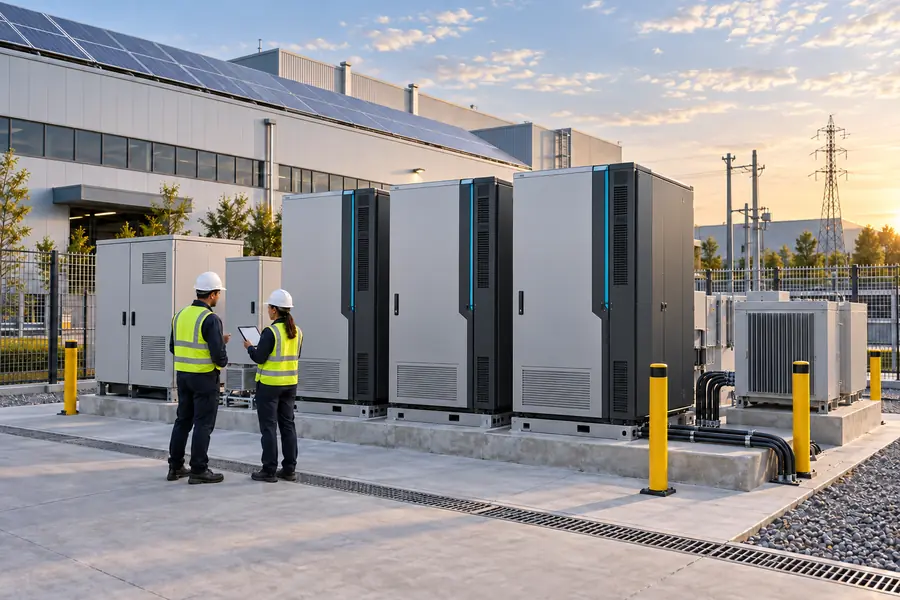
](https://voltcrave-battery.com/wp-content/uploads/2026/10/What-Are-the-Most-Common-Questions-When-Building-a-Commercial-and-Industrial-Energy-Storage-System.webp)
Building a commercial and industrial energy storage system involves many technical and financial decisions. Poor planning can lead to oversized batteries, unexpected costs, safety problems, and disappointing performance.
The most common questions when building a commercial and industrial energy storage system concern battery capacity, system components, safety requirements, installation costs, and return on investment. Businesses must determine their power requirements, select suitable battery technology, verify grid compatibility, and evaluate whether the system can reduce electricity costs or provide reliable backup power.
I believe successful C&I energy storage projects begin with clear technical requirements rather than selecting a battery product immediately. Factories, warehouses, commercial buildings, and industrial facilities have different electricity consumption patterns. The right system must balance power output, energy capacity, safety, reliability, and operating costs. Understanding the most important questions early helps project developers, engineers, and business owners avoid expensive mistakes.
How Do You Determine the Right Size for a Commercial and Industrial Energy Storage System?
Battery sizing is one of the first challenges when planning a C&I energy storage project. An undersized system may fail to meet demand, while an oversized system can increase investment without delivering enough additional value.
The correct size of a commercial and industrial energy storage system depends on peak power demand, daily electricity consumption, required backup duration, and operating objectives. Engineers determine battery power in kilowatts (kW) and energy capacity in kilowatt-hours (kWh) by analyzing electricity bills, historical load profiles, and intended applications.
How Much Battery Capacity Does a Commercial Building Need?
I usually begin by identifying why the facility needs energy storage.
Common objectives include peak shaving, electricity price optimization, solar energy self-consumption, emergency backup, and demand management.
These applications have different sizing requirements.
For example, a warehouse may need a relatively small battery to reduce short demand peaks.
A manufacturing facility requiring several hours of backup power may need much more battery capacity.
A commercial building with rooftop solar panels may use storage to shift excess daytime electricity into evening operating hours.
I would review at least 12 months of electricity consumption data when possible.
Fifteen-minute interval data or similarly detailed metering records can be particularly useful for identifying demand peaks.
What Is the Difference Between kW and kWh?
I consider this distinction essential for every energy storage project.
Kilowatts (kW) describe electrical power.
Kilowatt-hours (kWh) describe the amount of stored or consumed energy.
A system rated at 250 kW / 500 kWh can theoretically deliver 250 kW for approximately two hours at its rated energy-to-power ratio.
However, actual output duration depends on usable energy, conversion losses, temperature, operating limits, and battery degradation.
A simple sizing formula is:
Required Energy (kWh) = Average Supported Load (kW) × Backup Duration (hours)
For example, a facility requiring 200 kW for three hours needs 600 kWh of delivered AC energy.
The installed battery capacity must be larger if the rated capacity includes energy that cannot be used or if system losses must be covered.
I would also examine the highest simultaneous electrical loads, starting currents, and requirements for operating during grid outages.
What Are Common C&I Battery System Configurations?
| Illustrative System Size | Nominal Duration | Potential Application |
|---|---|---|
| 50 kW / 100 kWh | 2 hours | Small commercial peak shaving |
| 100 kW / 215 kWh | 2.15 hours | Commercial load management |
| 250 kW / 500 kWh | 2 hours | Industrial demand management |
| 500 kW / 1 MWh | 2 hours | Factory or warehouse energy storage |
| 1 MW / 2 MWh | 2 hours | Large commercial or industrial facility |
| 1 MW / 4 MWh | 4 hours | Longer-duration storage applications |
These are illustrative configurations, not standard sizing recommendations.
I would not assume that a 1 MWh battery is suitable for every large factory.
The National Renewable Energy Laboratory's 2025 Annual Technology Baseline models commercial battery systems across different storage durations and emphasizes the separate costs associated with battery energy capacity and power equipment.
I would use actual load data and dispatch simulation before finalizing the system size.
Can a C&I Battery System Work Without Solar Panels?
Yes. Commercial battery storage systems can charge from the utility grid without solar panels.
A grid-charged system may store electricity during lower-price periods and discharge during higher-price periods.
It can also support peak demand reduction.
However, businesses seeking backup during a power outage need an appropriately designed system capable of safe islanded operation.
A standard grid-connected battery system does not automatically provide backup power when the utility fails.
What Equipment Is Required to Build a C&I Battery Energy Storage System?
Commercial battery storage involves much more than installing battery modules. Multiple electrical, thermal, and digital control systems must work together to provide reliable energy storage and power delivery.
A complete C&I battery energy storage system typically includes LiFePO4 battery modules, a battery management system, a power conversion system, an energy management system, electrical protection equipment, thermal management, and communication devices. Depending on the installation, transformers, switchgear, fire protection systems, and grid interconnection equipment may also be required.
What Are the Main Components of a C&I BESS?
I divide the main components into energy storage, power conversion, control, and system protection.
| Component | Main Function |
|---|---|
| LiFePO4 Battery Modules | Store electrical energy |
| Battery Management System (BMS) | Monitors battery cells and protects operating limits |
| Power Conversion System (PCS) | Converts electrical power between AC and DC |
| Energy Management System (EMS) | Optimizes charging, discharging, and operating schedules |
| Thermal Management System | Controls battery and equipment temperatures |
| Electrical Control Cabinet | Houses specified control, switching, and protection equipment |
| Switchgear and Circuit Breakers | Provide electrical switching and fault protection |
| Transformer | Matches voltage levels when required |
| Fire Detection and Protection Equipment | Supports hazard detection and mitigation |
| Monitoring and Communication System | Provides operating data, alarms, and remote supervision |
Every component must match the overall system design.
For example, the PCS must support the specified battery voltage range and operating power.
The EMS must communicate correctly with the BMS and PCS.
Electrical protection must be coordinated with the available fault current and installation requirements.
What Is the Difference Between BMS, PCS, and EMS?
I consider these three systems central to reliable battery operation.
Battery Management System (BMS)
The BMS monitors battery voltage, current, temperature, and other operating conditions.
It estimates battery state of charge and may estimate state of health.
It also provides protection functions and operating limits to other equipment.
Power Conversion System (PCS)
The PCS controls energy conversion between the battery's DC electrical system and the facility's AC electrical system.
It manages battery charging and discharging within the required electrical operating conditions.
The selected PCS determines important capabilities, including AC output power and supported grid functions.
Energy Management System (EMS)
The EMS coordinates battery operation according to the project objectives.
For example, it may schedule battery charging during low electricity price periods and discharge during peak demand periods.
It can also coordinate battery storage with solar generation, facility loads, and other compatible energy resources.
I would verify the communication protocols and operating responsibilities between these systems before purchasing equipment.
Is LiFePO4 the Best Battery Chemistry for C&I Energy Storage?
I generally consider lithium iron phosphate, or LiFePO4, a strong choice for stationary C&I energy storage.
LFP batteries offer long cycle-life potential, good thermal stability, and competitive lifecycle costs.
They are commonly used in outdoor battery cabinets and containerized energy storage systems.
However, I would compare more than the battery chemistry.
Important purchasing specifications include rated energy capacity, usable energy, discharge power, charge and discharge rates, thermal performance, and warranty conditions.
I would also check the battery's expected capacity retention over the project lifetime.
Should I Choose an Outdoor Cabinet or Containerized BESS?
The physical system configuration depends on available space, power requirements, access, and expansion plans.
Outdoor Battery Cabinet
An outdoor battery cabinet can be suitable for small and medium commercial installations.
It may combine batteries, thermal management, controls, and other equipment in one enclosure.
Some systems integrate the PCS, while others use separate power conversion equipment.
Containerized Battery Energy Storage System
Containerized systems are often used for larger industrial and utility-scale installations.
They can house substantial battery capacity and supporting equipment in a factory-assembled enclosure.
I would choose the enclosure based on technical requirements rather than battery capacity alone.
Installation clearances, maintenance access, local environmental conditions, and fire safety requirements are important for both designs.
What Safety Standards and Installation Requirements Apply to C&I Energy Storage Systems?
Safety and regulatory compliance are major concerns for commercial battery projects. Battery systems store significant electrical energy, and failures can create fire, electrical, and operational hazards.
C&I energy storage systems must follow applicable electrical, building, fire, and grid interconnection requirements. Important standards in the United States include UL 9540, UL 9540A, NFPA 855, and IEEE 1547. Requirements vary by jurisdiction, project size, installation location, and the system's intended operation.
What Certifications Are Required for a C&I Battery System?
I recommend confirming applicable standards before equipment selection and procurement.
| Standard | Main Application |
|---|---|
| UL 9540 | Safety certification for energy storage systems and equipment |
| UL 9540A | Test method for evaluating battery thermal runaway and fire propagation |
| UL 1973 | Safety requirements for applicable stationary battery products |
| IEC 62619 | Safety requirements for industrial lithium cells and batteries |
| NFPA 855 | Installation safety requirements for stationary energy storage systems |
| IEEE 1547 | Interconnection and interoperability of distributed energy resources |
| IEC 62933 Series | Electrical energy storage system requirements and guidance |
Not every project requires every standard listed.
The applicable requirements depend on the local jurisdiction, battery system architecture, and intended market.
I would also distinguish between a certified complete energy storage system and certified individual components.
A certified battery module does not automatically make the entire assembled BESS compliant.
Why Are UL 9540 and UL 9540A Different?
UL 9540 evaluates the safety of energy storage systems and their integrated components.
UL 9540A is a test method used to evaluate thermal runaway behavior and related fire and explosion hazards.
I would not describe UL 9540A as a complete system safety certification.
The results of UL 9540A testing help manufacturers, engineers, and authorities assess suitable installation conditions and fire protection measures.
In 2026, important updates to NFPA 855 and UL 9540A placed additional attention on large-scale fire testing.
The sixth edition of UL 9540A was published on March 13, 2026.
I would confirm which code editions have been adopted by the local authority having jurisdiction before finalizing fire protection design.
What Should Be Considered Before Installing a Battery Cabinet?
I examine site conditions before selecting installation equipment.
Important considerations include:
- Available installation area and maintenance clearances
- Indoor or outdoor installation requirements
- Ambient temperature, humidity, and environmental exposure
- Flood risk and physical impact protection
- Foundation and structural requirements
- Electrical cable routing and grounding
- Fire detection and mitigation arrangements
- Required emergency access and shutdown procedures
- Distance from buildings and other equipment, where required
- Local permits, inspections, and utility approvals
I would coordinate with qualified electrical engineers, fire protection specialists, installers, and local authorities early in the project.
Can a Commercial BESS Connect Directly to the Grid?
Many commercial battery systems can operate in parallel with the utility grid.
However, utility approval may be necessary before connection or operation.
The interconnection process can involve electrical studies, equipment documentation, protection settings, metering arrangements, and commissioning tests.
In the United States, IEEE 1547 provides important technical requirements for distributed energy resource interconnection.
Other countries and utilities have their own applicable grid codes.
I would also check whether the project is permitted to export electricity.
A zero-export battery system may have different operating requirements from a system designed to sell electricity into the grid.
Can a C&I Battery Provide Backup During a Power Outage?
Yes, but this capability must be designed into the system.
A battery that performs peak shaving while connected to the grid may shut down during an outage if it does not support islanded operation.
For backup applications, I would verify grid-forming capability where needed, safe electrical isolation, transfer arrangements, critical-load distribution, and compatible controls.
A factory with sensitive production equipment may also need separate uninterruptible power supplies for loads that cannot tolerate the system's transfer time.
I would always ask suppliers to demonstrate the required backup operating mode during commissioning.
How Much Does a Commercial and Industrial Energy Storage System Cost, and Is It Worth It?
Commercial battery storage can reduce operating costs, but financial performance varies widely between facilities. Equipment prices alone cannot determine whether a project makes economic sense.
The cost of a C&I energy storage system depends on battery capacity, PCS power, installation complexity, certifications, grid connection, and supporting equipment. Financial returns come from applications such as peak shaving, time-of-use energy shifting, solar self-consumption, and avoided outage losses. A project-specific financial analysis is necessary to determine payback.
What Determines the Total Cost of a C&I BESS?
I divide the project budget into several categories.
| Cost Category | Included Items |
|---|---|
| Battery Equipment | Cells, modules, racks, battery management |
| Power Conversion | PCS, inverters, transformers |
| Electrical Equipment | Switchgear, breakers, control cabinets, cables |
| Thermal Management | HVAC or liquid cooling equipment |
| Fire Safety | Detection, mitigation, protection systems |
| Installation | Foundation, equipment placement, electrical work |
| Engineering | System design, studies, documentation |
| Interconnection | Utility studies, metering, required upgrades |
| Commissioning | Testing, configuration, inspection |
| Operating Costs | Maintenance, monitoring, insurance, replacements |
I would request an itemized installed-system quotation rather than comparing only the manufacturer's battery price per kWh.
A battery pack quotation does not represent the complete installed cost.
For example, a 500 kWh battery system with a 250 kW PCS has different equipment requirements from a 500 kWh battery system with a 500 kW PCS.
Both have the same nominal energy capacity, but their power ratings and operating capabilities differ.
The 2025 Annual Technology Baseline published by the National Laboratory of the Rockies uses separate energy-related and power-related cost components for commercial battery systems.
I consider that distinction essential when comparing project quotations.
How Does Peak Shaving Reduce Electricity Costs?
Peak shaving is a common commercial energy storage application.
Some electricity tariffs charge businesses according to their maximum grid demand during a billing period.
A battery can discharge during high-demand periods to reduce electricity drawn from the utility.
For example, consider a facility that can consistently reduce its billed demand by 100 kW.
If the applicable demand charge is $15 per kW per month, the illustrative gross demand-charge saving is:
100 kW × $15/kW = $1,500 per month
This equals $18,000 per year before charging costs, energy losses, operating expenses, and other tariff effects.
Actual savings may be lower because peak demand timing, ratchet clauses, measurement intervals, and battery availability affect billing outcomes.
I would use interval load data and the actual utility tariff to model the result.
Can Energy Storage Reduce Electricity Bills Without Solar?
Yes.
A standalone battery can charge from the electrical grid and discharge at strategically selected times.
When a business has time-of-use electricity pricing, the system may charge when electricity is inexpensive and discharge during more expensive periods.
However, battery round-trip efficiency is less than 100%.
I would account for energy losses and battery wear when calculating savings.
Some facilities may also participate in demand response or other grid services when their market rules and interconnection arrangements allow it.
I would not include grid-service revenue unless eligibility and compensation are reasonably supported.
How Long Does It Take to Recover the Investment?
I calculate simple payback using:
Simple Payback Period = Initial Project Investment ÷ Annual Net Cash Savings
For a realistic business case, I would include equipment and installation costs, electricity savings, maintenance, insurance, financing, battery degradation, and any necessary replacements.
I would also evaluate project cash flow using net present value and internal rate of return where appropriate.
A battery may provide operational benefits that are difficult to express as simple electricity savings.
For example, avoiding an interruption to a critical production line can be valuable.
However, I would only include avoided outage losses after assessing outage frequency, actual production impacts, and the system's ability to support critical loads.
The best C&I energy storage investment is not necessarily the largest system.
It is the one that delivers useful and measurable benefits over its intended service life.
My Insights: What Are the Most Common Questions When Building a Commercial and Industrial Energy Storage System
I believe the most common questions about C&I energy storage reveal a deeper issue: many projects begin with battery capacity or equipment price before defining the business objective.
A successful project needs a clear connection between energy requirements, system engineering, financial performance, and long-term operation.
Start With the Business Problem, Not the Battery Size
I would first ask why the facility needs an energy storage system.
Is the main objective to reduce electricity demand charges?
Does the company need to store excess solar energy?
Is emergency backup more important than daily energy savings?
Does the facility plan to expand production or install additional EV charging infrastructure?
Each answer changes the optimal system configuration.
I believe project developers should establish clear operating priorities before choosing battery capacity.
A system optimized for short demand peaks may not provide enough energy for long-duration backup.
A system designed to maintain critical production loads during outages may need additional controls and grid-forming equipment.
Evaluate the Whole System Rather Than Individual Components
I consider system integration one of the most important factors in C&I battery projects.
High-quality battery cells cannot guarantee reliable performance if the PCS, BMS, and EMS do not communicate correctly.
Poor thermal management can reduce efficiency and accelerate battery degradation.
Incorrect electrical protection can create serious safety risks.
I would therefore evaluate the complete battery energy storage system, including its controls, protection equipment, installation conditions, and documented operating limits.
For supplier qualification, I prefer clearly defined responsibility for component compatibility, commissioning, and warranty support.
Include Safety and Grid Approval Early
I would never treat fire safety and interconnection requirements as final administrative tasks.
These requirements can affect the system layout, enclosure selection, installation cost, and project schedule.
Early discussions with local authorities and utilities can help identify issues before major equipment is purchased.
I would also confirm which party is responsible for providing certification records, fire test reports, electrical drawings, and commissioning documentation.
The project should not depend on unclear assumptions about local code acceptance.
Long-Term Support Is Part of the Investment
I consider operating performance after installation just as important as initial equipment specifications.
Battery systems degrade over time.
Some components require maintenance or eventual replacement.
A reliable supplier should provide clear warranties, monitoring access, maintenance guidance, spare-part support, and technical assistance.
I would review how the warranty treats battery capacity retention, energy throughput, cycling conditions, and system availability.
I would also request factory acceptance testing and site acceptance testing with defined pass criteria.
For connected systems, I would verify cybersecurity controls, access permissions, software updates, and remote maintenance procedures.
My Recommended Project Development Approach
I would organize a typical C&I energy storage project into six stages:
- Energy assessment: Collect electricity bills, interval load data, tariff information, and operating requirements.
- System sizing: Determine the required PCS power, usable battery capacity, operating duration, and installation configuration.
- Technical selection: Compare battery chemistry, BMS, PCS, EMS, thermal management, and integrated system performance.
- Safety and approval: Confirm applicable standards, fire requirements, permits, and utility interconnection conditions.
- Financial evaluation: Model the installed cost, operating expenses, savings, incentives, and long-term project returns.
- Installation and commissioning: Verify electrical performance, system controls, protection functions, and ongoing service arrangements.
I would also document the project requirements in a technical specification before requesting final supplier quotations.
Conclusion
Building a successful C&I energy storage system requires proper sizing, compatible equipment, safety compliance, and financial planning. Clear project requirements and reliable integration support long-term performance.
](https://voltcrave-battery.com/wp-content/uploads/2026/08/The-Ultimate-Guide-to-Commercial-Battery-Energy-Storage-Systems-BESS-A-Strategic-Investment-for-Modern-Business-768x512.webp)
](https://voltcrave-battery.com/wp-content/uploads/2026/08/What-Are-Stacked-Batteries-and-How-Do-They-Work-768x512.webp)
](https://voltcrave-battery.com/wp-content/uploads/2026/06/The-Real-Cost-of-Commercial-Battery-Energy-Storage-in-2026-What-You-Need-to-Know-768x512.jpg)







































