
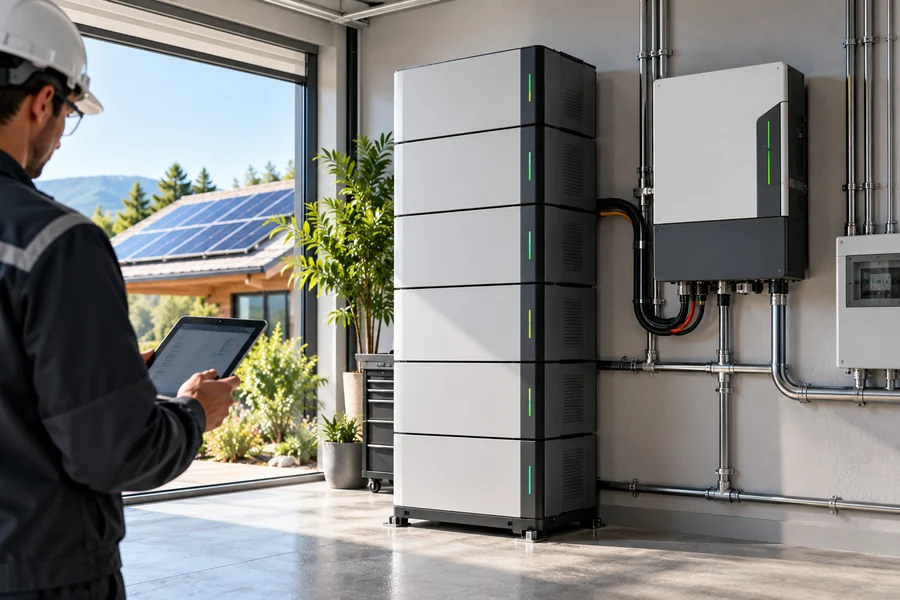
](https://voltcrave-battery.com/wp-content/uploads/2026/10/Advantages-of-Using-High-Voltage-LiFePO4-Batteries-in-Energy-Storage.webp)
Energy storage systems need high efficiency, dependable power, and long service life. Poor battery architecture can increase electrical losses, installation costs, and safety risks.
High-voltage LiFePO4 batteries offer several advantages for energy storage, including lower current at the same power, reduced conductor losses, flexible modular expansion, and good thermal stability. Their lithium iron phosphate chemistry supports long-cycle-life applications, while the high-voltage architecture can improve system-level power delivery when matched with suitable inverters and electrical protection.
I believe high-voltage LiFePO4 technology is particularly valuable for residential solar storage, commercial battery systems, and applications that require substantial electrical power.
What Are the Main Advantages of High-Voltage LiFePO4 Batteries?
High-voltage battery systems are becoming common in residential and commercial energy storage. However, their benefits come from both the battery chemistry and the electrical system architecture.
The main advantages of high-voltage LiFePO4 batteries are lower current during high-power operation, reduced potential cable losses, compatibility with suitable high-voltage inverters, modular energy storage expansion, and favorable battery durability. Their LFP chemistry also provides thermal stability, although safe operation still depends on proper battery management and electrical protection.
Lower Current at the Same Power
I consider lower operating current one of the most important advantages of a high-voltage battery system.
Electrical power depends on voltage and current.
The basic formula is:
Power (W) = Voltage (V) × Current (A)
For the same power requirement, increasing the operating voltage reduces the required current.
For example, consider a battery system supplying 10kW of DC power.
At 51.2V:
10,000W ÷ 51.2V = 195.3A
At 400V:
10,000W ÷ 400V = 25A
The 400V system requires much less current to deliver the same electrical power.
I believe this difference is important for energy storage applications that must support higher output power.
Lower current can simplify some aspects of conductor sizing and reduce resistive heating.
However, the high-voltage installation requires appropriately rated insulation, connectors, contactors, and protection equipment.
Reduced Cable Losses and Heat Generation
Electrical current produces heat when it flows through components with resistance.
The relationship is:
Resistive Power Loss = Current² × Resistance
I consider this important because current has a squared relationship with resistive losses.
For otherwise equal resistance, a lower-current electrical connection experiences less resistive heating.
This can provide benefits in appropriately designed high-power battery installations.
However, I would not assume that every high-voltage battery system has lower total losses than every 48V system.
The complete system includes internal battery resistance, wiring, contactors, power electronics, and thermal management equipment.
The overall efficiency depends on all these components.
Better Integration With High-Voltage Inverters
Many modern residential and commercial energy storage inverters are designed for high-voltage battery inputs.
A compatible high-voltage LiFePO4 battery can operate within the inverter's specified DC voltage range.
This may allow the power conversion system to use an architecture better suited to the target application.
For example, some high-voltage hybrid inverter configurations can reduce the need for a large voltage step-up stage compared with certain low-voltage battery designs.
However, this depends on the inverter topology.
I recommend checking the complete conversion architecture instead of assuming that higher battery voltage always removes a conversion stage.
Modular and Expandable Battery Design
High-voltage LiFePO4 systems commonly use modular battery construction.
A battery stack may contain several modules connected in series.
Additional modules can increase total voltage and energy capacity within the manufacturer's supported configuration.
For example, the BYD Battery-Box Premium HVS product family uses modular battery units to create different storage capacities.
The manufacturer also supports specified parallel stack configurations.
I consider this useful for residential and commercial projects that need different battery sizes.
However, modular expansion must follow the manufacturer's approved design.
Modules should not be added or connected arbitrarily.
High-Voltage vs. Low-Voltage LiFePO4 Batteries
| Feature | High-Voltage LiFePO4 | Low-Voltage LiFePO4 |
|---|---|---|
| Typical architecture | Hundreds of volts DC | Commonly 48V/51.2V |
| Current at equal power | Lower | Higher |
| Cable loss potential | Lower for comparable resistance | Higher-current design required |
| Inverter compatibility | High-voltage models | Low-voltage models |
| Battery chemistry | LFP | LFP |
| Cycle-life potential | Depends on cells and conditions | Depends on cells and conditions |
| Expansion | Manufacturer-approved configurations | Often modular |
| Safety requirements | Higher-voltage protection | High-current protection |
| Applications | Residential and C&I ESS | Telecom, off-grid, residential ESS |
I believe high-voltage architecture becomes especially attractive as system power requirements increase.
However, a properly designed low-voltage system remains suitable for many energy storage applications.
How Do High-Voltage LiFePO4 Batteries Improve Energy Storage Efficiency and Power Performance?
Energy storage efficiency depends on how electricity moves between the battery, inverter, and connected equipment. Poor system design can increase losses and reduce usable electricity.
High-voltage LiFePO4 batteries can improve power delivery by reducing current at a given power level and supporting compatible high-voltage conversion equipment. Lower current may reduce conductor losses and simplify some high-power connections. However, overall round-trip efficiency depends on battery resistance, inverter topology, auxiliary loads, operating temperature, and system design.
Reduced DC Current Supports High-Power Applications
I consider the current reduction especially useful when an energy storage system supplies substantial power.
For example, a commercial system may need to provide 20kW or more during peak demand.
At 51.2V, delivering 20kW would theoretically require approximately:
20,000W ÷ 51.2V = 390.6A
At 400V:
20,000W ÷ 400V = 50A
These calculations exclude conversion losses and use nominal voltage.
They demonstrate the different current levels required by the two electrical architectures.
I believe lower current can make certain high-power designs more practical.
However, the battery must still provide the required discharge power.
The BMS, cells, busbars, contactors, and inverter must all support the intended operating conditions.
Lower Resistive Losses Can Improve Electrical Design
I evaluate conductor heating using current and resistance.
Suppose two hypothetical connections have equal resistance of 0.01 ohm.
At 100A:
Power Loss = 100² × 0.01 = 100W
At 25A:
Power Loss = 25² × 0.01 = 6.25W
The lower-current connection experiences significantly less resistive loss under these assumptions.
However, this example applies only to the specified resistance.
A complete battery system has many additional components.
I would not use this calculation to claim a fixed whole-system efficiency improvement.
Instead, I would compare the actual energy delivered through the complete power conversion system.
Inverter Compatibility Can Reduce Design Complexity
Some high-voltage hybrid inverters are designed to connect directly to compatible battery stacks.
This can simplify the electrical architecture compared with certain lower-voltage configurations.
However, direct compatibility requires more than matching the nominal voltage.
I check:
- Minimum and maximum battery voltage
- Continuous charging current
- Continuous discharge current
- Battery communication protocol
- BMS firmware compatibility
- Supported battery configurations
- Backup operating modes
- Electrical protection requirements
I believe these factors are important because an incompatible battery and inverter combination can cause communication faults or operational restrictions.
The manufacturer's approved compatibility list should be treated as an essential reference.
Does High Voltage Increase Battery Energy Density?
Not directly.
I distinguish between energy density and electrical architecture.
Gravimetric Energy Density (Wh/kg) measures stored energy relative to battery weight.
Volumetric Energy Density (Wh/L) measures stored energy relative to volume.
These values depend largely on cell chemistry, construction, and packaging.
Connecting more LiFePO4 cells in series increases the total battery voltage.
It does not change the electrochemical energy density of the individual cells.
A high-voltage system may achieve better packaging or electrical integration in a particular design.
However, that is a system-level engineering result rather than an inherent increase in LFP cell energy density.
Can High-Voltage Batteries Support Faster Charging?
High-voltage systems can support substantial charging power with lower current.
However, I would not assume that higher voltage automatically means faster charging.
Battery charging power is limited by several factors.
These include cell specifications, BMS settings, temperature, inverter output, and available charging electricity.
The charging system must operate within the approved voltage and current limits.
I also consider battery temperature important because excessive charging stress can affect long-term durability.
How Should Buyers Compare Efficiency?
I recommend reviewing the efficiency of the complete energy storage system.
| Efficiency Factor | Why It Matters |
|---|---|
| Battery DC efficiency | Determines battery conversion losses |
| Inverter efficiency | Determines DC-to-AC losses |
| Round-trip efficiency | Measures returned energy relative to input |
| Auxiliary consumption | Covers cooling, controls, and monitoring |
| Standby power | Affects low-load and idle operation |
| Operating temperature | Influences performance and aging |
| Cable and connection losses | Affects power delivery |
| System architecture | Determines conversion stages |
I believe these measurements are more useful than comparing battery voltage alone.
A high-voltage LiFePO4 system is attractive when its architecture improves the complete installation's performance.
Why Are High-Voltage LiFePO4 Batteries Suitable for Safe and Long-Life Energy Storage?
Stationary energy storage systems may operate for many years and experience frequent charging and discharging. Battery chemistry, electrical protection, and thermal management all influence long-term reliability.
High-voltage LiFePO4 batteries are attractive for stationary energy storage because LFP chemistry offers good thermal stability and cycle-life potential. The phosphate-based cathode is generally more thermally stable than some other lithium-ion cathode materials. However, high-voltage systems still require BMS protection, insulation, fault isolation, and appropriate fire safety testing.
LiFePO4 Chemistry Supports Thermal Stability
I consider thermal stability one of the main advantages of lithium iron phosphate batteries.
LFP uses a phosphate-based cathode structure.
The chemical bonding contributes to favorable thermal behavior compared with several other lithium-ion cathode chemistries.
This has helped make LFP a common choice for stationary energy storage.
However, I would not describe LiFePO4 batteries as fireproof.
The cells still contain stored electrical energy and materials that can participate in hazardous failure events.
Electrical faults, physical damage, overheating, and manufacturing defects can contribute to thermal runaway.
The complete system must include suitable protection and monitoring.
Long-Cycle-Life Potential
LiFePO4 batteries are widely used in applications requiring repeated charging and discharging.
I consider this important for solar energy storage.
A residential battery may charge during daylight hours and discharge in the evening.
A commercial battery may operate regularly for peak shaving or demand management.
Battery chemistry and cell design influence degradation.
However, actual cycle life also depends on:
- Depth of discharge
- Charging and discharging rates
- Operating temperature
- Cell quality
- Battery management settings
- Calendar aging
- Maintenance conditions
I recommend comparing cycle-life ratings using the same test conditions.
A manufacturer advertising thousands of cycles should specify the associated temperature, discharge depth, and retained capacity.
Battery Management System Protection
A high-voltage battery requires coordinated monitoring and control.
The Battery Management System monitors operating conditions and can restrict charging or discharging when limits are exceeded.
Important functions may include:
- Cell voltage monitoring
- Battery current monitoring
- Temperature monitoring
- Cell balancing
- State-of-charge estimation
- Fault detection
- Charge and discharge protection
- Communication with the inverter
- Controlled battery isolation
I believe BMS quality is one of the most important factors in energy storage reliability.
However, a BMS cannot eliminate every possible failure.
The system also needs correct wiring, contactors, fuses, enclosure protection, and installation procedures.
High Voltage Introduces Additional Electrical Risks
I do not consider high voltage inherently safer than low voltage.
The higher operating voltage can create greater electric shock and DC arc hazards.
These risks require suitable system engineering.
Important protective measures may include:
- High-voltage-rated connectors
- Suitable electrical insulation
- Approved DC contactors
- Appropriate fuses
- Controlled precharge circuits
- Grounding and bonding
- Insulation monitoring where required
- Secure electrical enclosures
- Emergency disconnect procedures
I recommend professional installation and servicing for high-voltage systems.
I would not connect incompatible battery modules in series to create a high-voltage battery.
Important Battery Safety Standards
For North American and international energy storage projects, several standards may apply.
| Standard | Main Purpose |
|---|---|
| UL 1973 | Batteries for stationary and certain other applications |
| UL 9540 | Complete energy storage systems |
| UL 9540A | Thermal runaway fire-propagation testing |
| UL 1741 | Inverters and related energy equipment |
| IEC 62619 | Industrial lithium battery safety |
| IEC 63056 | Lithium battery safety for electrical energy storage |
| NFPA 855 | Energy storage installation requirements |
I distinguish between battery-level and system-level certification.
UL 1973 addresses battery safety.
UL 9540 evaluates the complete energy storage system.
UL 9540A provides a test method for examining thermal runaway fire propagation.
It should not be treated as a replacement for complete UL 9540 certification.
I recommend checking the exact product model, certification scope, and approved installation configuration.
Does LFP Offer Better Long-Term Value?
I consider LFP's service-life potential valuable for frequently cycled battery systems.
However, long-term value depends on more than cell chemistry.
The inverter, BMS, thermal management, warranty, and replacement requirements all contribute to ownership costs.
A reliable high-voltage battery system should combine durable cells with suitable engineering and long-term manufacturer support.
Where Are High-Voltage LiFePO4 Batteries Used, and How Do You Choose the Right System?
Energy storage applications differ in power requirements, installation size, operating cycles, and backup duration. A battery designed for a residential solar inverter may not be suitable for a commercial or industrial project.
High-voltage LiFePO4 batteries are commonly used in residential solar storage, commercial and industrial energy storage, hybrid inverter systems, and larger backup power applications. The right system should be selected according to usable capacity, voltage range, continuous power, inverter compatibility, safety certification, expansion capability, and lifetime cost.
Residential Solar Energy Storage
High-voltage LFP batteries are used with compatible residential hybrid inverters.
They can store excess solar electricity and supply household loads when needed.
I consider this useful for homes that want solar self-consumption and backup flexibility.
For example, the BYD Battery-Box Premium HVS uses series-connected battery modules.
Its configurations provide different usable storage capacities.
This allows installers to match the system to household energy demand within the manufacturer's approved limits.
However, the battery must be compatible with the selected inverter.
I recommend checking voltage range, communication protocol, and approved configurations before installation.
Commercial and Industrial Energy Storage
Commercial facilities may use energy storage for peak shaving, backup power, and electricity cost management.
Higher-voltage battery systems can be suitable for these applications because they support substantial power transfer at lower current.
For example, an industrial facility may need a battery system capable of delivering tens or hundreds of kilowatts.
The complete system may include battery cabinets, PCS equipment, EMS controls, electrical protection, and thermal management.
I consider system integration especially important for commercial projects.
The battery must meet the facility's energy and power requirements.
Solar Hybrid Inverter Applications
I consider inverter compatibility one of the most important reasons to evaluate high-voltage LFP products.
Some hybrid solar inverters are specifically designed for high-voltage battery inputs.
These systems can coordinate solar generation, battery charging, grid electricity, and backup operation.
However, the inverter must support the selected battery's electrical limits and communication protocol.
I would not assume that two products are compatible because both use the term "high voltage."
The complete approved configuration should be verified.
Modular and Stackable Energy Storage
I consider modular storage useful because electricity requirements may change over time.
A project may begin with a smaller battery configuration and increase capacity later.
However, expansion must follow the manufacturer's approved design.
For example, additional modules may increase series-string voltage.
Parallel battery stacks may require approved control equipment and suitable protection.
I would not assume that adding modules increases continuous inverter output.
Battery energy capacity and power conversion capability must be evaluated separately.
How Much Battery Capacity Does a Project Need?
I begin by calculating the required usable AC energy.
The simplified formula is:
Required AC Energy (kWh) = Average Load (kW) × Runtime (hours)
Suppose a commercial facility requires 10kW for two hours.
The required AC energy is:
10kW × 2 hours = 20kWh
Assume:
- Usable discharge fraction: 90%
- Energy delivery efficiency: 90%
The estimated nominal battery capacity becomes:
20kWh ÷ (0.90 × 0.90) = 24.7kWh
I would therefore evaluate approximately 25kWh or more of nominal storage as an initial planning point.
The selected system must also support the required continuous power and peak electrical loads.
High-Voltage vs. Low-Voltage Battery Applications
| Application | Suitable Starting Architecture |
|---|---|
| Small off-grid cabin | 48V LFP often practical |
| Telecom backup | 48V LFP commonly used |
| Residential solar storage | LV or HV, depending on inverter |
| High-power residential ESS | HV LFP worth evaluating |
| Commercial solar storage | Engineered HV system |
| Industrial peak shaving | Engineered HV BESS |
| Utility-scale battery storage | Project-specific HV architecture |
I believe the best architecture depends on the complete electrical design.
Higher voltage is not automatically the most economical choice for smaller systems.
What Should B2B Buyers Verify?
For solar installers, system integrators, and energy equipment distributors, I recommend reviewing the complete technical package.
| Procurement Factor | What I Check |
|---|---|
| Battery cells | Chemistry, quality, and traceability |
| Voltage | Nominal and operating range |
| Capacity | Nominal and usable kWh |
| Output power | Continuous and peak discharge limits |
| BMS | Monitoring, communication, and protection |
| Inverter compatibility | Approved inverter models |
| Thermal management | Cooling and temperature limits |
| Certifications | Applicable battery and ESS standards |
| Expansion | Supported series and parallel configurations |
| Warranty | Years, throughput, and capacity retention |
| Technical support | Manuals, commissioning, and troubleshooting |
| After-sales service | Replacement parts and service availability |
I also recommend checking the manufacturer's production quality controls and service capabilities.
For international projects, documentation should meet the destination market's requirements.
Long-Term Ownership Cost
I evaluate the complete energy storage system rather than battery hardware alone.
Important costs include:
- Battery equipment
- Inverter or PCS
- Thermal management
- Installation
- Electrical protection
- Monitoring
- Maintenance
- Replacement components
- Energy losses
I believe system compatibility and serviceability can influence lifetime value as much as the battery's initial purchase price.
A properly designed high-voltage battery system should provide reliable performance without unnecessary electrical complexity.
My Insights: Advantages of Using High Voltage LiFePO4 Batteries in Energy Storage
High-voltage LiFePO4 batteries are often promoted as more efficient, safer, and better suited to large energy storage systems. However, these benefits depend on different parts of battery technology and should be evaluated separately.
I believe the main advantages of using high-voltage LiFePO4 batteries are lower-current power delivery, suitable integration with high-voltage inverters, flexible system scaling, and the thermal stability and cycle-life potential of LFP chemistry. The strongest benefits come from complete system engineering rather than voltage alone.
I Prioritize System Architecture Over Voltage Claims
I do not believe a higher nominal battery voltage automatically makes one energy storage product better.
The battery must match the inverter's voltage range, current limits, and communication requirements.
A high-voltage system can be effective when the complete power conversion architecture is designed around it.
However, a properly engineered low-voltage system may provide better value for smaller applications.
I therefore compare complete battery-inverter configurations rather than battery voltage alone.
Lower Current Provides Practical Engineering Advantages
I consider reduced operating current one of the clearest advantages of high-voltage architecture.
At equal power, increasing voltage reduces current.
This can reduce certain conductor losses and support more practical high-power electrical connections.
However, I would not claim a fixed efficiency improvement without complete system testing.
Actual performance depends on cable resistance, power electronics, battery characteristics, and operating conditions.
I prefer comparing measured system efficiency under realistic loads.
LFP Chemistry Supports Durable Stationary Storage
I believe LiFePO4 is attractive for residential and commercial storage because of its favorable thermal characteristics and cycle-life potential.
However, battery chemistry does not eliminate degradation.
Temperature, charging rates, discharge depth, and cell quality all affect long-term performance.
I therefore consider warranty terms and validated cycle-life data important.
A durable cell is valuable, but the inverter and control electronics must also remain reliable.
High Voltage Requires Strong Electrical Protection
I also believe the additional safety requirements of high-voltage systems should be treated seriously.
A battery operating at several hundred volts DC can create significant shock and arc hazards.
The complete system needs suitable insulation, contactors, monitoring, and fault protection.
I would not rely only on the battery chemistry when evaluating safety.
The complete system should meet applicable product and installation standards.
For stationary ESS applications, system-level certification and appropriate installation practices are essential.
Modular Expansion Has Value When It Is Properly Designed
I consider modular energy storage useful for projects that may expand in the future.
However, the electrical configuration must remain within approved limits.
Adding series modules changes voltage as well as stored energy.
Adding parallel stacks introduces additional current-sharing and protection requirements.
I recommend checking expansion rules before selecting the initial system.
The best product should support the project's expected growth without creating compatibility problems.
My Final Recommendation
I evaluate high-voltage LiFePO4 energy storage systems through five connected factors:
Battery Chemistry → System Voltage → Power Conversion → Safety Protection → Lifetime Value
For high-power residential storage and commercial ESS projects, I consider high-voltage LFP technology a strong option.
For smaller off-grid or telecom applications, a compatible 48V LiFePO4 system may remain practical.
I recommend choosing between these architectures based on actual power demand, energy capacity, inverter compatibility, safety requirements, and total ownership costs.
Ultimately, I believe high-voltage LiFePO4 batteries deliver their greatest advantages when lower-current electrical design, reliable LFP cells, intelligent battery management, and verified system safety work together.
Conclusion
High-voltage LiFePO4 batteries support efficient power delivery, modular storage, and long-term reliability. Their advantages depend on compatible inverters, suitable protection, and complete system design.
](https://voltcrave-battery.com/wp-content/uploads/2026/09/What-Are-the-Disadvantages-of-a-Pure-Sine-Wave-Inverter-768x512.webp)
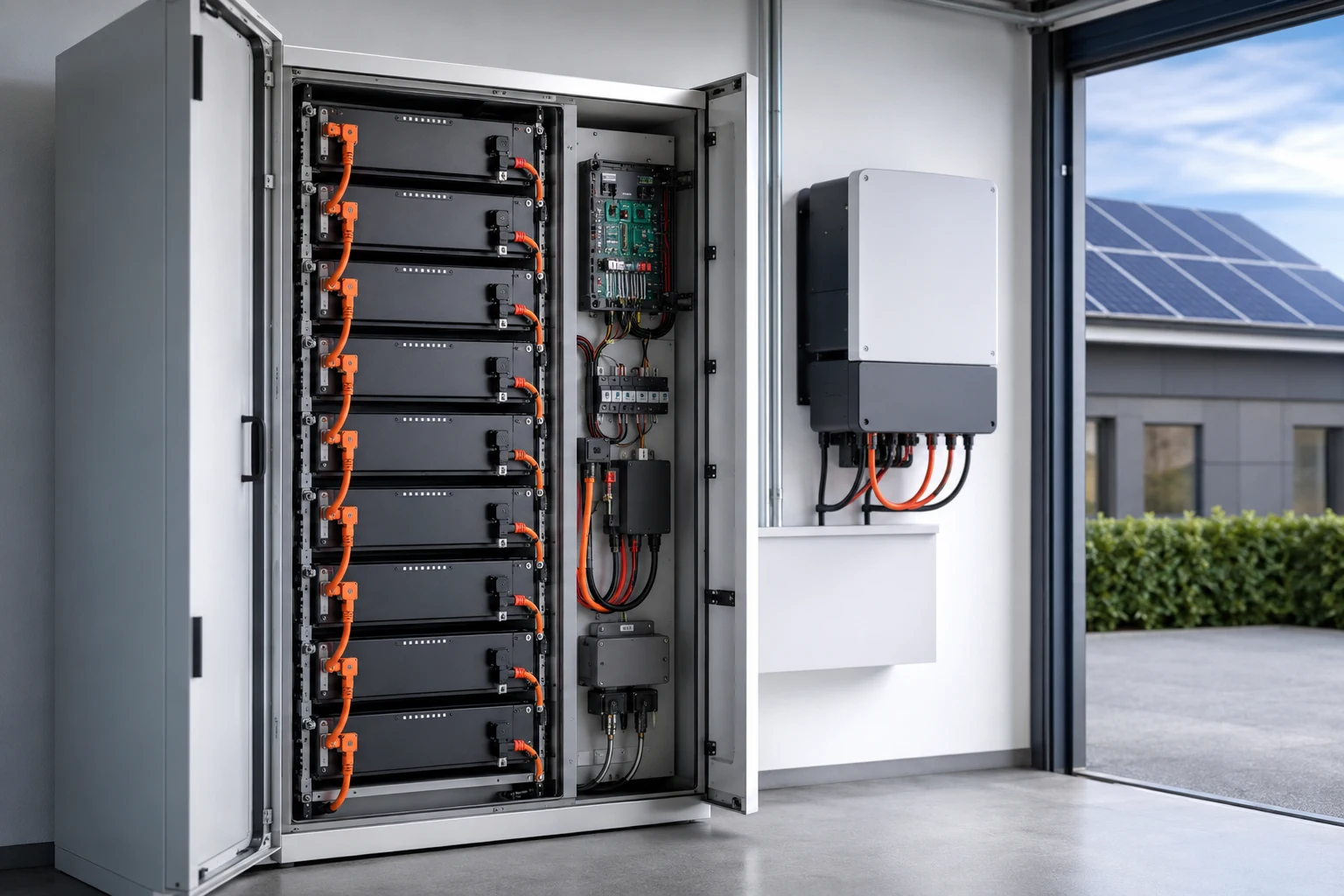](https://voltcrave-battery.com/wp-content/uploads/2026/08/What-Is-a-High-Voltage-LiFePO4-Battery-768x512.webp)
](https://voltcrave-battery.com/wp-content/uploads/2026/08/Who-Makes-the-Best-Solar-Backup-Battery-768x512.webp)







































