
](https://voltcrave-battery.com/wp-content/uploads/2026/09/What-Are-the-Dimensions-of-a-BESS-Container.webp)
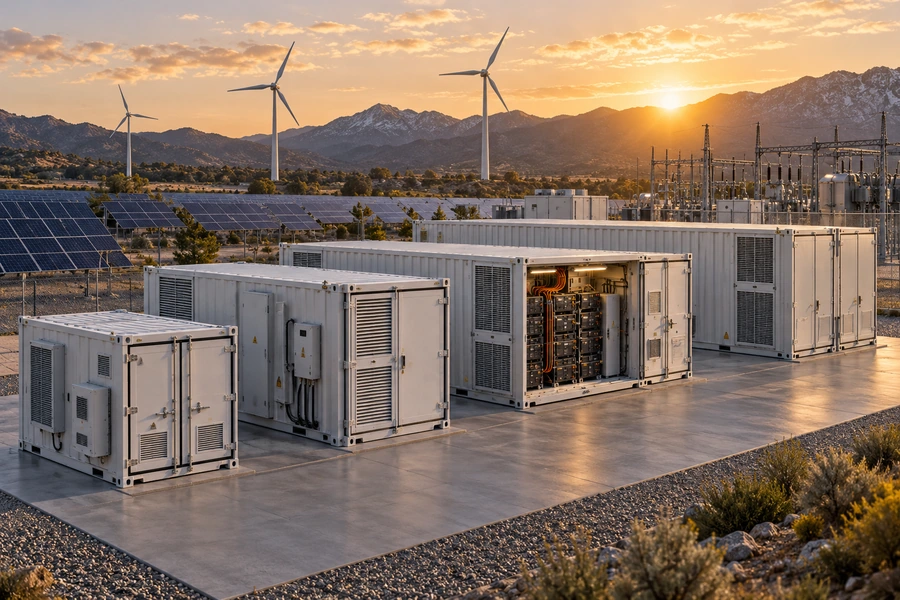
BESS containers often look like shipping containers, but their dimensions are not always identical. Cooling systems, fire protection, battery density, and maintenance access can change the enclosure.
A BESS container is commonly built in a 20-foot-class enclosure, roughly 6.1m long and 2.4–2.6m wide, while height often falls around 2.6–3.0m depending on the design. However, there is no universal BESS container dimension. Modern systems are also available in 10ft, 20ft, 30ft, 40ft-class, and customized enclosures.
The important point is that “20ft” usually describes the enclosure class or general form factor, not a guarantee that every BESS has exactly the dimensions of a standard ISO freight container. Current utility-scale products illustrate this clearly: Sungrow offers 10ft, 20ft, and 30ft configurations in its PowerTitan 3.0 platform, while CATL and Fluence also use high-density 20-foot-class enclosures.
What Is the Standard Size of a BESS Container?
There is no single global dimensional standard that every battery energy storage system follows.
The most common utility-scale BESS form factor is the 20-foot-class container because it offers a practical balance between energy capacity, transportation, site footprint, cooling, installation, and modularity. However, BESS manufacturers increasingly use purpose-built enclosures, so exact length, width, height, weight, and lifting requirements must come from the product datasheet.
For preliminary planning, I would use the following approximate dimensional classes:
| BESS Enclosure Class | Approx. Length | Approx. Width | Approx. Height | Typical Use |
|---|---|---|---|---|
| 10ft-class | ~3.0m | ~2.4–2.6m | ~2.6–3.0m | Compact/modular storage |
| 20ft-class | ~6.1m | ~2.4–2.6m | ~2.6–3.0m | Utility and C&I BESS |
| 30ft-class | ~9.1m | Product-specific | Product-specific | High-capacity integrated ESS |
| 40ft-class | ~12.2m | ~2.4–2.6m+ | ~2.6–3.0m+ | Larger/custom storage systems |
| Custom enclosure | Varies | Varies | Varies | Project-specific installations |
These are planning ranges, not manufacturer specifications.
This distinction matters during engineering.
A project designer cannot simply write:
“20ft container = 6.058 × 2.438 × 2.591m”
and assume every BESS will fit that exact envelope.
The battery enclosure may contain external:
HVAC equipment,
liquid-cooling equipment,
ventilation,
deflagration panels,
cable interfaces,
electrical cabinets,
doors,
or:
service structures.
Therefore, always use the manufacturer's general arrangement drawing for final site design.
Is a 20-Foot Container the Most Common BESS Size?
For utility-scale lithium-ion storage, the 20-foot-class enclosure has become extremely common.
Yes. The 20-foot form factor is widely used for modern utility-scale BESS because it combines high energy density with manageable transportation and modular deployment. Current examples include Sungrow PowerTitan 2.0 at 5MWh in a 20ft container, CATL TENER at 6.25MWh in a 20-foot container, and Fluence Gridstack Pro 5000 at up to 5.6MWh in a 20-foot enclosure.
This shows how quickly energy density has increased.
A 20-foot enclosure no longer implies one fixed amount of stored energy.
For example:
Sungrow PowerTitan 2.0 → 5MWh / 20ft
Fluence Gridstack Pro 5000 → up to 5.6MWh / 20ft
CATL TENER → 6.25MWh / 20ft
These are different product architectures, so I would not compare their MWh figures without also considering usable energy definitions, PCS configuration, operating conditions, safety architecture, warranty, and system boundaries.
But they demonstrate one important trend:
BESS energy capacity is increasing without requiring proportionally larger containers.
CATL says its 6.25MWh TENER system increased energy density per unit area by 30% compared with its previous reference while reducing overall station footprint by 20%.
Are BESS Containers the Same Size as Shipping Containers?
Some are based closely on ISO container dimensions, but many modern BESS products should be treated as purpose-built energy-storage enclosures.
A BESS container may use a 10ft, 20ft, or 40ft shipping-container-style form factor, but its exact dimensions can differ from standard freight equipment. Modern BESS enclosures may incorporate cooling systems, battery cabinets, electrical compartments, ventilation, fire-protection equipment, doors, and structural modifications specifically designed for stationary energy storage.
Historically, using ISO-style containers offered obvious advantages.
They are familiar to:
shipping companies,
crane operators,
trucking companies,
and:
construction teams.
Their geometry also makes modular site layouts relatively straightforward.
But BESS engineering has evolved.
Manufacturers now optimize enclosure geometry around:
battery-cell dimensions,
rack arrangement,
thermal management,
fire behavior,
service access,
cable routing,
and:
transportation limits.
Fluence documentation, for example, has described storage enclosures as either standard ISO containers or customized according to project requirements.
So I treat:
“20ft BESS”
as a useful product category.
I do not treat it as a final engineering dimension.
How Much Energy Can Fit Inside a 20ft BESS Container?
Modern battery density has dramatically increased the amount of storage that can fit into a relatively small enclosure.
A modern 20-foot-class utility BESS can contain roughly 5–7MWh in current high-density designs, although capacity varies significantly by manufacturer, cell chemistry, system voltage, cooling architecture, PCS integration, safety design, and usable-energy definition. The enclosure dimensions alone therefore cannot tell you its energy capacity.
Current examples demonstrate the range.
Sungrow's PowerTitan 2.0 integrates:
5MWh
of batteries and a:
2.5MW PCS
in a 20ft container.
CATL's TENER provides:
6.25MWh
in a 20-foot container.
Fluence states that its Gridstack Pro 5000 Series can deliver:
up to 5.6MWh
within a 20-foot enclosure.
Sungrow's newer PowerTitan 3.0 platform includes a:
20ft Class version with 6.9MWh
of capacity.
This means:
Container Size ≠ Battery Capacity
Two BESS containers with approximately the same external footprint can have significantly different MWh ratings.
Why Are BESS Containers Becoming More Energy-Dense?
The industry is trying to reduce the amount of land, equipment, cabling, and installation work required for each MWh of storage.
BESS containers are becoming more energy-dense because manufacturers are improving battery-cell energy density, module and rack packaging, liquid cooling, electrical architecture, and internal space utilization. Higher MWh per enclosure can reduce the number of battery containers required for a project, although thermal management, safety, weight, transportability, and service access remain important constraints.
Consider a hypothetical:
100MWh project.
If each container provides:
2.5MWh,
the project needs approximately:
100 ÷ 2.5 = 40 containers
If each provides:
5MWh:
100 ÷ 5 = 20 containers
At:
6.25MWh:
100 ÷ 6.25 = 16 containers
The real project calculation is more complicated, but the basic effect is clear.
Higher energy density can mean fewer:
foundations,
DC connections,
communication connections,
cooling systems,
and:
battery enclosures.
It may also reduce land requirements.
But higher energy density creates engineering challenges.
More stored energy inside the same physical envelope makes:
thermal management,
fire propagation testing,
gas management,
structural design,
and:
emergency planning
increasingly important.
Therefore, maximum MWh per container should never be the only selection criterion.
Are 10ft BESS Containers Available?
Yes. Smaller enclosures can be useful when sites need flexible modular capacity or have physical constraints.
10-foot-class BESS enclosures are available for projects requiring smaller modular blocks, restricted site footprints, or flexible system configurations. Their lower total energy per enclosure can make them suitable for distributed or specialized installations, although actual capacity depends heavily on battery density and product architecture.
The market is also moving beyond the traditional choice between:
20ft
and:
40ft.
For example, Sungrow's PowerTitan 3.0 platform was introduced with:
10ft Flex — 3.45MWh
20ft Class — 6.9MWh
30ft Plus — 12.5MWh
This is a useful illustration of where BESS enclosure design is heading.
Instead of forcing every project into one standard box, manufacturers can offer several enclosure lengths.
A smaller project might prioritize:
flexibility.
A large utility project might prioritize:
maximum MWh per unit of land.
Therefore, BESS container size is increasingly becoming a system optimization decision, rather than merely a logistics decision.
Are 40ft BESS Containers Still Used?
Larger containerized architectures remain relevant, although high-density 20ft systems have become increasingly prominent.
40-foot-class BESS containers can still be used in energy storage projects, particularly in customized or legacy architectures. However, improvements in battery-cell and system energy density have allowed modern 20-foot enclosures to store several MWh, making the smaller modular form factor increasingly attractive for transportation, layout, and deployment.
A 40ft-class enclosure offers more internal volume.
That can provide room for:
battery racks,
service aisles,
HVAC,
electrical equipment,
and:
support systems.
However, bigger is not automatically better.
A larger container can mean:
greater total weight,
different transportation requirements,
larger lifting equipment,
and:
a larger individual energy block.
Modern BESS design therefore increasingly asks:
How much usable MWh can I deploy per unit of land and infrastructure?
rather than simply:
How large can I make the container?
This is why high-density 20ft products have become so important.
How Much Space Does a BESS Container Need on Site?
The physical container footprint is only part of the land requirement.
A BESS site needs more space than the battery enclosure itself because the layout must account for container spacing, maintenance access, fire-safety requirements, PCS equipment, transformers, switchgear, cable routes, roads, drainage, fencing, and emergency access. Therefore, container dimensions should never be used alone to estimate total BESS project footprint.
Suppose a container itself measures approximately:
6.1m × 2.5m.
Its physical footprint is roughly:
6.1 × 2.5 = 15.25m²
But a 20-container project does not simply require:
20 × 15.25 = 305m²
of land.
Actual project area can be substantially larger.
Why?
Because the site also needs:
spacing between enclosures,
transformers,
PCS or MV stations,
roads,
turning areas,
maintenance zones,
and:
electrical clearances.
Product architecture can make a major difference.
For example, Sungrow reports that PowerTitan 2.0 supports very close back-to-back layouts in a specific project configuration, demonstrating how enclosure access and thermal design can affect total site footprint.
This is why I always separate:
Container Footprint
from:
BESS Site Footprint.
They are not the same number.
Does the PCS Change BESS Container Dimensions?
Yes. Whether the power conversion system is integrated or installed separately can significantly affect the enclosure and overall site layout.
BESS dimensions depend partly on whether the PCS is integrated inside the battery enclosure. A DC battery container may contain primarily batteries and supporting systems, while an AC-block or all-in-one BESS can integrate batteries and PCS in one enclosure. Integrated designs can reduce external equipment but may change container dimensions, internal density, thermal design, and service access.
Compare two architectures.
DC Block
Battery Container → External PCS → Transformer → Grid
The container mainly houses:
battery racks,
BMS,
thermal management,
DC protection,
and:
safety systems.
AC Block
Battery + PCS in Container → Transformer → Grid
Now the enclosure must accommodate:
battery equipment
plus:
power conversion.
Sungrow's PowerTitan 2.0 is an example of the second approach, integrating a 2.5MW PCS and 5MWh of batteries in a 20ft-class container.
Neither architecture is universally superior.
The correct choice depends on:
project power,
duration,
maintenance strategy,
site footprint,
electrical design,
and:
system economics.
Why Does BESS Container Height Vary?
Length receives the most attention, but height can vary considerably between storage products.
BESS container height varies because battery racks, cooling equipment, cable routing, fire-safety equipment, ventilation, structural requirements, and power electronics may be arranged differently. Some systems stay close to standard high-cube container geometry, while purpose-built enclosures may be taller or use roof-mounted equipment.
This is particularly important during:
transportation,
warehouse planning,
substation design,
and:
indoor installation.
A designer needs to consider not only enclosure height but also:
lifting clearance,
roof equipment,
ventilation discharge,
cable entry,
door swing,
and:
maintenance access.
For transportation, the complete shipping configuration matters.
For permanent installation, the operational configuration matters.
These may not always be identical.
A system may ship with certain external components removed or protected and then be assembled into its final operating configuration on site.
Therefore, the relevant question is not simply:
“How tall is the BESS?”
It is:
“What are its shipping, lifting, and installed dimensions?”
How Does BESS Container Size Affect Project Design?
Container dimensions influence almost every physical part of a battery storage project.
BESS container dimensions affect site layout, foundations, transportation, crane selection, spacing, maintenance access, cable length, thermal management, fire-safety planning, and the number of enclosures required. Engineers therefore need both the external dimensions and the product's MWh, MW, weight, access requirements, and safety clearances before finalizing a project layout.
For early project development, I would evaluate five dimensions of the problem:
Physical size
How much land does each enclosure occupy?
Energy density
How many MWh does each enclosure store?
Power architecture
Is the PCS integrated or external?
Weight
Can roads, foundations, trucks, and cranes support it?
Spacing
How close can enclosures be installed while satisfying product and project requirements?
A small physical enclosure with difficult maintenance clearances may not produce the smallest site.
Likewise, a slightly larger enclosure with front-only access or optimized back-to-back installation may create a more compact total project.
That is why:
MWh/m² of complete project footprint
can sometimes be more meaningful than:
MWh/container.
What Dimensions Should I Use When Planning a BESS Project?
Early feasibility work can use approximate dimensions, but detailed engineering requires manufacturer-specific drawings.
For preliminary planning, a 20ft-class BESS can be treated as roughly 6.1m long, 2.4–2.6m wide, and 2.6–3.0m high. For procurement, foundations, transport, crane planning, or permitting, however, use the exact manufacturer's general arrangement drawing because modern BESS enclosures frequently differ from standard ISO dimensions.
I would collect the following before freezing a layout:
External L × W × H
Operating weight
Shipping weight
Center of gravity
Lifting points
Door-opening clearance
Maintenance clearance
Required container spacing
Cable-entry locations
HVAC/liquid-cooling interfaces
Fire and emergency access requirements
PCS dimensions
Transformer dimensions
MV switchgear dimensions
A product datasheet is therefore much more useful than simply knowing:
“It is a 20ft BESS.”
The enclosure length is only the starting point.
My Insights: What Are the Dimensions of a BESS Container
BESS dimensions are best understood as a range of product architectures rather than one universal shipping-container measurement.
A typical utility-scale BESS today often uses a 20-foot-class enclosure approximately 6.1m long and around 2.4–2.6m wide, but exact height, width, equipment projections, and installed clearances are manufacturer-specific. Current products also use 10ft, 30ft, 40ft-class, and custom designs as manufacturers optimize energy density and project footprint.
My First Insight: “20ft” Is a Form Factor, Not a Complete Specification
If someone tells me:
“This is a 20ft BESS,”
I still need the datasheet.
I need:
length,
width,
height,
weight,
service clearance,
and:
lifting configuration.
The 20ft description alone is not enough for engineering.
My Second Insight: The Same Size Can Hold Very Different Energy Capacities
This is one of the biggest changes in modern BESS.
Current 20ft-class products can contain:
5MWh,
5.6MWh,
6.25MWh,
or even:
6.9MWh
depending on the system.
Therefore:
20ft ≠ fixed MWh.
My Third Insight: Smaller Containers Can Create Larger Systems
A compact high-density enclosure can reduce the number of battery blocks required.
For a simplified:
100MWh project:
At 2.5MWh/container:
40 containers
At 5MWh/container:
20 containers
At 6.25MWh/container:
16 containers
Higher container energy density can therefore affect:
land,
foundations,
cabling,
installation,
and:
maintenance.
My Fourth Insight: Site Footprint Matters More Than Container Footprint
A container may occupy only:
15–16m²
of physical ground.
But a BESS plant needs much more.
The complete site includes:
battery enclosures,
spacing,
PCS,
transformers,
switchgear,
roads,
fencing,
and:
service areas.
So when comparing systems, I would ask:
How many MWh can the complete project deliver per unit of site area?
not simply:
How small is the container?
My Fifth Insight: What Are the Dimensions of a BESS Container?
This directly answers the H1.
| BESS Type | Approximate Planning Dimensions | Current Capacity Example |
|---|---|---|
| 10ft-class BESS | ~3.0m × 2.4–2.6m × 2.6–3.0m | Sungrow PowerTitan 3.0 Flex: 3.45MWh |
| 20ft-class BESS | ~6.1m × 2.4–2.6m × 2.6–3.0m | Common utility-scale format |
| 20ft Sungrow PowerTitan 2.0 | 20ft-class | 5MWh |
| 20ft Fluence Gridstack Pro 5000 | 20ft-class enclosure | Up to 5.6MWh |
| 20ft CATL TENER | 20-foot container | 6.25MWh |
| 20ft Sungrow PowerTitan 3.0 Class | 20ft-class | 6.9MWh |
| 30ft-class BESS | ~9.1m length; other dimensions product-specific | Sungrow PowerTitan 3.0 Plus: 12.5MWh |
| 40ft-class BESS | ~12.2m length; width/height product-specific | Architecture-dependent |
| Custom BESS | Manufacturer/project-specific | Application-dependent |
The most useful rule is:
For concept design → use approximate container-class dimensions.
For engineering → use manufacturer drawings.
For site planning → include required spacing and auxiliary equipment.
For logistics → check shipping dimensions and weight.
For foundations → check installed dimensions, loads, and center of gravity.
So, what are the dimensions of a BESS container?
For a quick preliminary answer, I would use approximately:
20ft-class BESS = 6.1m L × 2.4–2.6m W × 2.6–3.0m H
or roughly:
20ft L × 8–8.5ft W × 8.5–10ft H.
But that is only a planning range.
Modern BESS products are increasingly purpose-built rather than simple shipping containers. Their dimensions are influenced by battery energy density, liquid cooling, fire protection, integrated PCS equipment, service access, transportation limits, and the manufacturer's overall system architecture.
That is why the exact BESS container dimensions should always come from the specific product datasheet or general arrangement drawing—not from the nominal 10ft, 20ft, or 40ft description alone.
Conclusion
A typical BESS uses a 20ft-class enclosure around 6.1m long, but exact width, height, capacity, spacing, and installed dimensions vary significantly by product.
](https://voltcrave-battery.com/wp-content/uploads/2026/09/Large-Battery-Storage-Systems-Engineering-Grid-Integration-Industrial-Solutions-768x512.webp)
](https://voltcrave-battery.com/wp-content/uploads/2026/10/What-Are-the-Disadvantages-of-a-Portable-Power-Station-768x512.webp)
](https://voltcrave-battery.com/wp-content/uploads/2026/10/What-Is-the-Price-of-a-5-MWh-BESS-Container-768x512.webp)







































