
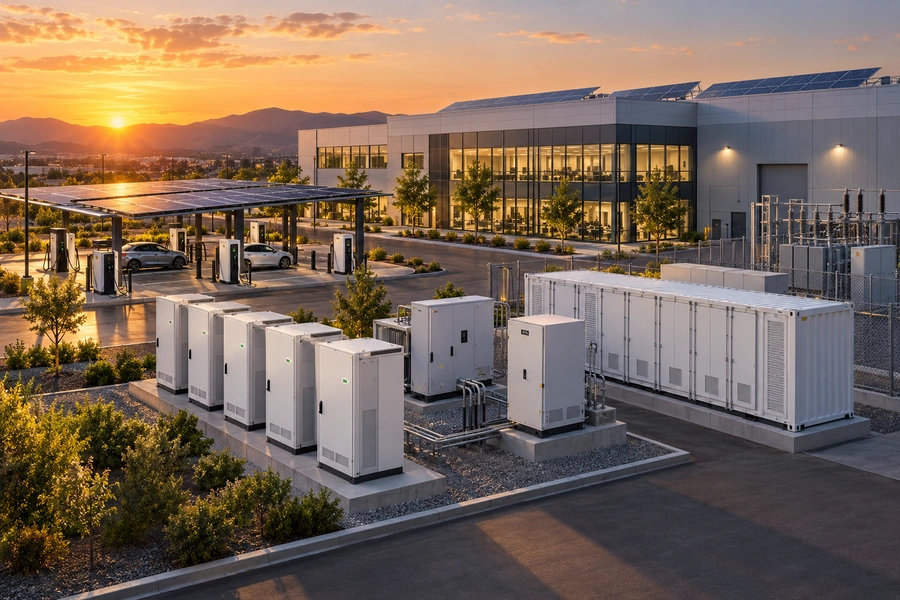
Commercial electricity demand is becoming more complex, while solar, EV charging, peak tariffs, and grid interruptions create new energy challenges. Conventional power consumption offers businesses little control.
Smart C&I energy power storage systems make the energy future different by turning commercial and industrial facilities from passive electricity consumers into flexible energy users. Batteries, PCS, BMS, EMS, solar, and intelligent controls can reduce peaks, shift energy, support backup power, coordinate EV charging, and respond dynamically to electricity prices and grid conditions.
Battery storage is growing rapidly, while smart C&I systems combine batteries, intelligent controls, onsite generation, and flexible loads to improve energy management, efficiency, and resilience.
What Is a Smart C&I Energy Storage System?
A conventional battery stores electricity, but a smart C&I storage system decides how that stored electricity should create operational value.
A smart Commercial and Industrial Energy Storage System is a battery-based power system designed for businesses, factories, warehouses, offices, data centers, EV charging sites, and other commercial facilities. It combines batteries with BMS, PCS, EMS, monitoring, thermal management, protection, and intelligent controls to optimize charging and discharging according to load, tariffs, solar production, and grid conditions.
The basic architecture can be represented as:
Grid + Solar + Battery → C&I Facility
Inside the storage system are several layers.
The battery provides:
kWh or MWh.
The Power Conversion System provides:
kW or MW.
The Battery Management System monitors:
cells and battery safety.
The Energy Management System decides:
when the battery should charge or discharge.
A smart system can also communicate with meters, solar inverters, EV chargers, generators, building-management systems, production loads, and cloud platforms.
That creates a much broader architecture:
Grid + PV + BESS + Generator + EV Chargers + Flexible Loads
controlled through:
EMS / Microgrid Controller.
This is why modern C&I storage should be understood as an energy-management platform, not merely a battery cabinet.
How Does a C&I Battery Energy Storage System Work?
A C&I BESS continuously responds to electricity demand, energy prices, renewable production, battery conditions, and programmed operating objectives.
A C&I battery storage system charges when electricity is abundant, inexpensive, or generated by surplus onsite solar, then discharges when electricity is expensive, facility demand is high, or grid power becomes unavailable. Smart EMS software coordinates these decisions while the BMS and PCS maintain battery safety and control electrical power flow.
Imagine a factory with the following load:
Normal demand:
800 kW
Afternoon peak:
1,200 kW
Target grid demand:
900 kW
The battery needs to provide:
1,200 – 900 = 300 kW
If that peak lasts:
2 hours
the theoretical energy requirement becomes:
300 kW × 2 h = 600 kWh.
During the peak:
Grid = 900 kW
Battery = 300 kW
Factory = 1,200 kW
Later, the battery can recharge when electricity is cheaper or when surplus solar is available.
This simple operating pattern is:
Charge Low → Discharge High.
Smart storage adds forecasting and optimization to that process.
What Makes a C&I Energy Storage System “Smart”?
The intelligence is mainly in the control layer rather than the battery cells themselves.
A smart C&I storage system uses an EMS to combine real-time and forecast data such as facility demand, battery SOC, solar generation, electricity tariffs, grid status, and equipment constraints. It can then automatically schedule charging, discharging, reserve capacity, and flexible loads to pursue cost savings and resilience without exceeding battery operating limits.
A conventional battery controller might follow:
Charge at 12:00
and:
Discharge at 17:00.
A more sophisticated system asks:
What is tomorrow's load forecast?
How much solar is expected?
When does the peak tariff begin?
What SOC should be preserved for backup?
Will EV charging increase tonight?
How much battery degradation would another cycle create?
Is the facility approaching a demand threshold?
The EMS can then update the battery schedule.
Suppose:
SOC = 80%
Solar forecast = high
Tomorrow's afternoon demand forecast = high
The EMS might discharge some energy tonight because it expects enough solar to recharge the battery tomorrow.
If:
Solar forecast = low
and:
Backup reserve requirement = 40%,
the system may adopt a more conservative strategy.
That ability to adapt is the difference between simply owning storage and intelligently operating storage.
What Is the Difference Between BMS, PCS, and EMS?
These three systems have different responsibilities and should not be treated as interchangeable.
The BMS protects and monitors the battery, the PCS converts and controls electrical power, and the EMS decides when and why the storage system should charge or discharge. In a smart C&I BESS, these layers work together so business objectives such as peak shaving never override battery safety or critical operating limits.
The simplest distinction is:
BMS: Is the battery safe?
It monitors cell voltage, temperature, current, SOC, and fault conditions.
PCS: How much power should move?
It performs bidirectional DC/AC conversion and controls charging and discharging power.
EMS: When should energy move?
It uses tariffs, loads, renewable generation, SOC, forecasts, and operating objectives.
The hierarchy can be expressed as:
EMS → PCS → Battery
while:
BMS → Safety Limits
can override normal operation when battery conditions require protection.
For C&I projects, this distinction matters because buying high-quality battery cells alone does not create a smart energy system.
The intelligence comes from how the complete architecture operates.
How Does C&I Energy Storage Reduce Peak Demand?
Peak shaving is one of the most straightforward commercial applications.
C&I energy storage reduces peak demand by discharging when facility electricity consumption approaches a predefined grid-demand limit. Instead of drawing the entire peak from the utility, the business uses battery power for part of the load. This can reduce demand-related costs where tariffs include charges based on maximum or peak electricity demand.
Suppose a commercial facility normally consumes:
500 kW.
Its monthly peak reaches:
800 kW
for one hour.
Target:
600 kW.
Battery power required:
800 – 600 = 200 kW
Energy required:
200 × 1 = 200 kWh.
If the battery successfully limits grid demand to 600 kW:
Facility Load = 800 kW
Grid = 600 kW
BESS = 200 kW
The battery then recharges after the peak.
This is why both power and energy ratings matter.
A:
50 kW / 500 kWh
battery has plenty of energy but insufficient power for this 200 kW peak.
A:
200 kW / 100 kWh
battery has enough power but cannot maintain it for one hour.
The application requires both:
kW + kWh.
How Does Time-of-Use Energy Shifting Work?
Peak shaving controls demand level, while energy shifting changes when electricity is purchased.
Time-of-use energy shifting charges a C&I battery when electricity prices are relatively low and discharges it when prices are higher. The economic value depends on the price spread, battery efficiency, cycling costs, degradation, and tariff rules. Smart EMS software can automate the process and combine it with solar or peak-demand management.
Suppose:
Off-peak electricity = $0.10/kWh
Peak electricity = $0.30/kWh
Nominal price difference:
$0.20/kWh.
If the battery delivers:
500 kWh
during the expensive period, simplified gross value is:
500 × $0.20 = $100 per cycle.
At:
300 cycles/year
that becomes:
$30,000/year gross
before considering efficiency, degradation, maintenance, and other costs.
The important word is:
gross.
The battery does not provide free energy.
Energy is lost during charging and discharging.
The battery also ages through time and cycling.
Therefore, a smart EMS should not simply cycle whenever:
Peak Price > Off-Peak Price.
It should consider whether the spread is large enough to justify the cycle.
How Can C&I Storage Work with Commercial Solar?
Solar generation and commercial demand do not always occur at the same time.
Solar-plus-storage allows businesses to capture surplus PV generation and use it later when facility demand is higher or electricity is more valuable. This can increase solar self-consumption, reduce exports or curtailment, support evening loads, and create a more controllable onsite energy system than solar PV alone.
Suppose a warehouse has:
1 MW solar PV.
At midday:
Solar generation = 900 kW
Facility demand = 500 kW
Surplus:
900 – 500 = 400 kW.
Instead of exporting all 400 kW:
Solar → BESS.
Later:
Solar generation = 100 kW
Facility demand = 700 kW
The battery can discharge.
The architecture becomes:
Day: Solar → Load + Battery
Evening: Solar + Battery → Load
This is especially valuable when:
export compensation is low,
evening electricity is expensive,
grid export is constrained,
or:
the site wants greater energy independence.
DOE describes storage as an important resource for capturing energy when supply is high and releasing it when demand increases, helping balance electricity systems and integrate variable renewable resources.
Can Smart C&I Storage Support EV Charging?
Rapid EV charging can create large new electrical peaks for commercial sites.
C&I storage can support EV charging by supplying part of the charging power when chargers would otherwise exceed a facility's preferred or available grid capacity. Smart controls can coordinate battery output, charger demand, building loads, solar generation, and charging schedules to reduce grid peaks and potentially delay expensive electrical infrastructure upgrades.
Imagine a logistics depot with:
Grid connection = 1 MW
Existing facility load = 500 kW
EV chargers request = 800 kW
Combined demand:
500 + 800 = 1.3 MW.
Grid shortfall:
1.3 – 1.0 = 300 kW.
The battery can potentially provide:
300 kW
during the charging peak.
If this condition lasts:
2 hours
the theoretical storage requirement is:
300 × 2 = 600 kWh.
A smarter strategy might also adjust charging power.
Instead of:
Battery Alone → Cover Entire Shortfall
the EMS could coordinate:
Battery + Managed EV Charging + Solar.
This is another example of why the future of C&I storage is increasingly about:
energy orchestration
rather than simply battery capacity.
Can C&I Energy Storage Provide Backup Power?
Some commercial BESS can provide backup, but backup capability must be intentionally engineered.
A C&I battery can support critical loads during grid outages when the PCS, switching, controls, protection, and electrical architecture are designed for islanded operation. Backup duration depends on usable battery kWh and critical-load demand, while the system's kW rating determines how much load it can support at one time.
Suppose usable battery energy is:
1 MWh.
Critical load:
250 kW.
Theoretical runtime:
1,000 kWh ÷ 250 kW = 4 hours.
If critical load is reduced to:
125 kW,
runtime becomes:
8 hours.
This illustrates a critical resilience principle:
Load Management Can Be as Important as Battery Capacity.
During an outage, the EMS can prioritize:
servers,
communications,
safety systems,
refrigeration,
critical manufacturing,
and:
essential lighting
while disconnecting lower-priority loads.
However, a normal grid-connected BESS should not automatically be assumed to provide uninterrupted backup.
Backup requires appropriate:
islanding,
transfer equipment,
grid-forming capability where needed,
and:
critical-load architecture.
How Do Smart C&I Systems Support Microgrids?
Storage becomes particularly powerful when combined with multiple onsite energy resources.
In a C&I microgrid, battery storage can coordinate with solar, generators, controllable loads, and the utility grid. The BESS provides rapid power balancing and stored energy, while the microgrid controller manages islanding, load priorities, generation, and reserve. This architecture can improve resilience while also optimizing normal-day electricity costs.
A simplified system is:
Grid + Solar + BESS + Generator → C&I Microgrid
During normal conditions:
Grid + Solar → Loads
and:
BESS → Peak Shaving / Energy Shifting.
During an outage:
Microgrid Disconnects From Grid
then:
Solar + BESS + Generator → Critical Loads.
The battery provides rapid response.
Solar provides renewable energy.
The generator can provide extended-duration support.
The EMS or microgrid controller coordinates the resources.
This creates:
layered resilience.
The battery does not need to solve every energy problem by itself.
DOE notes that energy storage and demand response can complement traditional power-system resources and support a wider range of system operations as grid technology evolves.
How Should a C&I Battery Storage System Be Sized?
Storage sizing should start with the business problem, not a predefined battery cabinet.
A C&I BESS should be sized by identifying the required power in kW or MW and the required duration in hours, then calculating the necessary kWh or MWh. The design should also account for usable SOC, efficiency, degradation, reserve requirements, future load growth, solar production, and the operating strategy.
The basic equation is:
Required Energy = Required Power × Duration
Suppose a factory wants to reduce:
1.5 MW
of peak demand for:
2 hours.
Theoretical energy:
1.5 × 2 = 3 MWh.
Now suppose the battery also needs to maintain:
1 MWh
of emergency reserve.
The storage requirement is already larger than the 3 MWh economic-dispatch requirement.
Additional design allowances may be needed for:
degradation,
conversion losses,
temperature,
and:
SOC operating limits.
NREL's commercial battery model evaluates systems across 1–8 hours of duration and power ratings from 100 kW to 2,000 kW DC, illustrating why C&I storage cannot be reduced to one standard size.
The correct sequence is:
Problem → kW → Duration → kWh → Architecture.
Not:
Battery Size → Find Something to Do With It.
Why Does Battery Duration Matter for C&I Storage?
Two batteries with identical power ratings can perform very different jobs depending on their energy capacity.
Battery duration is the relationship between stored energy and rated power. A 500 kW/500 kWh BESS has approximately one hour of nominal duration, while a 500 kW/2,000 kWh system has approximately four hours. Short-duration systems suit brief peaks, while longer-duration systems can support extended energy shifting or backup.
The equation is:
Duration = kWh ÷ kW
For:
500 kWh ÷ 500 kW
= 1 hour.
For:
1,000 kWh ÷ 500 kW
= 2 hours.
For:
2,000 kWh ÷ 500 kW
= 4 hours.
NREL emphasizes that accurately estimating storage duration is critical to determining total C&I system cost. Its commercial BESS model also separates energy-related battery costs from power-related balance-of-system costs.
This means:
$/kWh alone is not enough.
A buyer should compare:
kW + kWh + duration + complete installed system.
Why Is LFP Common in C&I Energy Storage?
C&I applications often require frequent cycling, making stationary-storage characteristics particularly important.
Lithium iron phosphate, or LFP, has become the dominant battery chemistry for stationary storage because its cost and cycling characteristics are well suited to frequent energy-management applications. The IEA reports that LFP represented around 90% of global battery-storage deployments in 2025, up from well below 50% only five years earlier.
LFP is a form of:
lithium-ion battery.
It is therefore incorrect to describe the technology as:
LFP vs. lithium-ion.
C&I storage typically places less emphasis on maximum gravimetric energy density than an electric vehicle.
A stationary battery does not need to travel.
Instead, system designers can prioritize:
cost,
cycling,
thermal behavior,
usable capacity,
and:
lifetime economics.
NREL's commercial-storage modeling likewise identifies LFP as the primary stationary-storage chemistry beginning in 2021.
But chemistry is only one part of safety and performance.
A reliable C&I system still requires:
BMS,
thermal management,
electrical protection,
fire-safety engineering,
and:
appropriate installation.
What Safety Standards Matter for C&I Battery Storage?
Commercial and industrial battery installations can concentrate substantial energy near buildings, workers, and valuable equipment.
C&I BESS safety should be evaluated at the system and installation levels. In North America, UL 9540 is the foundational product safety standard for energy storage systems, while UL 9540A evaluates thermal runaway and fire propagation. NFPA 855 addresses stationary ESS installation and increasingly emphasizes large-scale fire testing for BESS projects.
The standards have different purposes.
UL 9540 addresses the complete ESS product/system.
UL 9540A is the test method used to evaluate thermal runaway and fire-propagation behavior.
NFPA 855 addresses stationary ESS installation requirements.
The 2026 edition of NFPA 855 includes significant revisions emphasizing large-scale fire testing. Its Annex G.11 addresses scenarios in which fire could spread from one BESS to another, including separation distances and the role of active fire-protection systems.
The sixth edition of UL 9540A was published on March 13, 2026.
For C&I buyers, safety therefore should not be reduced to:
“What battery chemistry is inside?”
The better question is:
“How has the complete system been tested, integrated, installed, and protected?”
How Does Smart C&I Storage Improve Battery Economics?
The strongest economics often come from using one storage asset for several compatible functions.
Smart C&I storage can improve economics through value stacking, where one BESS performs multiple services such as peak shaving, energy shifting, solar self-consumption, backup reserve, EV charging support, and demand response. The EMS determines which service has the highest value while respecting SOC, battery degradation, power limits, and reliability requirements.
Imagine a:
1 MW / 2 MWh
system.
During weekdays:
Peak Shaving
may be the highest-value application.
At midday:
Solar Charging
may dominate.
During expensive evening tariffs:
Energy Shifting
may create value.
At all times:
20% SOC
might remain protected for emergency backup.
The same asset now performs several jobs.
However:
More Applications ≠ Automatically More Profit.
Two services can conflict.
For example, aggressive peak shaving might leave insufficient battery energy for:
backup.
Frequent arbitrage may accelerate:
degradation.
Charging for a future grid service may prevent:
solar absorption.
Smart optimization therefore means deciding not only:
when to use the battery
but also:
when not to use it.
How Can AI and Forecasting Improve C&I Energy Storage?
Smart storage increasingly depends on forecasts because tomorrow's conditions affect today's best battery decision.
AI and predictive analytics can improve C&I energy management by forecasting facility load, solar generation, electricity prices, EV charging demand, and battery behavior. These forecasts can help an EMS schedule storage more effectively, although automated optimization must remain constrained by battery safety, operating limits, contractual requirements, and critical backup reserves.
Consider two scenarios.
In the first:
Tomorrow's solar forecast = high
Tomorrow's peak demand = moderate
Current SOC = 80%
The EMS may choose to discharge more energy tonight because tomorrow's solar can replenish storage.
In the second:
Tomorrow's solar forecast = low
Expected facility peak = high
Grid reliability concern = elevated
The EMS may preserve more SOC.
The battery hardware is identical.
The difference is:
decision quality.
This is where digital energy management changes the value of physical storage.
However, forecasting is probabilistic.
It can be wrong.
Critical reserve should therefore not disappear simply because software predicts:
“the grid probably will not fail.”
Smart energy systems still need hard operating boundaries.
How Do C&I Storage Systems Help the Grid?
Behind-the-meter batteries can influence the wider power system by changing when businesses import electricity.
C&I batteries can help the grid by reducing facility demand during stressed periods, shifting consumption away from peaks, absorbing renewable electricity when supply is abundant, and potentially participating in demand response or other grid programs. Aggregated behind-the-meter storage can therefore make commercial loads more flexible rather than purely passive.
Traditionally, a commercial building responds to demand by:
drawing more electricity.
With storage, it can respond by:
discharging the battery.
That changes the grid-facing load.
Suppose:
Facility demand = 1 MW
BESS discharge = 300 kW
Grid sees:
700 kW.
Alternatively:
Facility demand = 500 kW
BESS charging = 300 kW
Grid sees:
800 kW.
The facility can therefore move its grid demand through time.
DOE identifies storage as a resource that can capture electricity when supply is high and release it when demand rises, helping balance the system and reduce strain on infrastructure.
At scale, this flexibility becomes increasingly important.
What Are the Main Challenges of Smart C&I Energy Storage?
Smart storage can solve several energy problems, but integration introduces its own technical and financial complexity.
The main challenges include upfront cost, battery degradation, tariff uncertainty, interconnection, fire safety, thermal management, EMS integration, cybersecurity, forecasting errors, warranty limits, maintenance, and incorrect sizing. A system can be technically excellent yet financially weak if its battery capacity and operating strategy do not match the facility's real load profile.
Oversizing is one risk.
Suppose the facility only needs:
300 kWh
for its regular peak.
Installing:
2 MWh
may provide additional flexibility.
But if that additional capacity creates little value, project economics suffer.
Undersizing creates the opposite problem.
A battery may run out before the peak ends.
Another risk is focusing only on battery price.
NREL's C&I model includes:
battery packs,
inverters,
and:
balance-of-system costs,
and emphasizes that the battery pack is significant but not the majority of complete battery-system cost in its modeled commercial configuration.
A realistic procurement analysis therefore needs:
Total Installed Cost
rather than:
Cell or Battery Pack Cost Alone.
What Are the Major Smart C&I Energy Storage Trends in 2026?
The market is moving from standalone battery capacity toward integrated energy-management infrastructure.
Major 2026 C&I energy-storage trends include rapid global battery deployment, LFP dominance, gradually longer storage durations, smarter EMS platforms, solar-plus-storage, EV-charging integration, microgrids, value stacking, and stronger fire-safety requirements. These developments are transforming batteries from isolated backup devices into actively managed commercial energy assets.
The market numbers are significant.
In 2025, global battery-storage additions reached:
108 GW.
Year-over-year growth:
40%.
Installed capacity compared with 2021:
11× higher.
LFP share:
around 90%.
Utility-scale share of new capacity:
around 80%.
The remainder came from behind-the-meter commercial and residential storage.
Duration is also changing.
Most projects still cluster around:
two hours,
but an increasing number provide:
four hours or more.
For C&I storage, the broader trend can be summarized as:
Battery → Smart BESS → Integrated Energy Platform.
My Insights: How Do Smart C&I Energy Power Storage Systems Make the Energy Future Different
The real change is not simply that businesses can store electricity. It is that they can increasingly decide when, where, and why electricity should be generated, stored, purchased, and consumed.
Smart C&I energy power storage systems make the energy future different by transforming businesses from fixed electricity consumers into controllable energy participants. By combining batteries with EMS, solar, EV charging, microgrids, forecasting, and flexible loads, businesses can manage cost, resilience, renewable energy, and grid interaction through one coordinated energy architecture.
My First Insight: The Future Is About Controlling Power, Not Just Consuming It
The traditional relationship is:
Grid → Business → Consumption.
The emerging relationship is:
Grid ↔ Business.
A facility can:
consume,
generate,
store,
shift,
reduce,
and potentially:
export energy.
Storage makes electricity demand partly controllable.
That is a fundamental change.
My Second Insight: The EMS May Become as Important as the Battery
Battery cells determine:
how much energy can be stored.
The EMS influences:
how intelligently that energy is used.
Two identical BESS installations can therefore create different economic outcomes because they use different:
load forecasts,
tariff strategies,
solar forecasts,
reserve policies,
and:
dispatch algorithms.
The physical battery creates capability.
The control system converts that capability into value.
My Third Insight: C&I Storage Connects Technologies That Were Previously Separate
Businesses once considered:
solar,
backup power,
EV charging,
building loads,
and:
electricity purchasing
as largely separate decisions.
Smart storage can connect them.
The architecture becomes:
Solar + Grid + BESS + EV Chargers + Generator + Flexible Loads
under:
one energy-management strategy.
This integration can be more important than any individual component.
My Fourth Insight: The Best Battery Is Not Necessarily the Largest Battery
A:
2 MWh
system that solves a clearly defined peak may create more value than a:
5 MWh
system with no strong operating strategy.
The sizing sequence should remain:
Business Problem → Load Data → Required kW → Duration → Required kWh → EMS Strategy.
NREL's commercial-storage modeling reinforces the importance of duration because C&I BESS costs depend on both energy and power components, and its benchmark covers storage durations from one to eight hours.
My Fifth Insight: How Do Smart C&I Energy Power Storage Systems Make the Energy Future Different?
This directly answers the H1.
| Energy Dimension | Traditional C&I Model | Smart C&I Storage Future |
|---|---|---|
| Electricity Use | Consume when needed | Shift consumption through time |
| Peak Demand | Accept grid peak | Battery can shave peak |
| Solar | Use or export immediately | Store and use later |
| Electricity Price | Pay current tariff | Optimize timing where tariffs permit |
| Backup | Generator/UPS-focused | BESS can add another resilience layer |
| EV Charging | Adds grid load | BESS and EMS can coordinate charging |
| Grid Relationship | Passive consumer | Flexible grid-facing load |
| Battery Control | Basic schedules | Forecast-based EMS optimization |
| Energy Data | Monitoring | Monitoring + automated decisions |
| Renewables | Separate asset | Integrated with storage and loads |
| Microgrid | Limited flexibility | Battery becomes balancing resource |
| Power Rating | Fixed facility demand | PCS can actively manage grid demand |
| Energy Capacity | No onsite flexibility | kWh/MWh can be shifted through time |
| Resilience | Separate backup assets | Layered battery + solar + generator strategy |
| Economics | Electricity bill as fixed operating expense | Energy becomes partially optimizable |
| Future Role | Energy consumer | Energy participant |
The fundamental transition can be written as:
Traditional C&I Energy
Grid → Load
becoming:
Smart C&I Energy
Grid ↔ Solar ↔ BESS ↔ Flexible Loads
with:
EMS
coordinating the entire system.
Consider a factory with:
Peak load = 2 MW
Normal load = 1.2 MW
Solar PV = 1 MW
BESS = 500 kW / 1 MWh
EV charging = 300 kW
and critical backup load = 200 kW.
Without intelligent coordination, these resources operate independently.
Solar produces when sunlight is available.
EVs charge when plugged in.
The factory creates peaks when production requires power.
The battery follows a basic schedule.
The grid absorbs the result.
With smart coordination, the system can operate differently.
At midday:
Solar → Factory + Battery.
During EV charging:
Solar + Battery → EVs + Factory.
During a facility peak:
Battery → Peak Shaving.
During expensive electricity periods:
Battery → Energy Shifting.
During an outage:
Battery Reserve → Critical Loads.
If the outage continues:
Solar → Loads + Battery Recharge.
The same physical assets now perform as:
one energy system.
This is what makes smart C&I storage fundamentally different from simply installing a large battery.
The storage system is becoming the flexible connection between:
generation,
consumption,
mobility,
backup,
and:
the grid.
The 2026 market direction supports this transition. Battery storage deployment reached 108 GW in 2025, installed capacity is eleven times its 2021 level, and LFP now accounts for approximately 90% of deployments. Storage duration is also gradually increasing as power systems need more flexibility alongside growing solar penetration.
At the same time, safety requirements are becoming more sophisticated. The 2026 edition of NFPA 855 places greater emphasis on large-scale fire testing, while the sixth edition of UL 9540A updates installation-level testing for severe fire scenarios.
For commercial and industrial users, this means the future decision is no longer simply:
“Should we buy a battery?”
A better set of questions is:
Where are our expensive peaks?
When do we have surplus solar?
How much grid capacity do we have?
How much EV charging is coming?
Which loads are critical during an outage?
How much reserve should the battery maintain?
Which loads can be flexible?
Can one BESS create several compatible sources of value?
Once these questions are answered, storage can be sized around the actual business problem.
That leads to the most important change:
C&I energy storage is evolving from a battery product into an intelligent energy-management system.
The battery stores energy.
The PCS controls power.
The BMS protects the battery.
The EMS makes decisions.
Solar creates onsite electricity.
EV charging creates flexible demand.
Microgrids coordinate resilience.
And the facility itself becomes an active participant in the energy system.
That is how smart C&I energy power storage systems can make the energy future different.
Conclusion
Smart C&I storage transforms businesses from passive power consumers into flexible energy participants, combining batteries, intelligent controls, renewables, resilience, and load management to create a more controllable energy future.
](https://voltcrave-battery.com/wp-content/uploads/2026/06/What-are-the-Best-Solar-Batteries-for-Home-Backup-in-2026-768x512.jpg)
](https://voltcrave-battery.com/wp-content/uploads/2026/09/Lead-Acid-vs.-Lithium-Ion-Batteries-Which-Is-Better-for-Residential-and-Commercial-BESS-768x512.webp)
](https://voltcrave-battery.com/wp-content/uploads/2026/10/How-Mobile-Battery-Energy-Storage-Systems-Are-Transforming-Event-Power-768x512.webp)







































