
](https://voltcrave-battery.com/wp-content/uploads/2026/10/How-Many-Hours-Will-a-Portable-Power-Station-Last-900x600-1.webp)
Portable power stations provide convenient electricity for camping, home backup, and outdoor activities. However, choosing the wrong battery capacity can leave essential devices without power.
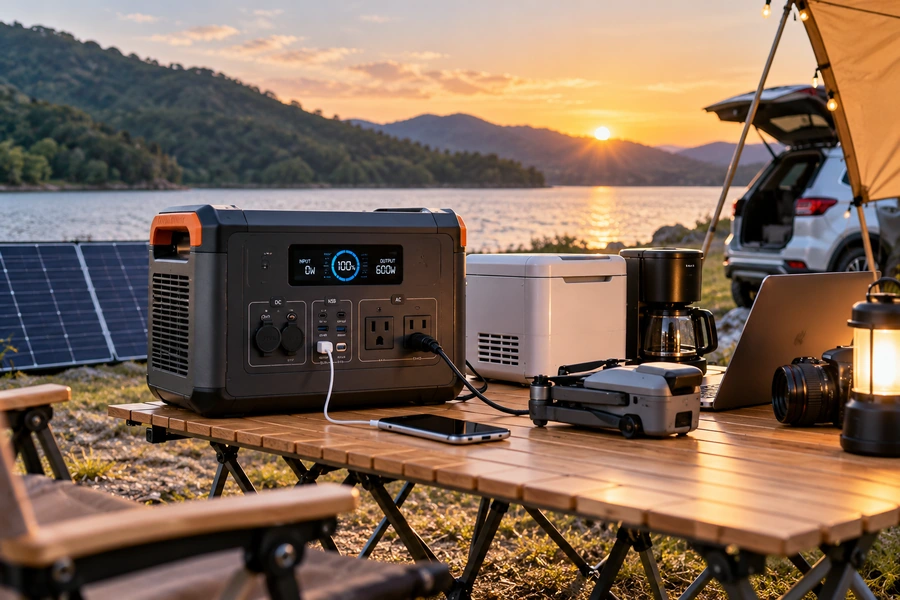
A portable power station can last from less than one hour to several days, depending on its battery capacity and connected devices. A 1,000Wh power station can theoretically run a 100W device for 10 hours, but actual runtime is often around 8–9 hours after accounting for conversion losses and system consumption.
Understanding battery capacity, power consumption, and operating efficiency helps users estimate runtime before purchasing a portable power station. It also makes it easier to choose the right system for emergency backup, RV travel, and off-grid electricity.
How Do You Calculate Portable Power Station Runtime?
The operating time of a portable power station depends mainly on battery capacity and the total power consumption of connected devices.
You can estimate portable power station runtime by dividing usable battery capacity in watt-hours (Wh) by the average power consumption in watts (W). For a general AC-powered application, using an estimated 85% usable-energy factor can help account for conversion losses, although actual efficiency varies by product and operating conditions.
Portable Power Station Runtime Formula
I use the following formula for a basic estimate:
Runtime (hours) = Battery Capacity (Wh) × 0.85 ÷ Device Power (W)
The three main factors are:
- Battery Capacity (Wh): The amount of electrical energy stored in the battery.
- Device Power (W): The average electricity consumption of the connected equipment.
- Efficiency Factor (0.85): An illustrative allowance for energy conversion losses and system consumption.
The 85% factor is not a fixed efficiency rating for every power station.
Manufacturers may publish different usable-energy specifications, so product-specific information should take priority.
Example: How Long Will a 1,000Wh Power Station Last?
Suppose a portable power station has a rated battery capacity of 1,000Wh.
A connected television consumes a steady 100W.
The estimated runtime is:
1,000Wh × 0.85 ÷ 100W = 8.5 hours
Under these assumptions, the power station could operate the television for approximately 8.5 hours.
However, actual performance may change because of temperature, battery condition, inverter consumption, and differences in appliance power usage.
Battery Capacity vs. Output Power
I consider the difference between watt-hours and watts particularly important.
Battery capacity determines how much energy the system can store.
Output power determines how much electricity the system can deliver at one time.
For example:
1,000Wh Battery Capacity: Represents stored electrical energy.
1,000W AC Output: Represents the maximum rated continuous power available to connected AC equipment.
A power station with a 1,000W inverter does not necessarily provide one hour of operation at 1,000W.
Its runtime depends on the actual battery capacity and energy losses.
Understanding these specifications is essential when comparing different portable power stations.
How Long Can a Portable Power Station Run Common Appliances?
Different electrical devices consume different amounts of electricity. Low-power electronics can operate for many hours, while high-power appliances may discharge a portable battery relatively quickly.
A portable power station generally lasts longer when powering LED lights, laptops, routers, and small fans than when running electric heaters, kettles, or cooking equipment. Runtime also depends on whether an appliance consumes constant power or operates intermittently, as refrigerators and some other motor-driven appliances do.
Estimated Runtime by Battery Capacity
The following table compares three common battery capacities under different continuous power loads.
| Average Load | 500Wh | 1,000Wh | 2,000Wh |
|---|---|---|---|
| 40W | 10.6 hours | 21.3 hours | 42.5 hours |
| 100W | 4.3 hours | 8.5 hours | 17 hours |
| 300W | 1.4 hours | 2.8 hours | 5.7 hours |
| 600W | 0.7 hours | 1.4 hours | 2.8 hours |
These are illustrative estimates using an 85% usable-energy factor, starting from a full battery with no incoming charging power. Actual runtime may differ. Each power station must also have sufficient continuous and startup output power for the connected equipment. Low-power AC loads can have disproportionately high inverter standby losses.
How Long Can a Power Station Run a Refrigerator?
Refrigerators require special consideration because their compressors usually cycle on and off.
A refrigerator may consume 120W while its compressor is operating but use significantly less energy when the compressor is off.
For example, if a refrigerator averages 50W over several hours, a 1,000Wh power station has a simplified estimated runtime of:
1,000 × 0.85 ÷ 50 = 17 hours
This estimate does not guarantee 17 hours of operation.
The actual result depends on compressor cycling, room temperature, refrigerator efficiency, and power station losses.
I recommend measuring the refrigerator's average electricity consumption rather than relying only on its nameplate wattage.
How Long Can It Power Laptops and Camping Equipment?
Portable power stations are well suited to many low- and medium-power applications.
Typical examples include:
- LED lighting for campsites
- Laptop charging
- Portable fans
- Camera and drone battery charging
- Small electric coolers
- Mobile communication equipment
I recommend calculating the combined power consumption when several devices operate simultaneously.
For example, a laptop consuming 60W, a fan using 40W, and lighting requiring 20W create a total load of 120W.
A 1,000Wh power station would have a simplified estimated runtime of:
1,000 × 0.85 ÷ 120 = 7.1 hours
This example shows why total power demand matters more than the number of connected devices.
What Factors Affect How Long a Portable Power Station Lasts?
Two portable power stations with similar battery capacities may provide different operating times. Battery technology, inverter efficiency, temperature, and operating settings can all influence performance.
Portable power station runtime is affected by battery capacity, connected load, inverter efficiency, temperature, battery age, standby power consumption, and charging conditions. Using high-power appliances or multiple devices simultaneously usually reduces runtime, while efficient DC connections and suitable solar charging can help improve available operating time.
AC Inverter Efficiency
Most portable power stations include an inverter that converts stored DC electricity into AC electricity.
This conversion consumes some energy.
The amount lost depends on the equipment design and operating load.
I recommend using a product's measured AC output capacity when that information is available.
For devices that support USB-C or compatible DC outputs, direct DC charging may avoid some inverter losses.
However, DC conversion also has efficiency losses, and actual results depend on the equipment.
Appliance Power Consumption
A portable power station discharges faster when connected to higher-power equipment.
For example, a 100W television requires much less power than a 1,500W electric heater.
A 1,000Wh power station supplying a constant 1,500W load would have a simplified runtime of:
1,000 × 0.85 ÷ 1,500 = 0.57 hours
That equals approximately 34 minutes.
The calculation is only valid if the power station supports the required continuous output power.
I generally consider portable battery stations more practical for essential electronics and moderate electrical loads than for prolonged high-power heating applications.
Battery Temperature
Battery performance changes with temperature.
Cold conditions can reduce available discharge capacity or limit output power.
High temperatures may also affect system performance and accelerate long-term battery degradation.
Many portable power stations include a battery management system that limits operation outside specified temperature ranges.
I recommend following the manufacturer's temperature and ventilation requirements.
Battery Age and Cycle Life
Rechargeable batteries gradually lose capacity over time.
This process depends on battery chemistry, charging cycles, storage conditions, and temperature.
Lithium iron phosphate (LiFePO4) batteries are popular because they generally offer a long cycle life.
Many modern LiFePO4 power stations advertise thousands of charging cycles before reaching a specified remaining-capacity threshold.
However, cycle ratings differ between models.
A battery that retains 80% of its original capacity will generally provide less runtime than it did when new.
Solar Charging and Additional Batteries
Some portable power stations support solar charging.
When suitable solar panels provide electricity during operation, the system can extend its available runtime.
However, solar output depends on sunlight, panel orientation, weather conditions, and charging efficiency.
Expandable battery systems can also provide additional stored energy.
I consider these options useful for longer camping trips, RV applications, and emergency backup situations.
How Do You Choose a Portable Power Station That Lasts Long Enough?
Selecting the right portable power station requires more than choosing the largest advertised battery. Users should calculate their electricity demand and compare it with usable battery capacity.
To choose a portable power station that lasts long enough, calculate the combined energy consumption of your devices, determine the required operating hours, and allow for conversion losses and reserve capacity. You should also verify inverter output, startup power requirements, charging methods, battery chemistry, and any available expansion options.
Calculate Your Daily Electricity Requirements
I recommend starting with a simple equipment list.
Suppose you plan to operate the following devices during an outdoor trip:
| Device | Power | Operating Time | Energy Required |
|---|---|---|---|
| Laptop | 60W | 4 hours | 240Wh |
| Portable Fan | 40W | 8 hours | 320Wh |
| LED Lighting | 20W | 5 hours | 100Wh |
| Router | 15W | 8 hours | 120Wh |
| Total | 780Wh |
The total estimated electricity consumption is 780Wh.
Assuming an 85% usable-energy factor:
Required Battery Capacity = 780 ÷ 0.85 = 918Wh
This is the approximate minimum rated capacity under the stated assumptions.
For more reliable planning, I recommend adding a reserve margin.
A 20–30% margin above the calculated minimum would suggest a battery capacity of approximately 1,100–1,200Wh.
This approach gives additional flexibility for power fluctuations and operating losses.
Consider Continuous and Surge Power
Battery capacity alone cannot determine whether an appliance is compatible with a power station.
The inverter must support the appliance's continuous operating power.
Some equipment also requires additional power during startup.
Refrigerators, compressors, pumps, and other motor-driven appliances may have significant starting currents.
I recommend checking both the continuous output rating and the manufacturer's surge specifications before connecting these devices.
Choose Battery Chemistry Carefully
Many newer portable power stations use LiFePO4 batteries.
I consider this technology suitable for frequent-use applications because it offers good cycle life and thermal stability.
However, battery chemistry is only one selection factor.
The complete product should also have suitable battery protection, cooling, output connections, and safety documentation.
Evaluate Charging and Expansion Options
A power station with solar charging capability can be useful when grid electricity is unavailable.
Expandable battery capacity can also support longer operating periods.
For example, an additional battery may allow a system to power essential equipment overnight without requiring immediate recharging.
However, expansion batteries must be compatible with the specific power station.
I recommend checking manufacturer-supported configurations rather than attempting unsupported battery modifications.
Consider Long-Term Reliability
For emergency backup and commercial applications, I also evaluate:
- Warranty and technical support
- Battery cycle-life specifications
- Available replacement parts
- Charging speed
- Product safety certification
- Battery management and protection functions
These factors can influence the total value of a portable power station over its operating life.
My Insight: How Many Hours Will a Portable Power Station Last
I believe the most useful way to evaluate portable power station runtime is to focus on usable energy rather than advertised battery capacity alone.
Two products with similar watt-hour ratings may deliver different results because of inverter design, internal consumption, operating temperature, and battery condition.
I also believe customers should distinguish between three important specifications.
Battery Capacity (Wh) determines how much energy the power station can store.
Output Power (W) determines which electrical devices the power station can operate.
Usable Energy (Wh) determines how much electricity is actually available to connected equipment.
For buyers, I recommend evaluating these specifications together rather than comparing battery capacity in isolation.
I also consider the intended application essential.
For occasional smartphone charging and small electronics, a compact portable power station may provide sufficient energy.
For overnight camping, a larger battery may be necessary to support lighting, fans, and refrigeration equipment.
For emergency home backup, I recommend calculating the daily electricity requirements of essential appliances before choosing a system.
My preferred evaluation process includes five steps:
- Identify the devices that require electricity.
- Measure or estimate their average power consumption.
- Calculate the required operating time and total energy demand.
- Allow for conversion losses and a practical reserve margin.
- Confirm that the power station supports the required continuous and startup power.
I also recommend considering solar charging or expandable batteries when operating time is a major concern.
However, I do not believe every customer needs the largest available battery.
A properly sized portable power station can provide better portability, lower initial costs, and sufficient operating time for its intended purpose.
The best choice is the system that reliably supports the required devices for the required duration without unnecessary capacity or cost.
Conclusion
Portable power station runtime depends on usable battery capacity, appliance consumption, and operating efficiency. Calculating energy demand helps users select a reliable power solution.
](https://voltcrave-battery.com/wp-content/uploads/2026/09/What-Is-an-Electrical-Cabinet-768x512.webp)
](https://voltcrave-battery.com/wp-content/uploads/2026/09/Which-Industries-Are-Harnessing-the-Power-of-High-Voltage-Inverters-and-How-768x512.webp)
](https://voltcrave-battery.com/wp-content/uploads/2026/08/What-Is-the-Lifespan-of-a-BESS-Battery-768x512.webp)







































