
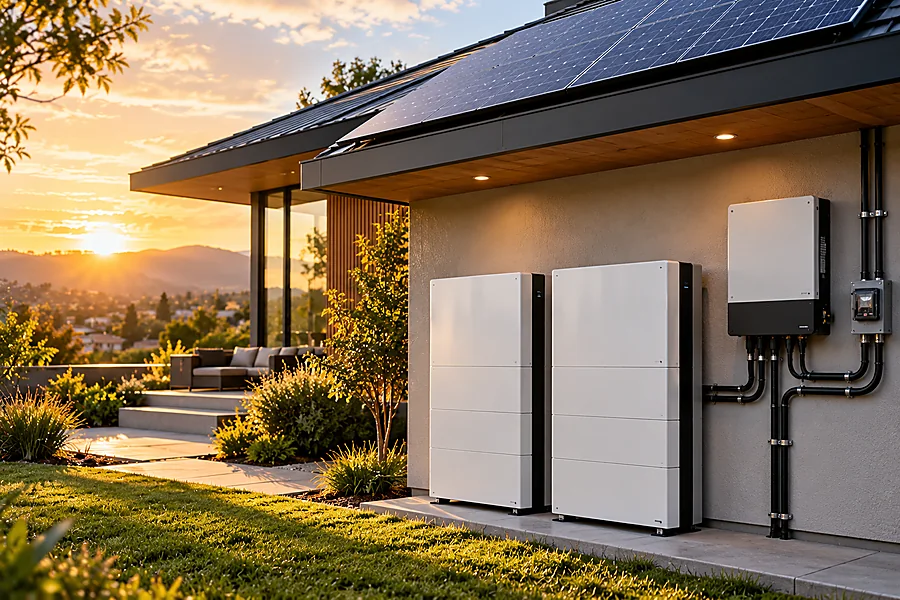
](https://voltcrave-battery.com/wp-content/uploads/2026/10/What-Is-the-Longest-Lasting-Solar-Battery-Type.webp)
Choosing a solar battery with a short lifespan can increase replacement costs and reduce long-term savings. Different battery chemistries offer significantly different durability and performance.
Lithium titanate (LTO) is among the longest-lasting rechargeable lithium battery types, offering exceptional cycle life. However, lithium iron phosphate (LiFePO4 or LFP) is generally the most practical long-lasting option for residential solar storage. Flow batteries can also provide very long service lives, but they are better suited to larger stationary installations.
Solar battery longevity depends on cycle life, safety, capacity, and cost. LTO excels in durability, LiFePO4 offers value, and flow batteries suit large-scale stationary installations.
Which Type of Solar Battery Has the Longest Lifespan?
Solar batteries are available in several chemistries, and each has different characteristics. Some provide exceptional cycle life, while others offer better energy density, lower initial costs, or simpler installation.
Lithium titanate batteries are among the longest-lasting lithium-ion technologies because of their excellent cycling stability. Vanadium flow batteries can also achieve very high cycle counts and long operating lives. For most residential solar installations, LiFePO4 batteries offer a more practical combination of longevity, efficiency, safety characteristics, and cost.
Lithium Titanate (LTO): Exceptional Cycle Life
Lithium titanate batteries use lithium titanate as the negative electrode material instead of the graphite commonly used in many lithium-ion batteries.
This design supports very high charge and discharge rates and can reduce certain degradation mechanisms associated with repeated cycling.
LTO batteries are known for excellent cycle-life potential and performance across demanding operating conditions.
Some specialized products advertise more than 10,000 or even 20,000 cycles under specified testing conditions.
However, I would not assume that every LTO battery can achieve those figures in actual solar installations.
Cycle life depends on temperature, charging conditions, operating limits, and the manufacturer's specific cell design.
The main disadvantages are higher purchase costs and lower energy density than many conventional lithium-ion technologies.
I consider LTO particularly attractive for high-cycle industrial applications, but it may not be the most economical choice for an ordinary household solar system.
Lithium Iron Phosphate (LiFePO4): Best Practical Choice for Homes
LiFePO4 batteries are widely used in residential and commercial solar energy storage.
Their main advantages include strong cycling durability, thermal stability, and suitability for repeated daily charging and discharging.
Many LFP battery products advertise several thousand charge-discharge cycles, with some specifying 6,000 cycles or more under defined conditions.
I consider this combination of performance and commercial availability important.
A homeowner may want to charge a battery with solar energy during the day and discharge it during the evening.
LFP batteries are well suited to this type of regular energy shifting.
They also provide an attractive balance between upfront cost and expected lifetime energy delivery.
Nickel Manganese Cobalt (NMC): Higher Energy Density
NMC batteries are another major lithium-ion technology.
They offer relatively high energy density, which can reduce the physical space needed for a given amount of stored energy.
This characteristic can be useful in applications where size and weight are especially important.
However, many conventional NMC designs have lower cycle-life potential than comparable LFP products under similar cycling conditions.
I would not reject an NMC battery simply because of its chemistry.
A well-designed NMC system with effective thermal management may still provide many years of service.
The manufacturer's actual warranty, operating limits, and verified performance are more important than general chemistry comparisons.
Flow Batteries: Long Life for Larger Storage Projects
Flow batteries store energy in liquid electrolytes that circulate through electrochemical cells.
Vanadium redox flow batteries are particularly relevant to stationary energy storage.
They can offer high cycling durability because their energy storage mechanism differs from that of conventional solid-electrode batteries.
Some flow battery designs target operating lives of 15–20 years or longer, although pumps, stacks, membranes, and other components may require maintenance or replacement.
I consider flow batteries particularly relevant for larger installations that require long discharge durations or frequent cycling.
However, their size, mechanical complexity, and supporting equipment generally make them less practical for typical residential installations.
Comparison of Solar Battery Types
| Battery Type | Cycle-Life Characteristics | Main Advantage | Main Limitation |
|---|---|---|---|
| LTO | Exceptionally high | Long cycle life | High cost and lower energy density |
| LiFePO4 | High | Balanced longevity and value | Larger volume than some lithium chemistries |
| NMC | Moderate to high | High energy density | Performance depends strongly on design and operating conditions |
| Vanadium Flow | Very high potential | Long-duration stationary storage | Complex and bulky system |
| Lead-Acid | Generally lower under deep cycling | Lower upfront cost | Shorter cycle life and more operating restrictions |
The table describes general technology characteristics rather than guaranteed performance for individual products.
How Many Years Can Solar Batteries Actually Last?
Battery manufacturers often advertise impressive cycle-life figures. However, homeowners usually want to know how many years the system will continue providing useful electricity.
A well-designed LiFePO4 solar battery may provide approximately 10–15 years of useful service, with some products designed or warranted for longer periods. LTO and selected flow battery systems can offer longer-life potential. Actual service life depends on cycling frequency, operating temperature, depth of discharge, battery design, and maintenance conditions.
Understanding Cycle Life and Calendar Life
I always distinguish between two important measurements.
Cycle Life describes how many charge-discharge cycles a battery can complete before reaching a specified remaining capacity.
Calendar Life describes how battery performance changes over time, even when the battery is not frequently used.
A battery may have substantial remaining cycle-life potential but still lose capacity because of calendar aging.
For this reason, cycle-life ratings should not be directly interpreted as guaranteed years of operation.
How Battery Cycles Affect Lifespan
Consider a solar battery advertised with 6,000 full equivalent cycles.
If the battery completes approximately one full equivalent cycle every day, the theoretical cycling period would be:
6,000 cycles ÷ 365 cycles per year = 16.4 years
However, this calculation does not guarantee 16.4 years of actual operation.
The battery may experience calendar aging, high temperatures, electrical stress, or other conditions that reduce its usable capacity before reaching the advertised cycle count.
The manufacturer's testing conditions also determine what its cycle-life figure means.
A 6,000-cycle rating measured at one temperature and discharge depth may not describe performance under more demanding conditions.
Real-World Battery Warranty Examples
Battery warranties provide a useful way to evaluate long-term manufacturer commitments.
For example, Tesla Powerwall has a ten-year limited warranty and a 70% capacity-retention commitment under applicable conditions.
Enphase IQ Battery 5P offers a limited warranty of up to 15 years or 6,000 cycles, whichever occurs first, with capacity-retention terms specified in its documentation.
These examples demonstrate that warranty conditions vary significantly between battery systems.
I recommend checking the following information:
- Warranty duration
- Minimum retained energy capacity
- Maximum warranted energy throughput
- Cycle-count restrictions
- Temperature and operating limitations
- Installation and monitoring requirements
A longer warranty does not automatically prove that a battery will outperform every competing product.
However, it provides an important indication of the manufacturer's contractual performance commitments.
Battery Degradation and Remaining Capacity
Battery degradation gradually reduces the amount of energy that a battery can store.
For example, a 10 kWh battery that retains 80% of its original capacity would store approximately 8 kWh under the same capacity-rating conditions.
This reduction may decrease backup operating time.
However, it does not necessarily mean the battery has failed.
I consider a solar battery useful as long as it can safely and reliably meet the application's electricity requirements.
The appropriate replacement point depends on actual capacity, power capability, reliability, and the owner's needs.
Why Are LiFePO4 Batteries Popular for Long-Term Solar Storage?
Solar batteries used for daily energy shifting may charge and discharge hundreds of times each year. This repeated operation makes cycle life an important factor in overall energy storage economics.
LiFePO4 batteries are popular for long-term solar storage because they combine good cycling durability, thermal stability, competitive energy efficiency, and practical manufacturing costs. Their characteristics make them suitable for residential backup systems, off-grid solar installations, and commercial battery storage where reliable daily operation is more important than maximum energy density.
Long Cycle Life for Daily Solar Charging
Solar battery systems commonly store electricity generated during daylight hours and supply energy during the evening or overnight.
This pattern creates repeated charging and discharging activity.
I believe LiFePO4 is especially useful for this operating profile.
Its cycling durability allows manufacturers to design batteries for frequent energy shifting over an extended service life.
However, actual performance still depends on the cell quality, BMS design, charging conditions, and operating temperature.
Thermal Stability and Battery Safety
LFP chemistry is generally recognized for its favorable thermal stability compared with several other lithium-ion chemistries.
This makes it attractive for stationary battery energy storage.
However, I would not describe LFP batteries as completely fireproof.
Lithium batteries still require appropriate protection against electrical faults, overheating, mechanical damage, and abnormal charging conditions.
The battery management system is therefore essential.
A well-designed BMS monitors cell voltage, temperature, current, and other operating parameters.
It helps keep the battery within its specified operating limits.
Long-Term Energy Storage Economics
I evaluate battery economics through more than purchase price.
A battery with a higher initial cost may provide better long-term value if it delivers more usable energy over its service life.
One useful measure is the levelized cost of storage.
This considers the cost of owning and operating the energy storage system relative to the electricity delivered over its useful life.
The simplified comparison is:
Lifetime Storage Cost per kWh = Total Lifetime System Cost ÷ Lifetime Delivered Energy
For example, consider two hypothetical battery systems.
Battery A costs $4,000 and delivers 30,000 kWh over its useful service life.
Battery B costs $5,000 and delivers 50,000 kWh.
Ignoring other costs and financial adjustments:
Battery A → $4,000 ÷ 30,000 kWh = $0.133/kWh
Battery B → $5,000 ÷ 50,000 kWh = $0.10/kWh
Battery B provides a lower simple cost per delivered kilowatt-hour despite its higher initial price.
Actual project economics also depend on inverter costs, maintenance, energy losses, financing, and replacement requirements.
Residential and Commercial Applications
I consider LFP particularly suitable for applications that combine regular cycling with long-term reliability requirements.
Typical applications include residential solar batteries, rack-mounted LiFePO4 systems, commercial battery storage, and off-grid electricity systems.
Its modular design possibilities also allow storage capacity to be expanded when supported by the battery and inverter manufacturer.
However, I recommend confirming expansion compatibility before combining battery modules.
Products from different manufacturers or generations should not be assumed to operate safely together.
How Do You Choose the Longest-Lasting Solar Battery for Your System?
Selecting a solar battery based only on advertised lifespan can create expensive installation problems. A battery may offer excellent cycle life but lack suitable inverter compatibility, power output, or safety certification.
To choose a long-lasting solar battery, I evaluate battery chemistry, usable energy capacity, cycle-life conditions, capacity-retention warranty, inverter compatibility, thermal management, and system safety. For most homes, a properly engineered LiFePO4 system provides a practical starting point, while specialized industrial projects may justify higher-cost alternatives.
Evaluate Depth of Discharge
Depth of Discharge (DoD) describes how much of the battery's rated energy capacity is used.
For example, discharging 8 kWh from a fully charged 10 kWh battery represents an 80% depth of discharge.
Repeated deep cycling can affect battery degradation, although the effect varies between chemistries and cell designs.
I always compare cycle-life figures at the same depth of discharge where possible.
A battery advertised with 6,000 cycles at 80% DoD should not automatically be considered equivalent to another battery advertised with 6,000 cycles under different testing conditions.
Consider Operating Temperature
Temperature is another major factor affecting battery life.
High operating temperatures can accelerate battery degradation.
Low temperatures can limit charging performance and reduce available power.
I recommend using a battery system with temperature management suitable for its installation environment.
For outdoor systems, enclosure protection, ventilation, heating, and cooling requirements may be especially important.
I would also verify the manufacturer's allowed charging and discharging temperature ranges.
Confirm Battery and Inverter Compatibility
A long-lasting battery must operate correctly with the rest of the solar energy system.
Important technical factors include:
| Specification | What I Check |
|---|---|
| Battery Chemistry | LFP, NMC, LTO, or another suitable technology |
| Usable Capacity | Energy available for daily operation |
| Cycle Life | Test conditions and remaining capacity threshold |
| Warranty | Years, throughput, and retained capacity |
| Continuous Power | Maximum sustained discharge output |
| BMS | Monitoring and electrical protection |
| Inverter Compatibility | Voltage, communication, and supported configuration |
| Thermal Management | Approved environmental operating conditions |
| Certifications | Applicable battery and system safety requirements |
I recommend reviewing complete technical documentation instead of selecting batteries based only on promotional lifespan figures.
Review Safety Certifications
For North American stationary energy storage systems, relevant requirements may include UL 1973 for batteries and UL 9540 for complete energy storage systems.
UL 9540A addresses thermal runaway and fire-propagation testing.
These standards have different purposes.
A battery certified under UL 1973 does not automatically mean that every inverter combination is certified as a complete UL 9540 energy storage system.
I recommend verifying the exact equipment configuration and applicable local electrical and fire safety requirements.
Installation should follow the manufacturer's instructions and be completed by qualified professionals.
My Insights: What Is the Longest Lasting Solar Battery Type
Solar battery buyers often focus on advertised cycle counts without considering operating conditions. This can create unrealistic lifespan expectations and lead to expensive storage decisions.
I believe lithium titanate offers some of the strongest cycle-life performance among lithium battery technologies, while LiFePO4 provides a better balance of durability, safety, and cost for most solar storage applications. Flow batteries can also achieve long service lives, especially in large stationary projects. The best choice depends on how the system will be operated.
The Longest Cycle Life Does Not Always Mean the Best Investment
I do not believe the battery with the highest advertised cycle count is automatically the best solar battery.
LTO technology can provide exceptional cycling durability, but its higher cost and lower energy density may reduce its economic advantages in smaller installations.
A residential solar system may complete approximately one equivalent full cycle per day.
In that situation, calendar aging, warranty limitations, and system compatibility can matter as much as the maximum laboratory cycle count.
I therefore evaluate battery longevity according to actual operating requirements.
Battery Chemistry Is Only One Part of System Longevity
I also believe that a battery's service life depends heavily on system engineering.
Even a durable cell chemistry can experience poor performance if the battery management system is inadequate.
Thermal conditions, charging limits, electrical protection, and communication with the inverter all influence long-term operation.
I evaluate the complete system through five connected factors:
Battery Chemistry → BMS Protection → Operating Temperature → Cycle Conditions → Capacity Retention
This approach provides a more useful understanding of battery longevity than chemistry comparisons alone.
LiFePO4 Offers a Strong Balance for Daily Solar Storage
For most residential applications, I favor properly designed LiFePO4 systems because they combine long cycle life with practical installation and maintenance requirements.
A homeowner generally needs reliable electricity during evenings, power outages, and periods of low solar generation.
This requires sufficient usable capacity and dependable power delivery, not simply a battery that can complete an extremely high number of cycles.
I also consider modular expansion, warranty coverage, and technical support important.
A battery system that can be maintained and expanded appropriately may provide greater long-term value than one with exceptional cell specifications but limited system compatibility.
Long-Term Performance Should Be Measured by Useful Energy Delivered
I believe the most meaningful measure of battery longevity is the amount of useful electricity delivered during the system's service life.
A battery that maintains adequate capacity over many years may be a better investment than one that experiences faster degradation or requires early replacement.
I would therefore evaluate the total ownership cost, expected energy throughput, retained capacity, and replacement requirements.
For a typical household, LFP is often the most practical long-life choice.
For high-cycle industrial applications, LTO deserves consideration.
For larger long-duration storage installations, flow batteries may provide advantages that conventional residential batteries cannot offer.
Ultimately, the longest-lasting solar battery is not defined by chemistry alone. It is the battery system that maintains reliable performance under the intended operating conditions for the greatest useful service life.
Conclusion
LTO offers exceptional cycle life, while LiFePO4 is a practical long-life choice for homes. Flow batteries can suit larger projects requiring durable, long-duration storage.
](https://voltcrave-battery.com/wp-content/uploads/2026/05/Is-Home-Battery-Storage-Worth-It-768x512.jpg)
](https://voltcrave-battery.com/wp-content/uploads/2026/08/How-to-Choose-a-High-Voltage-Battery-for-Home-Energy-Storage-768x512.webp)
](https://voltcrave-battery.com/wp-content/uploads/2026/09/What-Is-an-Electrical-Cabinet-768x512.webp)







































