
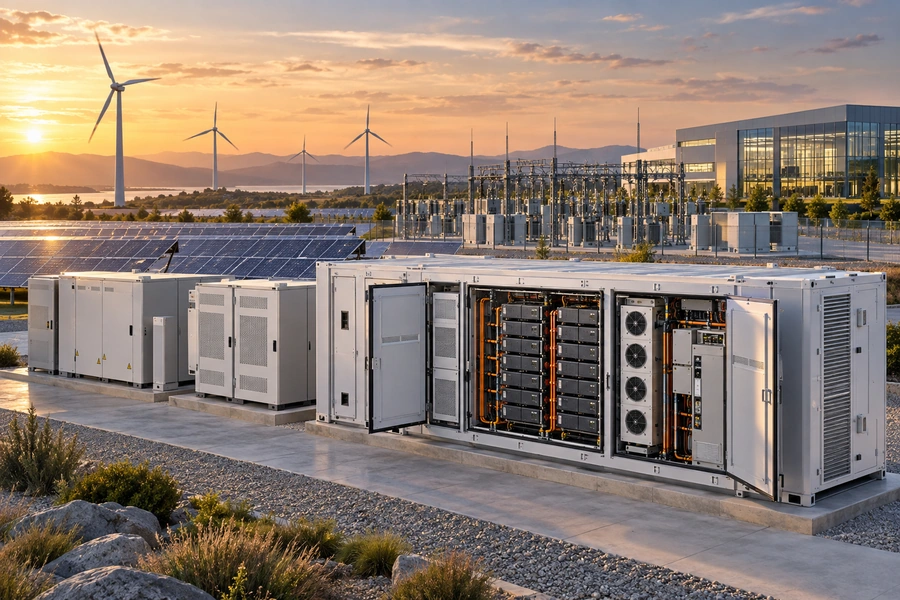
](https://voltcrave-battery.com/wp-content/uploads/2026/09/Navigating-the-Benefits-Challenges-and-Innovations-in-Energy-Storage-Systems.webp)
Renewable electricity is expanding, but generation and consumption rarely match perfectly. Without flexible storage, excess energy can be wasted while shortages still occur later.
Energy storage systems provide flexibility by storing electricity when it is available and releasing it when needed. Their key benefits include renewable integration, grid stability, peak management, backup power, and energy shifting. Major challenges include cost, degradation, safety, supply chains, and permitting, while innovations include advanced batteries, smarter EMS, long-duration storage, and recycling.
Energy storage is therefore moving beyond the idea of simply “saving electricity.” It is becoming infrastructure for managing when, where, and how electricity is used.
What Is an Energy Storage System?
An energy storage system captures energy at one time so it can be used at another, helping separate electricity generation from immediate consumption.
An energy storage system stores energy for later use. Battery Energy Storage Systems, or BESS, are among the fastest-growing forms of electrical storage, but the broader category also includes pumped hydropower, thermal storage, compressed-air systems, flywheels, flow batteries, and other technologies designed for different power and duration requirements.
For a battery system, the basic process is:
Electricity → Battery Charging → Stored Energy → Battery Discharging → Electricity
A complete BESS generally contains more than battery cells.
A simplified architecture is:
Cells → Modules → Racks → Battery System → PCS → Transformer → Grid/Load
Supporting this physical architecture are:
BMS + EMS + Thermal Management + Protection + Monitoring
The BMS monitors and protects the battery.
The PCS converts electricity between AC and DC.
The EMS determines when the system should charge or discharge.
Thermal management controls battery temperature.
Protection systems respond to electrical and other abnormal conditions.
The IEA reported that battery storage was the fastest-growing commercially available energy technology in the power sector in 2023, with deployment more than doubling year over year.
That growth reflects a broader need: electricity systems require more flexibility as solar, wind, EVs, electrification, and distributed energy resources expand.
What Are the Main Benefits of Energy Storage Systems?
Electricity normally needs to be generated at approximately the same time it is consumed. Storage introduces flexibility into that relationship.
The main benefits of energy storage systems include shifting electricity across time, integrating renewable generation, supporting grid stability, reducing peak demand, providing backup power, improving microgrid resilience, and helping electricity infrastructure operate more flexibly. Different storage technologies provide different combinations of response speed, power, energy capacity, duration, efficiency, and cost.
One of the easiest ways to understand storage is:
Excess Electricity → Store
Electricity Shortage → Discharge
Suppose a solar plant generates:
50MW
while the grid can accept only:
40MW.
Potential surplus:
50 – 40 = 10MW
If that surplus lasts for:
3 hours
the available energy is:
10MW × 3h = 30MWh
A sufficiently sized battery could capture some of that energy.
Later:
Battery → Grid
This changes electricity from an immediate-use resource into a more time-flexible resource.
Storage can also respond rapidly to changing grid conditions. Depending on the system and market, batteries may participate in frequency regulation, reserves, capacity, congestion management, and other grid services.
The value is therefore not just:
storing energy.
It is:
controlling energy across time.
How Does Energy Storage Support Renewable Energy?
Solar and wind are variable because their output depends on environmental conditions rather than electricity demand.
Energy storage supports renewable energy by absorbing surplus electricity when solar or wind generation exceeds immediate demand and releasing stored energy when renewable output falls. This energy shifting can reduce curtailment, smooth renewable production, improve local self-consumption, and help electricity systems accommodate larger amounts of variable generation.
Consider solar.
During midday:
Solar Production > Electricity Demand
Without storage, surplus electricity may need to be:
exported,
curtailed,
or:
otherwise balanced by the grid.
With storage:
Solar → BESS
Later:
BESS → Grid/Load
The U.S. Department of Energy describes solar-plus-storage as a way to store solar electricity for use at another time, helping address the mismatch between when solar energy is produced and when electricity is needed.
This is known as:
energy shifting
or:
time shifting.
Wind can use the same principle.
Suppose a wind project produces:
100MW
but the transmission system can accept:
80MW.
Potential excess power:
100 – 80 = 20MW
For two hours:
20MW × 2h = 40MWh
Storage could potentially absorb part of that otherwise constrained energy, subject to its MW and MWh ratings.
How Does Energy Storage Improve Grid Stability?
Modern electricity networks must continuously balance generation and consumption.
Energy storage can support grid stability because batteries and power electronics can adjust charging or discharging rapidly in response to grid conditions. Depending on system design and market rules, BESS can provide frequency response, reserves, renewable smoothing, ramp-rate management, voltage-related support through inverters, and other ancillary services.
Imagine electricity demand suddenly rises.
A battery can respond:
Battery → Grid
If electricity supply suddenly exceeds demand:
Grid → Battery
This bidirectional capability makes storage different from conventional one-directional loads.
The PCS is especially important.
It manages the relationship between:
Battery DC
and:
Grid AC.
For many grid-support applications, both speed and available power matter.
A:
100MW / 100MWh
battery can theoretically discharge at full rated power for around:
1 hour
before considering operating limits.
A:
100MW / 400MWh
system has approximately:
4 hours
of nominal duration at full power.
This illustrates why grid storage must always be discussed using both:
MW
and:
MWh.
What Is the Difference Between MW and MWh in Energy Storage?
Confusing power and energy can lead to incorrect conclusions about what a storage system can actually do.
MW measures power—the rate at which a storage system can charge or discharge. MWh measures energy—the amount of electricity it can store. Dividing MWh by MW gives the system's approximate nominal duration at full rated power, although usable duration can differ because of operating limits, efficiency, reserve, and degradation.
The basic equation is:
Duration = Energy ÷ Power
Examples:
| Power | Energy | Nominal Duration |
|---|---|---|
| 10MW | 5MWh | 0.5 hour |
| 10MW | 10MWh | 1 hour |
| 10MW | 20MWh | 2 hours |
| 10MW | 40MWh | 4 hours |
| 10MW | 80MWh | 8 hours |
A high-MW battery can deliver a large amount of power quickly.
A high-MWh battery can sustain output for longer.
Neither number alone describes the complete capability of the system.
This distinction becomes increasingly important as the industry moves from short-duration grid services toward applications requiring longer energy shifting.
What Are the Main Challenges Facing Energy Storage Systems?
Rapid growth does not eliminate the engineering and economic challenges associated with storing large amounts of energy.
Major energy storage challenges include upfront cost, battery degradation, thermal management, safety, raw-material supply, recycling, permitting, interconnection, system integration, and the difficulty of economically storing electricity for long periods. The importance of each challenge varies significantly by technology, project size, location, application, and storage duration.
Cost remains one of the most visible issues.
A storage project includes much more than battery cells.
The total system may include:
battery modules,
racks,
containers,
BMS,
PCS,
EMS,
transformers,
switchgear,
thermal management,
fire-risk controls,
foundations,
cabling,
engineering,
construction,
and:
grid interconnection.
Therefore:
Battery Cell Price ≠ Installed BESS Price
Degradation is another challenge.
Battery capacity and performance can change over time because of:
calendar aging,
cycling,
temperature,
SOC behavior,
and:
operating conditions.
A project expected to operate for 15 or 20 years therefore needs to consider performance over its entire life, not only its initial capacity.
Why Is Battery Safety an Important Challenge?
Large battery systems concentrate substantial electrochemical energy within relatively compact spaces.
Battery safety requires multiple layers of protection because abnormal electrical, mechanical, or thermal conditions can potentially lead to cell failure and, in severe cases, thermal runaway. Safe BESS design therefore depends on cell quality, BMS protection, thermal management, fault detection, electrical protection, enclosure design, fire testing, installation, and emergency-response planning.
No battery chemistry should be described as:
risk-free.
LFP, for example, has attractive thermal characteristics compared with some other lithium-ion chemistries.
But:
lower risk ≠ zero risk.
System-level safety matters.
In North America, UL 9540 addresses energy storage systems and equipment at the system level.
UL 9540A has a different purpose: it is a test method used to evaluate thermal runaway fire propagation behavior in battery energy storage systems.
Installation requirements can also involve NFPA 855 and applicable local electrical, building, and fire codes.
This distinction is important:
Cell Safety → Module Safety → Rack Safety → System Safety → Installation Safety
Each layer matters.
How Does Battery Degradation Affect Energy Storage Economics?
A battery is not a static asset. Its available capacity and performance change as it ages.
Battery degradation affects energy storage economics because the amount of usable energy and power available later in a project's life may differ from its initial performance. Degradation depends on calendar aging, cycling, temperature, depth of discharge, charge and discharge rates, SOC behavior, and battery chemistry. Project design must therefore consider lifetime energy throughput, not only initial capacity.
Suppose a battery completes:
1 equivalent full cycle per day.
Annual equivalent cycles:
1 × 365 = 365 cycles
Over 10 years:
365 × 10 = 3,650 cycles
Over 15 years:
365 × 15 = 5,475 cycles
Real operation is more complicated because batteries do not necessarily complete one identical cycle every day.
Still, this example illustrates why:
cycle life matters.
Temperature also matters.
High temperatures can accelerate aging.
Very low temperatures can reduce power and charge acceptance and create additional constraints depending on the chemistry.
Therefore, effective thermal management is not only about safety.
It also influences:
performance + lifetime + economics.
Why Has LFP Become So Important for Battery Energy Storage?
Stationary storage does not have exactly the same battery requirements as electric vehicles.
Lithium iron phosphate, or LFP, has become the dominant chemistry in stationary battery storage because it offers a strong combination of cost, cycling characteristics, material availability, and thermal behavior. The IEA reported that LFP accounted for around 80% of new battery storage deployments in 2023 and has continued gaining importance in stationary applications.
LFP is part of the:
lithium-ion battery family.
Therefore, the technically correct comparison is:
LFP vs. other lithium-ion chemistries
rather than:
LFP vs. lithium-ion.
An EV often places strong emphasis on:
energy density,
weight,
range,
and:
high-power performance.
Stationary storage places greater emphasis on:
cost,
cycle performance,
safety characteristics,
and:
long-term stationary operation.
This difference helps explain why LFP has become so prominent in BESS.
The IEA has also highlighted the cost advantages of LFP relative to nickel-rich chemistries, while noting its lower energy density.
For stationary systems, that energy-density tradeoff can be easier to accept because the battery does not need to move with a vehicle.
What Innovations Are Changing Energy Storage Systems?
Innovation is occurring across battery chemistry, system architecture, power electronics, software, thermal management, manufacturing, and recycling.
Important energy storage innovations include higher-density LFP systems, sodium-ion batteries, flow batteries, solid-state research, long-duration storage, advanced power electronics, liquid cooling, AI-assisted energy management, improved fire testing, battery recycling, and more modular system architectures. Together, these technologies aim to reduce cost while improving safety, duration, lifetime, flexibility, and sustainability.
Innovation is not limited to battery chemistry.
Consider a modern containerized BESS.
Improvements can occur in:
Cells
More energy per cell or lower cost.
Modules and Racks
More efficient packaging.
Thermal Management
Better temperature uniformity.
PCS
Higher conversion efficiency and improved grid functionality.
EMS
Better forecasting and dispatch.
Safety
Earlier detection and improved containment strategies.
Manufacturing
Greater standardization and automation.
This means a battery system can improve significantly even if the underlying chemistry remains LFP.
The future of storage will likely depend on improvements across the entire system rather than one “perfect battery.”
Will Sodium-Ion Batteries Change Energy Storage?
Lithium-ion dominates today's battery storage market, but alternative chemistries are attracting increasing attention.
Sodium-ion batteries could become an important complement to lithium-ion storage because sodium is abundant and the chemistry can reduce dependence on lithium, nickel, and cobalt supply chains. However, sodium-ion generally has lower energy density than leading lithium-ion technologies, and its future role will depend on manufacturing scale, cost, performance, lifetime, and application requirements.
Stationary storage may be particularly interesting for sodium-ion.
Why?
A stationary battery does not need to travel.
Weight and volume still matter, but often less than they do in an EV.
That means lower energy density can sometimes be accepted if the chemistry offers advantages in:
cost,
materials,
temperature performance,
or:
supply-chain diversification.
This does not mean sodium-ion will automatically replace LFP.
A more realistic possibility is a diversified market where:
LFP,
sodium-ion,
flow batteries,
and:
other technologies
serve different applications.
Energy storage is unlikely to converge on one chemistry for every use case.
What Is Long-Duration Energy Storage?
Many lithium-ion BESS projects focus on several hours of storage, but electricity systems can also require energy across much longer periods.
Long-duration energy storage, or LDES, generally refers to technologies designed to deliver electricity for extended periods beyond conventional short-duration battery applications. Depending on the definition and technology, this can mean approximately 8–10 hours or much longer, helping address overnight, multi-day, or other extended supply-demand imbalances.
Potential LDES technologies include:
flow batteries,
thermal storage,
compressed-air energy storage,
pumped hydropower,
hydrogen-based systems,
and:
other electrochemical or mechanical technologies.
The challenge is economic.
Suppose the grid needs:
100MW
for:
4 hours.
Required energy:
100 × 4 = 400MWh
For:
12 hours:
100 × 12 = 1,200MWh
For:
48 hours:
100 × 48 = 4,800MWh
As duration increases, the amount of stored energy grows rapidly.
This is why long-duration storage requires technologies with favorable:
$/kWh of stored energy
in addition to acceptable power cost.
How Is AI Changing Battery Energy Storage?
Energy storage creates value through decisions, and software increasingly helps make those decisions.
AI and advanced analytics can improve energy storage operation by forecasting electricity demand, renewable generation, market prices, battery behavior, and maintenance needs. When integrated with an EMS, these tools can help determine when to charge, discharge, preserve SOC, provide grid services, or reserve energy for future requirements.
Imagine a:
100MWh battery.
The system could use its capacity for:
energy arbitrage,
frequency response,
peak reduction,
renewable shifting,
or:
backup reserve.
But it cannot necessarily maximize all of them simultaneously.
If the battery is:
100% full,
it cannot absorb much additional electricity.
If it is:
near empty,
it cannot provide prolonged discharge.
If the PCS is already operating at maximum power, it cannot provide unlimited additional response.
An intelligent EMS therefore manages limited resources:
SOC + MW + MWh + Time
Forecasting improves those decisions.
For example, if high solar generation is expected tomorrow afternoon, the system may preserve enough empty battery capacity to absorb it.
Software can therefore create value without physically adding more cells.
How Can Energy Storage Reduce Peak Demand?
Electricity infrastructure must accommodate periods of high demand even when those peaks last for relatively short periods.
Energy storage can reduce peak demand by charging during lower-demand periods and discharging when consumption rises. This peak-shaving strategy can reduce grid import, support constrained electrical infrastructure, and potentially lower demand-related electricity costs for commercial and industrial users where tariffs include peak-demand charges.
Consider a factory.
Normal demand:
2MW
Peak demand:
3.5MW
Target grid demand:
2.5MW
Required battery output:
3.5 – 2.5 = 1MW
If the peak lasts:
2 hours
required theoretical energy is:
1MW × 2h = 2MWh
before accounting for:
losses,
reserve,
and:
operating constraints.
The battery therefore needs approximately:
1MW of power
and:
at least 2MWh of usable energy
for this simplified scenario.
Again:
MW determines peak reduction capability.
MWh determines how long it can continue.
What Role Does Energy Storage Play in Microgrids?
Microgrids need to balance local generation and consumption, particularly when disconnected from the wider electricity network.
Energy storage can help a microgrid balance renewable generation and local loads, provide rapid power support, maintain reserve energy, and reduce reliance on fuel generators. In islanded operation, storage can become a central flexibility resource, although the complete microgrid still requires appropriate controls, protection, generation, and power-conversion equipment.
A simplified microgrid might contain:
Solar + BESS + Generator + Loads
During sunny conditions:
Solar → Loads + Battery
At night:
Battery → Loads
During prolonged poor weather:
Generator → Loads/Battery
This creates multiple energy sources.
The EMS decides how to coordinate them.
Suppose critical loads consume:
500kW
for:
4 hours.
Theoretical battery requirement:
500kW × 4h = 2MWh
before losses and reserve.
Microgrid design therefore requires both:
power adequacy
and:
energy adequacy.
Storage helps connect those two requirements.
How Important Is Battery Recycling?
Rapid battery deployment means increasing volumes of batteries will eventually reach the end of their first useful life.
Battery recycling is increasingly important because it can recover valuable materials, reduce waste, diversify material supply, and lower dependence on newly mined resources. The effectiveness of recycling depends on battery chemistry, collection systems, recycling technology, economics, regulation, and the ability to recover materials at useful quality and scale.
A circular battery economy can be visualized as:
Raw Materials → Battery Manufacturing → Battery Use → Collection → Recycling → Recovered Materials → New Batteries
This is different from a linear model:
Mine → Manufacture → Use → Dispose
Battery chemistry influences recycling economics.
Chemistries containing expensive nickel and cobalt may offer different material recovery economics from LFP.
As LFP becomes increasingly dominant in stationary storage, recycling systems will need to adapt.
The challenge is therefore not simply:
Can the battery technically be recycled?
It is:
Can batteries be collected and recycled economically at industrial scale?
That will become more important as global battery deployment grows.
What Will the Future of Energy Storage Look Like?
The future is unlikely to depend on one battery chemistry or one storage duration.
Future energy storage systems will likely combine multiple technologies optimized for different applications. Lithium-ion batteries can continue serving fast-response and multi-hour applications, while long-duration technologies may address extended energy shifting. Software, power electronics, recycling, thermal management, and system integration will become increasingly important alongside battery chemistry.
I expect the storage landscape to become more specialized.
For seconds to minutes:
fast-response batteries and flywheels
can be valuable.
For several hours:
lithium-ion BESS
is already highly competitive in many applications.
For extended durations:
flow batteries, thermal storage, pumped hydro, compressed air, and other LDES technologies
may play larger roles depending on project economics and geography.
This means the question is moving away from:
“What is the best energy storage technology?”
toward:
“What storage technology best matches this duration, power, location, and application?”
That is a more useful engineering framework.
My Insights: What Are the Benefits, Challenges, and Innovations in Energy Storage Systems
Energy storage is developing from a specialized grid technology into a broad flexibility platform connecting renewable generation, electricity networks, businesses, homes, microgrids, and transportation.
The main benefits of energy storage are flexibility, renewable integration, grid support, peak management, and resilience. Its major challenges include cost, degradation, safety, supply chains, and long-duration economics. Innovation is addressing these limitations through improved LFP batteries, alternative chemistries, smarter EMS, advanced cooling, long-duration technologies, recycling, and safer system architectures.
My First Insight: Storage Is Really About Time
The simplest definition of storage is:
Electricity Now → Electricity Later
That time shift is what creates value.
It allows electricity generated at:
12:00 PM
to be used at:
8:00 PM.
This becomes increasingly important as solar and wind expand.
My Second Insight: The Complete System Matters More Than the Cell
Battery cells attract most of the attention.
But a successful BESS depends on:
Cells + BMS + PCS + EMS + Cooling + Protection + Grid Connection
A high-performance cell cannot compensate for:
poor thermal management,
weak controls,
or:
inadequate system protection.
Storage should therefore be evaluated as a complete system.
My Third Insight: No Single Storage Technology Will Solve Every Problem
Different applications require different combinations of:
power,
energy,
duration,
response speed,
lifetime,
and:
cost.
A technology optimized for:
15-minute frequency response
may not be the best solution for:
48-hour energy shifting.
The future will likely involve a portfolio of storage technologies.
My Fourth Insight: Software Is Becoming Part of Storage Capacity
Adding physical battery capacity increases:
MWh.
But better software can improve how existing MWh is used.
Forecasting and intelligent EMS controls can help determine:
when to charge,
when to discharge,
how much capacity to reserve,
and:
which service creates the most value.
That means storage innovation is increasingly:
hardware + software.
My Fifth Insight: What Are the Benefits, Challenges, and Innovations in Energy Storage Systems?
This directly answers the H1.
| Area | Key Issue | Energy Storage Impact |
|---|---|---|
| Renewable Integration | Solar and wind are variable | Stores surplus renewable energy |
| Grid Stability | Supply and demand change continuously | Provides rapid charge/discharge response |
| Peak Demand | Short peaks stress infrastructure | Shifts energy and reduces peak grid demand |
| Backup Power | Grid outages interrupt loads | Provides stored energy for resilience |
| Microgrids | Local generation must match local loads | Balances distributed resources |
| Cost | Storage remains capital-intensive | Manufacturing scale and technology innovation can reduce cost |
| Degradation | Batteries age with time and use | Better cells, controls, and cooling improve lifetime management |
| Safety | Concentrated battery energy creates hazards | BMS, thermal management, testing, and protection reduce risk |
| Supply Chain | Materials can be geographically concentrated | LFP, sodium-ion, recycling, and diversification can help |
| Long Duration | Multi-day storage is difficult | LDES technologies target longer energy shifting |
| Software | Storage has limited MW and MWh | EMS and AI optimize how capacity is allocated |
| Recycling | More batteries will reach end of life | Material recovery can support a circular supply chain |
The complete transition can be summarized as:
Traditional Electricity System
Generation → Grid → Consumption
versus:
Flexible Electricity System
Generation → Storage ↔ Grid → Consumption
Storage introduces the ability to move energy across time.
When renewable generation is abundant:
Charge
When demand exceeds generation:
Discharge
When grid frequency changes:
Respond
When peak demand rises:
Support
When the grid fails:
Provide Reserved Energy
When solar or wind would otherwise be curtailed:
Store
That flexibility is the central benefit.
The challenge is making it:
affordable + safe + durable + scalable + sustainable.
Innovation is attacking each part of that equation.
Higher-density LFP systems can reduce physical footprint.
Alternative chemistries can diversify materials.
Long-duration storage can address longer supply-demand gaps.
Advanced PCS technology can improve grid interaction.
Liquid cooling can improve temperature control.
Better fire testing and protection can strengthen system safety.
AI and EMS software can improve dispatch.
Recycling can recover materials at end of life.
The future of energy storage is therefore unlikely to be defined by one breakthrough battery.
It will be defined by the integration of:
Better Batteries + Smarter Controls + Safer Systems + Advanced Power Electronics + Diverse Storage Technologies + Circular Material Flows
That broader systems approach is how energy storage can evolve from simply holding electricity into one of the key flexibility resources of a renewable and increasingly electrified power system.
Conclusion
Energy storage delivers flexibility, renewable integration, grid support, and resilience, while advances in batteries, software, safety, long-duration storage, and recycling are addressing its major challenges.
](https://voltcrave-battery.com/wp-content/uploads/2026/08/What-Safety-Related-Designs-Are-Used-in-Energy-Storage-Systems-768x512.webp)
](https://voltcrave-battery.com/wp-content/uploads/2026/06/A-Complete-Guide-to-the-Lifespan-of-Lithium-Ion-Solar-Batteries-768x512.jpg)
](https://voltcrave-battery.com/wp-content/uploads/2026/06/Why-Do-You-Need-Large-Scale-Energy-Storage-in-Power-Grid-768x512.jpg)