

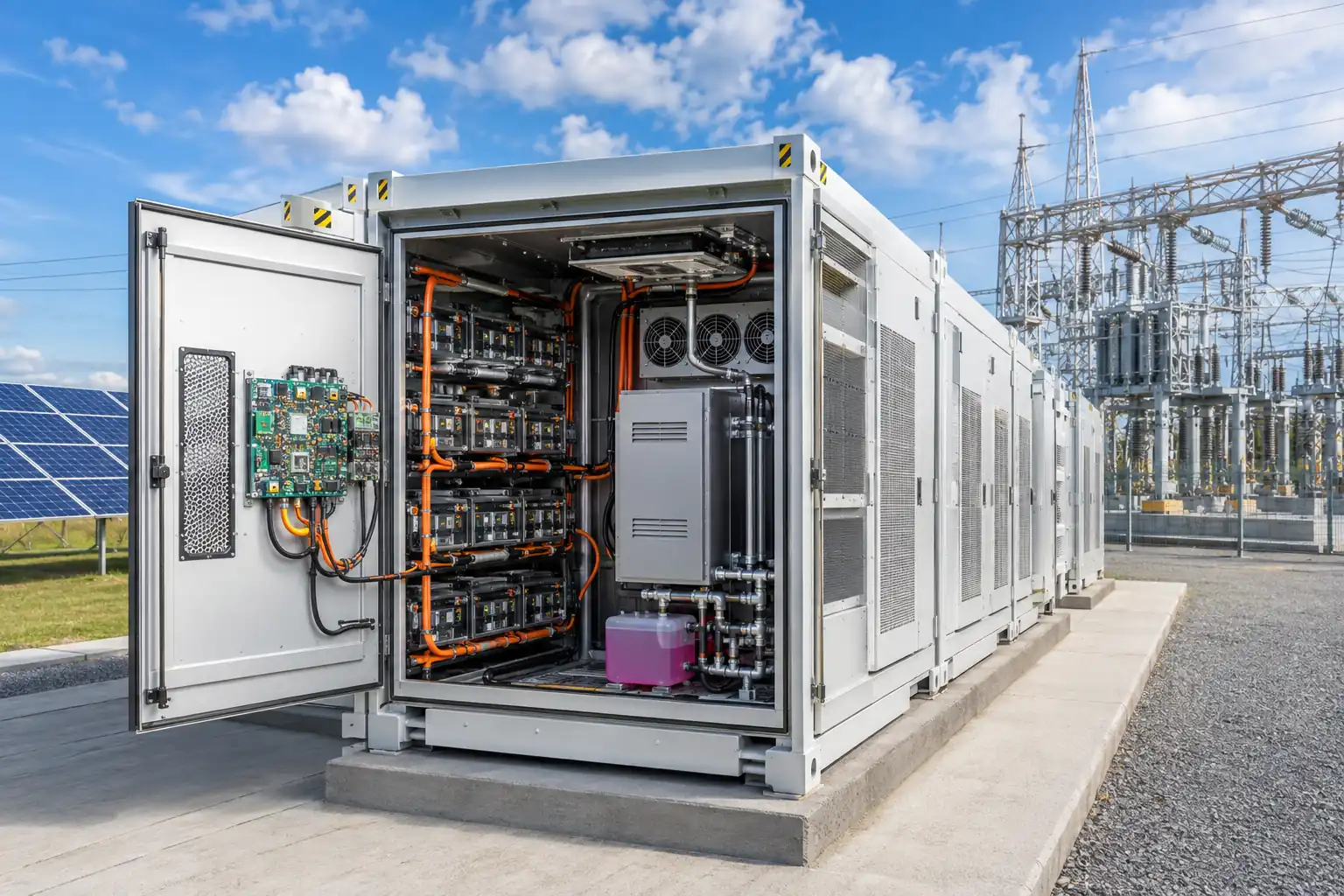
](https://voltcrave-battery.com/wp-content/uploads/2026/08/How-to-Choose-a-High-Voltage-Battery-for-Home-Energy-Storage.webp)
A high-voltage home battery can improve solar storage performance, but choosing the wrong voltage, capacity, or inverter pairing can make the entire system unusable.
I choose a high voltage battery for home energy storage by matching usable capacity, continuous power, operating voltage, inverter compatibility, BMS communication, battery chemistry, safety certification, installation environment, scalability, and warranty to my actual household needs. I always verify the battery and inverter as an approved combination before buying either one.
The best home battery is not automatically the model with the highest voltage or the largest kWh rating. I start with the home's energy profile and backup goals. I then work backward to the battery, inverter, and electrical architecture that can meet those requirements safely and efficiently.
How Much Battery Capacity Do I Need for Home Energy Storage?
Buying more battery capacity gives me longer runtime, but unnecessary capacity increases project cost and may remain unused for much of the year.
I size a home energy storage battery from the number of usable kilowatt-hours my home needs between charging opportunities. I calculate essential-load consumption, desired backup duration, nighttime electricity use, available solar generation, and battery reserve. I then choose usable capacity rather than relying only on the larger nominal-capacity number printed on a datasheet.
I Start With Energy Consumption, Not Battery Size
The first number I want is my household electricity consumption in kWh.
If my essential loads average 1.5 kW and I want eight hours of battery operation:
1.5 kW × 8 hours = 12 kWh
That gives me a basic energy requirement of 12 kWh.
However, I would not automatically buy a battery labeled exactly 12 kWh. Real energy storage involves conversion losses, reserve settings, battery management limits, and changing loads. The U.S. Department of Energy also distinguishes energy capacity, measured in kWh, from power capacity, measured in kW, and notes that storage always has some conversion loss.
I therefore look at usable capacity.
| Specification | What It Tells Me |
|---|---|
| Nominal capacity | Total rated battery energy |
| Usable capacity | Energy made available for normal operation |
| Backup reserve | Energy intentionally held for outages |
| Continuous power | How much load the battery can continuously support |
| Peak power | Short-duration power available for starting large loads |
Suppose a home uses 15 kWh between sunset and sunrise.
A battery with around 15 kWh of usable capacity might cover much of that consumption on a typical day. But if my solar array produces only enough excess energy to recharge 7 kWh, installing a very large battery does not automatically improve daily solar self-consumption.
I therefore evaluate the battery and solar array together.
I Calculate Backup Loads Separately
Backup sizing is different from normal nighttime energy shifting.
If my goal is blackout protection, I make a list of the appliances I really need.
For example:
| Backup Load | Example Power |
|---|---|
| Refrigerator | 150 W |
| Lighting | 200 W |
| Internet and electronics | 150 W |
| Freezer | 150 W |
| Essential outlets | 350 W |
| Small air conditioner | 1,500 W |
| Total example load | 2,500 W |
If those loads average 2.5 kW for four hours:
2.5 kW × 4 hours = 10 kWh
If I want eight hours:
2.5 kW × 8 hours = 20 kWh
This is why I never ask only, “How big should my battery be?”
I ask two questions:
How many kWh do I need?
and
How many kW must the system deliver at one time?
A 20 kWh battery may contain enough energy for my home but still be unsuitable if its inverter can deliver only 5 kW while my simultaneous loads require 8 kW.
That distinction becomes one of my most important filters when choosing a high voltage battery for home energy storage.
What Battery Voltage Should I Choose for a Home Energy Storage System?
I do not select a home battery from nominal voltage alone because the complete operating voltage range must match the hybrid inverter.
I choose a high-voltage battery whose minimum and maximum DC operating voltage fall inside the supported battery range of my inverter. I also verify the permitted number of modules because adding series-connected modules changes battery-stack voltage. A battery described as “high voltage” is not automatically compatible with every high-voltage inverter.
High Voltage Is a System Architecture
A high voltage LiFePO4 battery normally reaches its voltage by connecting multiple cells or battery modules in series.
As more compatible modules are added in series, voltage rises.
A simplified example is:
Cell → module → series-connected battery stack → BMS → hybrid inverter
This architecture is useful because higher voltage allows lower current for the same power.
The basic relationship is:
Power = Voltage × Current
For a theoretical 10 kW load:
| Battery Voltage | Approximate Current |
|---|---|
| 50 V | 200 A |
| 100 V | 100 A |
| 200 V | 50 A |
| 400 V | 25 A |
These calculations ignore conversion losses, but they show why high-voltage systems are attractive for higher-power home storage.
Still, I cannot simply select the highest voltage available.
The Inverter Decides Which Battery Voltage Is Useful
Every hybrid inverter has a defined battery input range.
If the battery stack operates below that range, the inverter may not start or may not reach its designed operating conditions.
If the battery exceeds the permitted maximum voltage, the combination may be unsuitable or unsafe.
This is why manufacturers publish model-specific compatibility tables.
Fronius, for example, currently lists individual high-voltage battery configurations against specific Primo GEN24 Plus, Symo GEN24 Plus, Verto Plus, and other inverter models. Some BYD HVS/HVM capacities work with particular inverter models while other configurations do not.
That gives me an important selection rule:
I match the complete battery configuration, not merely the battery brand.
A BYD HVS 5.1 configuration and HVS 12.8 configuration belong to the same product family, but they do not necessarily have the same approved inverter combinations. Fronius's current compatibility table demonstrates exactly this difference.
I Check Four Voltage Specifications
Before buying, I compare:
- Battery minimum voltage
- Battery nominal voltage
- Battery maximum voltage
- Inverter supported battery voltage range
I then confirm the allowed number of modules.
This becomes especially important with modular batteries because adding a module can change both total usable energy and the system's operating voltage.
A good modular architecture gives me flexibility.
But it is controlled flexibility.
I cannot add unlimited modules simply because they physically fit together.
How Important Are Inverter Compatibility and BMS Communication?
For me, this is the most important technical selection step. Correct voltage alone does not guarantee that the battery and inverter will work together.
I only choose a high voltage home battery after confirming that the exact battery configuration is supported by the exact inverter model. The battery management system and inverter normally need compatible communication, firmware, voltage limits, charge limits, and discharge limits. Matching connectors or CAN ports alone does not prove compatibility.
The BMS and Inverter Work Together
A modern high voltage battery includes a BMS that monitors conditions such as:
- Cell voltage
- Battery voltage
- Charge current
- Discharge current
- Temperature
- State of charge
- Protection status
- Fault conditions
The inverter needs to respect battery operating limits.
The battery may therefore communicate values such as maximum charging current and maximum discharge current to the inverter.
This communication is commonly handled through CAN or another manufacturer-supported interface.
I never assume:
CAN + CAN = compatible.
The physical communication standard may exist on both products while the software protocol is different.
That can cause problems such as:
- Incorrect state-of-charge reporting
- Charging failure
- Unexpected shutdown
- Limited discharge power
- Communication alarms
- Missing backup functions
- Inability to commission the system
Manufacturer Compatibility Lists Matter More Than Marketing Claims
BYD currently publishes dedicated compatible-inverter lists for its high-voltage Battery-Box products, along with operating manuals, service guides, and certification documents.
Fronius does the same from the inverter side. Its current battery compatibility page lists supported storage systems and exact battery capacities for each hybrid inverter. It also notes that the inverter should use current software to ensure full battery functionality.
I see that as strong evidence that home ESS compatibility is a system-level question.
I therefore check:
| Compatibility Item | What I Verify |
|---|---|
| Voltage | Entire battery stack stays inside inverter limits |
| Communication | Correct BMS protocol is supported |
| Firmware | Current approved versions are installed |
| Charge power | Battery and inverter limits match |
| Discharge power | Battery can support expected loads |
| Backup function | Battery is supported in backup mode |
| Country approval | Combination is approved for my market |
Backup Compatibility Deserves Its Own Check
A battery may work for normal solar self-consumption but still have restrictions in backup mode.
If blackout protection matters to me, I specifically verify:
- Whole-home or essential-load backup
- Single-phase or three-phase backup
- Continuous backup power
- Starting or surge power
- Transfer equipment
- Solar operation during outages
- Minimum battery SOC
- Black-start capability where relevant
The U.S. Department of Energy notes that adding battery storage can allow solar systems to provide electricity during outages when the installation has the required storage and electrical design. It also advises checking local utility requirements, electrical rules, and fire-code requirements.
This is why I choose the complete home energy storage system, not simply the battery cabinet.
Which Battery Chemistry and Safety Certifications Should I Look For?
For residential energy storage, I care about chemistry, BMS design, thermal behavior, system certification, and installation approval together.
I prefer a battery chemistry and complete ESS design with strong stationary-storage performance and documented safety testing. LiFePO4 is common in residential energy storage, but chemistry alone is not a safety certificate. I also verify the certifications, fire-testing documentation, electrical protection, installation instructions, and local code requirements for the complete battery system.
LiFePO4 Is Common, but I Still Evaluate the Complete System
LiFePO4 batteries are widely used for stationary storage because they are suited to repeated cycling and residential ESS architectures.
But two LiFePO4 batteries can have very different:
- Cell quality
- Module construction
- BMS design
- Fuse protection
- Contactor design
- Temperature sensing
- Enclosure construction
- Firmware
- Inverter integration
I therefore do not accept:
“It uses LiFePO4, so everything is safe.”
Chemistry is one layer of safety.
System design is another.
I Check Certification for My Market
The required documentation depends on the country.
For example, BYD currently publishes documentation for its HVS/HVM systems that includes IEC 62619, CE, UN38.3 transport information, and other market-specific certificates. Its U.S. HVM documentation also lists UL 1973 and UL 9540 certifications for relevant models.
For North America, I distinguish several standards.
UL explains that UL 1973 applies to stationary batteries, while UL 9540 evaluates the energy storage system as a complete system, including charging, discharging, protection, control, communications, and integration of components.
UL also distinguishes fire-propagation testing from ESS certification. UL 9540A addresses thermal-runaway propagation testing, while the newer UL 9540B specifically addresses large-scale fire testing for residential ESS of 20 kWh or less.
That means I do not treat these terms as interchangeable.
| Document / Standard | What I Use It For |
|---|---|
| UL 1973 | Stationary battery safety |
| UL 9540 | Complete ESS system certification |
| UL 9540A | Thermal-runaway propagation evaluation |
| UL 9540B | Residential ESS large-scale fire evaluation |
| IEC 62619 | Industrial/stationary lithium battery safety |
| UN38.3 | Lithium battery transportation testing |
| Local electrical/fire codes | Installation acceptance |
UL's current guidance also notes that the 2026 edition of NFPA 855 and the 2024 International Fire Code include fire and large-scale testing requirements in certain ESS installations.
For a European, Australian, Middle Eastern, or Southeast Asian installation, I would check the local standards and approval rules rather than assuming a U.S. listing is enough.
Safety documentation should match the market where the battery will actually be installed.
How Do I Compare Battery Power, Scalability, Lifespan, and Warranty?
After compatibility and safety are confirmed, I compare how useful the battery will be over ten or more years.
I compare continuous power, usable capacity, modular expansion, cycle-life conditions, expected degradation, warranty years, warranted energy throughput, remaining-capacity guarantees, and service support. I do not choose a battery only because it advertises a very high cycle count because the test conditions behind that cycle figure can change the real meaning significantly.
Power Is Just as Important as Capacity
Suppose I compare two batteries.
Battery A:
- 15 kWh usable capacity
- 5 kW continuous output
Battery B:
- 12 kWh usable capacity
- 10 kW continuous output
Battery A can store more energy.
Battery B can support a larger instantaneous load.
Which one is better depends on my home.
If I mainly need long overnight runtime with modest loads, Battery A may be more useful.
If I need to start a heat pump, pump, air conditioner, or several high-power appliances during an outage, Battery B may fit better.
I therefore compare kWh and kW together.
I Plan Expansion Before Buying
Home electricity demand often grows.
I may later add:
- An EV
- Heat pump
- Electric water heating
- Larger air conditioning
- More solar panels
- Additional backup circuits
A modular high voltage battery can make expansion easier.
BYD's current HVS/HVM platform illustrates this concept by using configurable high-voltage module stacks, while manufacturers such as Fronius publish exact compatible capacities for different inverter models.
But I verify expansion rules before installation.
I ask:
Can I add modules later?
Can I add another complete battery tower?
Must the towers contain the same number of modules?
Are there SOC requirements when new modules are added?
Will my inverter still support the larger battery?
A modular battery is only useful if the rest of the home energy storage system supports the expansion.
I Read Cycle-Life Conditions
If a supplier says:
“8,000 cycles.”
I ask:
- At what depth of discharge?
- At what temperature?
- At what C-rate?
- What remaining capacity defines end of life?
- Is the measurement based on cells or the finished battery system?
Without these conditions, the number is difficult to compare.
I also check warranty terms.
A battery may have a ten-year warranty, but the warranty might include:
- Maximum throughput
- Maximum cycles
- Required operating temperature
- SOC restrictions
- Remaining-capacity guarantee
- Approved inverter requirement
So I compare the complete warranty rather than the headline number.
Service Support Matters Over a Decade
A home battery may remain installed for many years.
I therefore ask whether the manufacturer or supplier can provide:
- Replacement modules
- Firmware updates
- BMS diagnostic support
- Installation manuals
- Wiring diagrams
- Remote troubleshooting
- Compatible inverter updates
- Warranty processing
A cheap battery becomes expensive if I cannot obtain support when the BMS reports a fault seven years later.
Long-term serviceability is part of battery quality.
My Insights: How to Choose a High Voltage Battery for Home Energy Storage
My main insight is that choosing a high voltage home battery is really a system-design decision. Battery capacity is only one part of that decision.
I choose a high voltage battery for home energy storage by first defining my energy, power, and backup requirements. I then select an approved battery-and-inverter combination with the correct voltage range, BMS communication, safety certification, usable capacity, expansion path, installation rating, cycle-life conditions, warranty, and long-term technical support.
I Use Compatibility as the First Filter
If the battery is not approved for my inverter, I stop evaluating it.
I do not care how attractive the price is.
I do not care whether the cell chemistry is excellent.
I do not care whether it has 20 kWh of capacity.
If the inverter cannot safely control it, the product is not the right battery for that system.
Current manufacturer documentation reinforces this approach. Fronius publishes exact compatible battery capacities for individual hybrid inverter models, while BYD maintains dedicated compatible-inverter documentation for its high-voltage battery families.
My Selection Order Is Simple
| Priority | What I Check |
|---|---|
| 1 | Household energy requirement |
| 2 | Backup and peak power requirement |
| 3 | Inverter compatibility |
| 4 | Battery operating voltage |
| 5 | BMS communication |
| 6 | Usable battery capacity |
| 7 | Safety certification |
| 8 | Installation environment |
| 9 | Expansion capability |
| 10 | Warranty and technical support |
This order prevents me from comparing batteries using one specification.
I Calculate Energy and Power Separately
If my home needs 12 kWh overnight, I choose enough usable battery capacity to cover that requirement with a reasonable operating margin.
Then I calculate peak load.
Suppose I may simultaneously operate:
- 2.5 kW air conditioner
- 2 kW cooking load
- 1 kW refrigerator and appliances
- 1 kW lighting and electronics
The combined load could approach:
6.5 kW
A battery and inverter combination limited to 5 kW may not meet that requirement even if it contains 20 kWh of stored energy.
So my home battery needs both:
Enough kWh to last
and
Enough kW to run the loads.
I Look at the Complete High-Voltage Architecture
A strong high voltage home ESS normally includes more than cells.
I expect:
LiFePO4 cells → battery modules → high-voltage series stack → BMS → protection/contactors → hybrid inverter → home electrical system
Every part has to fit.
The BMS protects the battery.
The inverter converts power.
The backup equipment isolates the home when required.
The EMS controls when the battery charges or discharges.
Safety certification evaluates different parts of that architecture. UL specifically describes UL 9540 as system-level evaluation that includes charging, discharging, protection, control, communications, and interaction between components.
That is why I prefer complete, documented ESS combinations over assembling unrelated components simply because their basic specifications look similar.
I Do Not Automatically Buy the Largest Battery
Larger storage can give me more backup time.
But capacity should have a purpose.
If my household uses only 8 kWh overnight and my solar system produces only 6 kWh of regular excess energy, a 30 kWh battery may spend much of its time underused unless I have another reason for the capacity.
Instead, I balance:
Daily consumption
Solar production
Backup duration
Utility tariff
Future load growth
Budget
This approach gives me a battery sized around the home instead of making the home adapt to the battery.
I Plan for Future Electrification
I also think several years ahead.
My home today may use natural gas for heating, cooking, and transportation.
Later I may add:
- Electric vehicle charging
- Electric water heating
- Heat pump heating
- Heat pump cooling
- Larger solar system
Those changes can significantly increase electricity consumption.
If I know they are likely, I may choose a modular high voltage battery system and an inverter with enough headroom for future expansion.
That does not mean I need to buy all the battery modules today.
It means I want an approved path to expand tomorrow.
My Final Buying Checklist
Before I choose a high voltage battery for home energy storage, I want a clear yes to each of these questions:
- Does the battery provide enough usable kWh for my energy needs?
- Can the battery and inverter deliver enough continuous and peak kW?
- Is the complete battery voltage range supported by my inverter?
- Is the exact battery configuration officially compatible with the exact inverter model?
- Does the BMS communication protocol work with that inverter?
- Does the system support the backup functions I need?
- Does the battery have the required safety documentation for my market?
- Can it operate in my installation temperature and environmental conditions?
- Can I expand capacity later if my household demand grows?
- Are the warranty terms, service network, firmware support, and replacement strategy acceptable?
If one of the first six answers is no, I normally look for another battery.
If all ten answers are yes, I then compare purchase price and installation cost.
That order gives me a high voltage home energy storage battery that is not simply attractive on a specification sheet.
It gives me a battery that can actually work as part of my home's electrical system.
Conclusion
I choose a high voltage home battery by matching usable energy, power, inverter compatibility, BMS communication, safety, scalability, warranty, and installation conditions to my real household requirements.
](https://voltcrave-battery.com/wp-content/uploads/2026/09/12V-vs-24V-vs-48V-Batteries-for-Solar-Systems-Whats-the-Difference-768x512.webp)
](https://voltcrave-battery.com/wp-content/uploads/2026/08/What-Determines-the-Lifespan-of-a-BESS-Battery-768x512.webp)
](https://voltcrave-battery.com/wp-content/uploads/2026/09/What-Are-the-Downsides-of-Using-a-Portable-Power-Station-768x512.webp)