
](https://voltcrave-battery.com/wp-content/uploads/2026/10/Can-I-Have-a-Whole-House-Battery-Backup-Without-Solar-Panels.webp)
Power outages can interrupt daily life, but installing solar panels is not always practical. Many homeowners need reliable backup power without changing their roofs or installing solar equipment.
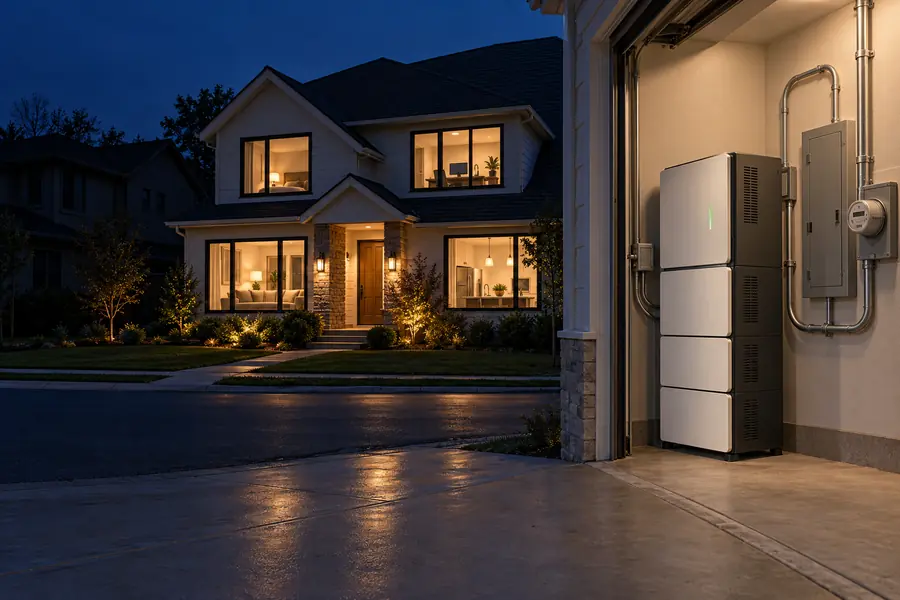
Yes, you can have a whole house battery backup without solar panels. A grid-charged battery storage system stores electricity from your utility supply and automatically powers your home during an outage. With enough battery capacity, inverter power, and proper backup equipment, it can support an entire house without requiring solar panels.
I believe a home battery backup without solar is a practical solution for homeowners who want emergency power, quieter operation, and better control over electricity use. However, the system needs enough stored energy to meet household demand. Understanding battery capacity, power output, backup duration, and installation requirements is essential before selecting a system.
How Does a Whole House Battery Backup Work Without Solar Panels?
A whole-house battery system may seem closely connected to solar technology, but solar panels are not required for battery storage. The utility grid can serve as the charging source.
A whole house battery backup without solar panels works by charging batteries from the electrical grid through a compatible inverter or charger. When utility power fails, a properly configured backup system disconnects the home from the grid and uses stored battery energy to supply electricity to household circuits.
The Main Components of a Grid-Charged Battery System
I usually divide a complete residential battery backup system into several essential components.
| Component | Main function |
|---|---|
| LiFePO4 Battery | Stores electrical energy for backup use |
| Battery Inverter | Converts stored DC electricity into usable AC electricity |
| Battery Management System (BMS) | Monitors cell voltage, temperature, and battery protection |
| Backup Gateway or Transfer Equipment | Detects outages and safely isolates the home from the grid |
| Energy Management System (EMS) | Controls charging, discharging, and power distribution |
| Electrical Distribution Panel | Delivers backup electricity to selected or whole-home circuits |
A correctly designed system works automatically.
During normal operation, electricity from the utility grid supplies the house and charges the battery when needed.
When the grid fails, the backup equipment isolates the home from the utility network. The battery inverter then supplies the backed-up electrical loads.
When utility electricity returns, the system can reconnect and recharge according to its settings.
The exact switching behavior depends on the inverter and backup equipment.
Can a Home Battery Charge Directly From the Grid?
Yes. Many residential energy storage systems support grid charging.
I consider this feature especially useful for homeowners who cannot install rooftop solar panels because of unsuitable roof conditions, shading, rental restrictions, or installation costs.
Some systems also support scheduled charging.
For example, homeowners with time-of-use electricity tariffs may charge their batteries during lower-price periods and discharge them when electricity prices increase.
However, a grid-charged battery does not generate electricity. It only stores energy purchased from the utility.
This difference becomes important during an extended blackout because the battery cannot recharge from the unavailable grid.
Manufacturers such as Tesla offer residential battery systems that support operation without solar panels. The exact backup configuration must be selected and installed correctly because not every battery installation includes outage protection.
How Long Can a Whole House Battery Backup Run Without Solar?
Battery backup duration is one of the most important questions homeowners ask. A system may power essential appliances for many hours but run out of energy quickly when several large appliances operate together.
A whole house battery backup without solar panels can run for several hours to more than a day, depending on battery capacity and household consumption. A 20 kWh system delivering an average of 1 kW may provide approximately 18 hours of backup under an illustrative 90% usable-energy assumption.
How Much Battery Capacity Does a Whole House Need?
I recommend starting with actual household electricity consumption rather than choosing a battery based on its advertised capacity alone.
Battery capacity is measured in kilowatt-hours (kWh).
Power demand is measured in kilowatts (kW).
These two measurements describe different parts of the backup system.
Battery capacity determines how much energy can be stored. Inverter power determines how much electricity the system can deliver at one time.
For example, a home may need 25 kWh of electricity over one day, but its peak power demand may reach 8 kW when multiple appliances operate simultaneously.
Both requirements must be considered.
Estimated Home Battery Backup Duration
The following examples assume that 90% of the stated battery capacity is available after accounting for an illustrative combination of operating reserve and losses.
| Battery Capacity | 0.5 kW Average Load | 1 kW Average Load | 2 kW Average Load |
|---|---|---|---|
| 10 kWh | 18 hours | 9 hours | 4.5 hours |
| 20 kWh | 36 hours | 18 hours | 9 hours |
| 30 kWh | 54 hours | 27 hours | 13.5 hours |
| 40 kWh | 72 hours | 36 hours | 18 hours |
These are calculation examples, not guaranteed product runtimes. Actual results depend on the battery's usable capacity, inverter efficiency, operating conditions, and backup settings.
I calculate estimated backup time using a simple formula:
Backup Time (hours) = Usable Battery Energy (kWh) ÷ Average Power Consumption (kW)
Which Appliances Consume the Most Battery Power?
Some household devices use relatively little electricity.
LED lighting, Wi-Fi routers, phone chargers, and modern refrigerators can often be supported by modest battery systems.
Other appliances need much more electricity.
Central air conditioning, electric heating, water heaters, ovens, and electric vehicle chargers can substantially reduce backup duration.
Motor-driven appliances may also require high startup power.
For this reason, I would check whether the battery inverter can supply both the normal operating load and the short-term startup demand.
If a household only needs lighting, refrigeration, internet access, and a few outlets, a smaller system may be sufficient.
For true whole-house backup with central air conditioning and other large loads, multiple battery modules or a higher-capacity system may be necessary.
Without solar panels, careful energy management becomes particularly important during a long outage.
How Much Does a Whole House Battery Backup Cost Without Solar Panels?
A residential battery backup system can reduce the inconvenience of power failures, but installation requires a significant upfront investment. The total price depends on energy capacity, inverter specifications, and electrical installation requirements.
A whole house battery backup without solar panels may cost several thousand to tens of thousands of dollars, depending on capacity and installation complexity. In the United States, EnergySage reported an average installed home battery price of about $15,650 for a 13.5 kWh system in August 2026. True whole-house backup may require additional capacity.
What Determines the Price of a Residential Battery System?
I separate the overall installation cost into several categories.
| Cost factor | Impact on total price |
|---|---|
| Battery capacity | More kWh generally increases equipment cost |
| Battery chemistry | Influences performance, design, and price |
| Inverter power | Larger power ratings may increase cost |
| Backup gateway | Adds grid isolation and backup controls |
| Installation labor | Depends on local labor rates and complexity |
| Electrical panel upgrades | May be needed in some installations |
| Permits and inspections | Depend on local requirements |
| Monitoring and controls | Vary by manufacturer and configuration |
The system design can make a large difference.
For example, a battery that supports essential household circuits may cost less than a complete whole-house configuration.
A larger home may require several batteries to achieve the desired backup duration.
I would therefore avoid comparing products only by their battery price.
An inexpensive battery module may not include the inverter, backup controls, protection equipment, or installation services needed for a complete system.
Can a Battery Without Solar Reduce Electricity Bills?
Yes, but savings depend on the utility tariff and how the battery operates.
Some utilities offer different electricity prices throughout the day.
A battery can charge when prices are relatively low and provide electricity during higher-price periods.
This process is often called time-of-use optimization or energy arbitrage.
However, batteries lose some energy during charging and discharging.
I would compare the price difference between off-peak and peak electricity against round-trip energy losses, battery degradation, and installation costs.
For homeowners with flat electricity tariffs, a standalone battery may offer limited direct electricity savings.
I see emergency protection as the main reason to install a home battery without solar.
Homeowners who want both long-term energy generation and battery storage may gain additional benefits by combining the system with solar panels later.
Is a Whole House Battery Backup Without Solar Worth It?
A standalone home battery provides reliable backup capabilities when designed correctly, but it may not be the best solution for every property. Its value depends on outage frequency, electricity costs, household demand, and backup expectations.
A whole house battery backup without solar can be worth it for homeowners who experience frequent outages, need quiet automatic backup power, or have favorable time-of-use electricity rates. However, limited stored energy and the inability to recharge from the grid during outages make proper sizing and load management essential.
Advantages of a Battery Backup Without Solar
I see several practical benefits.
1. No solar panel installation required
Homeowners can install compatible battery storage without mounting panels on the roof.
This is helpful for properties with heavy shading, limited roof space, or restrictions on solar installations.
2. Automatic backup power
A properly equipped system can detect a grid outage and switch to battery power automatically.
This reduces the need for manual generator startup.
3. Quiet operation
Battery systems operate much more quietly than conventional combustion generators.
They also produce no exhaust emissions at the point of use.
4. Flexible installation
Some residential batteries can be installed indoors or outdoors, depending on the product's environmental rating and local installation rules.
5. Future solar compatibility
Certain grid-charged battery systems can integrate with solar energy equipment later.
I would verify this capability before purchasing because solar compatibility varies between products.
Limitations of a Standalone Home Battery
A battery without solar also has limitations.
The most important issue is recharging during a prolonged outage.
When the utility grid remains unavailable, a grid-only battery system has no normal source of additional electricity.
Once the stored energy is depleted, backup power stops.
Another limitation is high household power demand.
A system with sufficient battery capacity may still be unable to operate large appliances if its inverter does not provide enough continuous or starting power.
Installation safety is also important.
Residential battery systems need suitable electrical protection, properly rated backup equipment, and compliance with local electrical and fire regulations.
In the United States, UL 9540 certification and applicable installation codes can be important parts of the approval process.
I would use a qualified installer to confirm equipment compatibility, safe grid isolation, required permits, and suitable installation locations.
Battery Backup Without Solar vs. Generator
| Feature | Home Battery Backup | Fuel Generator |
|---|---|---|
| Solar panels required | No | No |
| Noise | Very low | Usually higher |
| Fuel required during operation | No | Yes |
| Automatic operation | Available with suitable equipment | Available with automatic transfer equipment |
| Runtime | Limited by stored energy | Limited by fuel supply and equipment |
| On-site exhaust | None | Present with combustion generators |
| Maintenance | Generally lower | Generally higher |
| Recharge or refueling | Grid or approved charging source | Fuel replenishment |
I would choose a battery-first solution for households that value quiet operation and automatic backup during relatively short outages.
For areas where power failures regularly last several days, I would consider whether solar integration or an appropriately engineered generator-supported system is necessary.
My Insights: Can I Have a Whole House Battery Backup Without Solar Panels
I believe a whole house battery backup without solar panels is technically practical and can be an effective option for homeowners who want better energy security.
However, the most important question is not whether a battery can power a house. It is whether the complete system can support the household's actual electricity requirements for the desired period.
Whole-House Backup and Essential-Load Backup Are Different
I would distinguish between keeping every circuit available and maintaining only the most important appliances.
A whole-house backup system is connected and sized to support the home's required electrical loads, subject to its power and energy limits.
An essential-load backup system focuses on selected circuits, such as refrigeration, lighting, communications, and necessary equipment.
A smaller battery system may deliver excellent results when it supports only essential appliances.
It may provide disappointing results if the homeowner expects it to run central air conditioning, electric heating, and other large loads simultaneously.
This is why I consider load analysis the first step in system design.
Battery Capacity and Inverter Power Must Work Together
I would not select a residential battery solely because it offers 20 kWh or 30 kWh of storage.
The inverter must also provide enough continuous output power.
For example, a 30 kWh battery system paired with a 5 kW inverter may have considerable stored energy, but it cannot continuously power an 8 kW household load.
The system must either reduce demand, limit certain appliances, or use a higher-power configuration.
I would also evaluate battery cycle life, LiFePO4 chemistry, energy management, warranty coverage, and the ability to expand capacity.
Grid Charging Offers Convenience but Not Unlimited Independence
A grid-connected battery can recharge without solar panels and maintain a reserve for future outages.
However, this does not make the house permanently independent of the electrical grid.
The battery stores a limited amount of energy.
I consider this distinction especially important for homeowners in regions where hurricanes, severe storms, or other events can cause multi-day outages.
For short power interruptions, a standalone battery may be sufficient.
For longer outages, I would examine additional charging sources, compatible hybrid energy systems, or carefully planned load restrictions.
Modular LiFePO4 Systems Can Provide Greater Flexibility
I favor evaluating modular LiFePO4 battery systems when future expansion is important.
A modular design may allow additional battery capacity as energy needs change.
For residential applications, I would compare wall-mounted batteries, stacked battery systems, and integrated home energy storage units.
Each design offers different installation, expansion, and service advantages.
I would also verify that the manufacturer supports the required grid voltage, frequency, inverter functions, and local electrical standards.
Conclusion
Yes, a whole house battery backup without solar panels is possible. I consider a correctly sized, grid-charged LiFePO4 energy storage system a strong option for emergency backup, provided its power output, energy capacity, and installation configuration match the home.
](https://voltcrave-battery.com/wp-content/uploads/2026/10/Do-LiFePO4-Prismatic-Cells-Need-Compression-768x512.webp)
](https://voltcrave-battery.com/wp-content/uploads/2026/08/How-Is-a-Solar-Panel-Made-768x512.webp)
](https://voltcrave-battery.com/wp-content/uploads/2026/10/Why-Are-E-Bike-Batteries-So-Expensive-768x512.webp)







































