
](https://voltcrave-battery.com/wp-content/uploads/2026/09/What-Types-of-Electrical-Control-Cabinets-Are-Available.webp)
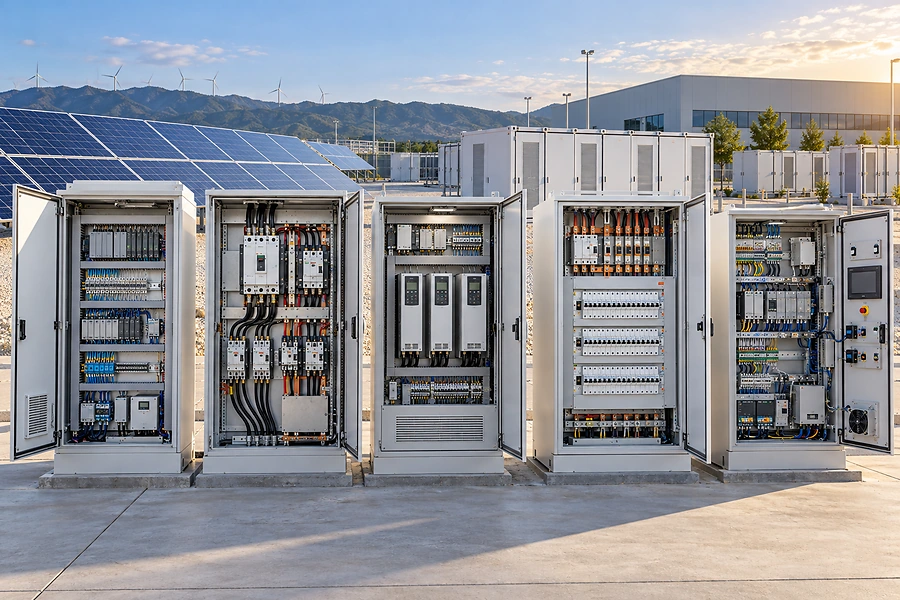
Electrical control cabinets may look similar externally, but their internal components and functions can differ significantly. Choosing the wrong type can complicate control, protection, maintenance, and expansion.
Common electrical control cabinets include PLC cabinets, motor control centers (MCCs), VFD cabinets, relay control cabinets, automation cabinets, process-control cabinets, power distribution and control cabinets, and custom machine-control cabinets. The correct type depends on the equipment being controlled, electrical ratings, automation requirements, communication needs, environment, and required protection.
Electrical control cabinets should therefore be classified primarily by what they control and how they control it, rather than simply by enclosure size. IEC 61439-1 covers general requirements for low-voltage switchgear and controlgear assemblies, while IEC 61439-2 covers power switchgear and controlgear assemblies used for functions including electrical-energy distribution, conversion, and equipment control.
A useful starting point is:
Application → Control Function → Electrical Load → Components → Cabinet Design
What Are the Main Types of Electrical Control Cabinets?
Control cabinets can be designed around automation, motors, variable-speed drives, relays, process equipment, power distribution, or a specific machine.
The main electrical control cabinet types include PLC control cabinets for programmable automation, MCC cabinets for groups of motors, VFD cabinets for variable-speed motor control, relay cabinets for simpler control logic, automation cabinets for integrated machine systems, process-control cabinets for industrial processes, and customized cabinets designed for specific equipment or production requirements.
A practical comparison is:
| Control Cabinet Type | Primary Function | Typical Components | Common Applications |
|---|---|---|---|
| PLC Cabinet | Programmable automation | PLC, I/O, relays, power supplies | Machinery, production lines |
| MCC | Motor control | Starters, contactors, breakers, overloads | Factories, pumps, conveyors |
| VFD Cabinet | Variable-speed motor control | VFD, breakers, reactors, controls | Fans, pumps, compressors |
| Relay Cabinet | Basic control logic | Relays, timers, contactors | Simple machines |
| Automation Cabinet | Integrated automation | PLC, HMI, I/O, network equipment | Automated production |
| Process-Control Cabinet | Process monitoring/control | PLC/DCS equipment, I/O, instruments | Chemical, water, food processing |
| Distribution & Control Cabinet | Power plus control | Breakers, busbars, contactors, controls | Industrial facilities |
| Custom Machine Cabinet | Equipment-specific control | Application-dependent | OEM machinery |
These categories overlap.
For example, an automation cabinet may contain both:
PLC + VFD
while an MCC may contain:
motor starters + VFDs + communication equipment.
The cabinet name usually describes its dominant function.
What Is a PLC Control Cabinet?
PLC cabinets are among the most common control cabinets in modern industrial automation.
A PLC control cabinet houses a Programmable Logic Controller and the supporting electrical equipment required to automate machinery or industrial processes. It commonly includes PLC CPUs, input/output modules, power supplies, relays, terminal blocks, circuit protection, Ethernet switches, communication modules, and connections to sensors and actuators.
The basic signal path is:
Sensor → PLC Input → Control Program → PLC Output → Actuator
Suppose a production line has a conveyor.
A sensor detects a product.
The sensor sends an electrical signal to the PLC.
The PLC program processes the input and determines what should happen.
The PLC output may then command:
a motor,
a pneumatic valve,
a robotic actuator,
or another machine.
A PLC cabinet can therefore coordinate hundreds or thousands of control signals.
Typical applications include:
packaging machinery,
production lines,
water treatment,
material handling,
HVAC,
food processing,
warehouse automation,
and robotic systems.
The main advantage is flexibility.
Control logic can be changed through software rather than completely rewiring the control system.
What Is a Motor Control Center Cabinet?
An MCC is designed primarily around groups of electric motors.
A Motor Control Center centralizes the switching, protection, and control of multiple motors. Depending on the design, an MCC may contain circuit breakers, motor starters, contactors, overload protection, VFDs, soft starters, control transformers, meters, PLC interfaces, and industrial communication equipment.
Consider a factory operating:
30 electric motors.
The motors might power:
conveyors,
pumps,
fans,
mixers,
and compressors.
Instead of creating a completely independent electrical system for each motor, the control equipment can be organized in an MCC.
The architecture becomes:
Incoming Power → MCC Bus → Individual Motor Units → Motors
Each motor unit can have its own:
protection,
switching,
control,
and monitoring.
MCCs are especially useful in facilities containing many motors.
Typical applications include:
manufacturing,
water treatment,
mining,
oil and gas,
HVAC plants,
material handling,
and process industries.
The main distinction is:
PLC Cabinet → Automation Logic
while:
MCC → Motor Power and Control.
However, modern MCCs can also communicate with PLC and automation systems.
What Is a VFD Control Cabinet?
VFD cabinets are designed for motors that require adjustable speed.
A VFD control cabinet contains one or more Variable Frequency Drives and supporting equipment used to regulate AC motor speed and torque. Typical components include VFDs, circuit breakers, fuses, contactors, reactors, filters, bypass equipment, control power supplies, PLC interfaces, communication devices, and thermal-management equipment.
The electrical path is approximately:
AC Supply → Protection → VFD → Motor
The VFD electronically controls the frequency and voltage supplied to the motor.
This allows motor speed to be adjusted according to actual demand.
For example, a pump may not need to operate at full speed continuously.
A VFD can reduce motor speed when flow demand decreases.
Common VFD cabinet applications include:
pumps,
fans,
compressors,
conveyors,
mixers,
and industrial processing equipment.
VFD cabinets also create a thermal-design challenge.
Drives generate heat.
Therefore, designers may need:
fans,
filtered ventilation,
heat exchangers,
or cabinet air conditioning.
The cabinet must balance:
Environmental Protection ↔ Heat Removal.
What Is a Relay Control Cabinet?
Relay cabinets use electromechanical or electronic relays to perform control functions.
A relay control cabinet uses relays, timers, contactors, switches, and other hardwired devices to implement control logic. It can be a practical solution for relatively simple machines and processes where the control sequence is limited and does not justify a more complex programmable automation system.
Consider a simple pump system.
The control requirement might be:
Low Level → Pump ON
High Level → Pump OFF
This can potentially be implemented using:
level switches,
relays,
contactors,
and protection devices.
No PLC may be necessary.
Relay control has several advantages for simple applications:
straightforward operation,
visible wiring logic,
low software dependence,
and familiar maintenance.
However, complexity increases quickly.
Imagine implementing:
50 inputs,
30 outputs,
timers,
interlocks,
alarms,
and multiple operating modes.
A large relay-based system can become difficult to:
wire,
modify,
document,
and troubleshoot.
At that point, a PLC cabinet often becomes more practical.
Therefore:
Simple Logic → Relay Control
Complex/Flexible Logic → PLC Control
is a useful general guideline rather than an absolute rule.
What Is an Automation Control Cabinet?
Automation cabinets integrate multiple control technologies.
An automation control cabinet combines controllers, communication equipment, I/O, power supplies, relays, drives, safety devices, and network components to coordinate automated machinery or production processes. It often serves as the central electrical and digital control point for an automated system.
A typical automation architecture might be:
Sensors → Remote I/O → PLC → Industrial Network → Drives/Actuators
An HMI may also connect to the PLC:
PLC ↔ HMI
allowing operators to:
start equipment,
stop equipment,
change settings,
view alarms,
and monitor production.
More advanced systems may connect to:
SCADA,
MES,
industrial databases,
or cloud platforms.
This means modern automation cabinets increasingly manage:
Power + Control + Communication + Data
rather than electrical switching alone.
Typical applications include:
robotic production,
automated warehouses,
packaging lines,
assembly systems,
machine tools,
and smart manufacturing.
What Is a Process-Control Cabinet?
Process-control cabinets are designed for continuous or batch industrial processes.
A process-control cabinet houses equipment used to monitor and regulate variables such as temperature, pressure, flow, level, speed, and chemical conditions. It may contain PLC or DCS hardware, I/O modules, signal conditioners, relays, power supplies, communication equipment, safety systems, and connections to field instrumentation.
Consider a water-treatment process.
Sensors measure:
flow,
tank level,
pressure,
and water quality.
The control system processes those signals.
It may then adjust:
pumps,
valves,
chemical dosing,
and filtration equipment.
The control loop can be represented as:
Sensor → Controller → Decision → Actuator → Process → Sensor
Process-control cabinets are common in:
water treatment,
chemical processing,
food and beverage,
pharmaceutical production,
oil and gas,
and industrial utilities.
Signal quality can be particularly important.
The cabinet may contain both:
high-power circuits
and:
low-level instrumentation signals.
Designers therefore need to consider:
cable routing,
grounding,
shielding,
and electromagnetic interference.
What Is a Power Distribution and Control Cabinet?
Some cabinets combine electrical distribution with control functions.
A power distribution and control cabinet receives electrical power, protects and distributes circuits, and also contains equipment used to control connected loads. It can combine breakers, busbars, fuses, contactors, relays, meters, PLC equipment, and communication devices within one coordinated assembly.
The architecture might look like:
Incoming Power → Main Breaker → Busbar → Branch Protection → Controlled Loads
At the same time:
PLC → Relay/Contactor → Load
This creates two interacting systems:
Power Path
and:
Control Path.
IEC 61439-2 applies to low-voltage power switchgear and controlgear assemblies used in applications involving generation, distribution, conversion, and control of electrical energy and connected equipment.
Combined distribution-and-control cabinets are common when a machine or process needs both:
electrical power distribution
and:
automation/control.
What Is a Custom Machine-Control Cabinet?
Many industrial cabinets are designed specifically for one machine.
A custom machine-control cabinet is engineered around the electrical and automation requirements of a particular machine or production system. Its components may include PLCs, drives, servo controllers, safety relays, contactors, breakers, transformers, power supplies, industrial computers, communication equipment, and application-specific interfaces.
Consider an automated packaging machine.
It might contain:
10 servo motors,
4 conveyors,
20 pneumatic valves,
80 sensors,
machine vision,
safety scanners,
and an HMI.
A generic cabinet may not meet those requirements.
The cabinet must be designed around:
I/O count,
motor power,
servo requirements,
network architecture,
safety circuits,
heat generation,
field wiring,
and maintenance access.
Custom control cabinets are therefore common among:
machine builders,
system integrators,
robotics companies,
and industrial OEMs.
Customization does not mean standards can be ignored.
The completed assembly still needs to be designed around applicable electrical and safety requirements.
What Is a Safety Control Cabinet?
Some industrial systems require dedicated safety-control functions.
A safety control cabinet contains equipment associated with machine or process safety functions. Depending on the application, it can include safety relays, safety PLCs, emergency-stop circuits, contactors, monitoring devices, and interfaces to guards, light curtains, scanners, and other protective equipment.
Imagine a robotic cell.
A person opens the safety gate.
The safety system detects the event.
The control system must bring hazardous movement into the required safe condition.
The simplified chain is:
Safety Device → Safety Controller → Safe Output → Hazardous Equipment
This is different from ordinary production logic.
A normal PLC may decide:
Run Conveyor.
A safety system may need to determine:
Remove Hazardous Motion.
Safety-related design depends on the specific machinery, risk assessment, architecture, and applicable functional-safety requirements.
Therefore, a safety cabinet should not be specified only by asking how many safety relays fit inside it.
The required safety function must be defined first.
What Is a Remote I/O Cabinet?
Large facilities may distribute control hardware closer to field equipment.
A remote I/O cabinet houses input/output modules and supporting communication, power, protection, and terminal equipment away from the main PLC cabinet. It reduces the need to route every individual sensor and actuator cable back to one central control cabinet.
Imagine a large factory.
The main PLC is:
200 meters
away from a production area.
Without remote I/O, dozens of field cables might need to run the full distance.
With remote I/O:
Sensors → Nearby Remote I/O Cabinet → Industrial Network → Main PLC
This can reduce:
cable length,
installation complexity,
and centralized cabinet congestion.
Remote I/O cabinets may contain:
I/O modules,
network adapters,
24 V DC power supplies,
terminal blocks,
fiber or Ethernet equipment,
and circuit protection.
They are especially useful in:
large factories,
water-treatment plants,
material-handling systems,
and distributed industrial processes.
What Is an HMI Control Cabinet?
Some control cabinets include operator interfaces on the door.
An HMI control cabinet combines electrical control equipment with a Human-Machine Interface that allows operators to monitor equipment, acknowledge alarms, adjust settings, and issue operating commands. The HMI may be installed directly on the cabinet door or located in a separate operator station.
A typical system might include:
HMI ↔ PLC ↔ VFD ↔ Motor
The operator sees:
machine status,
motor speed,
temperature,
production counts,
and alarms.
The HMI sends commands to the PLC.
The PLC then controls the equipment according to programmed logic.
An HMI does not normally replace the PLC.
Instead:
HMI = Human Interface
while:
PLC = Control Logic.
Keeping these functions separate helps explain the architecture of modern control cabinets.
Are Solar and Energy Storage Control Cabinets Available?
Renewable-energy systems also require specialized electrical control assemblies.
Solar and battery-storage installations can use specialized control cabinets containing protection, metering, PLCs, communication devices, auxiliary power equipment, EMS interfaces, and controls associated with inverters, batteries, and grid connections. Their architecture differs from conventional machine-control cabinets because they coordinate both power electronics and energy-management functions.
For solar applications, IEC published IEC 61439-8:2026 specifically for low-voltage switchgear and controlgear assemblies used in photovoltaic installations. It covers stationary enclosed assemblies for PV applications, including DC systems up to 1,500 V DC and AC auxiliary/control supplies within its defined scope.
A solar control architecture might include:
PV → Protection → Inverter → AC Distribution
with:
Controller → Meter → Inverter → Monitoring Platform
A battery-storage architecture may add:
Battery → BMS → PCS → EMS
The control cabinet may support communication between these systems.
This makes renewable-energy control cabinets increasingly important as electrical systems become more digital and distributed.
What Is the Difference Between Indoor and Outdoor Control Cabinets?
The control function can remain the same while the enclosure requirements change significantly.
Indoor and outdoor electrical control cabinets may contain similar control equipment, but outdoor cabinets require greater consideration of rain, dust, sunlight, corrosion, temperature changes, condensation, and thermal management. The required enclosure construction and protection rating should therefore be selected according to the actual installation environment.
Consider the same PLC system.
Inside a climate-controlled electrical room, it operates in relatively stable conditions.
Move it outdoors and the cabinet may experience:
summer heat,
winter cold,
rain,
dust,
sunlight,
and condensation.
Now the design may require:
additional sealing,
sun shielding,
heaters,
air conditioning,
or heat exchangers.
The electrical logic has not changed.
The enclosure engineering has.
This demonstrates an important distinction:
Control Cabinet Type = Function
while:
Indoor/Outdoor = Environment.
How Do You Choose the Right Electrical Control Cabinet?
The correct cabinet begins with the application rather than the enclosure.
Choose an electrical control cabinet by defining the machine or process, loads, voltage, current, control complexity, number of I/O points, motor-control requirements, communication architecture, safety functions, environmental conditions, thermal load, maintenance requirements, and applicable standards. Only then should cabinet dimensions, material, protection level, and cooling method be finalized.
A practical decision path is:
What must be controlled?
If it is mostly automation logic:
PLC Cabinet
If it is many motors:
MCC
If it is variable-speed motors:
VFD Cabinet
If the logic is simple:
Relay Cabinet
If it is a complete automated machine:
Automation or Custom Machine Cabinet
If it is an industrial process:
Process-Control Cabinet
But these choices can overlap.
A production line could require:
MCC + VFD Cabinet + PLC Cabinet + Remote I/O Cabinet.
One giant cabinet is not always the best solution.
The correct architecture depends on:
system size,
location,
heat,
maintenance,
wiring,
and reliability.
IEC's guidance for specifying low-voltage assemblies similarly emphasizes defining required functions and characteristics according to the specific application rather than treating every assembly as identical.
What Standards Apply to Electrical Control Cabinets?
Applicable standards depend on the market, cabinet type, and equipment.
Electrical control cabinets can fall under different standards depending on their construction and application. IEC 61439 addresses low-voltage switchgear and controlgear assemblies internationally, while UL 508A is widely associated with industrial control panels in North America. Product-specific and machine-specific requirements can also apply.
IEC 61439-1:2020 establishes general definitions, service conditions, construction requirements, technical characteristics, and verification requirements for low-voltage switchgear and controlgear assemblies. The applicable product part of the IEC 61439 series must also be considered.
IEC 61439-2:2020 covers power switchgear and controlgear assemblies for applications including electrical-energy distribution, conversion, and control.
For North American industrial control panels, UL maintains requirements associated with UL 508A, including requirements governing components used within industrial control panels.
Therefore:
Cabinet Type ≠ Applicable Standard Automatically.
The complete application and market must be considered.
My Insights: How Should Electrical Control Cabinets Be Classified
Control cabinets are easiest to understand when I classify them according to function first and physical construction second.
I would classify electrical control cabinets by asking whether their main job is automation, motor control, speed control, process control, safety, power distribution, or application-specific coordination. After establishing the function, I would select electrical ratings, control hardware, enclosure protection, thermal management, communications, dimensions, and applicable standards.
My First Insight: PLC, MCC, and VFD Cabinets Solve Different Problems
These three categories are often confused.
I would summarize them as:
PLC → Think
MCC → Control Motors
VFD → Control Motor Speed
In reality, they frequently work together.
A PLC can send a speed command to a VFD located inside an MCC.
Therefore, cabinet categories describe system functions rather than completely independent technologies.
My Second Insight: One Large Cabinet Is Not Always the Best Architecture
Centralizing everything can simplify some aspects of installation.
But it can also create:
long cable runs,
large heat loads,
difficult maintenance,
and crowded wiring.
Distributed architectures using:
main control cabinets,
remote I/O,
and local motor-control cabinets
can sometimes be more practical.
Cabinet architecture should follow the physical process.
My Third Insight: Heat Can Determine Cabinet Design
PLCs and relays may generate relatively modest heat.
Multiple large VFDs can generate considerably more.
That means two cabinets with identical external dimensions can require completely different cooling strategies.
Therefore:
Component Layout + Heat Loss + Ambient Temperature
must be considered together.
My Fourth Insight: Function Should Be Specified Before Enclosure Size
IEC's current guidance for specifying low-voltage assemblies focuses on defining functions and characteristics needed for the application.
That supports a practical engineering rule:
Do not start with “I need an 800 × 2000 mm cabinet.”
Start with:
“What must this electrical system safely control?”
Dimensions should follow engineering requirements.
My Fifth Insight: What Types of Electrical Control Cabinets Are Available?
Available electrical control cabinets include PLC cabinets, MCCs, VFD cabinets, relay control cabinets, automation cabinets, process-control cabinets, safety control cabinets, remote I/O cabinets, power distribution and control cabinets, and custom machine-control cabinets. Specialized solar and energy-storage control cabinets are also available. The right type depends primarily on the equipment, control strategy, electrical loads, environment, communications, and safety requirements.
A final comparison makes the choices easier:
| Requirement | Typical Cabinet Type |
|---|---|
| Programmable machine logic | PLC Cabinet |
| Multiple motors | MCC |
| Variable-speed motors | VFD Cabinet |
| Simple hardwired logic | Relay Cabinet |
| Complete automated system | Automation Cabinet |
| Temperature/flow/pressure process | Process-Control Cabinet |
| Machine safety functions | Safety Control Cabinet |
| Distributed field signals | Remote I/O Cabinet |
| Power plus control | Distribution & Control Cabinet |
| Specialized machine | Custom Control Cabinet |
| Solar system | Solar Control Cabinet |
| Battery energy storage | BESS Control Cabinet |
The most useful selection sequence is:
Application → Loads → Control Strategy → I/O → Motors/Drives → Safety → Communications → Environment → Thermal Design → Cabinet
This prevents a common mistake: selecting a cabinet based primarily on external size and then attempting to force the electrical system into it.
The cabinet should be the result of the control-system design.
Not the starting limitation.
Conclusion
Electrical control cabinets include PLC, MCC, VFD, relay, automation, process, safety, and custom designs. Choose according to control function, loads, environment, safety, and system architecture.
](https://voltcrave-battery.com/wp-content/uploads/2026/06/A-Complete-Guide-to-the-Lifespan-of-Lithium-Ion-Solar-Batteries-768x512.jpg)
](https://voltcrave-battery.com/wp-content/uploads/2026/08/Is-a-240V-Portable-Power-Station-Necessary-for-Home-Backup-768x512.webp)
](https://voltcrave-battery.com/wp-content/uploads/2026/08/What-Is-the-Lifespan-of-a-Solar-Inverter-768x512.webp)







































