

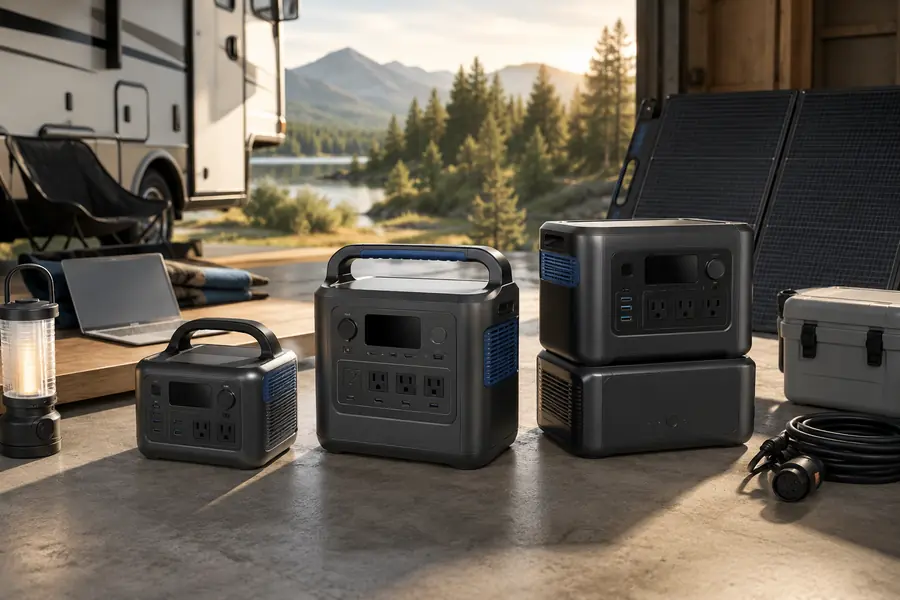
](https://voltcrave-battery.com/wp-content/uploads/2026/08/What-Is-the-Best-Portable-Power-Station.webp)
Choosing the best portable power station can be confusing because a larger battery, higher wattage, faster charger, or lower price does not automatically make one model better.
The best portable power station is the one whose battery capacity, continuous output, surge power, charging speed, solar input, battery chemistry, weight, ports, and safety features match how you actually plan to use it. For most buyers, an LFP model around 1–2kWh with roughly 2,000W output offers the strongest balance of portability, capability, longevity, and cost.
If I had to choose by category rather than declare one universal winner, I would favor a compact 1kWh-class station for camping and everyday emergencies, a 2kWh-class model for serious outage backup, and a 3kWh-plus expandable system for high-power home or RV applications.
What Should I Look for in the Best Portable Power Station?
The best portable power station is not determined by one specification.
I compare portable power stations using eight main factors: usable battery capacity in Wh, continuous and surge output in W, LFP battery chemistry, recharge speed, solar-input capability, weight, UPS/EPS performance, and independent safety certification. Capacity determines runtime, while inverter output determines which appliances the station can actually operate.
Start With Watts and Watt-Hours
The two most important specifications are:
W = power
Wh = stored energy
They answer different questions.
If a station has:
2,000W output
and:
1,024Wh capacity
it may run a relatively powerful appliance, but not necessarily for very long.
A station rated:
2,000W / 2,048Wh
can support a similar maximum continuous load but approximately doubles nominal stored energy.
I use the simplified runtime formula:
Runtime ≈ usable battery Wh ÷ average load W
For example:
| Battery Capacity | 100W Load | 500W Load | 1,000W Load |
|---|---|---|---|
| 500Wh | ~5 h ideal | ~1 h | ~0.5 h |
| 1,000Wh | ~10 h ideal | ~2 h | ~1 h |
| 2,000Wh | ~20 h ideal | ~4 h | ~2 h |
| 3,000Wh | ~30 h ideal | ~6 h | ~3 h |
Real runtime is shorter because of inverter losses, standby consumption, temperature, and battery-management reserves.
That is why I never buy a portable power station based solely on a large “2000W” or “3000W” number printed on the front.
What Is the Best Portable Power Station for Most People?
For many buyers, the sweet spot is now around 1,000Wh of LFP capacity with approximately 2,000W of continuous AC output.
For everyday emergency backup, camping, road trips, electronics, refrigerators, coffee makers, televisions, routers, and moderate appliances, I consider the 1kWh/2kW class the best overall category. It delivers substantially more appliance capability than older 1,000W stations while remaining portable enough for one person to move in many cases.
A current example is the Anker SOLIX C1000 Gen 2, which combines approximately 1,024Wh capacity with 2,000W output. That power-to-capacity ratio makes this class particularly useful for buyers who need strong appliance-starting capability without carrying a 2–4kWh home-backup unit.
Why the 1kWh Class Works So Well
Consider a basic outage load:
| Appliance | Example Average Load |
|---|---|
| Refrigerator | 100W |
| Wi-Fi router | 15W |
| Laptop | 60W |
| LED lighting | 25W |
| TV | 100W |
| Total | 300W |
With approximately 1,000Wh nominal capacity, theoretical runtime is:
1,000Wh ÷ 300W ≈ 3.3 hours
Real runtime would be somewhat lower.
But if the refrigerator cycles instead of operating continuously, actual emergency runtime may improve.
This category also gives enough inverter headroom for devices that may briefly draw more power when starting.
I consider this a much better general-purpose specification than choosing a tiny 300–500Wh unit unless low weight is the highest priority.
What Is the Best Portable Power Station for Home Backup?
For meaningful home backup, I prefer approximately 2kWh or more rather than focusing entirely on portability.
The best portable power station for home backup should normally offer at least around 2kWh of stored energy, 2,000W or more of continuous output, sufficient surge capacity for refrigerators and pumps, LFP batteries, fast AC charging, and a UPS/EPS function if uninterrupted electronics are important. Expandable capacity becomes particularly valuable for longer outages.
A strong example is the Jackery Explorer 2000 v2. Jackery currently specifies 2,042Wh capacity, 2,200W continuous output, 4,400W surge, LFP chemistry, and under-20ms switchover. It weighs about 39.5 lb, which is unusually manageable for its roughly 2kWh capacity.
Another higher-capacity option is EcoFlow DELTA 3 Ultra. EcoFlow specifies 3,072Wh capacity, 3,600W continuous AC output, 7,200W surge, LFP chemistry, and under-10ms UPS switching. The unit weighs about 32.7 kg, so I view it more as movable home backup than something I would casually carry around a campsite.
Home Backup Is an Energy Problem
Suppose my essential loads average:
400W
A 1kWh station gives roughly:
1,000Wh ÷ 400W = 2.5 ideal hours
A 2kWh station gives:
5 ideal hours
A 3kWh station gives:
7.5 ideal hours
before losses.
That difference is often more important than whether one inverter outputs 2,200W and another 2,400W.
For outage planning, I therefore prioritize:
Wh first, then W.
Is LiFePO4 the Best Battery Chemistry for a Portable Power Station?
For most modern portable power-station buyers, LFP is usually the chemistry I prefer.
LiFePO4, or LFP, is attractive for portable power stations because it generally supports long cycle life and good thermal stability while avoiding nickel and cobalt in the cathode. Many current premium power stations have therefore moved to LFP, especially products intended for frequent cycling, emergency preparedness, RV use, and home backup.
Current examples include both the EcoFlow DELTA 3 Ultra and Jackery Explorer 2000 v2, which use LFP cells.
Battery Chemistry Is Not the Only Safety Factor
I would not buy a power station simply because it says:
LiFePO4
on the product page.
The complete product also depends on:
- Battery-management system
- Cell quality
- Thermal design
- Charger design
- Inverter protection
- Enclosure construction
- Manufacturing quality
- Certification
UL Solutions identifies UL 2743 as the safety standard covering portable power packs intended to provide portable electricity when normal grid power is unavailable.
UL also warns that certification should be verified for the product's intended use. A portable power pack certified for portable use is not automatically equivalent to a stationary residential ESS, which falls under a different certification framework such as UL 9540.
That distinction matters if someone plans to permanently wire several portable power stations into a house.
How Much Battery Capacity Do I Need?
The right battery capacity comes from energy consumption, not from guessing which power station looks largest.
I calculate required capacity by multiplying appliance watts by operating hours, adding the devices that may run simultaneously, and then allowing a margin for conversion losses and reserve capacity. A 500Wh station may be enough for phones and laptops, while refrigerator backup commonly benefits from 1–2kWh, and longer home outages may justify 3kWh or expandable systems.
A Simple Capacity Calculation
Suppose I need:
- Refrigerator averaging 100W for 8 hours
- Router at 15W for 8 hours
- Laptop at 60W for 4 hours
- Lights at 20W for 5 hours
Energy use becomes:
Refrigerator: 100 × 8 = 800Wh
Router: 15 × 8 = 120Wh
Laptop: 60 × 4 = 240Wh
Lights: 20 × 5 = 100Wh
Total:
1,260Wh
I would not choose a 1,000Wh station for this target.
After accounting for inverter and system losses, I would want comfortably more than:
1,260Wh nominal capacity.
A 2kWh-class unit becomes much more logical.
Useful Capacity Categories
| Capacity | Best Fit |
|---|---|
| Under 500Wh | Phones, cameras, laptops, lights |
| 500–1,000Wh | Camping and short emergencies |
| 1–2kWh | Refrigerator and essential-load backup |
| 2–3kWh | Strong home/RV backup |
| 3kWh+ | Heavy appliances and longer outages |
| Expandable systems | Longer home/off-grid use |
This is why “best” depends so heavily on the application.
How Much Output Power Should the Best Portable Power Station Have?
Battery capacity does not determine whether a high-power appliance can start.
For most general-purpose users, I now consider roughly 1,500–2,000W continuous output a practical minimum for a versatile full-size portable station. Around 2,000–3,600W provides substantially more flexibility for kitchen appliances, tools, refrigerators, and RV equipment, while 6,000W-class systems begin moving toward serious whole-home or 120/240V backup applications.
For example, Anker SOLIX F3800 offers 3.84kWh capacity and 6,000W output, making it much closer to a portable home-energy platform than a normal camping power station.
By comparison, the 1,024Wh Anker SOLIX C1000 Gen 2 provides 2,000W output, which is far more manageable for transport and sufficient for many everyday loads.
Do Not Ignore Surge Power
Compressors and motors can briefly draw much more current during startup.
Typical examples include:
- Refrigerators
- Freezers
- Pumps
- Air conditioners
- Power tools
Jackery's current Explorer 2000 v2 illustrates this distinction clearly:
2,200W continuous
versus:
4,400W surge.
EcoFlow similarly specifies:
3,600W continuous
and:
7,200W surge
for the DELTA 3 Ultra.
Surge output should not be treated as continuous output. I check both.
How Important Is Solar Charging?
Solar charging can turn a portable battery into a much more useful off-grid energy system.
Solar input matters when I expect to camp, travel off-grid, or remain without utility power for multiple days. I compare maximum PV wattage, MPPT voltage range, connector requirements, and whether the power station can charge from solar while simultaneously supplying loads. A large battery with very low solar input can take an impractically long time to recharge outdoors.
For example, EcoFlow currently specifies up to 800W maximum PV input for the standard DELTA 3 Ultra, while its newer DELTA 3 Ultra Plus supports up to 1,600W PV input.
The difference becomes important with a 3,072Wh battery.
Using ideal arithmetic:
3,072Wh ÷ 800W ≈ 3.8 peak-sun hours
but actual recharge takes longer because solar panels rarely deliver rated output continuously and conversion losses occur.
With:
400W solar
the theoretical number doubles.
Therefore, buyers who expect frequent solar charging should evaluate:
battery Wh relative to solar-input W.
A huge battery with tiny solar input can be frustrating off-grid.
Is UPS or EPS Backup Important?
It depends on what I want to protect.
UPS or EPS capability allows some portable power stations to automatically switch from grid power to battery operation when an outage occurs. This is useful for routers, computers, NAS equipment, refrigerators, and other appliances that should remain powered. However, transfer times differ, and a portable station should not automatically be treated as equivalent to a dedicated online UPS.
EcoFlow specifies a transfer time below 10ms for the DELTA 3 Ultra.
Jackery specifies under 20ms for the Explorer 2000 v2.
Whether that is suitable depends on the equipment.
I would check the requirements of sensitive:
- Servers
- Medical devices
- Network storage
- Laboratory equipment
before relying on a portable power station as their sole backup supply.
Portable Backup Is Not Automatically Stationary Home Storage
This distinction is important.
UL states that UL 2743 applies to portable power packs intended for use when grid power is unavailable. Stationary residential energy-storage installations instead require the appropriate stationary ESS certification framework.
So a portable station connected through its normal outlets is not the same engineering problem as permanently installing a battery into a home's electrical infrastructure.
Which Portable Power Stations Are Worth Comparing in 2026?
Rather than declaring one product universally superior, I would shortlist models from different size classes.
For 2026, strong candidates range from compact 1kWh/2kW models to 2kWh portable backup stations and 3–4kWh high-output systems. The right comparison should use capacity, output, weight, expandability, solar input, UPS capability, warranty, certification, and current price—not brand reputation alone.
My practical shortlist looks like this:
| Use Case | Example Product | Key Reason |
|---|---|---|
| Best balance for most users | Anker SOLIX C1000 Gen 2 | 1,024Wh / 2,000W class |
| Portable 2kWh backup | Jackery Explorer 2000 v2 | 2,042Wh / 2,200W at ~39.5 lb |
| Higher-power home backup | EcoFlow DELTA 3 Ultra | 3,072Wh / 3,600W |
| Expandable 2kWh alternative | BLUETTI AC200L | 2,048Wh / 2,400W class |
| Heavy-duty 120/240V backup | Anker SOLIX F3800 | 3.84kWh / 6,000W class |
These are different tools.
A buyer who wants:
camping portability
should not automatically purchase the same product as someone who wants:
refrigerator + microwave + well pump backup.
Likewise, a 132-pound high-output system can be technically “portable” while being far less convenient to move than a 40-pound unit.
My Insights: What Is the Best Portable Power Station
The most useful answer to the question is not a single brand name.
The best portable power station is an LFP-based system sized around the appliances I actually need to run, with enough continuous and surge output to start them, enough Wh capacity for the required runtime, fast AC and solar charging, appropriate ports, reliable BMS protection, and verifiable safety certification. For most people, the 1–2kWh and roughly 2kW class provides the best overall balance.
My First Insight: Choose the Load Before the Power Station
I begin with the appliances.
For each device I determine:
running W
startup W
hours of operation
Then I choose the station.
This reverses the common shopping process of buying a battery first and discovering later what it can power.
My Second Insight: 1–2kWh Is the Current General-Purpose Sweet Spot
For a phone and laptop, 2kWh is excessive.
For multi-day whole-home backup, 2kWh is small.
But between these extremes, 1–2kWh works well for:
- Refrigerators
- Routers
- TVs
- Laptops
- Lighting
- CPAP machines
- Coffee makers
- Small tools
- Camping and RV loads
This is why I consider this the strongest all-around category.
My Third Insight: LFP and Safety Matter More Than Marketing Features
Fast charging and smartphone apps are useful.
But my higher priorities are:
cell chemistry + BMS + thermal protection + certification.
UL 2743 provides a relevant safety framework for portable power packs, while UL emphasizes that products should be certified for their actual intended application.
That makes safety verification more valuable than a long list of secondary app features.
My Fourth Insight: “Portable” Has a Practical Weight Limit
A product can have a handle and still be unpleasant to move.
For context:
- Jackery Explorer 2000 v2: approximately 39.5 lb
- EcoFlow DELTA 3 Ultra: approximately 72 lb
- Larger 6kW-class systems can exceed 100 lb
I therefore divide portability into:
carryable
and:
movable.
That distinction matters for camping, stairs, vehicles, and emergency deployment.
My Fifth Insight: What Is the Best Portable Power Station for You?
This directly answers What Is the Best Portable Power Station?
I use this selection table:
| If I Need... | I Prioritize... |
|---|---|
| Phone/laptop backup | 300–700Wh, low weight |
| Camping | 500–1,000Wh, solar input |
| General emergency use | ~1kWh, ~2,000W output |
| Refrigerator backup | 1–2kWh, strong surge |
| RV use | 1–3kWh, high AC/DC output |
| Extended outage backup | 2–4kWh or expandable |
| Heavy appliances | 3,000W+ output |
| 120/240V home loads | Purpose-built split-phase system |
| Sensitive electronics | Fast UPS/EPS transfer |
| Frequent cycling | LFP chemistry |
| Off-grid use | High solar-input capability |
| Long-term ownership | Strong warranty and service support |
If I wanted one general-purpose class rather than one universal model, I would choose:
about 1,000–2,000Wh
with:
about 2,000W or more continuous AC output
plus:
LFP cells
pure sine-wave output
strong surge capability
fast wall charging
meaningful MPPT solar input
USB-C PD
UPS/EPS operation
and:
verifiable safety certification.
Within that range, the Anker SOLIX C1000 Gen 2 makes sense when portability and everyday versatility dominate, while the Jackery Explorer 2000 v2 is a stronger fit when I want roughly twice the stored energy without moving into a very heavy home-backup platform.
For heavier backup requirements, the EcoFlow DELTA 3 Ultra offers much more energy and inverter power, while the Anker SOLIX F3800 moves into a different category designed around much larger loads.
So my final answer is:
There is no single best portable power station for every buyer. The best one is the smallest, safest system that can reliably run the required loads for the required number of hours and recharge fast enough for the way it will actually be used.
Conclusion
The best portable power station balances Wh capacity, inverter power, LFP longevity, recharge speed, solar input, weight, safety, and price around the loads you genuinely need to run.
](https://voltcrave-battery.com/wp-content/uploads/2026/08/Standalone-Battery-Energy-Storage-What-You-Need-to-Know-768x512.webp)
](https://voltcrave-battery.com/wp-content/uploads/2026/08/What-Is-Commercial-Energy-Storage-768x512.webp)
](https://voltcrave-battery.com/wp-content/uploads/2026/08/Why-Is-Energy-Storage-Important-for-the-Electric-Grid-768x512.webp)