
](https://voltcrave-battery.com/wp-content/uploads/2026/10/What-Is-the-Best-Backup-Power-Option-for-a-Home.webp)
Power outages can interrupt refrigeration, heating, communication, and essential household equipment. Choosing an unsuitable backup system can leave a home without electricity when it matters most.
The best backup power option for most homes is a properly sized solar battery storage system, especially when homeowners want quiet operation, renewable energy integration, and everyday electricity savings. A standby generator is often more practical for extended outages and high-power loads, while portable power stations offer affordable backup for essential appliances.
Choosing home backup power depends on household demand, outage duration, costs, and energy replenishment. Solar batteries, generators, portable stations, and hybrid systems offer different benefits.
What Are the Best Home Backup Power Options?
Homeowners have several ways to maintain electricity during power outages. However, different technologies have different installation costs, operating requirements, and power capabilities.
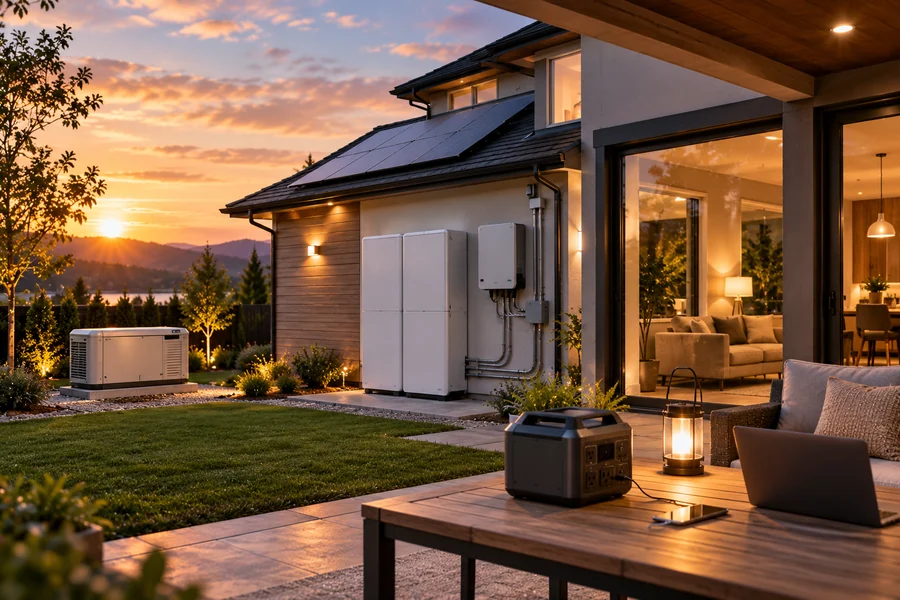
The main home backup power options include residential battery energy storage systems, solar-plus-battery installations, standby generators, portable power stations, and hybrid battery-generator systems. Battery storage provides quiet electricity without on-site combustion exhaust during discharge. Generators provide electricity as long as suitable fuel remains available, while hybrid systems can combine the advantages of both technologies.
Solar Battery Energy Storage Systems
A residential battery energy storage system stores electricity for later use.
The battery may charge from the utility grid or from compatible rooftop solar panels.
During a power outage, an appropriately configured system can isolate the home's backed-up electrical circuits from the grid and supply stored electricity.
I consider solar battery storage attractive for households that want both emergency electricity and improved daily energy management.
A battery may also help reduce electricity purchases during expensive time-of-use periods.
For example, homeowners can store solar electricity during daylight hours and use it during the evening.
However, this depends on local utility tariffs, solar production, and the system's control capabilities.
A battery does not generate electricity on its own.
Without solar generation or another charging source, its available energy is limited to what was stored before the outage.
Whole-Home Standby Generators
A standby generator converts fuel into electricity.
Common fuels include natural gas, propane, and diesel.
A properly installed automatic standby generator can start when grid electricity becomes unavailable and supply selected circuits or the entire house, depending on its rating and transfer system.
I consider this option especially useful for homes with large electrical loads or frequent long-duration outages.
For example, a home may need electricity for central air conditioning, heating equipment, well pumps, and refrigeration.
A suitable generator can continue supplying these loads while fuel remains available and the equipment operates correctly.
However, standby generators require regular maintenance, fuel, outdoor installation, and proper exhaust management.
Portable Power Stations
Portable power stations combine rechargeable batteries, charging electronics, and inverters inside movable enclosures.
They usually include AC outlets and USB charging ports.
I consider them suitable for apartments, smaller homes, renters, and households that need emergency electricity for selected devices.
Typical applications include:
- Refrigerators and small appliances
- Laptops and communication equipment
- LED lighting
- Wi-Fi routers
- Phone charging
- Selected low-power medical or monitoring equipment, when verified as compatible
A portable power station is not automatically suitable for powering the entire household electrical panel.
Home electrical integration requires manufacturer-approved equipment and installation methods.
Battery and Generator Hybrid Systems
A hybrid backup system combines battery storage with compatible generation equipment.
The battery can supply electricity during shorter outages or lower-demand periods.
A generator may provide additional electricity or recharge the battery when required.
I believe this approach is particularly valuable for households that need quiet operation during normal conditions but also want additional protection during extended outages.
However, not every home battery supports generator integration.
The inverter, charging controls, transfer equipment, and electrical protection must be designed for that configuration.
Home Backup Power Comparison
| Backup System | Main Advantage | Main Limitation |
|---|---|---|
| Solar + Battery | Renewable charging and quiet operation | Weather-dependent solar replenishment |
| Battery Only | Quiet backup and load management | Limited stored energy |
| Standby Generator | Long operation with available fuel | Fuel, exhaust, noise, and maintenance |
| Portable Power Station | Flexible and relatively simple | Limited capacity and output |
| Battery + Generator | Multiple energy sources | Greater complexity and cost |
I would not recommend a single technology for every household.
The correct solution depends on the actual outage conditions and electrical requirements.
Is a Solar Battery Better Than a Standby Generator for Home Backup?
Solar batteries and standby generators can both provide electricity during grid outages. However, their advantages depend on the required operating duration, maintenance expectations, and availability of fuel or solar energy.
Solar batteries are often better for short outages, quiet operation, and daily electricity management. Standby generators are generally more practical for extended outages and continuous high-power loads when fuel is available. For homes with frequent outages and changing electrical demand, a compatible battery-generator hybrid system can provide greater flexibility than either technology alone.
Why Solar Batteries Are Attractive for Homeowners
The main advantage of battery storage is that it supplies electricity without operating a combustion engine.
This reduces operating noise and eliminates on-site combustion exhaust during battery discharge.
A solar battery system may also provide financial benefits outside emergency situations.
For example, homeowners may use stored electricity during periods when grid electricity prices are high.
I consider this an important difference from conventional standby generators.
Generators are generally purchased primarily for backup operation.
Solar batteries can support both backup power and everyday electricity management.
However, the financial return depends on the local electricity rate structure and actual system operation.
Why Generators Remain Important
A generator does not depend on a fixed amount of stored electrical energy.
Instead, it converts fuel into electricity while operating.
This can be advantageous during extended outages when household energy consumption remains high.
For example, a home may need continuous heating or cooling during severe weather.
A battery system could require substantial storage capacity to support these loads for several days.
A standby generator may be more practical when a dependable fuel supply is available.
However, generator operation can still be interrupted by mechanical faults, maintenance problems, or fuel shortages.
I would not describe any generator as providing unlimited electricity.
Its operating duration depends on fuel availability and equipment condition.
Comparing Maintenance and Operating Requirements
| Factor | Solar Battery | Standby Generator |
|---|---|---|
| Operating noise | Generally low | Higher |
| On-site combustion emissions | None during discharge | Yes |
| Fuel requirement | Electricity | Gas, propane, or diesel |
| Backup duration | Limited by storage and recharging | Limited by fuel and system operation |
| Solar integration | Supported in compatible systems | Requires additional equipment |
| Mechanical maintenance | Generally lower | Regular engine servicing |
| Daily energy savings | Possible | Generally limited |
| Initial installation cost | Often higher | Often lower for comparable backup scope |
I believe the maintenance difference is important for homeowners who want a backup system that requires limited routine attention.
However, batteries still need appropriate monitoring, environmental protection, and manufacturer-approved servicing.
Why Solar Panels Alone May Not Provide Backup Power
Many homeowners assume that rooftop solar panels will continue powering the house during a grid outage.
This is not always correct.
Most conventional grid-connected solar inverters are designed to stop exporting power when the utility grid fails.
This protects utility workers and electrical infrastructure.
For a solar installation to provide backup electricity, it must have suitable equipment that can safely isolate the home's backed-up circuits from the grid.
This may include a compatible battery, a backup-capable inverter, and appropriate switching equipment.
I recommend confirming actual backup functionality before purchasing solar equipment.
A solar installation designed only for reducing electricity bills may not support household loads during an outage.
When Hybrid Backup Makes Sense
I consider hybrid backup particularly useful when outages can last several days.
For example, a battery may operate essential household appliances overnight.
During daylight hours, solar panels can recharge it when sufficient sunlight is available.
If weather conditions prevent adequate charging, a compatible generator can provide additional energy.
This combination reduces dependence on a single energy source.
However, the system must be professionally designed to coordinate charging, electrical transfer, and load protection.
How Much Battery Capacity or Generator Power Does a Home Need?
One of the most common backup power mistakes is selecting equipment according to house size rather than actual electricity demand. Two homes with similar floor areas may have completely different power requirements.
The required home backup capacity depends on average electricity consumption, peak power demand, and outage duration. A 10–15 kWh battery may provide useful essential-load backup, while 20–30 kWh or more may be needed for broader household coverage. Generator sizing depends primarily on simultaneous running power and motor-starting requirements rather than stored energy capacity.
Understand the Difference Between kW and kWh
I always distinguish between two electrical measurements.
Kilowatts (kW) measure electrical power.
Kilowatt-hours (kWh) measure electrical energy.
A battery rated at 15 kWh stores a quantity of energy.
An inverter rated at 5 kW determines how much AC power can be delivered continuously.
Both specifications matter.
A battery may contain sufficient energy for several hours but still be unable to operate multiple high-power appliances simultaneously.
Calculate Essential Household Loads
I begin by identifying the appliances that must remain operational during an outage.
Consider the following example.
| Essential Appliance | Estimated Daily Energy |
|---|---|
| Refrigerator | 1.2 kWh |
| Wi-Fi and communication | 0.3 kWh |
| LED lighting | 0.6 kWh |
| Television and computer | 0.8 kWh |
| Fans and small equipment | 1.0 kWh |
| Other essential loads | 1.1 kWh |
| Total | 5.0 kWh |
These are illustrative estimates rather than fixed appliance consumption values.
Actual electricity use varies by equipment type, operating schedule, and environmental conditions.
In this example, the home requires approximately 5 kWh per day for selected essential loads.
A 10–15 kWh battery could provide meaningful backup duration under suitable operating conditions.
However, the final system must account for usable capacity, conversion losses, and reserves.
Calculate Battery Storage Requirements
I use the following simplified formula:
Required Battery Capacity (kWh) = AC Energy Demand ÷ (Usable Discharge Fraction × Delivery Efficiency)
Suppose a household requires an average of 1 kW for 12 hours.
Its energy requirement is:
1 kW × 12 hours = 12 kWh
Assume:
- Usable discharge fraction: 90%
- Energy delivery efficiency: 90%
The nominal capacity requirement becomes:
12 kWh ÷ (0.90 × 0.90) = 14.8 kWh
I would therefore evaluate a battery configuration with at least approximately 15 kWh of nominal storage, plus any additional reserve needed for uncertainty or longer outages.
This is only an initial energy calculation.
The inverter must also support the household's peak power requirements.
Estimated Battery Backup Runtime
The following table assumes that 80% of nominal battery capacity becomes available as usable AC energy.
| Battery Capacity | 0.5 kW Load | 1 kW Load | 2 kW Load |
|---|---|---|---|
| 10 kWh | 16 hours | 8 hours | 4 hours |
| 15 kWh | 24 hours | 12 hours | 6 hours |
| 20 kWh | 32 hours | 16 hours | 8 hours |
| 30 kWh | 48 hours | 24 hours | 12 hours |
| 40 kWh | 64 hours | 32 hours | 16 hours |
These are simplified runtime estimates without solar recharging.
Actual operating duration depends on battery state of charge, ambient temperature, efficiency, and connected loads.
How Much Generator Power Does a Home Need?
Generator selection requires a different calculation.
Instead of focusing on kWh storage, I evaluate the maximum simultaneous electrical load in kW.
For example, a household may have a normal backup load of 4 kW but require additional power when a motor or compressor starts.
The generator must be capable of supporting these conditions.
I also consider whether the home uses electric heating, water pumps, air conditioning, or other high-power appliances.
A generator rated at 10 kW does not necessarily support every electrical device in a large home.
The complete electrical load should be evaluated by a qualified installer.
Why Load Management Matters
I believe load management is one of the most effective ways to reduce backup power costs.
A household does not always need to operate every appliance during a blackout.
By prioritizing refrigeration, lighting, communications, and other essential services, homeowners may reduce the battery or generator capacity required.
Larger appliances can be operated selectively when sufficient power is available.
This approach may reduce upfront costs while improving backup duration.
How Do You Choose the Safest and Most Cost-Effective Home Backup Power System?
Choosing a backup power system involves more than comparing equipment prices. Installation costs, long-term maintenance, fuel availability, battery lifespan, and electrical safety can significantly influence the final decision.
I recommend selecting a home backup power system by evaluating outage frequency, expected duration, essential electrical loads, installed costs, operating expenses, and safety requirements. Solar batteries are often attractive for regular energy management, while generators may suit long outages. Portable power stations offer a lower-cost starting point when only a few appliances need electricity.
Compare Installation Costs
Home battery systems generally require a larger upfront investment than many generator solutions.
According to EnergySage's July 2026 U.S. marketplace data, a typical installed 13.5 kWh home battery costs approximately $15,647 before available incentives.
EnergySage also gives an illustrative installed home generator cost of approximately $7,000, although actual prices vary significantly with capacity and installation requirements.
Portable power stations may cost substantially less, depending on their storage capacity and output.
I would not compare these prices without checking the amount of electricity each system can deliver.
A small portable power station and a whole-home standby generator serve different purposes.
Consider Total Ownership Costs
I evaluate the complete operating cost rather than only the purchase price.
For a battery system, important factors include equipment cost, installation, battery degradation, electricity for charging, and eventual replacement.
For a generator, I consider fuel expenses, maintenance, installation, testing, and possible repairs.
Solar batteries may also provide savings through daily electricity management.
Generators typically provide most of their value when grid power is unavailable.
However, I would not assume that solar battery savings automatically offset every installation.
Actual economic benefits depend on local tariffs, electricity consumption, system cost, and any applicable incentives.
Review Electrical and Fire Safety
Home battery installations must meet applicable electrical and fire safety requirements.
In North America, UL 9540 is an important product safety standard for complete energy storage systems.
UL 1973 applies to batteries used in stationary and certain other applications.
UL 9540A is a test method used to evaluate thermal runaway fire propagation.
I distinguish these requirements because UL 9540A testing is not equivalent to complete system certification.
Portable power packs may fall under UL 2743 when they meet that standard's intended scope.
I recommend checking the complete equipment configuration and following local installation codes.
Generator Safety Is Essential
Fuel-powered generators produce carbon monoxide, a dangerous gas that cannot be seen or smelled.
The U.S. Centers for Disease Control and Prevention recommends operating portable generators outdoors, more than 20 feet from windows, doors, and vents.
Portable generators must never operate inside a home, garage, or other enclosed space.
I also recommend using functioning carbon monoxide alarms when fuel-burning generators are used.
A generator connected to household wiring needs an appropriate transfer switch or another approved isolation arrangement installed by qualified personnel.
Improvised backfeeding can endanger occupants and utility workers.
Check Backup Transfer and Critical Equipment
Some battery systems can transfer to backup operation quickly when grid electricity fails.
However, I do not assume every home battery provides uninterrupted power under all conditions.
Computers, networking systems, and certain critical devices may require a dedicated uninterruptible power supply (UPS).
For medically necessary electrical equipment, I recommend following the equipment manufacturer's power requirements and maintaining an appropriate emergency plan.
The backup system must be tested for the actual load and required transfer behavior.
Which Backup Power System Should You Choose?
| Household Situation | Recommended Starting Point |
|---|---|
| Apartment or rental home | Portable power station |
| Short outages and essential loads | Home battery storage |
| Existing rooftop solar system | Compatible battery backup |
| Frequent multi-day outages | Standby generator or hybrid system |
| High electricity consumption | Engineered whole-home backup |
| Daily energy savings and backup | Solar + home battery |
| Long outages with limited sunlight | Hybrid battery-generator system |
I believe the best decision should be based on real household needs rather than the largest available equipment.
My Insights: What Is the Best Backup Power Option for a Home
Homeowners often compare batteries and generators using purchase price alone. This can overlook backup duration, energy availability, long-term costs, and the actual electrical needs of the household.
I believe a properly designed solar battery system is one of the best overall home backup options because it combines quiet operation, rechargeable energy storage, and everyday electricity management. However, standby generators remain valuable for extended high-power outages, while hybrid systems can provide additional resilience when weather, stored energy, or fuel availability becomes uncertain.
I Prioritize Essential Loads Before Whole-Home Backup
I do not believe every household needs enough backup power to operate all appliances simultaneously.
Essential equipment often represents a relatively small portion of total household electricity consumption.
For example, refrigeration, communications, lighting, and selected outlets may require significantly less energy than central air conditioning or electric heating.
By separating essential loads from optional loads, homeowners can often reduce the required backup system capacity.
I consider this one of the most practical ways to improve affordability.
Backup Duration Matters More Than Advertised Battery Size
I also believe that battery capacity should always be evaluated alongside actual electricity demand.
A 15 kWh battery may provide many hours of backup when household loads remain low.
The same battery may discharge much faster when running several high-power appliances.
I therefore evaluate backup performance using four connected factors:
Stored Energy → Household Load → Backup Duration → Recharging Availability
This approach provides a more useful understanding of whether a system can support the expected outage.
Solar Charging Adds Resilience but Depends on Weather
I consider solar integration a major advantage of residential battery systems.
Solar panels can provide electricity during daylight hours and recharge compatible batteries while the utility grid is unavailable.
However, this depends on having the correct backup-capable inverter and isolation equipment.
Cloud cover, shading, and seasonal weather conditions can reduce solar generation.
For this reason, I would not assume that solar-plus-storage automatically guarantees continuous electricity throughout an extended outage.
Hybrid Systems Can Reduce Dependence on One Energy Source
I believe a properly engineered hybrid system provides an attractive solution for households facing uncertain outage duration.
A battery can support quiet operation during shorter outages.
Solar generation can replenish stored energy when sunlight is available.
A compatible generator can provide additional electricity when the battery becomes depleted or solar production is insufficient.
The advantage is greater flexibility.
However, this comes with additional equipment and installation complexity.
I would recommend hybrid backup primarily when the household's reliability requirements justify the extra investment.
Long-Term Value Should Drive the Final Decision
I do not consider the cheapest initial purchase automatically the most economical choice.
A portable power station may provide the lowest-cost solution for a household that only needs several essential appliances.
A standby generator may offer greater value when outages regularly last several days.
A solar battery system may provide better long-term benefits when it supports both emergency backup and daily electricity savings.
I evaluate the final choice through five factors:
Reliability → Electrical Capacity → Operating Duration → Safety → Lifetime Cost
This framework helps balance practical backup requirements with financial considerations.
Ultimately, I believe the best home backup power option is the system that maintains essential electricity safely and reliably for the expected outage duration, without requiring unnecessary equipment or expense.
Conclusion
Solar batteries suit quiet daily backup, generators support extended outages, and portable power stations cover essential devices. Hybrid systems can provide greater resilience when properly engineered.
](https://voltcrave-battery.com/wp-content/uploads/2026/09/What-Is-a-Power-Battery-768x512.webp)
](https://voltcrave-battery.com/wp-content/uploads/2026/08/How-Does-Depth-of-Discharge-Affect-BESS-Lifespan-768x512.webp)
](https://voltcrave-battery.com/wp-content/uploads/2026/09/Shingled-Solar-Panels-Explained-What-Are-the-Pros-Cons-and-Future-Trends-768x512.webp)







































