
](https://voltcrave-battery.com/wp-content/uploads/2026/10/How-Long-Do-Base-Power-Batteries-Last.webp)
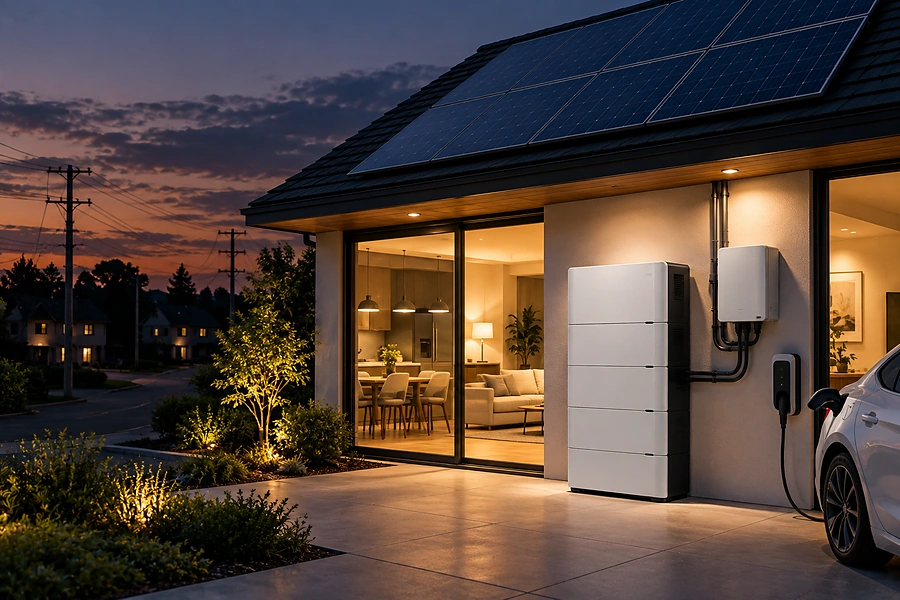
A home battery can last for years, yet during an outage the same battery may provide only hours of backup. These are two different measurements.
Base Power's current 39.2 kWh Base Core is listed with a 12-year lifetime and a 12-year Battery Services Agreement. During an outage, one Core typically provides about 12–18 hours at average household usage and up to 36 hours with reduced consumption. Actual battery life and backup duration depend on cycling, temperature, load, charging, and operating conditions.
Battery lifespan measures how many years a battery remains usable, while backup duration measures how many hours it can power a home during an outage.
What Is the Lifespan of a Base Power Battery?
Base's current documentation indicates that its residential batteries are designed for long-term service rather than short-term backup use only.
The current Base Core product page lists a 12-year lifetime, and Base states that the Battery Services Agreement for its 39.2 kWh battery runs for 12 years. Base retains ownership during that period and handles maintenance, warranty work, and replacement when necessary. Separate Base educational material describes battery lifespan more broadly as approximately 10–15 years.
This distinction is important because several official Base pages describe lifetime slightly differently.
The current Base Core product page specifies:
Lifetime: 12 years.
The Base Help Center states that the Battery Services Agreement for the 39.2 kWh battery lasts:
12 years.
Meanwhile, an official Base battery guide describes Base battery lifespan more generally as:
10–15 years.
Another current Base hardware FAQ describes its outdoor battery hardware as designed around a 15-year lifespan.
For a homeowner, I would therefore use 12 years as the clearest current Base Core service-life reference, because that figure appears directly on the current Core specification and agreement information.
The broader 10–15-year figure is better understood as a general technical-life range rather than a guaranteed homeowner service term.
How Long Does a Base Power Battery Last During an Outage?
Backup duration depends much more on household load than on the age figure printed in the battery specifications.
A single 39.2 kWh Base Core typically provides approximately 12–18 hours of backup at average household consumption, 22–36 hours at low consumption, 4–6 hours under high consumption, and roughly 2–3 hours under very high loads. Solar or a compatible generator may extend backup duration by recharging the battery.
Base provides several examples for its 39.2 kWh system:
| Household Usage | Typical Backup Duration |
|---|---|
| Low usage | 22–36 hours |
| Average usage | 12–18 hours |
| High usage | 4–6 hours |
| Very high usage | 2–3 hours |
Base describes low usage as loads such as a refrigerator, freezer, and lights, while high usage may involve heavier air-conditioning or appliance loads.
This illustrates the fundamental battery equation:
Backup Time ≈ Available Battery Energy ÷ Average Household Load
Suppose approximately 30 kWh were available for a particular operating period.
At an average load of:
1 kW
the theoretical duration would be:
30 kWh ÷ 1 kW
= 30 hours
At:
3 kW
the same energy would theoretically provide:
30 ÷ 3
= 10 hours
At:
6 kW
it becomes:
30 ÷ 6
= 5 hours
Real systems also have operating reserves, conversion losses, battery limits, changing loads, and control requirements, so this equation is a simplified estimate rather than a Base performance guarantee.
How Long Does the 39.2 kWh Base Core Battery Last?
The newer Base Core has substantially more stored energy than many common residential batteries.
Base Core stores 39.2 kWh of total energy. Base specifies approximately 12–18 hours of typical backup and up to 36 hours with reduced consumption. The system automatically switches to battery power when an outage occurs, while actual runtime continuously changes according to household demand and battery state of charge.
Base currently lists:
39.2 kWh total energy
for one Core battery.
A dual configuration can provide:
78.4 kWh
according to Base's current system lineup.
More energy generally means longer backup when household consumption remains similar.
However:
2× Battery Energy ≠ Exactly 2× Runtime in Every Situation
because actual loads change over time.
For example, an air conditioner may cycle on and off.
A refrigerator does the same.
Lighting may decrease overnight.
Electric heating can suddenly increase load.
The Base app therefore calculates estimated backup dynamically from actual household power consumption rather than relying on one fixed runtime figure.
How Long Does a 25 kWh Base Battery Last?
Base also provides runtime estimates for its 25 kWh ground-mounted system.
A single 25 kWh Base battery is estimated to provide approximately 8–12 hours of backup at average energy use, 15–24 hours at low use, 3–4 hours at high use, and about 1–2 hours under very high household demand. Two batteries approximately double available stored energy to 50 kWh.
Base's current guidance gives:
| System | Average Usage | Reduced / Low Usage |
|---|---|---|
| 25 kWh | 8–12 hours | 15–24 hours |
| 39.2 kWh | 12–18 hours | 22–36 hours |
| 50 kWh | 15–24 hours | 30–48 hours |
These are estimates, not guaranteed runtimes.
A home running:
central air conditioning,
electric heating,
an electric water heater,
dryer,
oven,
and EV charging
can consume battery energy dramatically faster than a home running only:
refrigeration,
lights,
internet,
and a few electronics.
That is why household load management is usually the most effective way to extend outage runtime.
What Type of Battery Does Base Power Use?
Base uses lithium iron phosphate battery chemistry, commonly abbreviated LFP or LiFePO4.
Base Power states that its residential batteries use lithium iron phosphate chemistry. LFP is widely suited to stationary storage because of its cycling capability and thermal stability. Base describes its LFP batteries as supporting approximately 1,000–10,000 cycles, although actual cycle life depends heavily on depth of discharge, temperature, charge rate, operating window, and end-of-life definition.
The important distinction is:
LFP = Battery Chemistry
while:
12 Years = System Lifetime / Service Reference
and:
12–18 Hours = Typical Backup Duration
These describe three different things.
A cycle means using and replacing battery energy.
However, one charging event does not necessarily equal one complete battery cycle.
For example:
two 50% discharge events
can roughly represent:
one full-equivalent cycle
in terms of energy throughput.
Base also uses its batteries for grid services when the grid is operating. Its utility information describes systems as dispatchable for substantial cycling activity, including deployments designed around as many as 500 cycles annually.
This makes cycle durability particularly important because a Base battery is not necessarily waiting unused for the next outage.
It can serve both:
Home Backup
and:
Grid Support.
Does Frequent Grid Use Shorten a Base Battery's Life?
All rechargeable batteries gradually degrade with cycling and calendar age, although LFP is well suited to frequent stationary-storage operation.
Frequent cycling contributes to battery aging, but Base's operating model is specifically designed around using batteries for grid services as well as household backup. Base owns and operates the battery, manages dispatch, covers normal maintenance, and states that it replaces the battery when it reaches end of life.
Battery aging normally has two main components:
Calendar Aging
and:
Cycle Aging.
Calendar aging happens even if the battery does little work.
Cycle aging results from charging and discharging.
The actual rate depends on conditions including:
temperature,
state of charge,
depth of discharge,
charge and discharge current,
and cell chemistry.
For a Base customer, the ownership structure changes the practical risk.
Base states that it owns and operates the battery and covers maintenance, repair, and service. When the battery reaches end of life, Base says it replaces it under the applicable service arrangement.
That is different from purchasing a residential battery outright and personally assuming degradation and replacement risk.
Does Base Power Guarantee the Battery for 12 Years?
The 12-year agreement is clearer than describing it simply as a conventional manufacturer warranty.
For the current 39.2 kWh system, Base states that its Battery Services Agreement lasts 12 years. Base retains ownership during the term, handles required maintenance, and says it will replace the battery if necessary. At the end of the 12-year period, customers can consider renewal or cancellation options under the applicable agreement.
This model is unusual compared with many residential storage systems.
The homeowner does not simply buy hardware and receive a traditional limited battery-capacity warranty.
Instead, Base remains involved in:
operation,
maintenance,
grid dispatch,
and hardware service.
Base also states that manufacturing or installation defects and damage outside the customer's control are covered, while damage caused by negligence or intentional acts can create replacement liability for the customer.
Therefore, anyone evaluating the system should review the current Battery Services Agreement rather than relying only on the phrase:
12-year battery life.
What Factors Affect How Long a Base Battery Lasts During an Outage?
Energy consumption is the biggest immediate factor.
Base identifies household electricity consumption, battery charge when an outage begins, and supplemental generation such as solar or generators as major factors affecting backup time. Air conditioning, electric heating, laundry equipment, and other high-power loads can reduce runtime substantially, while essential-load operation can extend backup for many additional hours.
Consider a 39.2 kWh battery.
A few essential devices might average less than:
1 kW.
A home running multiple HVAC systems and large electric appliances could reach:
several kilowatts
or much more.
That is why Base's estimates range from:
2–3 hours
at very high loads
to:
22–36 hours
at low loads
for the same 39.2 kWh battery.
The battery did not change.
The load changed.
This is one of the most important principles of home battery sizing:
Battery Size Determines Available Energy
while:
Household Load Determines How Quickly That Energy Is Consumed.
Can Solar Make a Base Battery Last Longer?
Yes. Solar can extend outage duration when it can recharge the battery during an outage.
Base states that compatible solar can recharge its battery during an outage, potentially extending backup beyond the app's initial runtime estimate. Solar production is not included in Base's standard backup-duration calculation because future sunlight is uncertain, so actual backup can exceed the estimate when sufficient solar generation is available.
Without solar, an outage generally follows:
Stored Battery Energy → Household Loads → Battery Depletes
With working solar:
Solar → Household Loads
and potentially:
Solar → Battery Recharge
This can significantly change outage performance.
For example, a battery might discharge overnight and recharge partially the next day.
That means a long outage does not always require enough stored battery energy to cover every hour entirely from battery storage.
However, solar output depends on:
weather,
season,
array size,
orientation,
shading,
and household consumption.
Solar can extend backup.
It cannot guarantee unlimited backup.
Can a Generator Extend Base Core Backup Time?
Base Core also supports generator-assisted recharging under its supported configuration.
Base says the current Core system includes a generator recharge port that allows a compatible portable generator to recharge the battery during an extended outage. This can extend backup for as long as sufficient fuel and suitable generator operation remain available, although Base states that whole-home standby generators are not compatible with this feature.
This creates a hybrid architecture:
Grid + Battery + Solar + Portable Generator
depending on the customer's installation.
Battery storage handles:
fast automatic transition,
short outages,
and quiet operation.
Solar can add renewable energy during daylight.
A generator can provide longer-duration energy when an outage continues beyond the battery's stored capacity.
This illustrates why backup resilience should not be measured only in battery kWh.
The complete energy architecture matters.
How Can You Make a Base Power Battery Last Longer During an Outage?
Reducing large electrical loads is the fastest way to extend runtime.
Base recommends reducing or turning off major loads such as air conditioning, electric heating, washers, and dryers during extended outages. Prioritizing refrigerators, freezers, lighting, communications, and other essential loads can dramatically increase backup duration. Solar and compatible generator charging can extend it further.
For example:
A home averaging:
4 kW
uses:
4 kWh every hour.
Reducing the load to:
1 kW
reduces energy consumption by:
75%.
That can transform a few hours of battery backup into a much longer period.
The most useful strategy is therefore:
Battery Capacity + Load Management + Supplemental Generation
rather than relying only on:
Battery Capacity.
How Does Base Battery Life Compare With Typical Home Batteries?
A direct comparison needs to distinguish service life, warranty terms, capacity, and ownership structure.
Base describes its battery technology as having an approximately 10–15-year general lifespan, while the current Base Core product specifies a 12-year lifetime and service period. That falls within the broad long-term operating range commonly associated with modern LFP residential storage, but Base's ownership model makes direct warranty comparisons with customer-owned batteries imperfect.
The unique part is not simply the chemistry.
It is the business model.
With a conventional battery purchase:
Homeowner Owns Battery → Homeowner Relies on Manufacturer Warranty
With Base:
Base Owns Battery → Base Operates and Services Battery → Base Replaces It at End of Life
according to Base's current service information.
Therefore, a comparison should consider:
battery capacity,
usable backup,
power output,
service term,
ownership,
replacement responsibility,
electricity agreement,
and operating rights.
Battery lifespan alone does not capture the entire value proposition.
My Insights: How Should Base Battery Life Be Understood
The phrase “how long does it last?” can produce the wrong answer unless we first decide whether we mean years or hours.
Base battery life should be evaluated across three dimensions: approximately 12 years of current Core service life, hours of backup during each outage, and cumulative cycling throughout the battery's operating life. These measurements answer different questions and should never be used interchangeably when comparing residential energy-storage systems.
My First Insight: 12 Years and 12 Hours Describe Completely Different Things
A 12-year lifetime describes:
long-term service.
A 12-hour backup duration describes:
one discharge event.
The numbers may look similar but measure different dimensions.
This distinction should always be made first.
My Second Insight: Household Load Determines Outage Runtime More Than Battery Age
A new 39.2 kWh Core can last only a few hours if the home continuously runs large electrical loads.
The same battery can provide more than a day of backup when consumption is reduced. Base's own estimates range from roughly 2–3 hours at very high usage to 22–36 hours under low usage.
Therefore:
Runtime = Energy ÷ Load
remains the most important conceptual equation.
My Third Insight: Base's Ownership Model Changes Battery-Lifespan Risk
Base owns and operates the battery and says it covers maintenance, repairs, and replacement at end of life.
This means battery degradation does not create exactly the same ownership risk as it does with a customer-owned storage system.
Customers should still understand the agreement terms, but the hardware-replacement responsibility is structured differently.
My Fourth Insight: Solar and Generator Charging Can Make Backup Duration Dynamic
Without additional generation, a home battery contains a finite amount of stored energy.
With compatible solar or generator charging, energy can be added during the outage.
That means the answer to:
“How long will my battery last?”
can change from a simple battery-capacity calculation into a full energy-balance calculation.
My Fifth Insight: How Long Do Base Power Batteries Last?
Base Power's current 39.2 kWh Core is listed with a 12-year lifetime, while broader Base material describes approximately 10–15 years of battery service life. During an outage, one 39.2 kWh Core typically provides about 12–18 hours at average usage and up to 36 hours with reduced consumption. Base owns the battery, handles maintenance, and states that it replaces the system when necessary.
The simplest summary is:
| Question | Current Base Reference |
|---|---|
| Core battery lifetime | 12 years |
| Battery agreement | 12 years |
| Broader technical-life reference | About 10–15 years |
| Core capacity | 39.2 kWh |
| Typical Core backup | 12–18 hours |
| Reduced-use Core backup | Up to 36 hours |
| Low-use estimate | 22–36 hours |
| High-use estimate | 4–6 hours |
| Chemistry | LFP / LiFePO4 |
| Maintenance | Handled by Base |
| End-of-life replacement | Handled by Base under its service model |
So the best short answer is:
Years: approximately 12 years for the current Base Core service-life reference.
Hours: approximately 12–18 hours during a typical outage for one 39.2 kWh Core, with reduced usage potentially extending backup to 36 hours.
Conclusion
Base Core is designed around roughly 12 years of service, while one 39.2 kWh battery typically provides 12–18 hours of outage backup depending on household consumption.
](https://voltcrave-battery.com/wp-content/uploads/2026/10/The-Ultimate-Mobile-Power-Guide-10ft-vs.-20ft-Mobile-Battery-Energy-Storage-Systems-768x512.webp)
](https://voltcrave-battery.com/wp-content/uploads/2026/08/Benefits-of-Energy-Storage-Systems-for-Industrial-and-Commercial-Users-768x512.webp)
](https://voltcrave-battery.com/wp-content/uploads/2026/10/What-Is-the-Best-Portable-Power-Station-to-Purchase-768x512.webp)







































