
](https://voltcrave-battery.com/wp-content/uploads/2026/10/Which-Battery-Is-Best-for-E-Bikes.webp)
Choosing an e-bike battery only by voltage, Ah, or low price can reduce range, create compatibility problems, and introduce serious charging and safety risks.
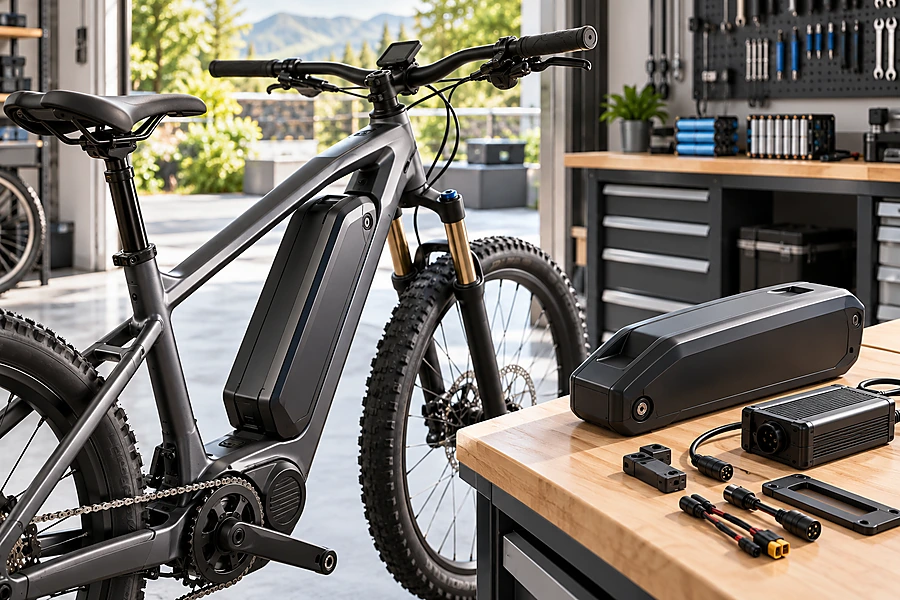
For most e-bikes, the best battery is a manufacturer-approved lithium-ion pack specifically designed for the bike's voltage, motor system, BMS, mount, and charger. Lithium-ion offers the best overall balance of weight, range, power, and practicality. LFP can offer longer life and favorable thermal characteristics, but its lower energy density usually means more weight and volume.
Lithium-ion offers the best overall balance for most e-bikes, LFP favors longer life over low weight, and OEM-compatible packs provide the safest replacement choice overall.
What Type of Battery Is Best for Most E-Bikes?
Modern lithium-ion batteries provide the strongest overall combination of energy density, weight, power, charging performance, and packaging flexibility for electric bicycles.
For most commuter, mountain, cargo, and recreational e-bikes, a high-quality lithium-ion battery supplied or approved by the e-bike manufacturer is the best choice. The battery should match the original system voltage, connector, mount, BMS communication, charger, discharge requirements, and physical dimensions rather than simply having the same advertised Ah rating.
Major e-bike manufacturers illustrate how common lithium-ion systems are.
Shimano's current BT-E8016-A battery is a:
36V lithium-ion system
with:
17.5Ah
and:
630Wh
of stored energy.
Its BT-E6000-A is also a 36V lithium-ion battery, offering:
418Wh
of capacity.
Specialized also sells current 500Wh and 700Wh lithium-ion batteries for its Turbo platform.
These products demonstrate an important point:
The mainstream e-bike answer is not simply:
“Buy the largest battery.”
It is:
Buy the correct battery for the complete drive system.
Is Lithium-Ion the Best Battery Chemistry for E-Bikes?
For most riders, yes.
Lithium-ion remains the most practical chemistry family for e-bikes because it can store substantial energy without making the bicycle excessively heavy or bulky. It also supports the power levels needed by modern e-bike motors. The exact lithium-ion chemistry can vary, so chemistry alone should not replace evaluation of the complete battery pack.
An e-bike must carry its battery everywhere.
That makes:
Wh/kg
and:
Wh/L
far more important than they are in stationary energy storage.
A home battery can weigh:
100 kg
or more
without significantly affecting its function.
An e-bike cannot.
Every additional kilogram influences:
handling,
acceleration,
lifting,
transport,
and:
riding without motor assistance.
This is one reason lithium-ion became so successful in micromobility.
CPSC describes lithium-ion cells as well suited to e-mobility because their energy density allows them to provide useful current and operating time relative to their size and weight.
So for a normal e-bike:
Lithium-Ion = Best Overall Technology Category
but the pack still needs good engineering and system compatibility.
Is NMC or LFP Better for an E-Bike?
The answer depends on whether minimum weight or long cycle life is more important.
NMC-type lithium-ion cells are attractive for e-bikes because their high energy density can reduce battery weight and volume for a given range. LFP offers favorable thermal characteristics and strong cycle-life potential but has lower energy density, meaning an equivalent-energy pack can be larger or heavier. For most lightweight e-bike designs, energy density remains a major advantage.
The IEA's 2026 battery analysis provides a useful chemistry-level comparison.
It reports advanced cell energy densities of approximately:
265 Wh/kg for NMC
and:
205 Wh/kg for LFP.
Those figures describe broader battery technology rather than a specific e-bike pack, so finished e-bike battery values will differ.
But the basic engineering trade-off remains useful.
Imagine two theoretical batteries that both need:
600Wh.
At:
205 Wh/kg,
the electrochemical cell mass associated with that energy would be roughly:
600 ÷ 205
≈ 2.93 kg
At:
265 Wh/kg,
it becomes:
600 ÷ 265
≈ 2.26 kg
Real battery packs weigh more because they also contain:
BMS,
enclosure,
wiring,
connectors,
structural protection,
and mounting hardware.
Still, the example explains why high-energy lithium-ion chemistry is valuable on a bicycle.
Is LiFePO4 a Good Battery for E-Bikes?
Yes, but it is not automatically the best choice for every bicycle.
LiFePO4 can be an excellent e-bike battery when cycle life, thermal stability, and long-term durability matter more than achieving the lightest possible pack. Its main disadvantage is lower energy density, which can increase battery size and weight compared with higher-energy lithium-ion chemistries for the same Wh capacity.
LFP makes sense in applications such as:
cargo bikes,
delivery fleets,
utility bikes,
heavy-duty cycles,
and:
systems where daily cycling is intensive.
For these applications, a slightly heavier battery may be acceptable.
The buyer may care more about:
daily throughput,
cycle life,
reliability,
and:
replacement frequency.
However, a performance mountain bike has very different requirements.
Adding battery mass can affect:
handling,
jumping,
climbing,
and:
bike balance.
Therefore:
LFP can be excellent for the right e-bike
without being:
the universal best e-bike chemistry.
What Voltage Is Best for an E-Bike Battery?
The best voltage is the voltage the motor controller and complete electrical system were designed to use.
There is no universal best e-bike battery voltage. Common systems include 36V and 48V, while other voltages also exist. A replacement battery should match the manufacturer's required voltage architecture because using an incompatible voltage can damage components or prevent the system from operating correctly.
Shimano provides a clear mainstream example.
Its current 630Wh BT-E8016-A battery is rated at:
36V.
The energy relationship is:
Wh = V × Ah
For that battery:
36V × 17.5Ah
= 630Wh
This also illustrates why comparing Ah alone is misleading.
A:
36V 14Ah battery
contains approximately:
504Wh.
A:
48V 14Ah battery
contains approximately:
672Wh.
Both say:
14Ah
but they store different amounts of energy.
Therefore, when comparing e-bike batteries:
Wh is usually more useful than Ah alone.
How Many Watt-Hours Should an E-Bike Battery Have?
Battery capacity should match desired range, bike weight, terrain, assistance level, and acceptable battery mass.
Many mainstream e-bike batteries fall roughly in the 400–700Wh range, although smaller lightweight systems and larger cargo or long-range systems also exist. More Wh generally provides greater potential range, but actual distance depends heavily on motor assistance, hills, speed, rider weight, wind, tire pressure, temperature, and riding style.
Current manufacturer examples include:
Shimano:
418Wh
504Wh
and:
630Wh batteries.
Specialized offers:
500Wh
and:
700Wh
battery options on relevant Turbo platforms.
Bosch also continues to offer multiple PowerTube capacities; for example, its newer PowerTube 540 provides 540Wh and can be combined with the PowerMore 250 range extender on compatible systems.
More Wh does not automatically mean better.
A larger battery usually means:
more range
but also:
more weight,
more cost,
and potentially:
a physically larger pack.
Is a 48V Battery Better Than a 36V Battery?
Not automatically.
A 48V system can deliver the same electrical power at lower current than a 36V system, which can reduce resistive losses in conductors. However, voltage alone does not determine battery quality, range, or performance. The battery voltage must match the motor controller, BMS, charger, and complete e-bike architecture.
Power is:
P = V × I
For a:
500W motor
at 36V, approximate current is:
500 ÷ 36
≈ 13.9A
At 48V:
500 ÷ 48
≈ 10.4A
Higher voltage can therefore reduce current for the same power.
Because resistive heating follows:
I²R
lower current can help reduce conductor losses.
But that does not mean a rider should replace a:
36V battery
with:
48V.
An e-bike designed for 36V may not tolerate 48V.
The correct principle is:
Match the System Voltage
rather than:
Choose the Highest Voltage.
How Much Range Does an E-Bike Battery Provide?
Range is strongly dependent on riding conditions.
A useful way to estimate e-bike range is to divide usable battery energy in Wh by average energy consumption in Wh per mile or Wh per kilometer. Because hills, rider mass, tire type, speed, wind, temperature, and assistance mode all affect consumption, the same battery can produce very different real-world range.
Suppose a battery contains:
630Wh.
If average consumption is:
15Wh/mile
the theoretical range is:
630 ÷ 15
= 42 miles.
At:
25Wh/mile
range falls to:
630 ÷ 25
≈ 25 miles.
The battery has not changed.
The operating conditions have.
This is why advertised range figures should always be treated as:
conditional estimates
rather than guarantees.
For range-focused riders, increasing Wh can help.
But improving:
tire pressure,
pedaling contribution,
speed,
load,
and:
assist level
can also materially change range.
How Long Should a Good E-Bike Battery Last?
Battery lifespan should be evaluated in both cycles and remaining usable capacity.
A high-quality e-bike battery can provide years of service, but exact life depends on chemistry, temperature, charging habits, depth of discharge, current, storage conditions, and cell quality. Cycle-life figures should always be interpreted together with the manufacturer's test conditions and remaining-capacity threshold.
Shimano provides a useful manufacturer-specific reference.
Its BT-E8036-A 630Wh battery is specified to retain more than:
60% capacity after 1,000 charges
under its stated conditions.
Shimano publishes similar cycle-life information for other e-bike batteries.
That does not mean every lithium-ion e-bike battery will deliver exactly:
1,000 cycles.
Battery aging depends on:
heat,
SOC,
charging,
discharge depth,
cell design,
and:
usage.
A commuter riding daily may accumulate cycles much faster than a recreational rider using the bike twice each month.
Therefore:
Calendar Age + Cycle Age + Operating Conditions = Real Battery Life
Is the BMS Important in an E-Bike Battery?
Yes. The battery management system is one of the most important parts of the complete battery pack.
A good BMS monitors battery conditions and helps protect cells from operating outside acceptable voltage, current, and temperature limits. For modern e-bikes, the battery may also communicate with the charger and drive system, making electrical and software compatibility important when replacing the original battery.
This is one reason battery replacement is not simply a connector-matching exercise.
A pack might have:
the correct voltage,
the correct physical connector,
and:
enough capacity
but still not communicate correctly with the e-bike.
CPSC testing has specifically examined how e-bike battery BMS protections behave under abnormal charger and temperature conditions, highlighting the importance of complete pack protection rather than cell specifications alone.
A complete battery should therefore be judged as:
Cells + BMS + Enclosure + Protection + Connector + Charger Compatibility
not just:
Cells.
Should You Buy an OEM or Aftermarket E-Bike Battery?
For safety and compatibility, the manufacturer-approved option is generally the strongest choice.
When replacing an e-bike battery, use a pack that the bicycle or drive-system manufacturer has tested and approved for that specific model. A generic replacement may have the same voltage and connector while differing in BMS behavior, charger compatibility, cell quality, protection design, or communications.
CPSC explicitly advises consumers to use only replacement or secondary battery packs that have been tested and approved to work safely with the device and confirmed as suitable by the device manufacturer.
The agency also advises against using:
modified batteries,
reworked batteries,
and packs made from repurposed or used cells.
Trek similarly notes that aftermarket components may physically fit while still lacking the correct hardware or software integration for a particular e-system.
Therefore:
Physical Fit ≠ Electrical Compatibility ≠ Safe Compatibility.
What Safety Certification Should an E-Bike Battery Have?
Safety should be evaluated at both battery and complete-system levels.
In the United States, UL 2271 applies to batteries used in light electric vehicles, while UL 2849 evaluates the complete e-bike electrical system, including the drive train, battery, and charger combination. A certified complete system provides stronger evidence of coordinated safety than simply seeing a generic lithium-ion label on a battery.
UL explains that UL 2849 evaluates the electrical drive train, battery system, and charger system combination for e-bikes.
UL 2271 applies specifically to batteries used in light electric vehicle applications.
This distinction matters.
UL 2271 → Battery
UL 2849 → E-Bike Electrical System
Buyers should also distinguish:
UL Certified
from vague advertising such as:
“tested to UL standards.”
UL notes that those descriptions are not necessarily equivalent to an actual UL-certified product.
Does the Charger Matter When Choosing an E-Bike Battery?
Absolutely.
The battery and charger should be treated as a matched system. Even if a charger connector fits, its charging voltage, current, control logic, and communication may be incompatible with the battery. Using the manufacturer-supplied or explicitly approved charger is one of the most important e-bike battery safety practices.
CPSC advises consumers to use only the charger supplied with or recommended by the manufacturer.
The agency has specifically warned against so-called universal e-bike chargers because apparently compatible chargers can still have electrical characteristics that are unsuitable for a particular battery.
Bosch similarly states that its chargers are specifically adapted to Bosch eBike systems and warns that other chargers may reduce battery life or cause damage or malfunction.
So:
Matching Plug ≠ Matching Charger.
What Is the Best Battery Size for Commuting?
Commuters usually need a balance between range and weight.
For typical commuting, a battery around 400–600Wh can provide a practical balance of range, weight, and cost, but riders with long routes, steep hills, heavy cargo, or limited charging access may benefit from 600–700Wh or more. The correct size should be based on daily energy consumption rather than distance alone.
Suppose a commuter rides:
20 miles per day
and averages:
15Wh/mile.
Daily energy demand is:
20 × 15
= 300Wh.
A 500Wh battery therefore provides a useful reserve.
But another rider covering the same 20 miles at:
25Wh/mile
requires:
500Wh.
Their range requirements are very different.
This is why I would size an e-bike battery around:
Expected Wh/mile × Required Distance + Reserve
rather than simply choosing the most popular capacity.
How Should You Choose the Best E-Bike Battery?
Begin with compatibility, then optimize range, weight, life, and cost.
The best e-bike battery should match the required voltage, mount, connector, BMS communication, motor-controller limits, and approved charger. After compatibility is confirmed, compare Wh capacity, weight, cycle life, cell quality, discharge capability, weather protection, certification, warranty, replacement availability, and price.
A practical comparison is:
| Requirement | Best Approach |
|---|---|
| Best overall | OEM-approved lithium-ion |
| Lowest battery weight | High-energy-density lithium-ion |
| Longer cycle-life priority | LFP can be attractive |
| Long-distance riding | Higher Wh capacity |
| Commuting | Balanced Wh and weight |
| Cargo / delivery | Higher capacity and strong cycle durability |
| Replacement | Manufacturer-approved compatible pack |
| Safety | Certified battery/system and approved charger |
| Performance | Correct power capability and low resistance |
The selection order should be:
Compatibility
→
Voltage
→
Wh Capacity
→
Power Capability
→
Weight
→
Cycle Life
→
Safety Certification
→
Warranty
→
Price
Price should come near the end.
A cheap battery that cannot safely communicate with or charge correctly on the bike is not a bargain.
My Insights: What Really Makes an E-Bike Battery the Best
The most important lesson is that e-bike battery selection is a system decision, not simply a chemistry decision.
I would prioritize manufacturer compatibility, certified safety, suitable Wh capacity, low weight, reliable BMS protection, and replacement support before comparing small differences in cell chemistry. An excellent cell inside an incompatible or poorly engineered pack can produce worse performance and greater risk than a properly integrated battery using less exotic cells.
My First Insight: Wh Is More Useful Than Ah for Comparing Range
Ah cannot be compared properly without voltage.
Because:
Wh = V × Ah
a 48V battery and a 36V battery with the same Ah rating do not store the same energy.
For range comparisons:
Use Wh.
My Second Insight: Lightweight E-Bikes Reward Energy Density
E-bike batteries move with the rider.
That means additional kilograms affect the complete vehicle.
This is why higher-energy-density lithium-ion solutions remain attractive even when another chemistry might offer greater cycle life.
My Third Insight: Replacement Compatibility Is More Important Than Upgrading Capacity
A larger battery is only useful if the e-bike was designed to accept it.
The replacement pack must work with:
the mount,
controller,
BMS communication,
charger,
and:
software architecture.
CPSC recommends using replacement packs approved for the device rather than relying on generic compatibility claims.
My Fourth Insight: Safety Is a System Property
Good cells matter.
But e-bike safety also depends on:
BMS,
charger,
wiring,
connectors,
enclosure,
temperature control,
and:
electrical-system integration.
That is why UL 2849 evaluates the larger e-bike electrical system, not merely an isolated cell.
My Fifth Insight: Which Battery Is Best for E-Bikes?
For most e-bikes, the best battery is a high-quality, manufacturer-approved lithium-ion pack specifically designed for the bike's voltage, BMS, motor system, mount, and charger. High-energy lithium-ion offers the strongest balance of low weight, range, and power for most riders. LFP can be attractive where long cycle life and thermal stability outweigh the added size and weight.
A simple decision table is:
| Rider Priority | Best-Fit Battery Approach |
|---|---|
| Everyday riding | OEM lithium-ion |
| Lightweight bike | High-energy lithium-ion |
| Long range | Higher-Wh OEM pack |
| Maximum cycle-life priority | Consider LFP if system supports it |
| Cargo / delivery | Durable high-capacity pack |
| Replacement battery | Manufacturer-approved exact-compatible pack |
| Safety priority | Certified battery/system + approved charger |
| Lowest price | Do not sacrifice compatibility or certification |
For most riders, I would prioritize:
OEM Compatibility
+
Lithium-Ion
+
Adequate Wh
+
Certified Safety
+
Approved Charger
rather than searching for the battery with the highest:
Ah,
voltage,
or:
advertised range.
Conclusion
For most e-bikes, an OEM-approved lithium-ion battery offers the best balance of weight, range, power, compatibility, and practicality. Choose Wh and safety carefully.
](https://voltcrave-battery.com/wp-content/uploads/2026/09/What-Are-the-Common-Problems-With-Sine-Wave-Inverters-768x512.webp)
](https://voltcrave-battery.com/wp-content/uploads/2026/09/What-Is-the-Best-Portable-Jump-Starter-for-2026-768x512.webp)
](https://voltcrave-battery.com/wp-content/uploads/2026/10/What-Is-an-Electrical-Control-Cabinet-768x512.webp)







































