

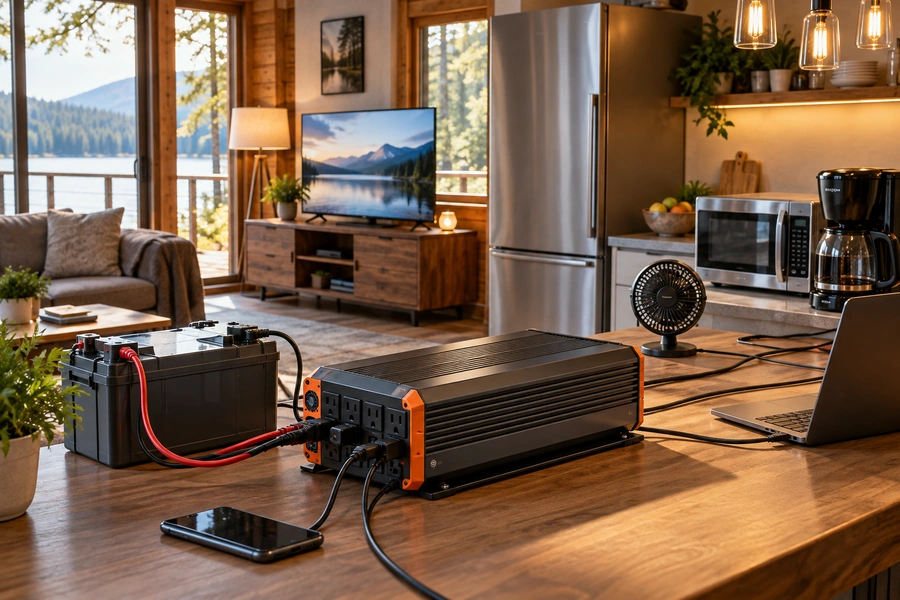
](https://voltcrave-battery.com/wp-content/uploads/2026/09/What-Will-a-3000W-Pure-Sine-Wave-Inverter-Run.webp)
A 3000W inverter sounds powerful, but appliance labels, startup surges, and simultaneous loads can quickly push a system beyond its practical limit.
A 3000W pure sine wave inverter can run most common household appliances whose combined continuous consumption stays below 3000W, including refrigerators, TVs, computers, microwaves, coffee makers, small air conditioners, power tools, and many kitchen appliances. Motor loads must also stay within the inverter's surge rating during startup.
The key is not simply asking what a 3000W inverter can run individually. I also check continuous watts, startup watts, simultaneous loads, battery current, and available battery energy.
What Does a 3000W Pure Sine Wave Inverter Mean?
The 3000W number describes output power, not how much energy the inverter stores.
A 3000W pure sine wave inverter converts DC battery power into AC electricity and can typically supply up to 3000W of continuous AC power when operated within its specifications. Pure sine wave describes the quality of the AC waveform, while the battery determines available energy and therefore how long connected appliances can operate.
These concepts should be separated:
3000W = inverter power capability
kWh = battery energy capacity
Surge watts = short-term starting capability
Suppose I have a 3000W inverter connected to a battery system.
If I plug in a:
100W television,
the inverter does not continuously consume 3000W just because it is rated at 3000W.
It supplies roughly what the television requires, plus conversion losses and the inverter's own consumption.
If I connect:
2,800W of appliances,
the inverter is operating much closer to its maximum continuous rating.
Pure sine wave means the AC output is designed to closely resemble utility-style sinusoidal AC. This generally provides better compatibility with sensitive electronics and motor-driven appliances than modified sine wave power.
But pure sine wave does not increase the inverter's stored energy.
A 3000W inverter still needs an appropriately sized battery.
What Appliances Can a 3000W Pure Sine Wave Inverter Run?
A 3000W inverter can operate a broad range of household, RV, workshop, and off-grid appliances when total demand remains within its limits.
Typical appliances that may run from a 3000W pure sine wave inverter include refrigerators, freezers, televisions, computers, lighting, fans, microwaves, coffee makers, kettles, toasters, washing machines, small air conditioners, pumps, and many power tools. Actual compatibility depends on each appliance's running watts, startup surge, and the inverter's surge capability.
Typical planning ranges might look like this:
| Appliance | Typical Power Range |
|---|---|
| LED lights | 5–20W each |
| Wi-Fi router | 10–30W |
| Laptop | 40–100W |
| Television | 50–200W |
| Fan | 30–100W |
| Refrigerator | 100–800W running |
| Freezer | 100–500W running |
| Coffee maker | 800–1500W |
| Microwave | 1000–1800W input |
| Toaster | 800–1500W |
| Electric kettle | 1200–2000W |
| Washing machine | 400–1500W |
| Small air conditioner | 500–1500W running |
| Circular saw | 1000–1800W |
| Hair dryer | 1000–2000W |
| Space heater | 1000–1500W |
These are general planning ranges rather than universal appliance specifications.
The nameplate or manufacturer specification of the actual appliance should always take priority.
A 3000W inverter could easily run a:
100W TV
but a:
2800W electric appliance
would leave almost no capacity for anything else.
Can a 3000W Inverter Run a Refrigerator?
Yes, most household refrigerators are well below 3000W while running, but compressor startup is the important part.
A 3000W pure sine wave inverter can normally run a typical refrigerator if its running consumption and compressor startup surge remain within the inverter's continuous and peak ratings. Because refrigerator compressors can briefly require significantly more power when starting, surge capability matters more than simply comparing the refrigerator's normal running watts with 3000W.
Imagine a refrigerator consumes:
250W
while the compressor is operating.
Once running, this is easy for a 3000W inverter.
However, suppose startup briefly reaches:
1,000W.
The inverter must tolerate that surge.
Now imagine several appliances are already operating:
TV: 100W
lights: 100W
computer: 150W
coffee maker: 1200W
Existing load:
1550W
The refrigerator then starts.
If its startup temporarily adds:
1000W,
instantaneous demand becomes:
2550W.
That may still be acceptable for a properly specified 3000W inverter.
But if several motor loads start simultaneously, the situation changes.
This is why I evaluate both:
running load
and:
worst-case simultaneous startup load.
Can a 3000W Inverter Run a Microwave?
Usually yes, but the microwave's electrical input rating matters more than its advertised cooking output.
A 3000W pure sine wave inverter can run many household microwaves, provided the microwave's actual electrical input remains within the inverter's continuous rating. A microwave advertised as 1000W cooking power may consume considerably more than 1000W from the AC supply, so its electrical nameplate should be checked before sizing the inverter.
This distinction is easy to miss.
A microwave might be marketed as:
1000W.
That number may describe cooking output rather than AC input.
Suppose its actual input is:
1500W.
Then the inverter must supply approximately 1500W.
If other appliances are operating simultaneously:
microwave: 1500W
refrigerator: 250W
TV: 100W
laptop: 80W
lights: 100W
Total:
2030W
That is below 3000W.
Now add a:
1500W coffee maker.
Total becomes:
3530W.
That exceeds the inverter's 3000W continuous rating.
So the microwave works individually, but the combination does not.
That distinction is essential when planning an inverter system.
Can a 3000W Inverter Run an Air Conditioner?
It can run many smaller air conditioners, but compressor startup can determine whether the system actually works.
A 3000W pure sine wave inverter can operate many small window, RV, and efficient air-conditioning units when their running watts remain below the inverter rating. However, compressor startup can create a substantial surge, so the inverter's peak rating, battery discharge capability, wiring, and the air conditioner's startup characteristics must all be checked.
Suppose an air conditioner uses:
1000W
while running.
A 3000W inverter appears comfortably large enough.
But if compressor startup temporarily requires:
3500W,
the continuous rating tells only part of the story.
The inverter needs sufficient:
surge power
for sufficient:
surge duration.
The battery must also deliver that temporary power.
At 12V, high-power air-conditioning loads create very high DC current.
This is one reason 24V or 48V battery architectures are often attractive for larger inverter systems.
A soft-start device may reduce startup demand for some compatible air-conditioning systems, but compatibility and installation should be verified for the specific equipment.
Can a 3000W Inverter Run a Coffee Maker and Microwave Together?
Sometimes, but combined wattage can approach the inverter limit surprisingly quickly.
A 3000W inverter may run a coffee maker and microwave simultaneously when their combined actual input remains below 3000W with enough margin for other loads and startup surges. For example, a 1200W coffee maker plus a 1500W microwave equals 2700W, leaving only about 300W before reaching the inverter's nominal continuous rating.
Consider:
Coffee maker = 1200W
Microwave = 1500W
Total:
1200 + 1500 = 2700W
Now add:
Refrigerator = 200W
Total:
2900W
Then add:
Lights = 100W
Total:
3000W
The system is now theoretically at the inverter's full continuous rating.
If the refrigerator compressor starts and briefly draws additional power, the inverter may need its surge capability.
For this reason, I generally avoid designing normal operation around continuously using exactly:
3000W on a 3000W inverter.
Operating margin helps accommodate:
startup events,
measurement differences,
temperature effects,
and:
unexpected additional loads.
The exact recommended margin should follow the inverter manufacturer's specifications.
Can a 3000W Inverter Run Power Tools?
Many power tools can run from a 3000W inverter, but motor startup can create demanding surge conditions.
A 3000W pure sine wave inverter can operate many drills, saws, grinders, and other portable power tools when their continuous and startup requirements remain within the inverter's ratings. Motor-driven tools may briefly draw several times their running power, making surge capacity and battery current capability particularly important.
Suppose a circular saw normally requires:
1500W.
Once running, a 3000W inverter has substantial capacity remaining.
But during startup, the motor may briefly demand much more.
If the inverter cannot provide that peak:
the tool may fail to start,
the inverter may alarm,
or:
the inverter may shut down.
The battery side matters just as much.
At high power, a 12V system can require well over:
100A.
So even if the inverter's AC specifications are adequate, poor battery cables or a weak battery can cause low-voltage shutdown during tool startup.
For workshop applications, I therefore check:
tool startup requirements,
inverter surge rating,
battery current capability,
and:
DC wiring.
What Can You Run at the Same Time on a 3000W Inverter?
Simultaneous loads must be added together rather than evaluated one appliance at a time.
A 3000W inverter can run several appliances simultaneously as long as their combined continuous consumption remains within the inverter's rating and temporary startup demand stays within its surge capability. A practical combination might include a refrigerator, television, laptops, lights, router, and microwave, while several high-wattage heating appliances may exceed 3000W quickly.
For example:
| Appliance | Example Load |
|---|---|
| Refrigerator | 200W |
| TV | 100W |
| Two laptops | 150W |
| Router | 20W |
| LED lighting | 80W |
| Microwave | 1500W |
| Fan | 50W |
| Total | 2100W |
This leaves approximately:
900W
before reaching 3000W.
Now replace the fan with:
1500W electric kettle.
New total:
3550W.
That combination exceeds the continuous rating.
This is why high-resistance heating appliances consume inverter capacity extremely quickly.
Examples include:
electric heaters,
kettles,
hair dryers,
toasters,
and:
electric cooking appliances.
A 3000W inverter can run many of them individually.
Running several simultaneously is the problem.
How Much Battery Power Does a 3000W Inverter Need?
At full load, a 3000W inverter can demand enormous DC current, particularly from a 12V battery.
A 3000W inverter delivering full output at 90% efficiency requires approximately 3333W from the battery. That equals roughly 278A at 12V, 139A at 24V, or 69A at 48V before allowing for real battery voltage, cable losses, and other system conditions. This makes battery discharge capability and DC wiring critical.
The calculation is:
DC Power ≈ AC Power ÷ Efficiency
At 90%:
3000 ÷ 0.90 = 3333W
Then:
Current = Power ÷ Voltage
At 12V:
3333 ÷ 12 ≈ 278A
At 24V:
3333 ÷ 24 ≈ 139A
At 48V:
3333 ÷ 48 ≈ 69A
This comparison explains why higher-voltage battery systems become attractive at higher inverter powers.
For the same power:
higher voltage = lower current.
Lower current can reduce:
cable size requirements,
voltage drop,
resistive losses,
and:
connection stress.
The inverter and battery voltage must, of course, match.
A 24V inverter should not simply be connected to a 12V battery.
How Big a Battery Do You Need for a 3000W Inverter?
The inverter size alone cannot determine battery capacity because battery sizing depends on both load and desired runtime.
A 3000W inverter does not require one universal battery capacity. Battery size should be calculated from the actual average load, desired operating time, usable battery capacity, and inverter efficiency. A system powering 500W for four hours needs far less stored energy than one supplying the full 3000W for four hours.
The basic relationship is:
Required Battery Energy ≈ Load × Runtime ÷ Efficiency
Suppose I need:
1000W for 4 hours.
AC energy:
1000 × 4 = 4000Wh
At 90% inverter efficiency:
4000 ÷ 0.90 ≈ 4444Wh
So I need at least around:
4.44kWh
of battery energy before adding:
reserve,
battery discharge limits,
degradation margin,
and:
other losses.
Now suppose I genuinely need:
3000W for four hours.
AC energy:
3000 × 4 = 12kWh
At 90% efficiency:
12 ÷ 0.90 ≈ 13.3kWh
The battery requirement becomes much larger.
This demonstrates the key rule:
Inverter watts tell me what can run.
Battery watt-hours tell me how long it can run.
How Long Will a Battery Run a 3000W Inverter?
Runtime depends on the actual load, not simply the inverter's 3000W rating.
Battery runtime can range from less than an hour to many hours depending on battery capacity and appliance consumption. A 5kWh battery powering a 500W load can operate far longer than the same battery supplying 3000W. Inverter efficiency, usable battery capacity, battery condition, temperature, and system losses further affect real runtime.
Suppose a battery provides:
5kWh usable DC energy.
At approximately:
90% inverter efficiency,
usable AC energy is around:
4.5kWh.
Then:
500W load:
4500Wh ÷ 500W = 9 hours
1000W load:
4500 ÷ 1000 = 4.5 hours
1500W load:
4500 ÷ 1500 = 3 hours
3000W load:
4500 ÷ 3000 = 1.5 hours
These are simplified estimates.
Real-world results depend on:
battery BMS limits,
temperature,
inverter efficiency at different loads,
cable losses,
battery degradation,
and:
changing appliance demand.
A refrigerator, for example, cycles on and off rather than consuming its rated running power continuously.
Therefore, accurate runtime calculations should use:
average energy consumption
when possible.
Is 12V, 24V, or 48V Better for a 3000W Inverter?
For high-power inverter systems, higher DC voltage can significantly reduce current.
A 3000W inverter can be built for 12V, 24V, or 48V battery systems, but higher voltage reduces DC current for the same power. At full 3000W output and 90% efficiency, simplified current is approximately 278A at 12V, 139A at 24V, and 69A at 48V, making higher-voltage systems attractive for sustained high-power applications.
The underlying relationship is:
P = V × I
For the same power:
if voltage increases,
current decreases.
This matters because resistive loss follows approximately:
P loss = I²R
So reducing current can substantially reduce cable losses.
A 12V 3000W inverter can still be useful, particularly where a 12V electrical architecture already exists.
But full-load current is extremely high.
A 48V system reduces that current dramatically.
The tradeoff is that higher-voltage battery systems require:
compatible equipment,
appropriate safety practices,
correct battery configuration,
and:
properly rated protection devices.
Voltage should therefore be selected as part of the overall system architecture rather than based on the inverter alone.
What Should You Not Run on a 3000W Inverter?
The main limitations are loads that exceed continuous output, surge capability, battery current capability, or system design.
You should not operate appliance combinations that exceed the inverter's continuous rating or equipment whose startup surge exceeds its peak capability. Very large air conditioners, electric water heaters, induction ranges, large welders, multiple heating appliances, and high-power motors can exceed 3000W. Compatibility should always be verified from actual equipment specifications.
Consider:
electric heater: 1500W
kettle: 1800W
Combined:
3300W
Even though each appliance can run individually, together they exceed:
3000W.
Similarly:
microwave: 1500W
coffee maker: 1200W
refrigerator: 300W
Total:
3000W
The system is already at the nominal continuous limit before considering refrigerator startup.
This is why load management is important.
Instead of operating everything simultaneously:
finish microwave use,
then start the kettle.
The inverter suddenly becomes much more practical without changing any hardware.
Why Is Pure Sine Wave Better for a 3000W Inverter?
At 3000W, the inverter may be expected to power a wide variety of electronic and motor-driven equipment.
Pure sine wave output closely resembles utility AC power and generally provides broad compatibility with electronics, variable-speed devices, motors, chargers, audio equipment, refrigerators, and other sensitive loads. It does not increase the inverter's wattage or battery runtime, but it can improve compatibility compared with modified sine wave output.
This distinction matters.
Pure sine wave = waveform quality
It does not mean:
more battery capacity,
higher efficiency automatically,
or:
greater surge capability.
Two inverters can both be:
3000W pure sine wave
while having different:
surge ratings,
efficiency,
idle consumption,
thermal performance,
DC voltage,
protection features,
and:
output quality.
So I would not select an inverter based on only:
3000W + pure sine wave.
I also check:
continuous rating,
surge rating and duration,
battery voltage,
efficiency,
no-load consumption,
operating temperature,
protection functions,
and:
manufacturer specifications.
My Insights: What Will a 3000W Pure Sine Wave Inverter Run
A 3000W inverter is powerful enough for many household and off-grid loads, but the real limit comes from simultaneous wattage, startup surge, and battery capability.
A 3000W pure sine wave inverter can run refrigerators, freezers, TVs, computers, microwaves, coffee makers, kettles, small air conditioners, washing machines, pumps, and many power tools, provided combined continuous consumption stays below 3000W and startup demand remains within the inverter's surge rating. Battery capacity determines how long those appliances can run.
My First Insight: 3000W Is a Power Limit, Not an Energy Capacity
This is the most important distinction.
A 3000W inverter does not contain:
3000Wh
of energy.
It might run:
3000W for 10 minutes
or:
300W for 10 hours
depending on the battery.
So I separate:
W = power
from:
Wh = energy.
That prevents many inverter-sizing mistakes.
My Second Insight: Appliance Combinations Matter More Than Individual Appliances
A 3000W inverter can run many appliances individually.
Problems appear when they operate together.
For example:
Microwave = 1500W
Coffee maker = 1200W
TV = 100W
Lights = 100W
Total = 2900W
Now a refrigerator compressor starts.
The inverter may suddenly experience a surge above the normal load.
So simultaneous operation matters.
My Third Insight: Surge Power Can Be More Important Than Running Power
Motor loads are the classic example.
A refrigerator might require only a few hundred watts after starting.
An air conditioner might run below 1500W.
A power tool may also operate comfortably below 3000W.
But startup can require substantially more power.
Therefore:
continuous watts tell me whether it can run.
surge watts tell me whether it can start.
Both specifications matter.
My Fourth Insight: A 3000W Inverter Makes Battery Design Critical
At full output and 90% efficiency, simplified battery current is approximately:
12V → 278A
24V → 139A
48V → 69A
That makes a 3000W inverter much more than an AC appliance question.
It becomes a:
battery + BMS + cable + fuse + inverter
system-design question.
A powerful inverter connected to an undersized battery does not create a powerful electrical system.
My Fifth Insight: What Will a 3000W Pure Sine Wave Inverter Run?
This directly answers the H1.
| Appliance | Can a 3000W Inverter Run It? | Main Consideration |
|---|---|---|
| Laptop | Yes | Very low load |
| TV | Yes | Low load |
| LED lights | Yes | Low load |
| Wi-Fi router | Yes | Low load |
| Refrigerator | Usually | Compressor surge |
| Freezer | Usually | Compressor surge |
| Microwave | Usually | Check actual input watts |
| Coffee maker | Usually | High resistive load |
| Electric kettle | Usually | High wattage |
| Toaster | Usually | High wattage |
| Washing machine | Often | Motor/heater demand |
| Small air conditioner | Often | Compressor startup |
| Circular saw | Often | Motor surge |
| Drill/grinder | Usually | Startup surge |
| Hair dryer | Usually | High continuous load |
| Space heater | Usually | High continuous load |
| Large water heater | Often no | May exceed 3000W |
| Electric range | Often no | High total demand |
| Large central AC | Often no | Running and startup power |
| Large welder | Depends | Very high peak demand |
So, what will a 3000W pure sine wave inverter run?
For most practical systems, the answer is:
almost any individual household appliance that consumes less than 3000W continuously and remains within the inverter's surge capability.
That includes many:
refrigerators,
freezers,
microwaves,
coffee makers,
small air conditioners,
washing machines,
TVs,
computers,
fans,
lights,
and:
power tools.
But the inverter cannot ignore mathematics.
If appliances consume:
1000W + 800W + 1500W = 3300W,
the combination exceeds a 3000W continuous rating.
If a motor normally uses:
1000W
but briefly requires more power than the inverter can provide during startup, it may fail to start even though its running wattage looks acceptable.
And if the battery cannot deliver the necessary DC current, the inverter may shut down before reaching its rated AC output.
The most useful rule is therefore:
Check continuous watts to know what can run.
Check surge watts to know what can start.
Check battery Wh to know how long it can run.
Check battery amps, BMS, cables, and fuses to know whether the DC system can safely supply it.
A properly designed 3000W pure sine wave inverter system can therefore cover a large portion of normal household, RV, van, backup, and off-grid electrical needs without requiring utility power.
Conclusion
A 3000W pure sine wave inverter can run most common appliances, but combined watts, startup surge, battery capacity, DC current, and runtime ultimately determine what works.
](https://voltcrave-battery.com/wp-content/uploads/2026/06/What-Are-the-Pros-and-Cons-of-Solar-Energy-Storage-768x512.jpg)
](https://voltcrave-battery.com/wp-content/uploads/2026/09/What-Does-an-Inverter-Do-for-a-Car-768x512.webp)
](https://voltcrave-battery.com/wp-content/uploads/2026/08/Standalone-Battery-Energy-Storage-What-You-Need-to-Know-768x512.webp)