

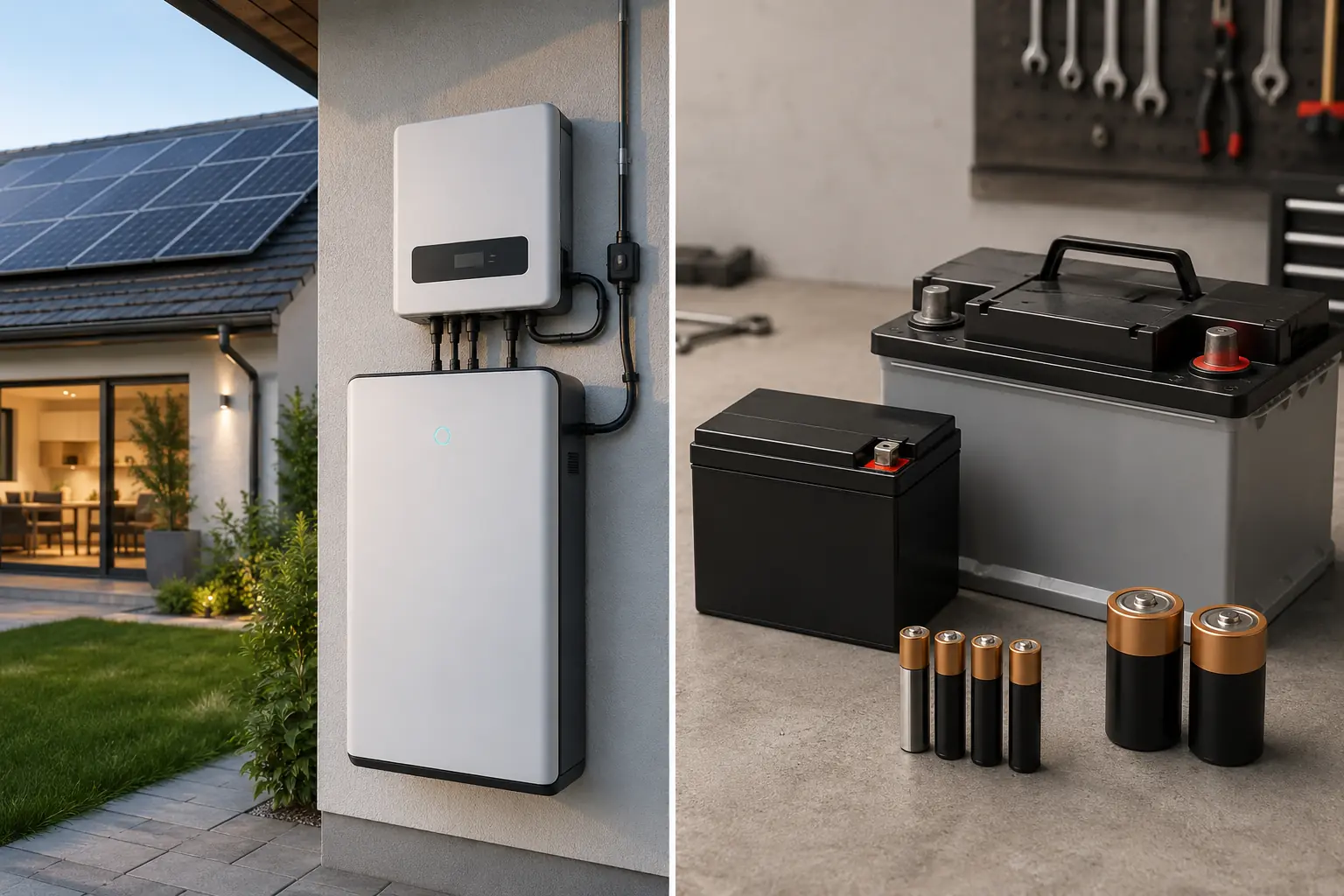
](https://voltcrave-battery.com/wp-content/uploads/2026/08/What-Are-the-Key-Differences-Between-a-Solar-Battery-and-a-Regular-Battery.webp)
Batteries may look similar from the outside, yet a battery designed for solar storage has a very different job from a disposable household cell or automotive starter battery.
A solar battery is a rechargeable energy-storage battery designed to repeatedly store electricity from solar panels or the grid and release it later. A “regular battery” may instead be disposable, designed for short bursts of starting power, or built for another specific device. The main differences involve rechargeability, cycling, capacity, BMS control, inverter compatibility, lifespan, and application.
I therefore do not compare solar batteries with “regular batteries” as though regular battery were one technical category. An AA alkaline cell, a car starter battery, a laptop battery, and a deep-cycle lead-acid battery are all batteries, but they are designed for very different duty cycles. EPA distinguishes primary non-rechargeable batteries from rechargeable battery types, while Battery Council International separately distinguishes starting batteries from deep-cycle batteries.
What Is a Solar Battery?
A solar battery is designed around repeated energy storage rather than one-time discharge or occasional engine starting.
A solar battery is a rechargeable battery used in a solar-plus-storage system to capture electricity for later use. It may charge from photovoltaic panels, the utility grid, or both, depending on the system. Solar batteries are usually integrated with a BMS and inverter so they can repeatedly charge and discharge while supporting household loads, energy shifting, or backup power.
Solar Batteries Move Solar Energy Through Time
Solar panels generate electricity only when sufficient sunlight is available.
A household, however, may use electricity at:
- Night
- Early morning
- Cloudy periods
- Evening peak-rate periods
A battery solves the timing mismatch.
During the day:
Solar panels → household loads
and:
Excess solar → battery
Later:
Battery → household loads
DOE describes solar-plus-storage in essentially this way: storage captures energy when solar generation is available and releases it later when electricity is needed.
That is the solar battery's fundamental job.
A Solar Battery Is Usually Part of a System
I do not think of a modern home solar battery as an isolated battery pack.
A complete residential storage system normally includes or interacts with:
- Battery cells
- Battery modules
- Battery management system
- Inverter or PCS
- Energy-management controls
- Electrical protection
- Communications
- Thermal management
UL 9540 reflects this system-level approach. UL explains that an energy storage system involves charging, discharging, protection, controls, communications, and interaction between components rather than merely the battery cells themselves.
This is already one major difference from a conventional household battery.
An alkaline AA battery does not need to negotiate charge limits with a solar inverter.
A solar battery does.
What Does “Regular Battery” Mean?
This is the most important terminology problem in the comparison because there is no single battery type officially called a regular battery.
“Regular battery” can refer to several different products. It may mean a disposable alkaline household battery, a rechargeable consumer battery, an automotive starter battery, or a conventional lead-acid battery. Each is designed for a particular job. Therefore, the correct comparison depends on which battery I am comparing with the solar battery.
Household Disposable Batteries
Common household batteries include formats such as:
- AA
- AAA
- C
- D
- 9 V
- Coin cells
Many are primary batteries.
A primary battery is normally intended to be used and then replaced rather than repeatedly recharged.
EPA's current household-battery guidance distinguishes common rechargeable batteries from ordinary household battery types and emphasizes that consumers need to identify battery chemistry and rechargeability from the label.
So compared with an ordinary disposable battery:
Solar battery = rechargeable
Disposable household battery = generally single-use
That is a fundamental difference.
Automotive Starter Batteries
A car battery is rechargeable, but that does not make it equivalent to a solar battery.
Battery Council International explains that automotive starting batteries are designed to deliver a short burst of high power to start an engine. Deep-cycle batteries, by contrast, provide power for a longer period and are designed around deeper repeated discharge.
This gives me:
Starter battery → very high power for a short time
versus:
Solar storage battery → sustained energy delivery and repeated cycling
The chemistry can even be similar in some cases.
The duty cycle is different.
Rechargeable Consumer Batteries
A laptop or cordless-tool battery may also use lithium-ion chemistry.
DOE notes that lithium-ion chemistry used for energy storage is related to the rechargeable battery technology used in consumer devices.
But a phone battery and a 15 kWh home storage battery differ dramatically in:
- Voltage
- Capacity
- BMS architecture
- Power electronics
- Installation
- Safety requirements
- Operating environment
- Grid integration
So chemistry alone does not define a solar battery.
The complete application does.
Are Solar Batteries Designed for Deeper and More Frequent Cycling?
Repeated cycling is one of the clearest practical differences between solar batteries and many ordinary battery types.
Solar batteries are designed for repeated charge-and-discharge operation because storing daytime energy and releasing it later may happen every day. Deep-cycle battery designs are intended to tolerate repeated removal of a meaningful portion of stored capacity. Automotive starter batteries, in contrast, are optimized primarily for short high-current starting events rather than routine deep discharge.
What Is a Battery Cycle?
A simplified battery cycle is:
charge → discharge → recharge
Battery Council International defines a cycle as one discharge followed by one recharge and notes that cycle-life results depend on the test conditions used.
This last point matters.
I do not compare two batteries by cycle count unless I also know:
- Depth of discharge
- Temperature
- Charge rate
- Discharge rate
- End-of-life definition
- Test method
A manufacturer claiming 6,000 cycles under one test cannot automatically be compared directly with another manufacturer's 4,000-cycle claim under different conditions.
Solar Storage Can Cycle Daily
Imagine a household solar battery operating like this:
Morning SOC: 30%
Midday solar charging: 30% → 95%
Evening household use: 95% → 35%
That pattern may occur hundreds of times each year.
The battery therefore needs to tolerate repeated energy throughput.
A Starter Battery Has a Different Job
A vehicle starter battery behaves differently.
Before starting:
Battery near full charge
During engine start:
Short high-current discharge
After start:
Alternator recharges battery
Only a relatively small fraction of total capacity should normally be removed during a successful engine-start event.
Battery Council International specifically describes starting batteries as providing short bursts of strong power, while deep-cycle products deliver steadier power over longer periods.
Repeatedly using an ordinary starter battery like a deep solar-storage battery can therefore shorten its useful life.
Solar Batteries Are Not All Identical Either
Older solar installations often used deep-cycle lead-acid batteries.
Modern residential stationary storage increasingly uses lithium-ion chemistry.
The 2024 residential battery-storage assumptions published through the national-laboratory ATB model represent lithium-ion storage, including NMC and LFP, with LFP becoming the primary stationary-storage chemistry in its modeling.
So “solar battery” describes the application, not one chemistry.
What Is the Difference in Battery Chemistry?
A common misconception is that solar batteries use a unique solar-specific chemistry. They do not.
Solar batteries can use several rechargeable chemistries, including lithium-ion and historically lead-acid. Modern stationary storage increasingly uses lithium iron phosphate, or LFP. Regular batteries may use alkaline, lead-acid, lithium-ion, nickel-metal hydride, or other chemistries depending on their application. The intended use is therefore more important than the word “battery.”
Modern Solar Storage Often Uses Lithium-Ion
NREL's 2024 residential-storage modeling focuses on lithium-ion systems using LFP and NMC chemistry, with LFP representing the primary stationary-storage chemistry in the model.
A modern residential system might therefore use:
LiFePO4 cells
↓
Battery modules
↓
BMS
↓
Inverter
↓
Home electrical system
The chemistry stores energy.
The surrounding electronics make it suitable for stationary solar storage.
Regular Batteries Use Many Chemistries
EPA's battery guidance identifies a wide variety of battery types in everyday products.
Rechargeable batteries can include:
- Lithium-ion
- Nickel-cadmium
- Nickel-metal hydride
- Lead-acid
while household single-use products commonly include alkaline and other primary chemistries.
That means I cannot say:
solar battery = lithium
and:
regular battery = lead acid
That would be inaccurate.
A car battery may be lead-acid.
A deep-cycle solar battery may also be lead-acid.
A laptop battery may be lithium-ion.
A solar battery may also be lithium-ion.
The architecture and intended operating profile distinguish them.
Chemistry Still Affects Performance
Although chemistry does not define the application, it affects:
- Energy density
- Charging behavior
- Temperature sensitivity
- Cycle life
- Weight
- Safety design
- Cost
That is why I still evaluate chemistry when choosing a solar battery.
I simply do not use chemistry alone to decide whether something is suitable for solar energy storage.
Why Does a Solar Battery Need a BMS and Inverter?
A home storage battery needs far more coordination than an ordinary disposable or automotive battery because it interacts continuously with a larger electrical system.
A modern solar battery typically relies on a battery management system to monitor cells and enforce operating limits, while an inverter converts DC battery electricity into the AC electricity used by a home. Solar-plus-storage systems may also use communications and energy-management controls to coordinate solar production, charging, discharge, backup reserve, and grid interaction.
Batteries Produce DC Electricity
Battery output is direct current.
Homes generally use alternating current.
So the energy path may be:
Battery DC → inverter → household AC
Solar panels also generate DC.
A solar-plus-storage architecture may therefore use AC coupling or DC coupling.
DOE explains that DC-coupled solar-plus-storage systems can connect PV and storage through shared bidirectional power-conversion equipment, while AC-coupled systems use separate PV and battery inverter functions.
A normal AA battery does not need any of this infrastructure.
The BMS Protects the Battery
In a lithium solar battery, the BMS may monitor:
- Cell voltage
- Battery temperature
- Pack current
- State of charge
- Fault conditions
It can then limit or stop charging and discharging when required.
The inverter may also receive battery information such as:
- Maximum charge current
- Maximum discharge current
- SOC
- Alarm status
That means a solar battery needs to be electrically compatible with the complete ESS.
Backup Requires Even More Integration
Installing a solar battery does not automatically mean the house will operate normally during every outage.
DOE explains that solar-plus-battery systems depend on advanced inverter functionality to operate without grid support when the system is specifically designed for outage operation.
The system may need:
- Grid isolation
- Transfer equipment
- Backup-capable inverter
- Critical-load panel
- Appropriate controls
So the solar battery is part of an engineered power system.
That is very different from simply placing a rechargeable battery beside a solar panel.
Can I Use a Regular Car Battery for a Solar System?
A car starter battery may technically store energy from a suitable charging system, but that does not make it a good long-term solar-storage choice.
I generally would not use an automotive starter battery as the main battery for a solar energy storage system. Starter batteries are optimized for brief high-current engine-starting events, while solar storage requires repeated sustained charging and discharging. I use batteries specifically designed and approved for deep-cycle or stationary energy-storage operation instead.
The Duty Cycle Does Not Match
A car battery wants to operate approximately like:
charged → brief engine start → quickly recharged
A solar battery may operate like:
charged during the day → discharged for several hours → recharged tomorrow
These are very different demands.
Battery Council International explicitly distinguishes starting and deep-cycle lead batteries based on the amount of power delivered and how long it needs to be delivered.
Voltage Alone Does Not Make a Battery Compatible
Suppose I have:
48 V solar inverter
and somehow construct:
48 V battery bank
That does not automatically make the battery appropriate.
I still need to consider:
- Charge voltage
- Discharge limits
- Maximum current
- Cycle capability
- BMS
- Temperature
- Communications
- Electrical protection
Modern lithium ESS products may also require supported communication between the battery BMS and inverter.
So I never select solar storage using voltage alone.
Stationary Storage Has Specific Safety Requirements
There is another major difference between a battery that can electrically work and a battery that is appropriate for permanent residential installation.
UL states that stationary residential energy storage systems are evaluated as complete ESS products under UL 9540, which covers charging, discharging, protection, controls, communications, and other integrated functions.
UL has also emphasized that portable power products should not simply be treated as certified stationary residential BESS; permanent ESS installations are subject to the relevant stationary-storage requirements.
That is why I use equipment intended for the actual application.
What Are the Main Differences Between Solar Batteries and Regular Batteries?
When I put the comparison together, the biggest differences are not simply size or chemistry.
Solar batteries are optimized as rechargeable stationary energy-storage assets. They are designed to work with power electronics, repeat charging and discharging, provide meaningful kWh capacity, and integrate with solar or grid energy management. Regular batteries are optimized for their own applications, which may involve one-time discharge, portable electronics, engine starting, or other specific power requirements.
Solar Battery vs Regular Battery Comparison
| Feature | Solar Battery | Regular Household Battery | Car Starter Battery |
|---|---|---|---|
| Main purpose | Store energy for later home/system use | Power small devices | Start engine |
| Rechargeable | Yes | Often no; depends on type | Yes |
| Repeated cycling | Core requirement | Depends on product | Not intended for repeated deep cycling |
| Typical energy scale | kWh | Wh or less | Usually sub-kWh |
| BMS | Common in lithium systems | Usually simple/internal or none | Different battery control requirements |
| Solar inverter integration | Yes | No | No |
| Deep discharge | Designed around defined cycling window | Product dependent | Generally undesirable |
| Backup application | Common | No | Not designed as residential ESS |
| Stationary ESS certification | Relevant | No | Different standards/application |
| System monitoring | Often available | Usually none | Vehicle related |
| Expandability | Common in modular ESS | No | Not normally |
| Typical installation | Fixed home/commercial system | Portable device | Vehicle |
The comparison makes one thing clear:
A solar battery is not necessarily a fundamentally different electrochemical invention.
It is a battery engineered for a different job.
My Insights: What Are the Key Differences Between a Solar Battery and a Regular Battery
My main insight is that battery selection should always begin with the required duty cycle rather than chemistry, voltage, or appearance.
The key differences between a solar battery and a regular battery are purpose, rechargeability, cycling behavior, usable energy capacity, system integration, BMS control, and safety requirements. A solar battery is engineered to repeatedly store and release significant amounts of energy as part of a stationary ESS, while regular batteries are optimized for other tasks such as disposable device power or short engine-starting bursts.
My First Insight: “Regular Battery” Is Too Broad to Be a Technical Category
This is the first thing I would clarify.
There is no single regular-battery design.
EPA recognizes both primary and rechargeable household batteries across multiple chemistries, while Battery Council International distinguishes starting batteries from deep-cycle batteries according to their intended duty.
So my comparison depends on the reference battery.
Against an alkaline AA:
solar battery = rechargeable and much larger
Against a car starter battery:
solar battery = designed for sustained repeated cycling
Against another stationary deep-cycle battery:
the differences may be much smaller.
My Second Insight: Solar Batteries Are Defined More by Application Than Chemistry
A solar battery can use lithium-ion.
So can a laptop.
A solar battery can use lead-acid.
So can a car.
The chemistry therefore does not tell me enough.
What matters is that a solar battery is designed for:
repeated energy storage + stationary installation + inverter integration
NREL's residential-storage modeling reflects this application-oriented approach by evaluating lithium-ion battery systems specifically as multi-hour stationary storage rather than merely as generic cells.
My Third Insight: kWh Matters More Than Starting Amps
Different batteries are optimized around different performance metrics.
For a car battery, I care strongly about the ability to provide a short burst of power.
For a solar battery, I usually care about:
usable kWh
and:
continuous kW
Suppose my home needs:
2 kW for 5 hours
The simplified energy requirement is:
2 kW × 5 hours = 10 kWh
That is fundamentally an energy-storage problem.
A starter battery may be excellent at producing very high current for a few seconds and still be poorly suited to this application.
My Fourth Insight: Solar Battery Safety Is System-Level Safety
A modern solar battery does not operate alone.
It works with:
cells + BMS + inverter + controls + protection + enclosure
That is why UL 9540 evaluates the complete ESS architecture rather than only the battery chemistry.
This also explains why I would not install a portable rechargeable battery pack as though it were automatically equivalent to a permanently installed home ESS.
UL specifically distinguishes portable products from stationary residential BESS certification requirements.
My Fifth Insight: What Are the Key Differences Between a Solar Battery and a Regular Battery in Practical Use?
This is the core question behind What Are the Key Differences Between a Solar Battery and a Regular Battery?
I summarize the answer through the job each battery is designed to perform.
A solar battery is designed to operate like:
Solar generation or grid electricity
↓
Battery charges
↓
BMS monitors battery
↓
Energy remains stored
↓
Battery discharges later
↓
Inverter supplies household AC loads
↓
Battery repeats this process again and again
DOE describes the fundamental solar-plus-storage value in exactly this timing sense: electricity generated by solar can be stored and used when generation and demand do not occur simultaneously.
A disposable household battery works more like:
stored chemical energy → device → battery depleted → replace battery
A starter battery works more like:
charged battery → brief high-power engine start → vehicle charging system replenishes battery
Those three batteries are all energy-storage devices.
But they solve completely different problems.
That is why I evaluate the following before deciding whether any battery is appropriate for solar:
- Is it designed to be rechargeable?
- Can it tolerate the required cycling profile?
- How many usable kWh does it provide?
- How much continuous and peak kW can it deliver?
- What DoD or SOC operating window is allowed?
- Does it have a suitable BMS?
- Is it compatible with the inverter or PCS?
- Can it communicate the required charge/discharge limits?
- Is it designed and certified for stationary installation in the intended market?
- What warranty and cycle or throughput conditions apply?
- Can it provide backup if the complete system is designed for islanding?
- Can its capacity be expanded as household demand grows?
If the battery cannot answer those questions satisfactorily, I do not use it simply because it can technically hold electrical energy.
My simplest distinction is therefore:
A regular battery is designed to power a particular device or perform a particular short-term job. A solar battery is designed to become a repeatedly cycled, managed part of a larger energy system.
That system-level role is the real difference.
Conclusion
Solar batteries are rechargeable, cycle-oriented energy-storage systems designed to work with solar inverters and household loads, while regular batteries are optimized for other specific tasks such as disposable power or engine starting.
](https://voltcrave-battery.com/wp-content/uploads/2026/08/What-Is-the-Best-Portable-Power-Station-768x512.webp)
](https://voltcrave-battery.com/wp-content/uploads/2026/08/How-to-Choose-a-High-Voltage-Battery-for-Home-Energy-Storage-768x512.webp)
](https://voltcrave-battery.com/wp-content/uploads/2026/08/What-Are-Some-Common-Problems-With-Solar-Inverters-768x512.webp)