

](https://voltcrave-battery.com/wp-content/uploads/2026/09/What-Is-the-Difference-Between-EV-Battery-and-ESS-Battery.webp)
EV and ESS batteries can use similar lithium-ion cells, yet their jobs are very different. Treating them as interchangeable overlooks major design priorities.
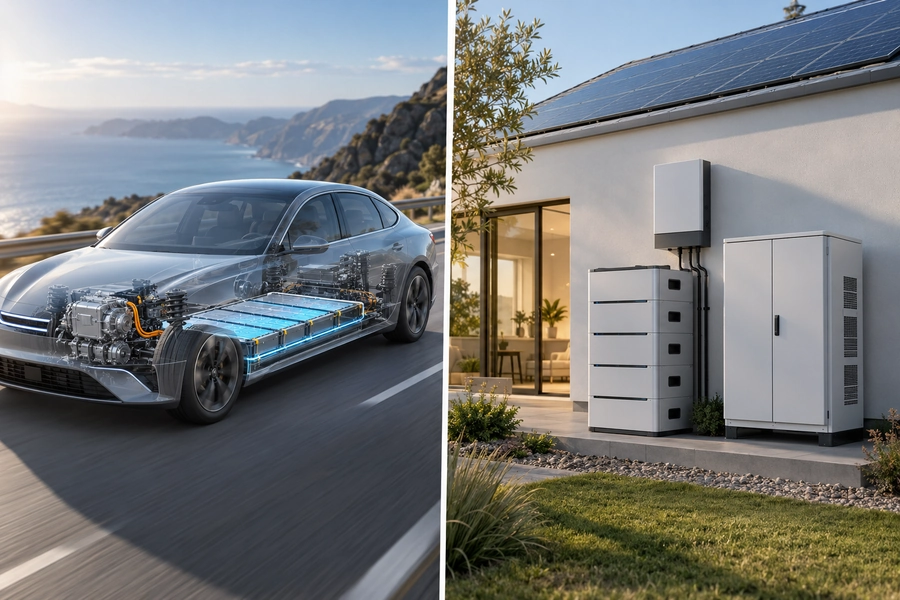
The main difference between an EV battery and an ESS battery is their design objective. EV batteries prioritize high energy and power density, low weight, fast acceleration, charging performance, and automotive durability. ESS batteries prioritize long cycle life, low cost per stored kWh, thermal stability, scalability, and reliable stationary operation over many years.
Both systems store electrical energy. Both may use lithium-ion technology, and both increasingly use lithium iron phosphate (LFP). However, their cell selection, pack architecture, cooling, BMS strategy, mechanical design, and operating profiles can differ substantially.
What Is an EV Battery?
An EV battery is designed first and foremost to move a vehicle, so every kilogram and liter can affect vehicle efficiency, range, and performance.
An EV battery is a high-voltage rechargeable battery pack that stores energy for an electric vehicle's traction motor and other high-voltage systems. It must deliver substantial power during acceleration, accept energy during charging and regenerative braking, operate across changing temperatures, survive vibration and impacts, and provide useful driving range without excessive weight or volume.
A simplified EV energy path is:
EV Battery → Traction Inverter → Electric Motor → Wheels
During regenerative braking, some energy can flow in the opposite direction:
Wheels → Motor → Power Electronics → EV Battery
This means an EV battery experiences a dynamic operating environment.
Its power can change rapidly.
During gentle cruising, demand may be relatively low.
During hard acceleration, the battery may need to deliver very high power.
During regenerative braking, it suddenly needs to accept power.
During DC fast charging, it may also receive substantial charging current.
At the same time, the battery moves with the vehicle and must tolerate:
vibration,
road shock,
temperature changes,
crash-related requirements,
and strict packaging constraints.
For this reason, EV battery engineering places considerable emphasis on the relationship between:
kWh, kW, kg, liters, safety, and thermal performance.
What Is an ESS Battery?
An ESS battery is designed to store stationary energy rather than propel a moving vehicle.
An ESS battery is a rechargeable battery used in an Energy Storage System to store electricity for later use. It can support solar and wind integration, peak shaving, backup power, microgrids, EV charging, energy arbitrage, and grid services. Stationary applications generally prioritize cycle life, safety, cost, scalability, and lifetime energy throughput over minimum weight.
A simplified stationary system looks like:
Grid / Solar → PCS → ESS Battery
During discharge:
ESS Battery → PCS → Building / Grid
Unlike an EV battery, the ESS battery does not need to accelerate itself down a highway.
An additional:
100kg
may be unacceptable in an electric car.
The same additional weight may matter much less in a:
commercial battery cabinet
or:
containerized BESS.
This changes battery design priorities.
Stationary batteries can accept:
larger enclosures,
heavier structural components,
more extensive cooling equipment,
and:
lower gravimetric energy density
if those choices improve:
cost,
cycle life,
safety,
or:
maintainability.
That is one major reason LFP chemistry has become so important in stationary energy storage.
What Is the Main Difference Between EV and ESS Batteries?
The fundamental difference is what engineers optimize.
EV batteries are optimized to store substantial energy and deliver high power while remaining compact and lightweight enough for a vehicle. ESS batteries are optimized to repeatedly store and release electricity at low lifetime cost while remaining stationary. As a result, EV design emphasizes mobility and performance, while ESS design emphasizes cycling, scalability, safety, and economics.
A simple comparison makes this clearer:
| Feature | EV Battery | ESS Battery |
|---|---|---|
| Primary purpose | Vehicle propulsion | Stationary energy storage |
| Weight importance | Very high | Lower |
| Volume importance | Very high | Moderate |
| Energy density | High priority | Less critical |
| Power capability | High priority | Application-dependent |
| Cycle life | Important | Extremely important |
| Cost per kWh | Important | Extremely important |
| Fast charging | Often important | Application-dependent |
| Vibration resistance | Critical | Less demanding |
| Crash protection | Critical | Not automotive crash-focused |
| Scalability | Vehicle-pack scale | kWh to GWh-scale projects |
| Thermal management | Critical | Critical |
| BMS | Automotive-focused | Stationary ESS-focused |
Neither design is universally better.
They are optimized for different jobs.
Why Does Energy Density Matter More for EV Batteries?
A vehicle must physically carry its battery everywhere it goes.
Energy density is particularly important for EV batteries because a higher-energy-density pack can store more driving energy without increasing weight and volume proportionally. Lower battery mass can support vehicle efficiency, packaging, payload, and driving range. ESS batteries remain stationary, so manufacturers can accept lower energy density when it produces benefits in cost, safety, or cycle life.
Imagine two batteries.
Battery A:
100kWh at 600kg
Battery B:
100kWh at 900kg
For a stationary solar system, the extra:
300kg
may have relatively little operational impact once the foundation and enclosure are designed for it.
For a passenger EV, adding 300kg affects:
vehicle mass,
suspension,
handling,
acceleration,
payload,
efficiency,
and:
potentially range.
Volume creates similar constraints.
An EV battery must fit within a carefully engineered vehicle structure, often underneath the passenger compartment.
A stationary battery can instead be installed in:
racks,
cabinets,
outdoor enclosures,
or:
20-foot-class BESS containers.
Therefore, EV battery designers may place greater value on:
Wh/kg
and:
Wh/L.
ESS designers often care more about:
$/kWh
cycles
and:
lifetime MWh throughput.
This is a fundamental engineering difference.
Do EV and ESS Batteries Use the Same Chemistry?
Sometimes they do, but chemistry alone does not make two battery systems equivalent.
EV and ESS batteries can both use lithium-ion chemistries such as LFP, while some EVs also use nickel-rich chemistries such as NMC. LFP has become particularly important in stationary storage because of its cost, cycle-life potential, and thermal characteristics. However, an LFP EV battery and an LFP ESS battery can still have very different cells, packaging, cooling, BMS settings, and performance targets.
Consider:
LFP EV battery
versus:
LFP containerized ESS.
Both use lithium iron phosphate chemistry.
But the EV pack may be optimized for:
vehicle weight,
fast charging,
acceleration,
regenerative braking,
pack height,
and:
crash protection.
The stationary battery may instead be optimized for:
daily cycling,
four-hour discharge,
low $/kWh,
long service life,
container energy density,
and:
easy system expansion.
So:
same chemistry ≠ same battery design.
This is an important distinction when comparing products.
The chemistry tells me how the cell stores energy.
It does not tell me everything about how the complete battery system is engineered.
Why Is Cycle Life So Important for ESS Batteries?
Stationary storage can charge and discharge repeatedly as part of its normal daily business model.
Cycle life is particularly important for ESS batteries because many systems are expected to charge and discharge every day for solar shifting, peak shaving, or electricity-price arbitrage. Higher cycle capability can increase lifetime energy throughput and reduce replacement or augmentation requirements, making battery degradation a major factor in project economics.
Suppose a commercial BESS performs:
1 equivalent full cycle per day.
Annual cycles are approximately:
365.
Over ten years:
365 × 10 = 3,650 cycles.
Over fifteen years:
365 × 15 = 5,475 cycles.
Now imagine the battery performs more than one equivalent cycle on some days.
Lifetime throughput becomes even more important.
This is why an ESS battery should not be judged only by:
purchase price per kWh.
A better metric considers:
how many useful kWh it can deliver during its lifetime.
A simplified concept is:
Lifetime Energy Throughput ≈ Usable Capacity × Equivalent Full Cycles
For example, a:
1MWh
battery completing:
5,000 equivalent full cycles
would theoretically process:
5,000MWh
of discharge energy before considering degradation and operating limitations.
That is why cycle life is directly connected to ESS economics.
Do EV Batteries Need More Power Than ESS Batteries?
EV batteries often face rapid and highly variable power demands, although some stationary systems can also be extremely high-power.
EV batteries must support rapid changes in power during acceleration, hill climbing, regenerative braking, and fast charging. This makes power density and dynamic response important. ESS power requirements depend on application: a four-hour solar-shifting battery may operate relatively steadily, while a grid-frequency or fast-charging BESS can require very high power and rapid response.
Suppose an EV cruises at:
20kW.
The driver suddenly accelerates.
Battery demand might increase dramatically within seconds.
Then the driver releases the accelerator and regenerative braking begins.
Power flow reverses.
This creates a dynamic battery profile:
discharge → high discharge → low discharge → charge
within a short period.
A solar ESS may follow a smoother pattern.
For example:
charge for four hours → idle → discharge for four hours.
However, this is not universal.
A BESS supporting frequency regulation can respond continuously to grid commands.
A BESS supporting a high-power EV charging hub can also experience substantial C-rates.
Therefore, I would not say:
“EV batteries are always higher-power than ESS batteries.”
The more accurate statement is:
EV battery power requirements are inherently linked to vehicle performance, while ESS power requirements are determined by the storage application.
How Are EV and ESS Battery Cooling Systems Different?
Both need thermal management, but their physical environments are very different.
EV battery cooling must manage rapidly changing loads, fast charging, limited vehicle space, changing ambient conditions, and motion. ESS thermal management operates in a stationary enclosure and can be designed around predictable installation conditions. Modern ESS may use air or liquid cooling, while EV packs commonly use tightly integrated liquid thermal-management systems.
Temperature affects:
battery performance,
charging capability,
power output,
degradation,
and:
safety.
An EV may travel from:
a cold winter morning
to:
highway driving
to:
DC fast charging
within a short period.
Its thermal system must respond accordingly.
The battery pack also has severe packaging constraints.
An ESS has a different advantage:
it stays in one place.
Engineers know its enclosure design.
They can design dedicated:
HVAC,
fans,
cold plates,
pumps,
liquid loops,
and:
heat exchangers.
Large BESS systems increasingly focus on temperature uniformity across cells and racks.
This matters because a pack is affected not only by its average temperature but also by differences between cells.
A consistently hotter group of cells can degrade faster than cooler cells.
So both EV and ESS batteries need thermal management, but their cooling systems are optimized around very different physical environments.
How Is an EV BMS Different From an ESS BMS?
Both systems use a BMS, but their control priorities and interfaces differ.
An EV BMS monitors and protects the traction battery while supporting driving power, regenerative braking, charging, thermal control, and vehicle communication. An ESS BMS also monitors cells, voltage, current, temperature, SOC, and faults, but it operates within a stationary energy-storage architecture and coordinates with the PCS, EMS, site controller, and grid-control systems.
In an EV, the BMS may communicate with:
vehicle control unit,
traction inverter,
onboard charger,
DC/DC converter,
thermal system,
and:
charging interface.
The vehicle needs to know:
how much power the battery can deliver,
how much regenerative power it can accept,
SOC,
temperature,
and:
whether any fault exists.
In an ESS, the communication hierarchy may look more like:
Cell → Module BMS → Rack BMS → System BMS → EMS → PCS/Grid
The EMS then makes higher-level decisions based on:
electricity prices,
solar generation,
facility load,
grid commands,
and:
battery condition.
So both BMS types protect batteries.
But the EV BMS operates as part of a moving electric drivetrain.
The ESS BMS operates as part of a stationary energy-management system.
Are ESS Batteries Safer Than EV Batteries?
It is too simplistic to call one category inherently safe and the other unsafe.
EV and ESS batteries both require layered safety engineering, but their risks and safety standards differ. EV batteries must address crashes, vibration, road conditions, high-voltage isolation, and vehicle thermal events. ESS batteries must address large quantities of stored energy, thermal-runaway propagation, fire detection, enclosure design, spacing, ventilation, emergency shutdown, and site-level response.
An EV battery may contain:
tens of kWh.
A large containerized ESS can contain:
several MWh.
So even if individual cells have strong thermal characteristics, the total stored energy in a BESS can be enormous.
Stationary systems therefore rely on multiple safety layers:
BMS protection,
thermal management,
electrical protection,
gas or smoke detection,
emergency shutdown,
fire protection,
and:
system-level testing.
EVs require different safety engineering because the battery is moving at road speeds and may experience collision forces.
The correct conclusion is therefore not:
“ESS is safer.”
It is:
“EV and ESS safety engineering addresses different operating risks.”
Battery chemistry is only one layer of that safety architecture.
Can an EV Battery Be Used for Home Energy Storage?
Technically, EV batteries can store energy for buildings, but the implementation must be specifically engineered.
An EV battery can contribute to stationary energy storage through bidirectional charging such as vehicle-to-home or vehicle-to-grid, while retired EV batteries can potentially be repurposed in second-life stationary applications. However, compatibility, remaining battery health, power electronics, BMS integration, certification, safety, warranty, and economics must all be considered.
There are two very different concepts here.
Vehicle-to-Home
The battery remains inside the EV.
A compatible bidirectional charging system allows energy to flow from the vehicle toward the home.
The architecture becomes:
EV Battery ↔ Bidirectional Charger ↔ Home
Second-Life EV Battery
The battery is removed from the vehicle after automotive use.
If it retains sufficient capacity and passes appropriate evaluation, it may potentially be repurposed for stationary storage.
The second-life concept is attractive because an EV battery may no longer meet automotive range or performance requirements while still retaining useful storage capacity.
But this is not simply:
remove battery → connect inverter → use at home.
A safe system requires appropriate:
battery assessment,
BMS,
power conversion,
electrical protection,
thermal management,
controls,
and:
certification.
So EV batteries can participate in stationary storage, but that does not make them identical to purpose-built ESS batteries.
Which Is Cheaper: EV Battery or ESS Battery?
Direct $/kWh comparisons can be misleading because the products have different design requirements.
ESS batteries are generally engineered around low stationary storage cost and lifetime energy throughput, while EV batteries must also satisfy demanding requirements for weight, volume, crashworthiness, vehicle integration, fast charging, and power performance. The meaningful comparison is therefore not simply cell price, but total system cost relative to the service each battery must provide.
An EV pack cost may include engineering for:
structural integration,
crash protection,
high-voltage disconnects,
vehicle cooling,
pack sealing,
and:
automotive communication.
An ESS project may instead require:
containers,
PCS,
EMS,
transformers,
switchgear,
fire systems,
foundations,
and:
grid interconnection.
So even when cells are inexpensive, the complete system is not just:
cell price × number of cells.
For ESS, I prefer to evaluate:
installed $/kWh
$/kW
lifetime cycles
and:
lifetime energy throughput.
For EVs, additional metrics include:
Wh/kg
Wh/L
range
power
and:
fast-charging performance.
The economic goals are different because the products create different forms of value.
My Insights: What Is the Difference Between EV Battery and ESS Battery
The easiest way to understand the difference is to look at what each battery must optimize rather than focusing only on chemistry.
An EV battery is optimized to move a vehicle, requiring high energy and power density, low weight, compact packaging, dynamic power delivery, fast charging, and automotive durability. An ESS battery is optimized to store stationary electricity repeatedly and economically, prioritizing cycle life, safety, scalability, thermal management, low cost, and lifetime energy throughput.
My First Insight: Same Chemistry Does Not Mean Same Battery
An EV and an ESS may both use:
LiFePO4.
That does not make their batteries interchangeable.
Their cells can have different:
dimensions,
electrode designs,
power characteristics,
cycle targets,
and:
thermal requirements.
Their packs can have completely different:
mechanical structures,
cooling,
BMS,
electrical interfaces,
and:
safety systems.
So chemistry is only the starting point.
The application defines the battery.
My Second Insight: EV Batteries Fight Weight; ESS Batteries Fight Cost and Degradation
For EV engineering:
every kilogram moves.
For ESS engineering:
every unnecessary dollar affects project economics.
This creates two optimization paths.
EV:
more Wh + more kW + less kg + less volume
ESS:
more lifetime kWh + more cycles + lower cost + controlled degradation
This is why battery specifications should always be interpreted in the context of their application.
My Third Insight: ESS Battery Value Comes From Lifetime Throughput
A stationary battery may cycle almost every day.
Therefore, the amount of energy delivered over its entire life becomes extremely important.
Suppose two 1MWh batteries have similar purchase prices.
Battery A provides significantly more useful lifetime cycles than Battery B under the required operating conditions.
Battery A may therefore deliver more lifetime MWh.
For commercial energy storage, that can directly affect:
ROI,
payback,
and:
levelized storage cost.
This makes degradation an economic variable rather than merely a technical specification.
My Fourth Insight: EV Batteries Can Become Part of the ESS Ecosystem
The line between EV and ESS is becoming less rigid.
With bidirectional charging:
EV → Home
or:
EV → Grid
allows the traction battery to temporarily act as stationary energy storage.
After automotive service, some EV batteries may also be considered for second-life stationary applications.
However, this convergence does not eliminate the engineering differences between a traction battery and a purpose-built ESS.
The battery's original design objective still matters.
My Fifth Insight: What Is the Difference Between EV Battery and ESS Battery?
This directly answers the H1.
| Comparison | EV Battery | ESS Battery |
|---|---|---|
| Main purpose | Move an electric vehicle | Store stationary electricity |
| Energy density | High priority | Moderate priority |
| Power density | High priority | Application-dependent |
| Weight | Critical | Less important |
| Volume | Critical | Less restrictive |
| Cycle life | Important | Major priority |
| Cost per kWh | Important | Major priority |
| Lifetime throughput | Important | Major economic metric |
| Fast charging | Often critical | Depends on application |
| Dynamic power | Frequent | Application-dependent |
| Vibration resistance | Critical | Lower requirement |
| Crash protection | Critical | Not automotive-focused |
| Thermal management | Highly integrated | Air or liquid cooling |
| BMS integration | Vehicle drivetrain | PCS/EMS/grid system |
| Typical chemistry | LFP, NMC and others | Increasingly LFP |
| Scalability | Vehicle pack | kWh to GWh projects |
| Typical use | Transportation | Solar, grid, backup, C&I |
So, what is the difference between an EV battery and an ESS battery?
The fundamental difference is:
EV batteries are designed around mobility. ESS batteries are designed around stationary energy management.
An EV battery must carry its own weight.
Every kilogram affects the vehicle.
The battery must also support:
rapid acceleration,
regenerative braking,
highway driving,
fast charging,
changing temperatures,
vibration,
and:
vehicle safety requirements.
That pushes EV battery engineering toward:
high energy density,
high power density,
compact packaging,
and:
low weight.
An ESS battery does not need to move.
That gives engineers more freedom.
They can prioritize:
long cycle life,
low $/kWh,
thermal stability,
easy scalability,
maintenance,
and:
lifetime energy throughput.
A stationary system can be installed in:
a rack,
cabinet,
battery room,
or:
containerized BESS.
Weight still affects structural design and transportation, but it does not continuously consume propulsion energy.
This difference explains why two LFP batteries can look similar chemically while being very different products.
One might be designed for:
a 400V or 800V EV drivetrain.
Another might be designed for:
a multi-MWh containerized BESS.
Their chemistry may share the same broad name.
Their engineering targets do not.
The simplest rule I use is:
EV battery = optimize energy storage for movement.
ESS battery = optimize energy storage for repeated stationary use.
Once that distinction is clear, the differences in:
energy density,
power,
weight,
cycle life,
cooling,
BMS,
safety,
and:
cost
become much easier to understand.
Conclusion
EV batteries prioritize mobility, power, compactness, and weight, while ESS batteries prioritize long cycling, scalability, safety, lifetime energy throughput, and economical stationary storage.
](https://voltcrave-battery.com/wp-content/uploads/2026/08/What-Are-the-Two-Types-of-Energy-Storage-Systems-768x512.webp)
](https://voltcrave-battery.com/wp-content/uploads/2026/09/BESS-Container-or-Battery-Building-Which-Is-Best-for-Solar-Power-Plants-768x512.webp)
](https://voltcrave-battery.com/wp-content/uploads/2026/06/What-Is-the-Most-Efficient-Energy-Storage-System-768x512.jpg)