

](https://voltcrave-battery.com/wp-content/uploads/2026/09/What-Is-the-Best-Portable-Car-Jump-Starter.webp)
A dead car battery can leave you stranded without warning, and an underpowered jump starter may be almost as frustrating as having no starter at all.
The best portable car jump starter should match your engine size while remaining compact, reliable, and easy to use. For most passenger cars and SUVs, a quality 1,000–1,500A lithium jump starter is a practical choice. Larger gasoline engines, diesel trucks, and frequent professional use may justify 2,000A or more.
There is no single portable jump starter that is best for every vehicle. I choose one by matching its starting capability to the engine, then comparing clamp quality, safety protection, battery capacity, cold-weather performance, portability, charging speed, and long-term storage requirements.
What Is a Portable Car Jump Starter?
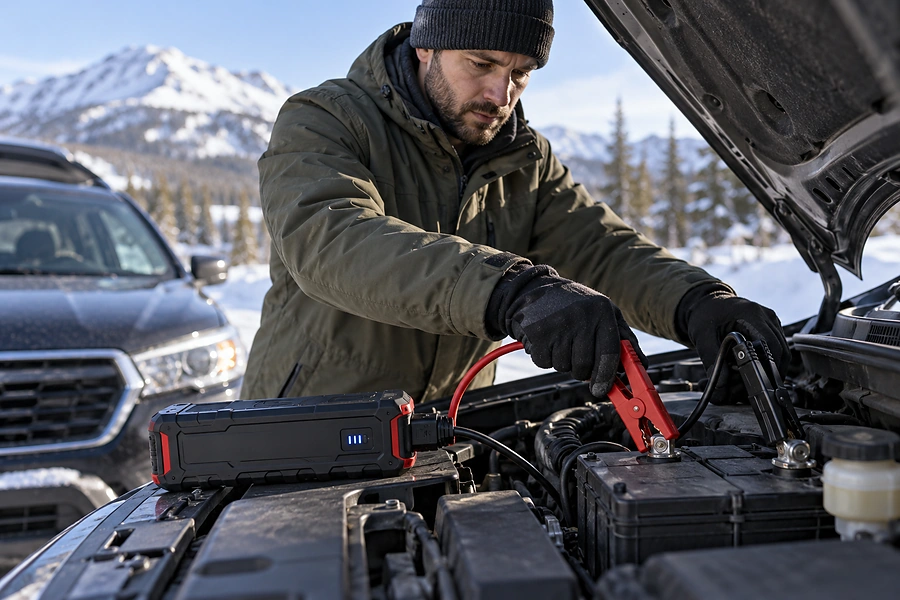
A portable jump starter is a compact battery pack designed to provide the high current needed to crank a vehicle when its starter battery cannot do so.
Unlike traditional jumper cables, a portable jump starter does not require a second vehicle. Most modern units use lithium batteries, connect directly to a 12V vehicle battery through clamps, and include electronic protections against common connection errors. Many also function as USB power banks and emergency lights.
This independence is its biggest advantage.
Traditional jumper cables require another vehicle to be positioned close enough to the disabled car. A portable jump pack carries its own stored energy.
The normal process is straightforward: connect the clamps according to the manufacturer's instructions, activate the unit if required, start the vehicle, disconnect the pack, and recharge it afterward.
However, the jump starter is not really “charging” the dead car battery in the way a battery charger does.
Its primary job is to provide a short burst of high power so the vehicle's starter motor can crank the engine.
That distinction matters.
A jump starter solves an immediate starting problem.
A battery charger or maintainer restores and maintains battery charge over a much longer period.
For roadside emergencies, portability and immediate cranking ability make a lithium jump starter particularly useful.
How Many Amps Should a Portable Jump Starter Have?
More advertised peak amps do not automatically make a jump starter better.
I choose jump-starting capacity primarily from engine size and fuel type. Smaller gasoline engines generally need less starting capability, while large-displacement engines and diesels benefit from greater reserve. Rather than buying the largest advertised amp number, I check the manufacturer's supported engine sizes and independent starting tests.
This is important because “peak amps” are not always directly comparable across brands.
One manufacturer may advertise:
1,000A
while another advertises:
3,000A
or even:
6,000A.
The larger number looks dramatically better, but it does not automatically prove that the second device will be six times better at starting your car.
I prefer to evaluate the complete product.
NOCO's current selection guidance illustrates how one manufacturer matches jump starters to engine size. Its GB40 is rated for gasoline engines up to 6.0L and diesels up to 3.0L; the GB50 increases those ratings to 7.0L gasoline and 4.5L diesel; and the GB70 covers up to 8.0L gasoline and 6.0L diesel.
That creates a useful principle:
Buy enough starting capacity for your engine, with reasonable headroom.
Buying substantially more than the vehicle needs can increase cost, weight, and storage size without improving everyday usefulness.
What Is the Best Portable Jump Starter for Most Cars?
For a typical passenger vehicle, portability and reliability matter as much as maximum power.
For most ordinary cars, crossovers, and smaller SUVs, I would start with a compact lithium jump starter around the NOCO GB40 class. The GB40 provides 1,000A and is officially rated for gasoline engines up to 6.0L and diesel engines up to 3.0L, covering a broad range of everyday vehicles.
Car and Driver's May 2026 hands-on comparison selected the GB40 as its Most Compact jump starter. Testers praised its small size and simple interface, although they also noted short leads, stiff clamps, and limited stored energy compared with larger units.
That last point is important.
The best emergency jump starter is often not the one with the biggest specification.
It is the one you will actually keep in the car.
A massive jump pack sitting in a garage is useless when the battery dies in a parking lot.
For an ordinary sedan or crossover, I therefore value:
compact size + sufficient engine rating + reliable clamps + simple operation
more than an extreme peak-amp specification.
What Is the Best Jump Starter for a Truck or Diesel Engine?
Larger engines change the selection criteria because they require greater cranking capability.
For full-size trucks, large V8 gasoline engines, and diesel vehicles, I prefer a higher-capacity jump starter with substantial starting headroom. A 2,000A-class unit such as the NOCO GB70 is one example, with the manufacturer currently rating it for gasoline engines up to 8.0L and diesel engines up to 6.0L.
A larger unit has tradeoffs.
It costs more.
It takes up more space.
It weighs more.
But those disadvantages can be worthwhile when the starter has to crank:
a diesel pickup,
a large SUV,
a V8 truck,
an RV,
or several different vehicles.
The same logic applies to fleet or professional use.
A driver who expects to use the device once every few years has different requirements from a roadside technician who may jump several vehicles.
For larger engines, I would rather have adequate power reserve than choose the smallest possible unit.
Are Cheap Portable Jump Starters Worth Buying?
Price matters, but emergency equipment is one category where I do not evaluate value solely by the lowest purchase cost.
A budget jump starter can be worthwhile if it has sufficient tested starting capability, dependable clamps, appropriate safety protection, and good charge retention. However, extremely high peak-amp claims at unusually low prices deserve closer inspection. Independent tests and realistic engine ratings are more useful than a large marketing number alone.
Current products illustrate how wide the market has become.
I would compare these products by use case rather than simply arranging them from highest to lowest peak amps.
A lower-cost unit can make sense for a small gasoline car.
A more expensive unit can make sense for a diesel truck, frequent use, or harsh conditions.
What I would avoid is assuming:
6,000A must be six times better than 1,000A.
Starting performance depends on more than the largest number printed on the case.
What Safety Features Should a Car Jump Starter Have?
Portable jump starters deliver very high current, so connection protection matters.
I look for reverse-polarity protection, spark-resistant connection logic, insulated clamps, short-circuit protection, overcurrent protection, overtemperature protection, and clear status indicators. I also want a manual override function only when its purpose and risks are clearly explained, because bypass modes can remove some normal protection.
NOCO, for example, describes its Boost products as incorporating spark-proof connections and reverse-polarity protection.
These features are particularly useful for occasional users.
When someone has a dead battery late at night, in bad weather, or on the roadside, conditions are not ideal for careful electrical work.
Good product design should make correct operation obvious.
Clamp design matters too.
I look for:
strong spring pressure,
adequate contact area,
insulated handles,
durable cable connections,
and enough cable length to reach awkward battery terminals.
Car and Driver's testing highlights why physical design matters: it found the GB40 very compact but criticized its short leads and difficult-to-squeeze clamps.
That is the kind of detail a peak-amp specification cannot reveal.
Does Battery Capacity Matter in a Jump Starter?
Yes, but capacity and starting current solve different problems.
Starting capability determines whether the device can crank the engine, while internal battery capacity influences how much stored energy is available for repeated attempts, USB charging, lights, and other functions. A compact jump starter can have enough power for one difficult start without having enough energy for many repeated starts.
This difference appeared clearly in Car and Driver's GB40 testing.
The testers found that one jump of a severely discharged vehicle reduced the unit's indicated capacity from full to approximately 25%, and they cautioned against expecting many difficult starts from such a compact device.
This illustrates an important distinction:
high power ≠ high energy capacity.
A jump starter can produce an intense burst of current for a short time while containing relatively little total stored energy.
That can be completely acceptable for an emergency tool.
But a fleet operator may want a larger battery pack because repeated starts matter more.
I therefore ask:
Do I need one emergency jump, or multiple jumps before recharging?
The answer can change which model is best.
What Features Are Worth Paying Extra For?
Extra features are useful when they improve emergency readiness rather than simply adding specifications.
The features I value most are fast USB-C recharging, a clear state-of-charge display, a strong flashlight, durable clamps, a robust carrying case, useful power-bank outputs, and good low-temperature performance. A built-in air compressor can also be valuable if the goal is to combine dead-battery and flat-tire protection in one emergency tool.
Fast recharging is especially useful.
An emergency tool only works when it is charged.
Older jump starters may rely on relatively slow USB charging. Newer products increasingly support higher-power USB-C input and output.
A battery percentage display can also be more useful than several vague LEDs.
If the unit shows:
63%
I know approximately where I stand.
If it shows three illuminated dots, the information is less precise.
A flashlight is another feature I consider genuinely useful because dead batteries do not wait for daylight.
Power-bank functionality is convenient, but I see it as secondary.
The jump starter's primary purpose should remain:
starting the vehicle reliably.
How Often Should You Recharge a Portable Jump Starter?
A jump starter stored at zero charge provides no roadside protection.
I check the jump starter regularly and recharge it according to the manufacturer's storage instructions, especially before long trips or severe weather. Lithium packs self-discharge relatively slowly, but temperature, storage time, age, and standby electronics can reduce available charge. I would not assume a unit left untouched in a vehicle for a year is ready for a difficult start.
A practical habit is to inspect the jump starter whenever you perform other seasonal vehicle checks.
For example:
before winter,
before a road trip,
or during routine maintenance.
I also avoid unnecessary exposure to extreme temperatures when the manufacturer's storage limits advise against it.
Vehicle interiors can become extremely hot in summer and very cold in winter.
Because the jump starter itself contains a lithium battery, storage conditions affect its performance and longevity.
The goal is simple:
when the car battery is dead, the jump starter should not also be dead.
My Insights: What Is the Best Portable Car Jump Starter
There is no universal winner because engine size, portability, climate, and expected usage change the answer.
The best portable car jump starter is one that reliably starts your specific engine while remaining small enough to keep in the vehicle and simple enough to use under stress. For most passenger cars, I favor a reputable 1,000–1,500A lithium unit; larger trucks and diesels justify moving toward 2,000A or higher-capability models.
My First Insight: Engine Size Matters More Than the Biggest Amp Number
I would not shop by sorting products from:
highest peak amps
to:
lowest peak amps.
I would start with:
gasoline or diesel?
Then:
what engine displacement?
Then I would choose a manufacturer-rated model with adequate headroom.
NOCO's own range demonstrates this approach: its models step upward in supported engine displacement as starting capability increases.
That is a much more useful selection method than chasing an enormous marketing number.
My Second Insight: Portability Is Part of Reliability
Car and Driver's 2026 testing called the GB40 the most compact model in its test group.
I consider that more important than it initially sounds.
A jump starter needs to stay:
inside the vehicle.
If it is inconveniently large or heavy, users may remove it from the car.
The technically stronger product then becomes practically less useful.
For a daily commuter, compactness deserves significant weight.
My Third Insight: Large Engines Need Real Power Reserve
For a large gasoline engine or diesel truck, I would not choose the smallest starter simply because it worked on someone's compact car.
Diesels and large-displacement engines can be much more demanding.
A product such as the GB70 moves into a different category: NOCO rates it for engines up to 8.0L gasoline and 6.0L diesel.
For an ordinary four-cylinder sedan, that may be unnecessary.
For a diesel pickup, it may be exactly the additional headroom I want.
My Fourth Insight: The Best Jump Starter Must Still Be Charged
This sounds obvious, but it is one of the biggest practical weaknesses of portable battery emergency equipment.
A jump starter can have:
excellent clamps,
strong output,
a bright flashlight,
and impressive independent reviews.
If its internal battery is empty when the vehicle fails, none of those features matter.
I therefore consider:
charge retention
recharging speed
and:
battery-level indication
part of the buying decision, not optional conveniences.
My Fifth Insight: What Is the Best Portable Car Jump Starter?
This directly answers the H1 question.
| Driver / Vehicle | My Selection Direction | Why |
|---|---|---|
| Small gasoline car | Compact lithium starter | Easy storage, sufficient power |
| Typical sedan/crossover | 1,000–1,500A class | Strong balance |
| Larger SUV | 1,500–2,000A class | More starting reserve |
| V8 truck | Around 2,000A+ | Higher cranking demand |
| Diesel pickup | Higher-capability model | Diesel needs more reserve |
| Multiple vehicles | Larger-capacity unit | More repeated starts |
| Limited storage space | Compact model | More likely to stay in vehicle |
| Professional/fleet use | Heavy-duty starter | Frequent starting requirements |
For a typical passenger-car owner, my selection process is straightforward.
First, I identify:
engine displacement and fuel type.
Second, I choose a jump starter officially rated for that engine with some additional headroom.
Third, I check:
independent starting tests.
Fourth, I examine:
clamps, cables, safety protection, and controls.
Fifth, I compare:
size, weight, recharge speed, and internal energy capacity.
Using those criteria, a product in the NOCO GB40 class is a strong choice for most ordinary passenger vehicles, while something closer to the GB70 class makes more sense for larger trucks and diesel engines. The current 2026 evidence supports that distinction: independent testing praises the GB40's compactness, while NOCO's specifications clearly move larger engines toward its higher-capability models.
The most important lesson is that I would not choose a jump starter because it has the biggest advertised amp number.
I would choose the smallest reliable product that provides sufficient starting capability for the vehicle, good safety features, enough energy reserve, and enough portability that it will actually remain in the car.
That is what makes a portable jump starter useful when it matters.
Conclusion
The best portable car jump starter matches your engine, provides reliable starting power and safety protection, stays charged, and is compact enough to keep in your vehicle.
](https://voltcrave-battery.com/wp-content/uploads/2026/06/How-Long-Do-Grid-Storage-Batteries-Last-768x512.jpg)
](https://voltcrave-battery.com/wp-content/uploads/2026/09/How-to-Choose-the-Best-Lithium-Battery-for-Off-Grid-Solar-Power-768x512.webp)
](https://voltcrave-battery.com/wp-content/uploads/2026/08/What-Are-the-Key-Differences-Between-Stackable-and-Non-Stackable-Solar-Batteries-768x512.webp)