
](https://voltcrave-battery.com/wp-content/uploads/2026/10/What-Is-the-Best-Portable-Power-Station-for-Home-Backup.webp)
Power outages can quickly shut down refrigeration, internet, lighting, computers, and essential electronics, while an undersized portable battery may run out when it is needed most.
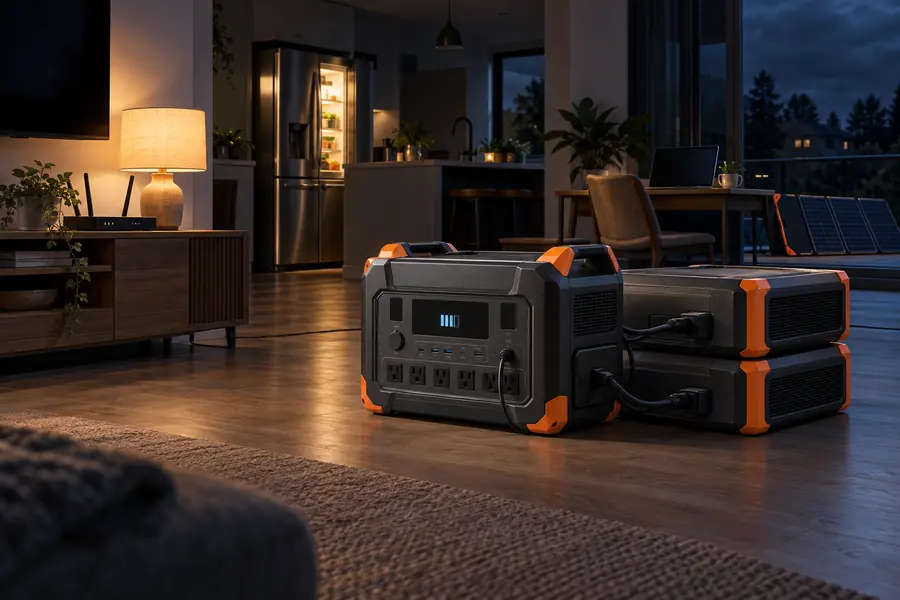
For most homes, the EcoFlow DELTA 3 Plus is the best balanced portable power station for backup because its 1,024Wh LFP battery, 1,800W output, sub-10ms UPS, 1,000W solar input, and expansion to 5kWh cover refrigerators, routers, electronics, and selected appliances without moving into a much heavier home-battery system overall today.
1kWh powers essentials during short outages; 2kWh extends runtime for larger loads; 4kWh+ suits heavier home or RV backup. Size systems around critical devices first.
What Is the Best Portable Power Station for Home Backup in 2026?
A good home-backup power station needs more than a large battery. It must provide enough inverter power, usable energy, fast switchover, practical charging, and manageable weight.
For most users, EcoFlow DELTA 3 Plus offers one of the strongest overall combinations of portability, 1,024Wh capacity, 1,800W rated AC output, sub-10ms UPS switching, LFP chemistry, high solar-input capability, and expandable storage. Anker C1000 Gen 2 is stronger when compact size and 2,000W output matter more than expansion.
Independent testing supports the DELTA 3 Plus as a particularly strong all-around option. TechRadar's 2026 portable-power guide ranked it best overall after testing more than 50 units, highlighting its fast charging, quiet operation, 1,024Wh capacity, solar input, expansion capability, and 10ms-class UPS performance.
Its current official specification includes approximately:
| Specification | EcoFlow DELTA 3 Plus |
|---|---|
| Battery capacity | 1,024Wh |
| Rated AC output | 1,800W |
| Surge output | 3,600W |
| Battery chemistry | LFP |
| UPS transfer | <10ms |
| Solar input | Up to 1,000W |
| Expansion | Up to 5kWh |
| Cycle rating | 4,000 cycles to 80%+ |
For home backup, its expansion capability is especially valuable.
A 1kWh unit is small enough to move around the house, but the same platform can grow toward 5kWh if future outages require more runtime.
That produces a useful upgrade path:
Start Small → Measure Real Outage Consumption → Add Capacity if Necessary
The Anker SOLIX C1000 Gen 2 takes a different approach.
It also stores:
1,024Wh
but provides:
2,000W continuous AC output
and:
3,000W peak output.
Anker lists a 10ms UPS, up to 600W solar input, approximately 24.9 lb weight, and 4,000 cycles to at least 80% capacity.
That makes it a particularly compelling choice when the priority is:
maximum useful AC power from a compact 1kWh battery.
My practical distinction is therefore:
EcoFlow DELTA 3 Plus → Better all-around expandable backup
Anker C1000 Gen 2 → Excellent compact fixed-capacity backup
Neither is automatically the better product for every house.
The right answer depends on runtime.
How Much Capacity and Output Do You Need for Home Backup?
Many people compare portable power stations using watt-hours alone, but capacity and power solve different problems.
For basic home backup, approximately 1kWh is suitable for routers, lights, computers, refrigeration, and selected electronics, while 2kWh provides more practical outage runtime. Capacity in Wh determines how long loads can operate, while inverter output in watts determines which appliances can run simultaneously or start successfully.
The basic runtime relationship is:
Runtime ≈ Usable Battery Energy ÷ Average Load
Consider a 1,024Wh station.
At an average:
100W
load, the theoretical runtime is approximately:
1,024 ÷ 100
= 10.2 hours
At:
250W
it becomes:
1,024 ÷ 250
≈ 4.1 hours
At:
500W
it falls to:
about 2 hours.
Actual runtime will normally be lower because the system consumes energy through:
inverter conversion,
fans,
electronics,
standby operation,
and battery-management limits.
This is why a 1kWh battery can be excellent for:
Wi-Fi,
phones,
laptops,
LED lighting,
and intermittent refrigeration,
but much less suitable for continuous:
space heating,
electric cooking,
or large HVAC loads.
When Does 2 kWh Make More Sense?
If the outage regularly lasts overnight or you want to support refrigeration plus several additional loads, the 2kWh category becomes more attractive.
The BLUETTI Elite 200 V2 provides:
2,073.6Wh
with:
2,600W AC output
and:
1,000W maximum solar input.
It uses LFP cells, and BLUETTI currently rates it for more than 6,000 cycles to 80% original capacity. It weighs about 53.4 lb.
That illustrates the trade-off clearly.
You approximately double stored energy compared with a 1kWh station.
But portability becomes substantially worse.
The Jackery Explorer 2000 v2 takes another approach. It stores:
2,042Wh
and delivers:
2,200W
while weighing approximately:
17.9kg, or about 39.5 lb.
It uses LFP cells and provides UPS transfer within 20ms according to Jackery's current documentation.
For home backup, I therefore think about three practical categories:
| Capacity Class | Best Home-Backup Role |
|---|---|
| ~1kWh | Router, lights, refrigerator, computers, small essentials |
| ~2kWh | Overnight essentials and larger appliance combinations |
| 3–5kWh+ | Longer outages, heavier loads, semi-stationary backup |
The biggest mistake is assuming:
More Wh = More Appliance Capability
It does not.
A 2kWh battery with a 1,500W inverter may store more energy than a 1kWh battery with a 2,000W inverter, but the smaller battery may still operate the larger instantaneous load.
Therefore:
Wh = Runtime
while:
W = Load Capability.
Which Portable Power Stations Are Best for Different Home Backup Needs?
There is no universal winner because a compact 1kWh battery and a heavy 2kWh station solve different problems.
EcoFlow DELTA 3 Plus is my strongest balanced choice for expandable home backup. Anker C1000 Gen 2 is excellent for compact 1kWh performance. BLUETTI Elite 200 V2 is better when approximately 2kWh of runtime and high output matter most, while Jackery Explorer 2000 v2 combines 2kWh capacity with comparatively lower weight.
A useful comparison is:
| Model | Capacity | Continuous Output | Weight | Solar Input | Best Fit |
|---|---|---|---|---|---|
| EcoFlow DELTA 3 Plus | 1,024Wh | 1,800W | ~27.6 lb | Up to 1,000W | Best expandable balance |
| Anker C1000 Gen 2 | 1,024Wh | 2,000W | 24.9 lb | 600W | Compact high-output backup |
| BLUETTI Elite 200 V2 | 2,073.6Wh | 2,600W | 53.4 lb | 1,000W | Longer runtime |
| Jackery Explorer 2000 v2 | 2,042Wh | 2,200W | ~39.5 lb | 400W | Lighter 2kWh backup |
Best for Expandable Backup: EcoFlow DELTA 3 Plus
Its strongest advantage is not simply its 1,024Wh battery.
It is the ability to begin at 1kWh and expand toward:
5kWh.
That makes sense for buyers who are not yet sure how much battery capacity they actually need.
It also supports high solar input for its size, making it more useful when outages extend beyond the energy initially stored in the battery.
Best Compact High-Output Choice: Anker C1000 Gen 2
The Anker delivers:
2,000W
from a roughly:
25 lb
unit.
It also offers 10ms UPS operation and can recharge at up to 600W from solar under specified conditions.
For someone mainly protecting:
refrigeration,
a home office,
Wi-Fi,
CPAP equipment,
and several ordinary household devices,
this is a very strong configuration.
Best for Longer Runtime: BLUETTI Elite 200 V2
The BLUETTI nearly doubles energy capacity compared with a 1kWh station.
It is therefore much better suited to extended outages.
Its disadvantage is:
weight.
At more than 53 lb, it is movable but no longer something most people will casually carry from room to room.
A recent TechRadar assessment similarly described it as particularly suitable for heavy-duty backup while noting that its capacity can be excessive for occasional users.
Best Lightweight 2kWh Option: Jackery Explorer 2000 v2
The Jackery offers roughly:
2.04kWh
while remaining around:
39.5 lb.
That is significantly easier to move than many 2kWh-class alternatives.
Its weakness for solar-heavy users is the:
400W maximum solar input
in Jackery's current specification.
So I would favor it when:
portability matters more than rapid solar replenishment.
What Should You Check Before Using a Portable Power Station at Home?
A portable battery may look like a miniature home ESS, but it should not automatically be treated as a permanently installed household battery.
Before choosing a portable station, check continuous output, surge capability, capacity, UPS transfer, LFP cycle rating, solar input, operating temperature, warranty, and safety certification. Portable packs are primarily designed to supply equipment through their own outputs; permanent connection to household wiring belongs to a different system and safety category.
This distinction is important.
The current UL 2743 standard covers portable and movable power packs, including lithium-ion systems up to defined capacity thresholds. Its scope specifically excludes portable packs permanently connected to premises wiring or designed to supply premises wiring; those applications fall under energy-storage-system requirements such as UL 9540.
UL also cautions that portable power packs marketed for home use should not automatically be assumed suitable as stationary residential ESS equipment merely because they meet a portable-power standard.
In practical terms:
Plugging a Refrigerator Into a Portable Power Station
is different from:
Connecting a Battery Into the House Electrical Panel.
If the system is intended to energize home circuits through a transfer panel, inlet, or other integration equipment, use manufacturer-approved hardware and qualified electrical installation appropriate to the system.
UPS Transfer Also Needs Context
A 10ms or 20ms transfer specification can be extremely useful for:
routers,
computers,
home-office equipment,
and other electronics.
EcoFlow lists sub-10ms UPS operation for its DELTA 3 family, while Anker lists 10ms for the C1000 Gen 2.
Jackery states that its Explorer 2000 v2 switches to battery within 20ms, but it specifically notes that this is not a zero-interruption UPS and should not be treated as appropriate for equipment requiring a true no-break supply.
That is an important distinction.
Portable UPS Function ≠ Every Dedicated UPS Application.
Solar Is Valuable During Extended Outages
Without a recharge source, every portable battery eventually becomes empty.
Solar can restore some or all of that energy during daylight.
This makes solar-input capacity particularly important for:
multi-day outages,
off-grid use,
and emergency preparedness.
A 1kWh station capable of accepting 1,000W of solar has a very different recovery profile from a 2kWh model limited to 400W, assuming suitable panels and real sunlight are available.
So for long outages, I would compare:
Battery Capacity + Solar Input
rather than capacity alone.
My Insights: What Is the Best Portable Power Station for Home Backup
Power stations are often compared by battery size alone, but poor output, slow recharging, limited expansion, or excessive weight can make a large battery inconvenient during an outage.
For most households, the best portable power station for home backup is a 1–2kWh LFP model with roughly 1,800–2,600W continuous output, fast UPS switching, and practical solar charging. I favor EcoFlow DELTA 3 Plus for expandable 1kWh backup, while BLUETTI Elite 200 V2 better suits users needing longer runtime overall.
My preferred decision framework is simple:
| Home Backup Priority | Best-Fit Option |
|---|---|
| Best overall balance | EcoFlow DELTA 3 Plus |
| Compact 1kWh + higher AC output | Anker C1000 Gen 2 |
| Longer 2kWh runtime | BLUETTI Elite 200 V2 |
| Lighter 2kWh portability | Jackery Explorer 2000 v2 |
For a normal household outage, I would start with:
1–2kWh LFP capacity
and then ask three questions:
How many watts must run simultaneously?
How many hours must those loads operate?
How will the battery recharge if the outage continues?
A refrigerator, router, lights, laptops, phones, and selected medical or communication equipment can often be supported effectively by a portable battery.
Electric resistance heating, central HVAC, water heating, dryers, ovens, and EV charging can consume energy much faster.
Therefore, the best portable backup strategy is usually:
Protect Critical Loads, Not Normal Whole-House Consumption.
For users wanting permanent automatic backup of multiple household circuits, a listed stationary home ESS may ultimately be more appropriate than continuously increasing the size of a portable power station.
Conclusion
For most homes, EcoFlow DELTA 3 Plus offers the best expandable balance; choose a 2kWh BLUETTI or Jackery when longer outage runtime matters more than portability.
](https://voltcrave-battery.com/wp-content/uploads/2026/09/Off-Grid-Solar-Battery-Storage-How-Do-You-Build-a-Reliable-Power-System-768x512.webp)
](https://voltcrave-battery.com/wp-content/uploads/2026/09/BESS-Container-or-Battery-Building-Which-Is-Best-for-Solar-Power-Plants-768x512.webp)
](https://voltcrave-battery.com/wp-content/uploads/2026/08/What-Is-the-Outlook-for-the-BESS-Industry-768x512.webp)







































