

](https://voltcrave-battery.com/wp-content/uploads/2026/08/How-Much-Battery-Storage-Do-You-Need-to-Run-a-House.webp)
A battery that is too small may keep the lights on but fail quickly once air conditioning, heating, pumps, or other large appliances start operating.
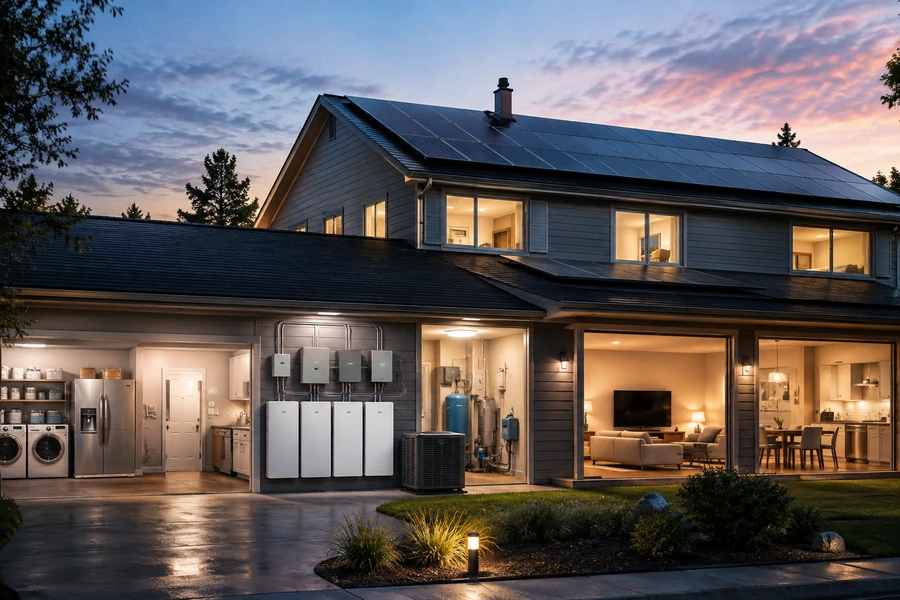
Most homes need about 10–15 kWh of battery storage for essential-load backup and roughly 30 kWh or more for about one day of whole-home electricity use. Homes seeking two or three days of autonomy may need 40–90 kWh or more, depending on HVAC, appliances, weather, solar recharging, and energy consumption.
I normally size a home battery from actual electricity consumption rather than house square footage. For a typical U.S. household, around 30 kWh is a useful starting point for one day, but efficient homes or essential-load backup systems can require much less.
How Much Battery Storage Does an Average House Need?
The easiest starting point is the home's daily electricity consumption. Battery capacity is measured in kilowatt-hours, or kWh, so I compare usable battery kWh directly with the amount of electricity the house expects to consume during an outage.
For many U.S. homes, approximately 30 kWh of usable battery storage is a reasonable starting point for one day of whole-home backup without solar recharging. Essential loads may need only 10–15 kWh, while larger all-electric homes may require considerably more than 30 kWh per day.
Why 30kWh Is a Useful Starting Point
The U.S. Energy Information Administration reports that the average U.S. household consumes about 10,500 kWh of electricity annually.
Dividing that by 365 days gives:
10,500 kWh ÷ 365 ≈ 28.8 kWh per day
That makes approximately 30 kWh per day a useful national-average reference.
However, I would never automatically install 30 kWh of batteries just because the national average is close to that number.
Household electricity use varies significantly according to:
- Climate
- Home size
- Air conditioning
- Electric heating
- Water heating
- EV charging
- Pool equipment
- Well pumps
- Number of occupants
- Appliance efficiency
EIA specifically notes substantial regional differences and reports that detached homes in the South tend to use more electricity than apartments in the Northeast.
A small efficient home may use 10–15 kWh per day.
A large all-electric property can easily exceed 40–50 kWh on a hot or cold day.
The battery should therefore be sized from the house, not the national average.
Is 10kWh of Battery Storage Enough to Run a House?
Ten kilowatt-hours can provide meaningful backup, but it normally requires prioritizing critical loads.
A 10 kWh battery is often enough for essential household loads such as refrigeration, lights, internet equipment, electronics, and selected outlets for part or most of a day. It is usually not enough for unrestricted whole-home operation when central HVAC, electric water heating, cooking, laundry, or EV charging continue normally.
What Can a 10kWh Battery Run?
Consider a simplified essential-load example:
| Essential load | Approximate daily energy |
|---|---|
| Refrigerator/freezer | 1.5 kWh |
| Wi-Fi and communications | 0.5 kWh |
| LED lighting | 0.8 kWh |
| TVs/computers | 1.0 kWh |
| Small appliances | 1.0 kWh |
| Heating controls/fans | 1.5 kWh |
| Miscellaneous loads | 1.2 kWh |
| Total | 7.5 kWh |
A 10 kWh battery could potentially support this type of reduced-load profile for roughly a day.
These figures are examples rather than universal appliance ratings. Real consumption varies with appliance size, runtime, efficiency, temperature, and household behavior.
This is why essential-load backup works so well.
Instead of trying to operate every circuit normally, I prioritize:
- Refrigerator
- Freezer
- Lighting
- Internet
- Phones
- Medical equipment
- Garage door
- Selected outlets
- Heating controls
Then I temporarily avoid large loads.
A smaller battery becomes much more useful when the homeowner actively manages consumption.
EnergySage currently describes 10–15 kWh as a typical range for homeowners focused on essential backup rather than full whole-home operation.
Is 20kWh of Battery Storage Enough for a House?
Twenty kilowatt-hours is a strong middle ground between critical-load backup and unrestricted whole-home backup.
A 20 kWh battery can run many homes through an overnight outage and may provide close to a full day when high-power appliances are managed carefully. It is particularly useful with solar because daytime PV can power the house and recharge the battery, reducing the amount of stored energy required at the beginning of an outage.
20kWh Works Well With Load Management
Suppose the home reduces outage consumption to:
0.8 kW average
A simplified runtime calculation is:
20 kWh ÷ 0.8 kW = 25 hours
At an average 2 kW load:
20 kWh ÷ 2 kW = 10 hours
At an average 4 kW load:
20 kWh ÷ 4 kW = 5 hours
Actual runtime will differ because of conversion losses, battery reserves, battery condition, temperature, and varying appliance loads.
The key point is that runtime depends on average power consumption, not the physical size of the house.
A large house with only a refrigerator, lights, internet, and one efficient heat pump operating can consume less backup energy than a smaller house using resistance heating, an electric water heater, oven, dryer, and EV charger simultaneously.
For many homeowners, I would rather install 20 kWh combined with intelligent load management than install substantially more battery capacity while allowing every discretionary load to operate normally.
Is 30kWh Enough for Whole-House Backup?
For many U.S. homes, 30 kWh is the point where genuine whole-home backup becomes realistic for approximately one day.
About 30 kWh is a practical starting capacity for one day of whole-home battery backup because it is close to average U.S. daily household electricity consumption. EnergySage similarly estimates that whole-home systems typically require approximately 30 kWh or more, although the actual requirement varies significantly by household.
One Day of Backup Does Not Mean Every Day Is Average
Averages can hide large differences.
A home may consume:
- 20 kWh on a mild spring day
- 35 kWh on a warm summer day
- 60 kWh during extreme heat
If I install exactly 30 kWh because annual average consumption is 30 kWh per day, the battery may still be undersized during the conditions most likely to produce an outage.
Storms, heat waves, and winter weather can increase both outage risk and household energy demand.
I therefore examine actual utility interval data when available.
Ideally, I review:
- Average daily consumption
- Summer peak days
- Winter peak days
- Overnight consumption
- Largest hourly demand
- Essential-load consumption
Then I decide whether the objective is:
Essential backup, normal whole-home operation, or maximum energy independence.
Those are three very different battery designs.
How Much Battery Storage Is Needed for Two or Three Days?
Multi-day backup changes the economics quickly because each additional day requires much more stored energy unless solar can recharge the system.
A home seeking two or three days of battery autonomy may require approximately 40–90 kWh or more. Tesla notes that homes continuing to operate large loads during outages can require around 40–90 kWh for two to three days of autonomy. Homes aggressively conserving energy can achieve longer runtime with substantially less storage.
Why Multi-Day Storage Gets Large Quickly
Suppose a household consumes 25 kWh per day during an outage.
For one day:
25 × 1 = 25 kWh
For two days:
25 × 2 = 50 kWh
For three days:
25 × 3 = 75 kWh
I would then add design margin for:
- Conversion losses
- Minimum battery reserve
- Battery degradation
- Uncertain appliance usage
A three-day battery-only system can therefore become very large.
This is where solar becomes extremely important.
If solar produces enough electricity each day to serve daytime loads and restore the previous night's battery consumption, I may not need three full days of battery capacity.
Instead of storing every kWh in advance, the system produces new energy throughout the outage.
How Does Solar Change the Amount of Battery Storage You Need?
Solar panels can dramatically reduce the battery capacity required for long outages.
Without solar, a battery contains a fixed energy reserve that steadily declines during an outage. With properly configured solar-plus-storage, solar can serve daytime loads and recharge the battery for nighttime use. This can allow a smaller battery system to provide much longer backup, assuming sufficient sunlight and appropriate islanding controls.
Solar and Battery Should Be Sized Together
Consider a house using:
20 kWh per day during an outage
Without solar, three days require approximately:
20 × 3 = 60 kWh
Now suppose the solar system produces 18 usable kWh per day during the outage.
The battery only needs to bridge the mismatch between generation and consumption instead of carrying the entire three-day requirement at the beginning.
The energy flow becomes:
Daytime solar → house
Excess solar → battery
Nighttime → battery → house
DOE explains that storage allows solar electricity to remain available when sunlight is unavailable and can help match renewable generation with electricity demand.
However, I do not assume perfect sunshine.
A severe storm can reduce PV production for several days.
My backup design therefore considers:
- Winter solar production
- Cloudy-day production
- Roof orientation
- Shading
- Snow
- Outage season
- Battery reserve
Solar reduces the battery requirement, but it does not eliminate weather risk.
How Much Battery Do You Need to Run an Air Conditioner?
Air conditioning changes battery sizing because it requires both substantial energy and substantial instantaneous power.
A home battery must have enough kWh to operate an air conditioner for the desired number of hours and enough kW or surge capability to start the compressor. This means a battery can have sufficient energy capacity but still fail to operate an HVAC system if its inverter output or motor-start rating is too low.
Energy and Power Are Different
This distinction is fundamental.
kWh = how long the battery can run
kW = how much equipment it can run at once
Suppose an air conditioner averages 3 kW while operating.
Running for five total hours consumes:
3 kW × 5 hours = 15 kWh
That one appliance could consume most of a 15 kWh battery.
But the system must also start the air conditioner.
The compressor can briefly require much more power during startup.
This is why I check:
- Continuous inverter output
- Surge output
- Motor-start rating
- Locked-rotor amps
- 120/240V capability
Tesla Powerwall 3, for example, contains 13.5 kWh of battery energy but can be configured for as much as 11.5 kW of continuous AC output.
The two specifications answer completely different questions.
A battery buyer should always compare both.
What Household Loads Use the Most Battery Energy?
Large electric heating and cooling loads usually have the biggest effect on backup runtime.
HVAC, electric water heating, EV charging, clothes dryers, electric ovens, pool equipment, and well pumps can dramatically increase battery requirements. During an outage, temporarily disabling discretionary high-energy loads can turn a 10–15 kWh battery from a short-term backup system into a much more useful resilience resource.
Loads I Usually Reduce During an Outage
If maximum runtime is important, I normally prioritize:
Keep operating:
- Refrigerator
- Freezer
- Essential lighting
- Internet
- Phones
- Medical equipment
- Security systems
- Heating controls
- Well pump when necessary
Manage carefully:
- Central air conditioning
- Heat pumps
- Electric water heaters
Temporarily disable when possible:
- EV charging
- Clothes dryer
- Pool heater
- Pool pump
- Hot tub
- Electric oven
- Secondary HVAC zones
This can dramatically reduce required battery capacity.
Tesla gives a useful illustration: it notes that 13.5 kWh can support more than two days without recharge when large loads such as HVAC, pool pumps, and laundry equipment are avoided, while continuing to use major loads can require 40–90 kWh for two to three days.
The lesson is not that every 13.5 kWh battery lasts two days.
The lesson is that load management is as important as battery size.
How Do I Calculate the Battery Size My House Needs?
I use actual electricity consumption whenever possible.
To estimate home battery capacity, I add the daily energy consumption of the appliances that must operate during an outage, multiply it by the required number of backup days, and then add a margin for losses, battery reserve, and future degradation. Solar production can then be subtracted conservatively when estimating multi-day requirements.
Step 1: Choose the Loads
Assume I want to operate:
| Load | Daily energy |
|---|---|
| Refrigerator | 1.5 kWh |
| Lights | 1 kWh |
| Internet/electronics | 1 kWh |
| HVAC | 8 kWh |
| Well pump | 1.5 kWh |
| Cooking | 2 kWh |
| Other essentials | 3 kWh |
| Total | 18 kWh/day |
Step 2: Choose Backup Duration
For one day:
18 kWh
For two days:
36 kWh
For three days:
54 kWh
Step 3: Add Margin
If I apply a simplified 15% design margin:
18 × 1.15 = 20.7 kWh
I would therefore look around the 20–25 kWh range for approximately one day of this particular load profile before considering solar contribution.
Step 4: Check Power
Then I calculate maximum simultaneous demand.
If the refrigerator, HVAC, pump, microwave, and lighting could require 9 kW simultaneously, installing 25 kWh of batteries with only a 5 kW inverter would still be inadequate.
DOE similarly emphasizes that storage systems must be described by both power capability and energy capacity because a large amount of stored energy does not automatically provide a large instantaneous power output.
How Many Home Batteries Do You Need?
Most current residential batteries provide roughly 10–15 kWh per primary unit, so many homeowners need multiple units for unrestricted whole-home backup.
One typical 10–15 kWh battery is often sufficient for essential-load backup. Two batteries commonly provide approximately 20–30 kWh and can support more substantial whole-home operation. Three or more may be required for larger all-electric homes, extended outages, or homeowners who want to maintain normal consumption without aggressive load management.
Example Using a 13.5kWh Battery
Tesla Powerwall 3 has 13.5 kWh of nominal battery energy.
That gives:
| Number of 13.5 kWh units | Total energy |
|---|---|
| 1 | 13.5 kWh |
| 2 | 27 kWh |
| 3 | 40.5 kWh |
| 4 | 54 kWh |
| 5 | 67.5 kWh |
Two units place the home close to average U.S. daily residential consumption.
Three provide more than 40 kWh.
Four provide 54 kWh.
However, this does not mean every average home needs two Powerwalls. A homeowner protecting only essential circuits may need one. A fully electric house in a harsh climate may need substantially more.
EnergySage currently estimates that around 10 kWh can be enough for selected critical loads, while approximately 30 kWh or more is typically needed for one day of whole-home operation.
Is It Better to Buy More Battery or Reduce Backup Loads?
I usually optimize the load profile before adding another expensive battery.
Reducing unnecessary outage loads is often more economical than installing enough storage to run every appliance normally. Smart load management can prioritize HVAC, refrigeration, pumps, and essential circuits while temporarily disabling EV chargers, dryers, pool equipment, and other discretionary loads when battery state of charge becomes low.
One Avoided Load Can Save an Entire Battery
Suppose an EV normally charges at 9.6 kW.
Just two hours of charging could consume:
9.6 kW × 2 hours = 19.2 kWh
That is more energy than many individual residential batteries store.
The vehicle may already contain tens of kWh of energy and does not necessarily need charging during a grid outage.
Turning off that one circuit can therefore preserve an entire battery's worth of household backup energy.
The same logic applies to:
- Pool heaters
- Electric resistance heating
- Hot tubs
- Clothes dryers
I first decide what the household actually needs during an emergency.
Then I buy enough batteries for those loads.
This approach usually produces a more economical and resilient design.
My Insights: How Much Battery Storage Do You Need to Run a House
I believe the most useful starting point is 10–15 kWh for essential backup and approximately 30 kWh for one day of normal whole-home use, followed by adjustments for the home's actual loads.
Most homes need about 10–15 kWh of battery storage to run essential appliances during an outage and roughly 30 kWh or more for approximately one day of whole-house operation. For two or three days without dependable solar recharge, 40–90 kWh may be more realistic, especially when HVAC and other large loads remain active.
I Start With Actual Daily kWh
My first number is not the size of the house.
It is the household's daily electricity consumption.
The national U.S. average works out to roughly 29 kWh per day from EIA's annual household consumption figure, but individual homes vary widely.
I review the utility bill or, preferably, hourly or 15-minute smart-meter data.
I Separate Essential Backup From Whole-Home Backup
For essential backup, I normally start around:
10–15 kWh
For one day of substantial whole-home backup, I start around:
25–35 kWh
For two or three days, I may consider:
40–90+ kWh
These are planning ranges, not universal engineering requirements.
I Check kW Before Finalizing kWh
A 30 kWh battery bank may contain plenty of energy but still be unable to start an air conditioner if the inverter has inadequate output.
I therefore verify:
- Continuous kW
- Surge capability
- Motor starting
- 120/240V operation
- Simultaneous loads
I Use Solar to Reduce the Required Battery Bank
For long outages, I would rather have a correctly sized solar-plus-storage system than simply install enormous battery capacity.
DOE notes that solar storage allows electricity generated during sunny periods to be used when solar production is unavailable.
A well-designed system can recharge during daylight and support the house overnight.
This makes the battery part of a repeating daily energy cycle rather than a reserve that can only be depleted once.
My Practical Sizing Guide
| Backup goal | Battery capacity I would initially evaluate |
|---|---|
| Refrigerator, lights, Wi-Fi, essentials | 10–15 kWh |
| Essentials + limited HVAC | 15–20 kWh |
| Approximately one day of typical whole-home use | 25–35 kWh |
| Large/all-electric home for one day | 30–50+ kWh |
| Two days with moderate loads | 40–60+ kWh |
| Two to three days with large loads | 40–90+ kWh |
| Off-grid/multi-day autonomy | 60 kWh+, plus substantial solar or another energy source |
I would use this table only to begin the design. The final answer should come from the home's measured energy use, critical circuits, peak power, expected weather, and solar-production profile.
Conclusion
Most homes need 10–15 kWh for essential backup or around 30 kWh for one full day. Larger loads, longer outages, and limited solar require more storage.
](https://voltcrave-battery.com/wp-content/uploads/2026/08/What-Are-BESS-Containers-Used-For-768x512.webp)
](https://voltcrave-battery.com/wp-content/uploads/2026/06/Commercial-Energy-Storage-Systems-The-Future-of-Reliable-Power-for-Businesses-768x512.jpg)
](https://voltcrave-battery.com/wp-content/uploads/2026/08/10-Best-Battery-Energy-Storage-Companies-in-2026-768x512.webp)