

](https://voltcrave-battery.com/wp-content/uploads/2026/08/What-Is-the-Overview-of-BESS.webp)
Electricity production and electricity demand rarely match perfectly. Without storage, excess generation can be wasted while later demand still requires additional power.
A battery energy storage system, or BESS, stores electrical energy in rechargeable batteries and releases it when needed. A complete BESS combines battery cells, a battery management system, power conversion equipment, thermal management, safety systems, controls, and grid connections. It supports renewable integration, peak shaving, backup power, energy shifting, and grid stability.
I see BESS as more than a large battery. It is a complete power system that must measure, protect, convert, control, and deliver stored energy safely. Its value depends on battery chemistry, power rating, storage duration, controls, efficiency, degradation, safety, and the application it serves.
What Is a Battery Energy Storage System?
A BESS captures electricity, converts it into electrochemical energy, stores it inside battery cells, and later converts that energy back into electricity.
A battery energy storage system is an integrated system that stores electricity in rechargeable batteries for later use. It can range from a small residential battery to a multi-gigawatt-hour utility project. Modern systems usually use lithium-ion batteries, especially lithium iron phosphate, because they offer fast response, modular construction, frequent cycling, and competitive costs.
BESS Includes More Than Battery Cells
The cells are the energy-storage medium, but they cannot operate safely or connect directly to most buildings or electricity grids without additional equipment.
A typical BESS includes:
| Component | Main function |
|---|---|
| Battery cells | Store electrochemical energy |
| Modules or packs | Organize cells into larger units |
| Battery racks | Combine modules into manageable electrical groups |
| BMS | Monitors and protects the battery |
| PCS/inverter | Converts DC battery power to AC and AC to DC |
| Thermal management | Maintains safe battery temperatures |
| EMS | Determines when the system charges and discharges |
| Fire and gas detection | Monitors abnormal conditions |
| Switchgear | Protects and isolates electrical circuits |
| Transformer | Matches system voltage to the facility or grid |
| SCADA/HMI | Provides monitoring, alarms, and operator control |
UL 9540 evaluates energy storage systems as complete integrated products rather than simply evaluating battery cells. Its scope includes charging, discharging, protection, controls, communications, grid interaction, and other system functions.
This system-level approach is important because a reliable battery cell can still perform poorly when the inverter, cooling equipment, software, electrical protection, or commissioning is inadequate.
BESS Can Exist at Several Scales
I usually divide the market into three broad segments.
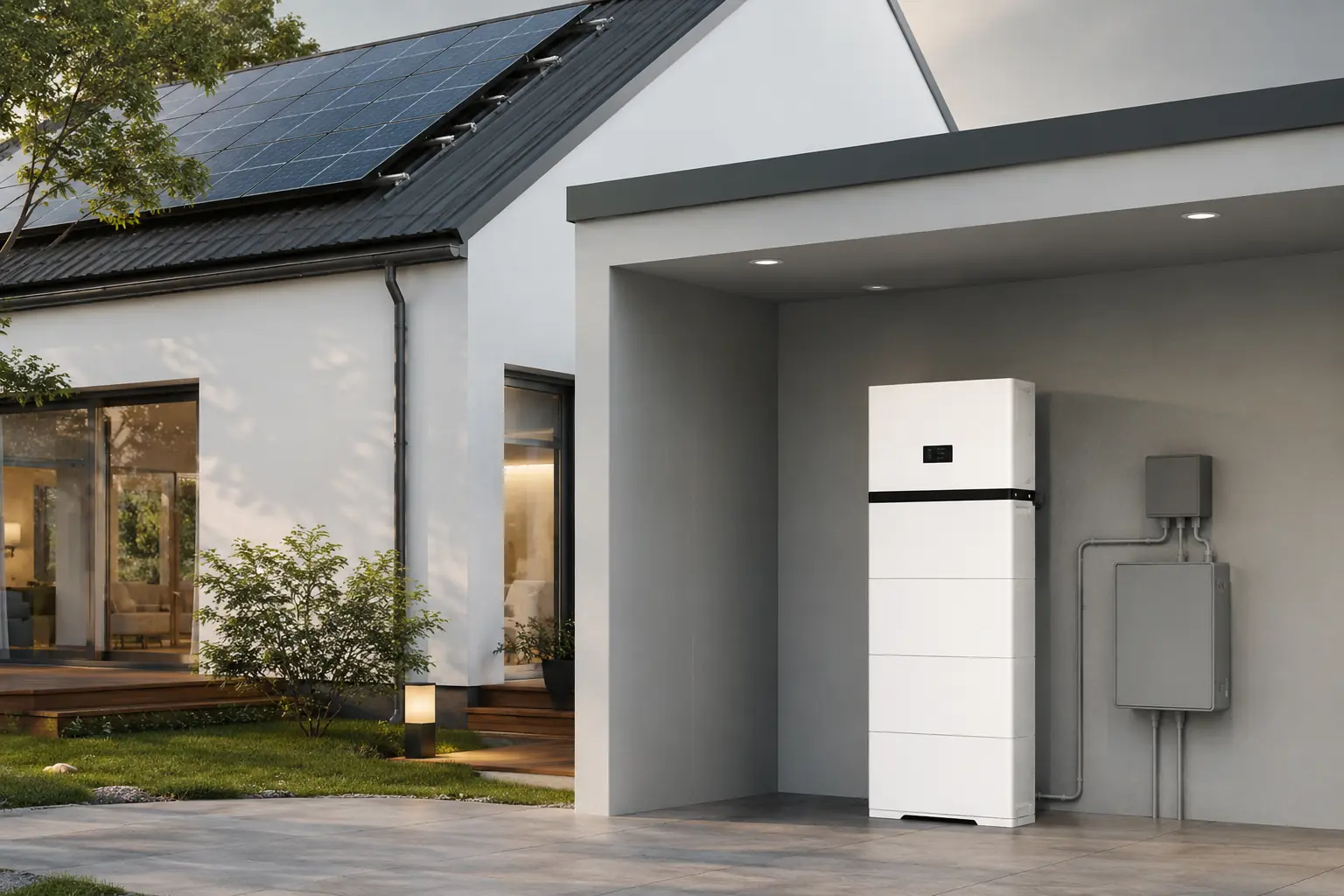
Residential BESS serves homes. It may store rooftop solar energy, reduce time-of-use electricity costs, and provide backup during outages.
Commercial and industrial BESS serves businesses, factories, warehouses, data centers, EV charging sites, and institutions. It may reduce demand charges, manage solar production, provide resilience, or participate in utility programs.
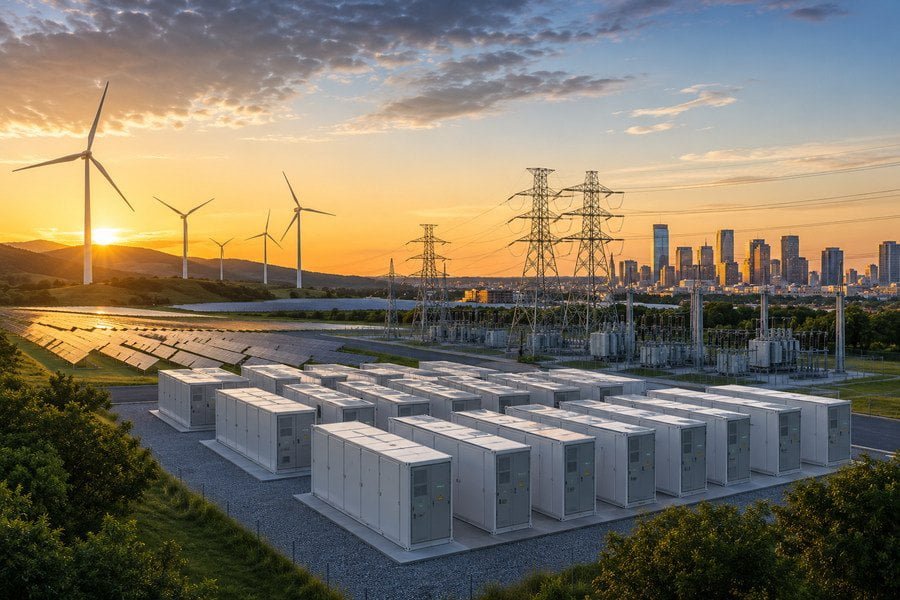
Utility-scale BESS connects directly to the wider power system. It may shift renewable energy, provide capacity, regulate frequency, support voltage, reduce congestion, or participate in wholesale electricity markets.
NREL models residential, commercial, and utility battery systems separately because their size, duration, cost structure, and operating objectives differ.
How Does a BESS Work?
A BESS repeatedly moves through charging, storage, and discharging cycles.
During charging, electricity passes through the power conversion system and is stored as chemical energy inside the battery. During discharge, the process reverses and the PCS delivers AC electricity to the building or grid. The BMS protects the battery, while the EMS determines when charging or discharging creates the most technical or financial value.
The Charging Process
Electricity may come from:
- The utility grid
- A solar PV system
- A wind project
- A generator
- Another local energy source
When the source provides AC power, the PCS converts that power into the DC electricity required by the battery.
The BMS monitors:
- Cell voltage
- Battery current
- Cell temperature
- State of charge
- State of health
- Communication status
- Contactor condition
- Faults and alarms
If the battery becomes too hot, too cold, too full, or otherwise unsafe, the BMS can reduce or stop charging.
The Discharging Process
When energy is needed, the battery releases DC power.
The PCS converts this into AC electricity.
That energy may then supply:
- A home
- A commercial building
- Industrial machinery
- An EV charging station
- A microgrid
- The utility grid
The EMS determines the appropriate discharge time.
For example, a solar-plus-storage project may charge around midday and discharge after sunset. A commercial BESS may discharge only when building demand reaches a predetermined peak. A grid battery may respond within seconds to frequency changes.
Power and Energy Are Different
This distinction is central to understanding BESS.
Power is measured in kW or MW.
Energy capacity is measured in kWh or MWh.
A 10 MW/40 MWh BESS can theoretically deliver 10 MW for approximately four hours.
| BESS rating | Maximum power | Stored energy | Nominal duration |
|---|---|---|---|
| 1 MW/1 MWh | 1 MW | 1 MWh | 1 hour |
| 1 MW/2 MWh | 1 MW | 2 MWh | 2 hours |
| 10 MW/40 MWh | 10 MW | 40 MWh | 4 hours |
| 100 MW/400 MWh | 100 MW | 400 MWh | 4 hours |
Actual usable duration may be slightly different because of protected state-of-charge limits, auxiliary consumption, conversion losses, and degradation.
I therefore never evaluate a BESS from its MW rating alone.
What Battery Chemistry Is Most Common in BESS?
Different electrochemical technologies can be used, but lithium-ion batteries dominate the modern stationary-storage market.
Lithium iron phosphate, or LFP, is currently the most common BESS chemistry. The IEA reports that LFP accounted for around 90% of battery storage deployments in 2025. Its popularity comes from relatively low cost, frequent-cycle capability, thermal stability, and suitability for stationary systems where maximum energy density is less important than in electric vehicles.
Why LFP Became Dominant
LFP does not have the highest energy density among lithium-ion chemistries.
However, stationary batteries do not need to carry their own weight in the way that EV batteries do.
I give greater importance to:
- Cost per usable kWh
- Cycle life
- Thermal stability
- Degradation
- Availability
- Manufacturing scale
- Warranty support
- System integration
The IEA reported that installed battery storage capacity in 2025 had become eleven times larger than in 2021, while LFP's market share rose from below 50% five years earlier to around 90%.
Other Battery Technologies Still Matter
LFP is dominant, but it is not the only option.
| Technology | Typical strength | Typical limitation |
|---|---|---|
| LFP | Cost, cycle life, mature supply chain | Lower energy density than NMC |
| NMC | High energy density | Higher material and thermal-management requirements |
| Sodium-ion | Material diversification | Less commercial history |
| Flow battery | Long cycling and scalable duration | Larger footprint and system complexity |
| Lead-acid | Mature backup technology | Lower cycle life for daily operation |
| Zinc-based systems | Alternative materials and stationary applications | Commercial scale varies |
NREL's commercial and utility storage benchmarks currently focus mainly on lithium-ion technologies while acknowledging that additional commercial and emerging storage technologies exist.
What Is BESS Used For?
One battery can provide several services. The application determines how it should be sized, controlled, and financed.
BESS is used for energy shifting, renewable-energy integration, peak shaving, frequency regulation, capacity support, backup power, microgrids, demand response, grid congestion management, and electricity-price optimization. The same battery may combine several of these functions when operating rules and available capacity allow it.
Renewable Energy Integration
Solar and wind generation are variable.
Solar production often reaches its maximum near midday while electricity demand may remain high into the evening.
A battery can charge during high renewable production and discharge later.
This reduces the timing mismatch between generation and consumption.
The IEA reports that battery durations are gradually increasing as power systems use storage for a larger energy-shifting role. Most projects still cluster around roughly two hours, but more systems are being built for four hours or longer.
Peak Shaving
A business or grid system may experience short periods of very high demand.
Instead of building infrastructure that operates only during those peaks, a BESS can discharge temporarily.
For a commercial customer, this may reduce demand charges.
For a utility, it may reduce pressure on a feeder, substation, or generation fleet.
Frequency Regulation
Electricity supply and demand must remain closely balanced.
A sudden mismatch affects system frequency.
Batteries can respond very quickly, making them useful for frequency-response and reserve services.
This fast response is one of the key advantages of electrochemical storage compared with slower conventional resources.
Backup Power
A properly designed BESS can supply power during outages.
Residential systems may protect refrigerators, lights, internet equipment, and other essential circuits.
Commercial systems may protect:
- Servers
- Medical equipment
- Refrigeration
- Communications
- Security systems
- Critical production equipment
Large microgrids may combine solar, storage, and generators to maintain critical facilities for longer periods.
Energy Arbitrage
A BESS can charge when electricity prices are low and discharge when prices are high.
The basic concept is simple, but profitability must account for:
- Round-trip efficiency
- Battery degradation
- Market fees
- Financing
- Operating expenses
- Electricity-price spreads
I do not assume that every price difference produces profitable arbitrage.
What Are the Main Advantages of BESS?
Battery storage offers a combination of speed, modularity, location flexibility, and digital control that is difficult to reproduce with one conventional technology.
The main BESS advantages are fast response, modular installation, renewable-energy shifting, reduced peak demand, backup capability, grid flexibility, and the ability to perform several services from one asset. Battery systems can also be deployed much closer to loads than many large conventional energy resources.
BESS Responds Quickly
Battery inverters can change power output rapidly.
This makes BESS useful for:
- Frequency response
- Voltage support
- Renewable smoothing
- Ramp control
- Backup transfer
- Power-quality services
BESS Is Modular
A project can be built from repeated battery blocks.
This allows developers to scale systems from a few kilowatt-hours to hundreds or thousands of megawatt-hours.
Modularity also supports factory production.
Large portions of the battery, cooling, protection, and power-conversion equipment can be assembled before reaching the project site.
BESS Can Be Installed Near Demand
Pumped hydro needs suitable terrain.
Compressed-air storage may need suitable underground geology.
Battery systems are less geographically constrained.
They still require land, fire access, electrical infrastructure, permits, and appropriate safety separation, but they can be installed at homes, commercial properties, renewable plants, industrial facilities, substations, and grid nodes.
What Are the Main Disadvantages of BESS?
BESS is flexible, but it is not an unlimited energy source.
The main disadvantages of BESS include high upfront capital cost, battery degradation, finite discharge duration, energy losses, fire and thermal-runaway risk, supply-chain concentration, interconnection complexity, software dependence, and eventual battery replacement or recycling. These limitations must be evaluated across the full project lifecycle.
Batteries Degrade
Battery capacity gradually declines.
A project designed to supply 100 MWh at the beginning of operation may provide less usable energy after years of cycling.
Owners may respond by:
- Oversizing initially
- Adding batteries later
- Replacing modules
- Accepting lower capacity
Degradation must therefore be included in long-term project guarantees.
Energy Is Lost During Each Cycle
The battery, inverter, cables, transformer, cooling system, and auxiliary equipment consume energy.
The system therefore returns less electricity than it received during charging.
This is expressed through round-trip efficiency.
Losses reduce the economic value of energy arbitrage and increase the amount of renewable generation required to provide a given amount of delivered electricity.
Safety Requires Multiple Layers
Battery cells contain significant stored energy.
Thermal runaway can occur after severe electrical, thermal, mechanical, or internal failures.
A BESS therefore needs:
- BMS protection
- Cooling
- Fault detection
- Electrical isolation
- Gas detection
- Fire controls
- Appropriate enclosure design
- Emergency-response planning
UL 9540 provides a system-level safety framework, while UL 9540A addresses thermal-runaway fire propagation testing. Current U.S. installation codes can also require large-scale fire testing under specified conditions.
Duration Is Limited
A four-hour battery does not provide four days of power.
Once its energy is exhausted, it must recharge.
This makes conventional BESS excellent for daily balancing but less suitable as the only resource for prolonged periods of low renewable generation.
Long-duration storage technologies may become more important when grid requirements extend beyond conventional lithium-ion durations.
How Large Is the BESS Market?
Battery storage has moved rapidly from a niche technology into one of the world's fastest-growing power sectors.
Global battery-storage deployment reached 108 GW of new capacity in 2025, 40% more than in 2024. Around 80% of the additions were utility scale. Installed global battery capacity had grown to eleven times its 2021 level, showing that BESS is becoming a major part of electricity infrastructure rather than a limited demonstration technology.
Utility-Scale Storage Leads Deployment
The IEA reports that around 87 GW of utility-scale batteries were added globally during 2025.
Behind-the-meter residential and commercial storage also expanded, particularly where electricity prices are high or policy support is strong.
| 2025 market indicator | Reported level |
|---|---|
| Global battery-storage additions | 108 GW |
| Annual growth | About 40% |
| Utility-scale additions | About 87 GW |
| Utility-scale share | Around 80% |
| Growth in installed capacity since 2021 | About 11× |
| LFP share of deployments | Around 90% |
China represented around 60% of global battery additions in 2025, followed by the United States and Europe. Australia and parts of the Middle East also showed strong growth.
Storage Is Taking on a Larger Grid Role
The market is not only becoming larger.
The function of batteries is changing.
Early BESS projects were often focused on short-duration frequency services.
Modern projects increasingly perform energy shifting.
The IEA notes that storage durations are lengthening and that a growing number of projects provide four hours or more of discharge capability as solar penetration increases.
I expect this trend to continue because future grids will need both rapid response and larger amounts of energy flexibility.
How Do I Evaluate a BESS Project?
I do not begin by choosing a battery manufacturer.
I begin by defining the operating problem.
A BESS should be evaluated by its required power, energy capacity, duration, duty cycle, battery chemistry, efficiency, degradation, safety design, interconnection, warranty, controls, and lifecycle economics. The best system is the one that solves the project's specific problem at an acceptable cost and risk level.
I Define the Application First
I ask:
- Is the system shifting solar energy?
- Is it reducing commercial peak demand?
- Is it providing backup?
- Is it supplying frequency regulation?
- Is it participating in energy markets?
- Is it supporting a microgrid?
- Is it relieving a grid constraint?
The answer determines the design.
I Then Define Power and Duration
A project requiring a 5 MW discharge for one hour is different from a 5 MW discharge for four hours.
The first may require around 5 MWh.
The second may require around 20 MWh before adjusting for reserves and degradation.
Duration directly influences battery quantity and project cost.
I Compare the Complete System
My BESS evaluation normally includes:
| Evaluation area | Key question |
|---|---|
| Power | How many MW must the system deliver? |
| Energy | How many MWh are required? |
| Duration | How long must full output continue? |
| Chemistry | Which battery technology fits the duty cycle? |
| Efficiency | How much charging energy returns as usable electricity? |
| Degradation | How will capacity change over time? |
| Safety | How are faults detected and contained? |
| Interconnection | Can the site connect at the required power? |
| Warranty | What performance is guaranteed? |
| Software | How will charging and discharging be optimized? |
| Service | Who maintains the asset locally? |
| End of life | How will batteries be removed and recycled? |
This prevents a procurement decision from being reduced to battery price per kWh.
My Insights: What Is the Overview of BESS
I see BESS as a bridge between electricity generation and electricity demand. It gives operators control over when electrical energy is used rather than only controlling how much is produced.
The overview of BESS is that it is a complete battery-based power system combining energy storage, power conversion, protection, thermal management, and intelligent controls. Its core value is flexibility: it can move electricity across time, respond rapidly to grid conditions, support renewable generation, reduce demand peaks, and provide backup when properly configured.
BESS Is Becoming Infrastructure, Not Just Equipment
The most important industry change is scale.
With 108 GW of new battery-storage capacity added globally in 2025 and installed capacity eleven times higher than in 2021, storage is becoming a routine part of modern power-system planning.
Utilities increasingly evaluate batteries alongside:
- Generation
- Transmission
- Substations
- Demand response
- Flexible loads
Commercial customers evaluate batteries alongside:
- Solar PV
- EV charging
- Building automation
- Backup generators
- Energy-efficiency measures
Residential users increasingly evaluate batteries as part of a complete solar and home-energy system.
The Battery Cell Is Only One Part of BESS Quality
I believe this is one of the most important lessons for buyers.
Two systems can use similar LFP cells and still provide very different results.
Performance depends on:
- Cell consistency
- BMS accuracy
- Thermal uniformity
- PCS reliability
- EMS software
- Fire-safety design
- Commissioning quality
- Warranty structure
- Service support
The most competitive BESS is therefore not necessarily the system with the cheapest cells.
It is the system that delivers the required energy safely and predictably throughout the project life.
Storage Duration Will Become More Important
Today's market remains concentrated around systems that discharge for a few hours.
That matches daily solar shifting, evening peaks, and many grid services.
As renewable generation grows, I expect more projects to require:
- Four-hour storage
- Six-hour storage
- Eight-hour storage
- Ten-hour or longer storage
This may create room for sodium-ion, flow batteries, zinc systems, iron-based technologies, compressed air, thermal storage, and other long-duration alternatives.
LFP will likely remain highly important, but BESS technology will become more diverse as applications expand.
Software Will Determine More of the Value
A battery only stores energy.
Software decides when that energy should be used.
Future BESS value will increasingly depend on:
- Load forecasting
- Electricity-price forecasting
- Solar and wind forecasting
- Automated dispatch
- Degradation-aware optimization
- Grid-forming controls
- Predictive maintenance
- Cybersecurity
- Fleet management
A well-controlled battery may create significantly more value than an identical battery operated with a simple fixed schedule.
The Best BESS Starts With the Problem, Not the Product
I would not begin a project by asking, “Which battery should I buy?”
I would begin with:
What problem must the battery solve?
Then I define power, duration, operating frequency, site conditions, safety requirements, financial objectives, and grid connection.
Only after that do I select the chemistry, system integrator, and product.
This keeps the BESS design connected to its real technical and commercial purpose.
Conclusion
BESS stores electricity and delivers it when needed. Its value comes from combining batteries, inverters, controls, safety systems, and software into a flexible energy asset.
](https://voltcrave-battery.com/wp-content/uploads/2026/08/The-SunESS-Power-Energy-Storage-System-Modular-Intelligent-and-Efficient-768x512.webp)
](https://voltcrave-battery.com/wp-content/uploads/2026/06/Why-Do-You-Need-Large-Scale-Energy-Storage-in-Power-Grid-768x512.jpg)
](https://voltcrave-battery.com/wp-content/uploads/2026/08/Benefits-of-Energy-Storage-Systems-for-Industrial-and-Commercial-Users-768x512.webp)