
](https://voltcrave-battery.com/wp-content/uploads/2026/10/What-Is-the-Best-Type-of-Solar-Battery-for-Residential-Use.webp)
Choosing the right solar battery can be confusing. Different battery technologies offer different lifespans, safety levels, and prices. A poor choice can increase long-term costs and reduce energy reliability.
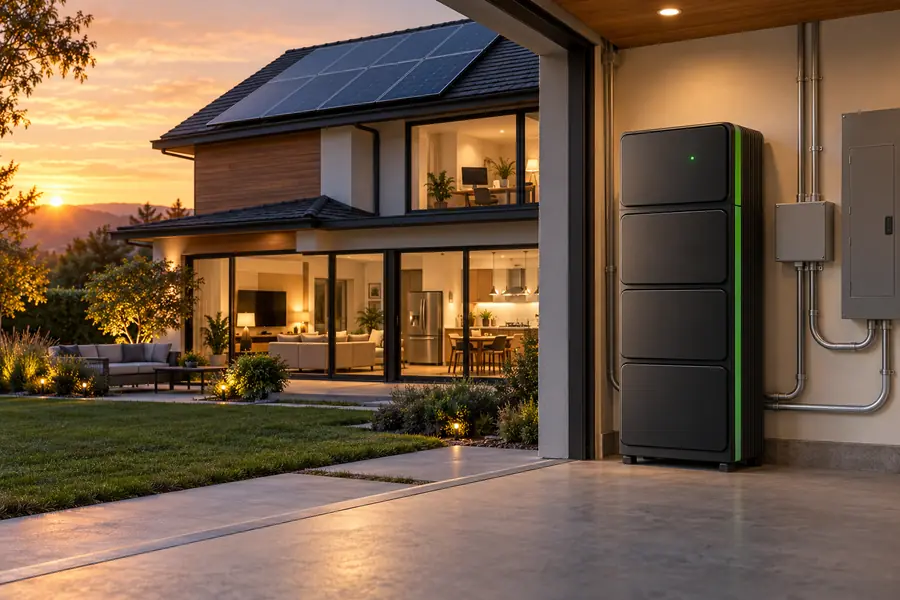
Lithium iron phosphate (LiFePO4 or LFP) is generally the best type of solar battery for residential use. It offers strong thermal stability, long cycle life, high usable capacity, and competitive lifetime costs. Compared with lead-acid and many NMC batteries, LiFePO4 is well suited to daily solar energy storage, home backup, and residential energy independence.
I believe homeowners should focus on battery performance over its full service life rather than the lowest initial price. A good residential solar battery must store excess solar electricity, provide stable power at night, and support essential household loads during grid outages. Battery chemistry matters, but capacity, inverter compatibility, warranties, and installation quality are equally important.
Which Solar Battery Chemistry Is Best for Home Use?
Residential solar batteries use several technologies, including lithium iron phosphate, nickel manganese cobalt, and lead-acid batteries. Each chemistry has different performance characteristics and costs.
LiFePO4 is the best all-around solar battery chemistry for most homes because it combines long cycle life, thermal stability, and cost efficiency. NMC batteries provide higher energy density when installation space is limited, while lead-acid batteries may suit low-budget applications with infrequent use.
Why Are LiFePO4 Batteries Popular for Residential Solar Storage?
Lithium iron phosphate batteries belong to the lithium-ion battery family.
Their cathode materials contain lithium, iron, and phosphate. This chemical structure provides relatively strong thermal stability compared with many nickel-rich lithium-ion batteries.
I consider this an important advantage because residential batteries are often installed in garages, utility areas, or approved outdoor locations.
According to the International Energy Agency's Global Energy Review 2026, LFP batteries accounted for approximately 90% of global stationary battery storage deployments in 2025.
The main advantages of LiFePO4 batteries include:
- Long cycle life: Many well-designed LFP batteries support thousands of charge and discharge cycles.
- Thermal stability: LFP chemistry generally offers a lower thermal runaway risk than nickel-rich lithium-ion chemistries.
- High usable capacity: Many residential systems allow a high depth of discharge within approved operating limits.
- Low maintenance: Integrated battery management systems monitor operating conditions.
- Competitive lifecycle costs: Long service life can reduce the cost per unit of electricity delivered over time.
- Modular configurations: Many home battery systems support capacity expansion.
I also value the fact that LFP batteries do not require nickel or cobalt in their cathode materials.
However, LFP batteries are not completely free from safety risks. Incorrect installation, physical damage, poor electrical protection, and unsuitable operating temperatures can still cause failures.
Are Lithium-Ion and LiFePO4 Batteries Different?
LiFePO4 is a specific type of lithium-ion battery.
The term lithium-ion battery describes a family of rechargeable batteries rather than one chemical composition.
Two widely discussed cathode chemistries are LFP and NMC.
NMC batteries use nickel, manganese, and cobalt in the cathode. They generally provide higher energy density, allowing more energy to fit into a smaller or lighter battery.
For a stationary home battery, however, weight is usually less important than cost, service life, and safe operation.
I would normally select LFP for a new residential solar storage project unless another chemistry offered a clear advantage for the installation.
How Do LiFePO4, NMC, and Lead-Acid Batteries Compare?
Battery chemistry affects how much energy a system stores, how often it can cycle, and how much maintenance it requires. Buyers need to understand these differences before selecting a residential battery.
LiFePO4 batteries generally provide the best balance of safety, lifespan, and operating cost for residential solar storage. NMC batteries offer higher energy density, while lead-acid batteries have lower initial equipment costs but typically shorter cycle life, lower usable capacity, and higher maintenance requirements.
Comparison of Residential Solar Battery Types
| Feature | LiFePO4 (LFP) | NMC Lithium-Ion | Lead-Acid |
|---|---|---|---|
| Thermal stability | Generally high | Lower than LFP | Different safety risks |
| Cycle life | Typically long | Moderate to long | Generally shorter |
| Energy density | Moderate | High | Low |
| Usable capacity | Often high | Often high | More limited in routine use |
| Maintenance | Low | Low | Varies; flooded types need more |
| Initial equipment cost | Moderate | Moderate to high | Often lower |
| Lifecycle value | Usually strong | Application-dependent | Often lower for daily cycling |
| Best application | Daily home solar storage | Space-limited systems | Budget or occasional backup |
These are general chemistry comparisons. Performance varies by cell design, battery management, operating conditions, and product quality.
Why Does Battery Cycle Life Matter?
Battery cycle life measures how many charge and discharge cycles a battery can complete before reaching a specified remaining capacity.
A battery rated for 6,000 cycles does not necessarily stop operating after its 6,000th cycle.
Instead, the rating normally refers to a defined capacity-retention threshold under specific testing conditions.
For example, some LFP batteries are designed for 3,000–6,000 or more cycles, while certain products claim significantly higher values.
I would not compare two cycle-life ratings without checking the test conditions.
A complete specification should explain:
- Depth of discharge during testing
- Charging and discharging current
- Operating temperature
- End-of-life capacity threshold
- Cycle-count methodology
A battery cycled once each day would complete approximately 3,650 cycles in ten years.
However, that does not mean every battery rated for 4,000 cycles will last longer than ten years. Calendar aging, temperature, and other operating conditions also affect battery life.
Are Lead-Acid Batteries Still Worth Buying?
Lead-acid batteries remain available for solar systems, especially in some remote and budget-sensitive installations.
They usually cost less upfront than lithium-based alternatives.
However, traditional lead-acid batteries are heavier and generally provide fewer cycles under daily deep-discharge conditions.
Flooded lead-acid batteries also require suitable ventilation and periodic maintenance.
I would consider lead-acid technology mainly when the initial budget is highly restricted or an existing system is specifically designed for it.
For most new grid-connected residential solar installations, I would give LiFePO4 batteries greater priority because of their long-term performance advantages.
How Long Do LiFePO4 Solar Batteries Last in Residential Systems?
Solar batteries experience repeated charging and discharging. Over time, chemical aging gradually reduces their energy storage capacity, even when the system operates correctly.
A quality LiFePO4 solar battery can often provide around 10–15 years of residential service, although actual lifespan varies by product and use. Many LFP cells are rated for thousands of cycles. Temperature, depth of discharge, charging rate, calendar aging, and battery management determine real-world longevity.
What Affects Solar Battery Lifespan?
I evaluate battery lifespan through both cycle aging and calendar aging.
Cycle aging occurs as the battery charges and discharges.
Calendar aging occurs over time, even when the battery is not used frequently.
Several operating conditions influence both processes.
1. Depth of Discharge
Depth of discharge, or DoD, describes how much stored energy is removed from the battery.
For example, an 80% DoD means the battery has discharged 80% of its reference capacity.
Deep cycling can increase battery wear, depending on the chemistry and operating conditions.
I would follow the battery manufacturer's approved DoD range rather than assume every LFP battery should be completely discharged every day.
2. Battery Temperature
High temperatures can accelerate battery degradation.
Low temperatures can reduce available power and limit charging performance.
Many LFP battery systems restrict charging below approximately 0°C unless they include appropriate temperature management or heating.
I would always check the permitted charging and discharging temperature ranges.
3. Battery Management System
The BMS monitors battery operation and provides important protection functions.
These can include overvoltage protection, undervoltage protection, temperature monitoring, overcurrent protection, and cell balancing.
A properly designed BMS helps maintain stable battery operation.
4. Charging and Discharging Rate
High charging or discharging currents can increase electrical and thermal stress.
I would verify that the battery supports the intended solar inverter power and household load.
How Do Battery Warranties Compare With Cycle-Life Claims?
A battery warranty is not the same as a theoretical cycle-life rating.
Many residential battery manufacturers provide warranties of approximately 10 years, although individual products vary.
Warranties can include capacity-retention guarantees, operating conditions, and total energy throughput limits.
For example, a warranty may specify that the battery retains at least a certain percentage of its initial usable capacity after a defined number of years or amount of energy delivered.
I would review the warranty terms carefully.
A battery advertised as supporting 6,000 cycles may not have a warranty that guarantees 6,000 full cycles under every operating condition.
For long-term solar energy storage, I consider documented warranty coverage and local technical support as important as laboratory cycle-life figures.
How Do I Choose the Right Solar Battery for My Home?
The best battery chemistry is only one part of a successful solar energy storage installation. A battery also needs enough capacity, sufficient power output, and compatibility with the rest of the solar system.
To choose the right residential solar battery, start with a LiFePO4 system and calculate your daily electricity needs. Then compare usable capacity, inverter power, AC or DC coupling, cycle life, certifications, warranty coverage, and installation requirements. The best battery should match your household consumption and solar generation profile.
How Much Solar Battery Capacity Do I Need?
Battery capacity is measured in kilowatt-hours (kWh).
Power output is measured in kilowatts (kW).
I would calculate the battery capacity based on the electrical loads the homeowner wants to support and how long those loads must operate.
For example, a household with an average backup demand of 1 kW would require approximately 10 kWh of delivered electricity for ten hours.
The installed battery would need additional energy allowance for conversion losses and any required operating reserve.
| Residential application | Illustrative battery capacity | Main purpose |
|---|---|---|
| Small essential-load backup | 5–10 kWh | Lighting, internet, refrigeration |
| Typical household solar storage | 10–15 kWh | Evening solar self-consumption |
| Higher-consumption home | 15–30 kWh | Extended household energy use |
| Whole-house backup | 30–40+ kWh | Multiple household circuits and major loads |
| Off-grid residential system | Project-specific | Energy independence and low-sunlight reserve |
These ranges are planning examples, not fixed requirements.
EnergySage's 2026 guidance explains that many residential batteries provide around 10–13.5 kWh of storage per unit, while complete whole-house backup can require multiple batteries.
I would also review how much energy the solar panels generate in winter and during cloudy conditions.
Should I Choose an AC-Coupled or DC-Coupled Battery?
Residential batteries can integrate with solar installations through different electrical architectures.
An AC-coupled battery system connects through an inverter arrangement on the AC side of the electrical system.
This approach can be useful when adding storage to an existing solar installation.
A DC-coupled configuration connects solar production and battery storage through compatible DC-side equipment, often using a hybrid inverter.
It may avoid some conversion steps when charging the battery directly from solar power.
I would choose between these approaches based on the installed inverter, electrical design, backup requirements, and expansion plans.
Neither approach is automatically the best for every house.
What Safety Certifications Should I Check?
Safety should be a major purchasing requirement.
I recommend checking the applicable certifications for the complete energy storage system, not only the battery cells.
| Standard | Main relevance |
|---|---|
| UL 9540 | Safety certification for energy storage systems and equipment |
| UL 9540A | Test method for evaluating thermal runaway fire propagation |
| UL 1973 | Safety requirements for applicable stationary battery products |
| IEC 62619 | Safety requirements for industrial lithium cells and batteries |
| UN 38.3 | Lithium battery transportation testing requirements |
Installation requirements vary by country, region, and local authority.
I would also review the manufacturer's installation instructions, inverter compatibility list, electrical protection requirements, and warranty documentation.
For residential systems, proper installation and complete-system safety validation are essential, even when the batteries use LiFePO4 chemistry.
My Insights: What Is the Best Type of Solar Battery for Residential Use
I consider LiFePO4 the best overall choice for most residential solar energy storage systems because it offers a useful combination of thermal stability, long cycle life, and reasonable lifecycle costs.
However, I would never select a battery based only on its chemistry.
The Best Battery Must Match Daily Household Energy Use
I believe the most important factor is how the homeowner plans to use stored electricity.
Some homes mainly need energy storage for evening electricity consumption.
Others need emergency backup during power outages.
A few homeowners want a system capable of operating independently from the utility grid.
These applications require different battery capacities and inverter configurations.
For a typical grid-connected home, I would start by evaluating a modular LiFePO4 battery in the 10–15 kWh range, then adjust the size using actual household energy data.
For whole-house backup, I would evaluate a larger or expandable system.
System Design Matters as Much as Battery Chemistry
I would also pay attention to the quality of the inverter, BMS, and energy management system.
A high-quality battery cannot deliver reliable whole-house backup if the inverter is undersized or the electrical design lacks proper backup isolation.
I prefer systems with clear technical documentation, suitable monitoring features, and confirmed compatibility between components.
Modular wall-mounted batteries, stacked battery systems, and all-in-one solar energy storage systems can all provide practical residential solutions.
The best physical configuration depends on the available space, required capacity, installation conditions, and future expansion needs.
Long-Term Value Should Guide the Purchase
I do not consider the cheapest battery to be the best value automatically.
I would compare the total installed cost with usable capacity, expected service life, warranty, replacement requirements, and maintenance.
I would also check whether the battery manufacturer or supplier can provide replacement modules and long-term technical support.
For homes with solar panels, a well-matched battery can increase the amount of self-generated electricity used on-site.
However, the financial benefit depends on electricity tariffs, export compensation, system efficiency, and battery costs.
Conclusion
LiFePO4 is my preferred residential solar battery chemistry in 2026. I would select a properly certified LFP system with sufficient usable capacity, compatible inverter power, and dependable warranty support rather than choosing a battery based on brand reputation or low price alone.
](https://voltcrave-battery.com/wp-content/uploads/2026/08/What-Is-a-High-Voltage-LiFePO4-Battery-768x512.webp)
](https://voltcrave-battery.com/wp-content/uploads/2026/10/What-Is-the-Typical-Size-of-a-BESS-Container-768x512.webp)
](https://voltcrave-battery.com/wp-content/uploads/2026/09/Top-5-Applications-of-BESS-Containers-in-Renewable-Energy-Projects-768x512.webp)







































