
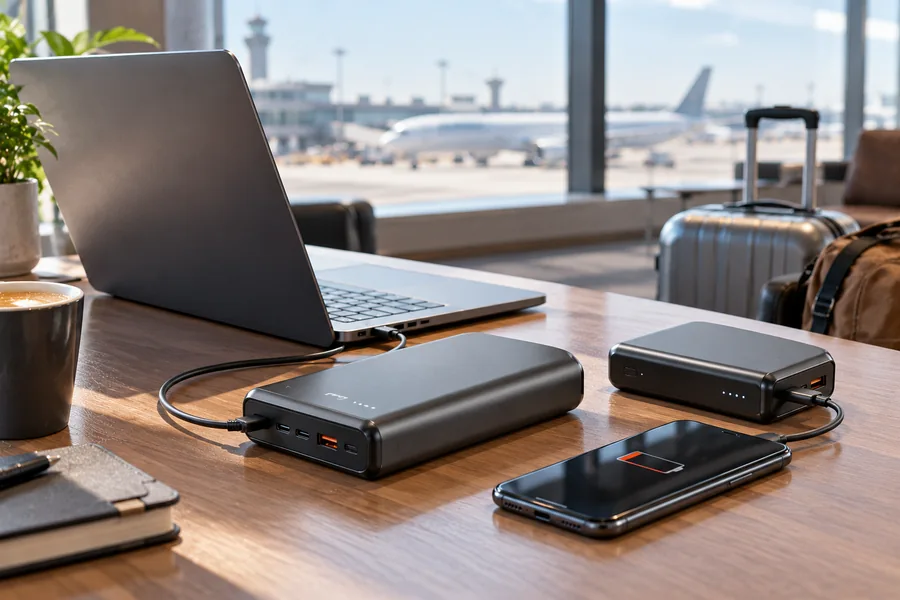
](https://voltcrave-battery.com/wp-content/uploads/2026/10/What-Is-the-Best-Portable-Power-Bank-in-2026.webp)
Running out of battery during travel or work can interrupt communication and productivity. Choosing a power bank with insufficient capacity or output can leave devices charging slowly.
The Anker Prime 26K 300W is one of the best high-performance portable power banks in 2026, offering 26,250mAh capacity and up to 300W combined output. For everyday travel, the Anker 25K 165W is a practical all-around choice, combining 25,000mAh capacity, built-in USB-C cables, and fast laptop charging.
The best portable power bank balances capacity, charging speed, USB-C compatibility, safety, and weight. Choose 10,000–27,000mAh based on devices, daily usage, travel needs, and portability.
Which Portable Power Banks Are the Best Choices in 2026?
Portable power banks now support more than emergency smartphone charging. Many models can recharge tablets, laptops, gaming devices, and several electronics simultaneously.
Among the strongest portable power banks in 2026, the Anker Prime A110A stands out for high output power, while the Anker Laptop Power Bank A1695 offers a useful balance of capacity and convenience. The UGREEN Nexode 25K 200W and INIU P63 25K 100W provide alternative configurations for multi-device charging and portable laptop power.
Anker Prime A110A: Best High-Performance Power Bank
The Anker Prime A110A is a strong option for users who want substantial output power in a portable battery.
It offers:
- 26,250mAh battery capacity
- 99.75Wh rated energy
- 300W maximum combined output
- Up to 140W from a compatible USB-C output
- Two USB-C ports and one USB-A port
- Digital display and app monitoring
- High-power dual-port recharging
Expert Reviews selected the Anker Prime A110A as its best overall power bank in its October 2026 buying guide.
I consider this model particularly suitable for professionals who need to charge laptops and other high-power USB-C devices while traveling.
However, its 300W rating represents combined output across supported ports. It does not mean one USB-C port can continuously deliver 300W.
Its relatively high price and approximately 600g weight may also make it unnecessary for users who only need smartphone charging.
Anker Laptop Power Bank A1695: Best for Everyday Versatility
The Anker Laptop Power Bank A1695 provides 25,000mAh capacity and up to 165W combined output.
Its main advantage is convenience.
The design includes built-in USB-C charging cables, a digital display, and support for multiple connected devices.
WIRED selected this product as its best power bank in its October 2026 recommendations.
I find integrated cables particularly useful for travel because users do not need to carry a separate charging cable for every compatible device.
The product also supports up to 100W through a suitable individual USB-C connection.
This makes it practical for many USB-C laptops, tablets, and smartphones.
UGREEN Nexode and INIU: Alternative High-Capacity Options
The UGREEN Nexode 25,000mAh 200W power bank provides another option for users who want to charge multiple devices.
Its specifications include up to 140W from its primary USB-C port and a digital display for monitoring charging information.
The INIU Cougar P63 offers 25,000mAh capacity and up to 100W output, making it worth considering for users who do not require extremely high combined charging power.
I recommend comparing actual port specifications instead of assuming that every high-capacity power bank delivers the same charging performance.
Comparison of Popular 2026 Power Banks
| Power Bank | Capacity | Maximum Advertised Output | Main Advantage |
|---|---|---|---|
| Anker Prime A110A | 26,250mAh | 300W combined | High-performance multi-device charging |
| Anker Laptop Power Bank A1695 | 25,000mAh | 165W combined | Integrated cables and travel convenience |
| UGREEN Nexode 25K | 25,000mAh | 200W combined | Laptop and multi-device charging |
| INIU Cougar P63 | 25,000mAh | 100W | High-capacity laptop charging |
| Anker Nano 10K | 10,000mAh | 45W | Compact everyday charging |
I do not consider one model the best choice for every user.
For everyday smartphone charging, a smaller 10,000mAh power bank may be more convenient than carrying a high-output laptop battery.
What Battery Capacity Is Best for a Portable Power Bank?
Battery capacity is one of the first specifications buyers compare. However, a larger number printed on a product does not guarantee more useful charging or better portability.
A 10,000mAh power bank is suitable for everyday smartphone backup, while 20,000mAh offers more flexibility for longer trips. A 25,000mAh-class power bank is often better for laptops and multiple devices. The right capacity depends on device battery size, charging efficiency, weight, and the number of expected charging sessions.
Understanding mAh and Wh
Power bank capacity is commonly displayed in milliamp-hours (mAh).
However, mAh alone does not describe the full energy capacity unless the battery voltage is also known.
Watt-hours provide a clearer measure of stored electrical energy.
I use the following formula:
Energy (Wh) = Nominal Battery Voltage (V) × Capacity (Ah)
For example, a 20,000mAh lithium-ion battery rated at 3.7V contains approximately:
3.7V × 20Ah = 74Wh
This value represents nominal stored energy before power conversion losses.
Power banks use internal electronics to convert battery voltage into the voltage required by connected devices.
As a result, the amount of energy delivered to a phone or laptop is usually lower than the battery's nominal capacity.
Comparing Common Battery Capacities
| Nominal Capacity | Approximate Energy at 3.7V | Typical Application |
|---|---|---|
| 5,000mAh | 18.5Wh | Emergency smartphone charging |
| 10,000mAh | 37Wh | Everyday commuting |
| 15,000mAh | 55.5Wh | Longer smartphone use |
| 20,000mAh | 74Wh | Travel and multiple devices |
| 25,000mAh | 92.5Wh | Laptop and tablet charging |
Actual products may use different nominal cell voltages, so their official watt-hour ratings take priority over these estimates.
I prefer comparing watt-hours when evaluating products from different manufacturers.
How Many Times Can a Power Bank Charge a Smartphone?
Charging performance depends on more than nominal battery capacity.
Suppose a smartphone has an approximately 19Wh battery and a power bank contains 74Wh of stored energy.
If the overall energy delivery efficiency is assumed to be 80%, the approximate number of full charges would be:
74Wh × 0.80 ÷ 19Wh = 3.1 charges
This is a simplified estimate.
Actual results depend on charging conditions, battery temperature, device usage, and conversion losses.
I would not assume that a 20,000mAh power bank can recharge every 5,000mAh smartphone four times.
Battery capacities are not necessarily rated at the same voltage, and some energy is lost during charging.
Why Portability Matters
Large-capacity power banks generally contain more battery cells and may be heavier.
A high-output laptop power bank can weigh approximately 600g, while smaller smartphone power banks are often much lighter.
I consider this difference important for commuting, hiking, business travel, and everyday carrying.
The best capacity is not necessarily the maximum available.
It is the amount of stored energy that meets the user's charging requirements without unnecessary weight or expense.
What Features Make a Portable Power Bank Worth Buying in 2026?
A power bank can advertise high capacity while delivering slow charging performance. Modern smartphones and laptops also use different charging standards that affect compatibility.
The best portable power banks in 2026 combine sufficient battery capacity with USB-C Power Delivery, suitable output wattage, efficient charging electronics, and reliable protection systems. Additional features such as integrated cables, battery displays, multiple ports, and fast recharging improve convenience, but they should not replace electrical compatibility or safety.
USB-C Power Delivery and Fast Charging
USB-C Power Delivery allows compatible chargers and devices to negotiate suitable charging voltages and currents.
The supported power level depends on the power bank, cable, and connected device.
A smartphone may require only 20W–45W for fast charging.
Many USB-C laptops benefit from 65W–100W or higher charging capability.
Some high-performance laptops support higher USB-C charging power, depending on their specifications.
I always check the output rating of the individual USB-C port.
A product advertised with 200W total output may distribute that power across several ports rather than delivering it through one connection.
Multiple Ports and Power Distribution
Portable power banks commonly include USB-C and USB-A connections.
Some models support charging several devices at the same time.
However, connecting additional devices can change the maximum output available from each port.
For example, a power bank may provide 100W through one USB-C port when operating alone but distribute its available power differently when two laptops are connected.
I recommend reviewing the manufacturer's multi-port charging table.
This is more useful than comparing only the advertised total output.
Recharge Speed and Charging Efficiency
A portable power bank also needs to recharge its own battery.
Some high-performance models support 100W or higher input power, allowing them to recharge faster with compatible charging equipment.
The Anker Prime 26K 300W, for example, supports up to 250W combined input under specified dual-port charging conditions.
However, this requires suitable high-power charging equipment and cables.
I do not assume that the maximum advertised input power is available with an ordinary phone charger.
Important Power Bank Features
| Feature | Why It Matters |
|---|---|
| USB-C Power Delivery | Supports compatible fast charging |
| Maximum Single-Port Output | Determines device charging capability |
| Combined Output Power | Determines multi-device charging capacity |
| Battery Management System | Helps monitor and protect battery operation |
| Fast Recharge Input | Reduces time spent recharging the power bank |
| Integrated Cables | Improves travel convenience |
| Digital Display | Shows charge level and operating information |
| Thermal Protection | Helps manage overheating risks |
| Warranty and Support | Supports long-term product ownership |
Power Bank vs. Portable Power Station
I also distinguish a USB power bank from a portable power station.
A conventional power bank is designed primarily for small electronic devices using DC charging connections.
A portable power station is generally much larger and may include an AC inverter, household-style outlets, and higher energy capacity.
| Feature | Portable Power Bank | Portable Power Station |
|---|---|---|
| Typical Capacity | Around 20–100Wh | Hundreds or thousands of Wh |
| Main Output | USB-C and USB-A | AC, DC, and USB |
| Typical Use | Phones, tablets, laptops | Camping, appliances, emergency power |
| Portability | Handheld | Carryable or wheeled |
| Air Travel | May qualify within limits | Most larger units exceed airline limits |
For laptops and smartphones, I usually recommend a USB power bank.
For outdoor appliances, extended off-grid operation, or emergency household equipment, a portable power station may be more appropriate.
How Do You Choose a Safe and Reliable Portable Power Bank?
Power banks contain rechargeable batteries that store substantial energy in compact enclosures. Poor manufacturing quality, damaged cells, or inadequate protection can create overheating and fire hazards.
I choose a portable power bank by checking battery capacity, USB-C compatibility, actual output power, documented safety testing, manufacturer support, and product recall status. For air travel, I also verify its rated watt-hours and airline restrictions. A reliable power bank should provide appropriate charging performance without sacrificing battery safety.
Battery Management and Thermal Protection
Lithium-ion batteries require careful management during charging and discharging.
A Battery Management System helps monitor battery conditions and control operation within specified limits.
Important protection functions can include overcurrent, overvoltage, overtemperature, and short-circuit protection.
I consider these functions essential for high-capacity power banks.
However, product descriptions that advertise multiple safety protections do not automatically prove independent certification.
Safety Standards and Certification
ANSI/CAN/UL 2056 is a product safety standard for power banks within its defined scope.
The June 2026 revision includes requirements related to battery safety, electrical tests, thermal behavior, and abnormal charging conditions.
I recommend checking whether a product has verifiable certification for its intended market.
A manufacturer's claim of compliance is not always equivalent to certification by an independent testing organization.
I also check product model numbers against official recall databases.
For example, the U.S. Consumer Product Safety Commission announced recalls of specific Anker power bank models in 2025 because of overheating and fire hazards.
These recalls do not mean every Anker power bank is affected.
They demonstrate why buyers should verify the exact model and serial number rather than relying only on brand reputation.
Can You Take a Power Bank on an Airplane?
Airline battery restrictions are especially important for high-capacity portable chargers.
Under U.S. FAA guidance, spare lithium-ion batteries, including power banks, must be transported in carry-on baggage rather than checked luggage.
| Rated Battery Energy | General FAA Guidance |
|---|---|
| Up to 100Wh | Generally permitted in carry-on baggage |
| Above 100Wh up to 160Wh | Airline approval required; quantity restrictions apply |
| Above 160Wh | Not permitted as ordinary passenger spare batteries |
Airlines and other countries may impose stricter limits.
I recommend checking the actual watt-hour rating printed on the battery and reviewing the airline's current requirements before departure.
A 25,000mAh-class power bank may remain below 100Wh, depending on its nominal battery voltage.
However, capacity expressed in mAh does not independently establish air-travel eligibility.
Evaluate Price and Long-Term Value
I compare power banks based on usable energy, charging capability, convenience, warranty support, and manufacturing quality.
A lower-cost power bank may be appropriate for occasional smartphone charging.
However, frequent travelers who rely on laptop charging may benefit from a higher-power model with integrated cables and detailed battery information.
I do not believe the most expensive power bank automatically provides the best value.
The better choice is the model that matches the user's charging requirements while providing dependable electrical and safety performance.
My Insights: What Is the Best Portable Power Bank in 2026
Choosing a portable power bank based only on battery capacity can lead to unnecessary weight, slower charging, and higher costs. The most powerful model is not always the most practical.
I believe the best portable power bank in 2026 is the one that balances usable battery energy, charging power, portability, and safety. The Anker Prime 26K 300W is a strong high-performance choice, while the Anker 25K 165W offers better everyday convenience for many travelers. Smaller 10,000mAh models may be more suitable for smartphone-only use.
I Prioritize Usable Energy Over Advertised Capacity
I always distinguish between nominal battery capacity and the electrical energy delivered to a connected device.
A 25,000mAh battery does not necessarily provide 25,000mAh of usable output at the voltage required by a smartphone.
Conversion losses and charging conditions affect the final result.
I prefer comparing products using their official watt-hour ratings and realistic charging performance.
This provides a better understanding of how much energy the user can actually expect.
Charging Compatibility Is More Important Than Maximum Wattage
I do not consider a 300W power bank automatically superior to a 100W model.
If a laptop accepts only 65W charging, a properly designed 100W USB-C power bank may already meet its needs.
Additional output capability becomes more useful when charging several devices simultaneously.
I therefore compare four factors:
Battery Capacity → Single-Port Power → Device Compatibility → Charging Efficiency
This approach helps avoid paying for output specifications that the user's devices cannot use.
Portability Determines Everyday Convenience
I believe weight and cable management are often underestimated.
A large power bank may offer impressive specifications but become inconvenient when carried every day.
For frequent travel, integrated USB-C cables and a readable battery display can provide practical benefits.
For short commutes, a compact 10,000mAh battery may be easier to carry and sufficient for the intended charging period.
I would choose the product according to actual daily use instead of selecting the largest battery available.
Safety Should Remain a Primary Selection Factor
I also believe that battery safety deserves the same attention as charging speed.
Power banks combine high-energy lithium-ion cells with compact electronic circuits.
Manufacturing quality, battery management, thermal protection, and proper charging equipment all matter.
I recommend choosing products with traceable manufacturers, suitable technical documentation, credible safety certification, and clear warranty support.
I would also check current recall notices before purchasing or continuing to use an older power bank.
Ultimately, I believe the best portable power bank in 2026 is not defined by a single capacity or wattage figure. It is the model that delivers dependable charging for the user's actual devices, with suitable portability and verified safety.
Conclusion
The best power bank in 2026 balances capacity, USB-C charging performance, portability, and safety. Choose high-output models for laptops and compact batteries for everyday smartphones.
](https://voltcrave-battery.com/wp-content/uploads/2026/10/Can-I-Upgrade-My-E-Bike-Battery-768x512.webp)
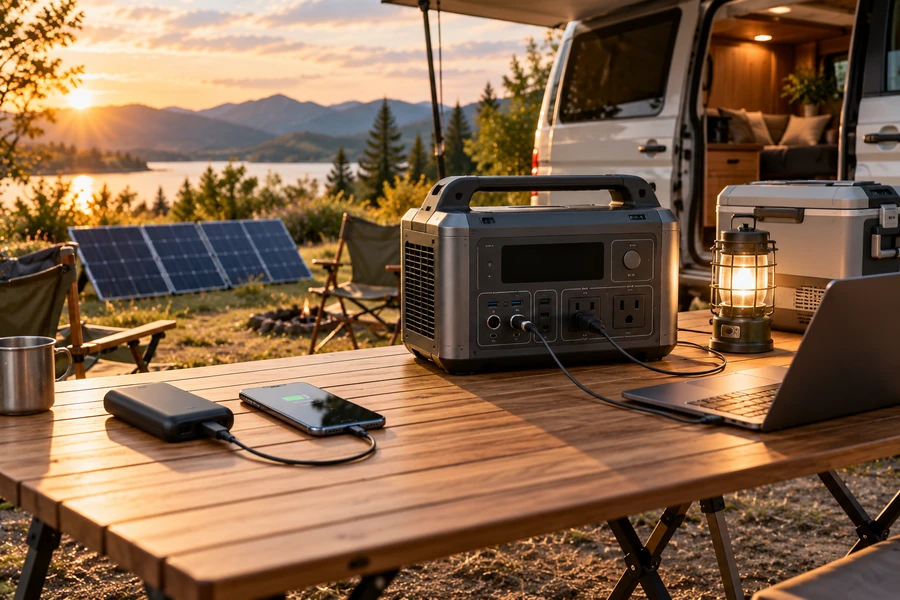](https://voltcrave-battery.com/wp-content/uploads/2026/10/Which-Is-Better-a-Powerbank-or-a-Power-Station-768x512.webp)
](https://voltcrave-battery.com/wp-content/uploads/2026/06/Why-Do-You-Need-Large-Scale-Energy-Storage-in-Power-Grid-768x512.jpg)







































