
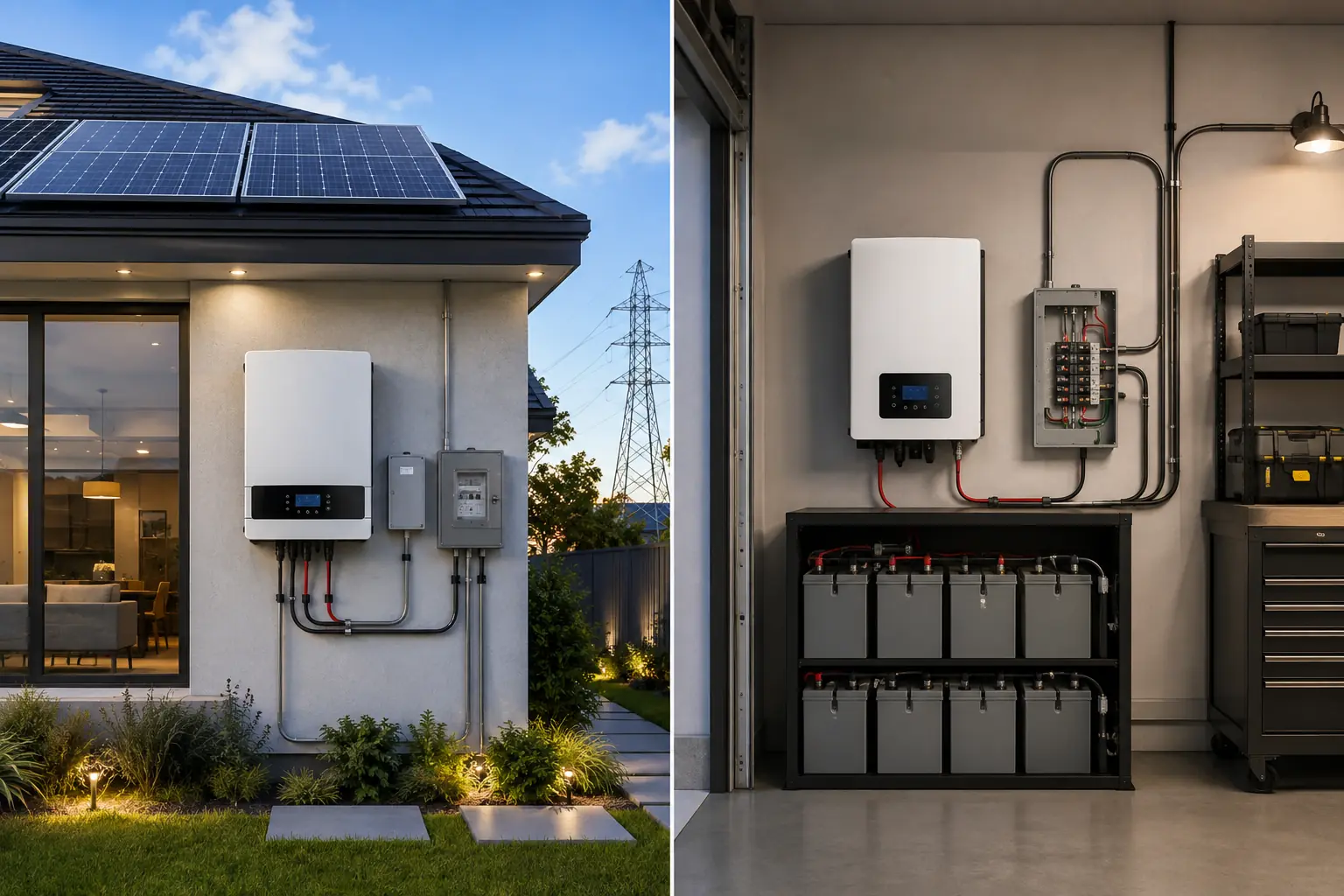
](https://voltcrave-battery.com/wp-content/uploads/2026/10/Is-Whole-House-Battery-Backup-Worth-It.webp)
Power outages can disrupt heating, refrigeration, internet access, and daily life. Whole-house battery systems offer protection, but their high installation costs make the investment difficult to evaluate.
Whole-house battery backup is worth it for homeowners who face frequent outages, need reliable electricity, or can benefit from solar energy storage and time-of-use electricity rates. However, systems often cost $24,000–$40,000 or more in the United States. Their financial value depends on electricity savings, outage protection, battery lifespan, and installation costs.
Whole-house battery backup improves outage resilience, solar utilization, and potential electricity savings. Proper sizing and generator integration enhance reliability, even when financial payback remains uncertain.
What Are the Main Benefits of Whole-House Battery Backup?
Power outages can interrupt household appliances, home offices, communication equipment, and heating or cooling systems. Conventional generators provide backup electricity, but they require fuel and regular maintenance.
Whole-house battery backup offers several benefits, including quiet electricity during outages, automatic backup operation, solar energy storage, and potential electricity bill savings. A properly designed system can support multiple household circuits without burning fuel during battery discharge. Its value is especially significant in areas with unreliable grid electricity or expensive peak electricity rates.
Reliable Electricity During Power Outages
I consider backup reliability the main reason homeowners invest in residential battery energy storage systems.
A properly configured whole-house battery can detect a grid outage and supply electricity to the home's protected electrical system.
Depending on its capacity and inverter output, it may support refrigeration, lighting, internet equipment, heating controls, water pumps, and selected larger appliances.
However, I distinguish between supporting the complete electrical panel and providing unlimited electricity to every appliance.
A system may connect to the entire home but still require load management when electrical demand becomes too high.
The battery must have enough stored energy and continuous output power for the intended appliances.
Quiet Operation and Lower Maintenance
Battery storage systems generally operate more quietly than fuel-powered generators.
They do not use combustion engines to produce electricity.
Instead, they release previously stored electrical energy through an inverter.
I consider this useful for residential areas where generator noise can disturb occupants and neighbors.
Battery discharge also produces no on-site combustion exhaust.
However, battery systems are not completely maintenance-free.
They still require proper installation, monitoring, suitable environmental conditions, and manufacturer-approved servicing.
Better Solar Energy Utilization
Homeowners with rooftop solar panels may generate more electricity during daylight hours than they consume immediately.
A compatible battery system can store part of this surplus electricity.
The household can then use stored energy during the evening or when grid electricity becomes more expensive.
I consider this particularly useful when the utility provides relatively low compensation for exported solar electricity.
However, actual savings depend on the local electricity tariff and the amount of solar energy available for storage.
Energy Independence and Grid Resilience
Whole-house battery backup can reduce dependence on the utility grid during short outages.
When paired with backup-capable solar equipment, it may also recharge during a daytime outage.
I do not consider battery storage equivalent to complete energy independence.
The system still needs an energy source for recharging.
Without solar generation or another compatible source, the available backup duration is limited by stored energy.
Main Advantages and Limitations
| Feature | Main Benefit | Important Limitation |
|---|---|---|
| Emergency backup | Keeps household loads operating | Limited stored energy |
| Quiet operation | Reduced operating noise | Cooling equipment may still produce sound |
| Solar integration | Stores excess solar electricity | Depends on solar generation |
| Time-of-use control | Potential bill savings | Depends on electricity tariffs |
| Automatic backup | Convenient outage response | Requires approved switching equipment |
| Modular expansion | May support future capacity growth | Compatibility and expansion limits apply |
I believe these benefits make battery backup attractive for many homeowners, but they do not automatically justify the cost for every household.
How Much Does Whole-House Battery Backup Cost, and Will It Pay for Itself?
The initial price is one of the largest barriers to residential energy storage. Homeowners may spend thousands of dollars on equipment that operates only occasionally during emergencies.
Whole-house battery backup commonly costs approximately $24,000–$40,000 for a two- or three-battery installation in the United States. A typical installed 13.5 kWh home battery costs around $15,650 in 2026. Financial payback depends on electricity price differences, solar self-consumption, available incentives, and the value of backup protection.
Average Home Battery Installation Costs in 2026
EnergySage's 2026 marketplace research provides useful U.S. price estimates.
| Backup Configuration | Indicative Installed Cost |
|---|---|
| Essential-load backup, 10–13.5 kWh | $5,000–$18,000 |
| Typical 13.5 kWh battery installation | Approximately $15,650 |
| Whole-house backup, often 2–3 batteries | $24,000–$40,000 |
| Larger extended-duration backup | Depends on capacity and installation |
| Typical installed standby generator | Approximately $7,000 |
These figures represent general market estimates rather than guaranteed installation prices.
I recommend comparing detailed quotations that include battery hardware, inverter equipment, backup switching, labor, permits, and any required electrical upgrades.
A lower battery price does not necessarily mean a lower total installation cost.
Can Whole-House Batteries Save Money on Electricity?
Some utilities charge different electricity rates depending on the time of day.
A home battery can store electricity during lower-cost periods and discharge during more expensive periods.
This is called time-of-use energy management.
I evaluate potential savings using the difference between charging costs and avoided peak electricity purchases.
Consider a simplified example:
- Off-peak electricity rate: $0.15/kWh
- Peak electricity rate: $0.35/kWh
- AC energy delivered from the battery: 10 kWh
- Assumed round-trip efficiency: 90%
The grid electricity required to recharge the battery is:
10 kWh ÷ 0.90 = 11.11 kWh
Charging cost:
11.11 kWh × $0.15 = $1.67
Value of avoided peak electricity:
10 kWh × $0.35 = $3.50
Estimated gross savings per cycle:
$3.50 − $1.67 = $1.83
If the system achieves this result every day:
$1.83 × 365 = approximately $668 per year
This estimate excludes battery degradation, financing, maintenance, changing electricity tariffs, and other costs.
I would not assume the system can perform a profitable full cycle every day while also maintaining sufficient emergency reserves.
How Long Does It Take to Recover the Investment?
I calculate simple payback using:
Simple Payback Period = Net Installation Cost ÷ Annual Net Savings
For example, if a battery costs $15,650 and generates $668 in annual savings:
$15,650 ÷ $668 = approximately 23.4 years
This is a simplified scenario rather than a forecast.
It also illustrates why a battery purchased only for time-of-use savings may not recover its cost during a typical warranty period.
Other households may have better economics because of higher electricity price differences, solar self-consumption, or additional incentives.
Solar Self-Consumption Can Improve Economics
I consider the value of stored solar electricity important.
Without a battery, some homeowners export excess solar generation to the utility.
If export compensation is low, storing electricity for evening consumption may be more valuable.
However, the result depends on the utility's export compensation rules, battery efficiency, and daily energy consumption.
A system with solar panels may provide stronger economic benefits than a grid-charged battery used only for electricity price shifting.
Are Battery Incentives Available in 2026?
In the United States, the federal Residential Clean Energy Credit under Section 25D ended for new qualifying residential installations after December 31, 2025.
Therefore, homeowners installing new residential battery systems in 2026 generally cannot claim the former federal 30% credit for that installation.
I would still check state, local, and utility incentive programs.
For example, California's Self-Generation Incentive Program (SGIP) supports qualifying energy storage installations.
However, program eligibility, funding availability, and reservation status vary.
Some utilities also offer virtual power plant programs that compensate homeowners for allowing eligible batteries to support the grid.
I recommend confirming program terms before including these payments in a financial estimate.
How Long Can a Whole-House Battery Power Your Home During an Outage?
Battery storage capacity determines how much energy is available, but household demand determines how quickly that energy is consumed. A system that supports essential appliances for many hours may operate for much less time when powering air conditioning or electric heating.
Whole-house battery backup duration depends on usable capacity and average household electricity consumption. A 30 kWh battery system delivering 80% of its rated capacity as AC electricity could theoretically power a constant 1 kW load for 24 hours or a 2 kW load for 12 hours without recharging. Actual runtime depends on operating conditions and connected appliances.
Understand Battery Capacity and Power Output
I distinguish between two electrical measurements.
Kilowatt-hours (kWh) measure the amount of energy stored.
Kilowatts (kW) measure the rate at which electrical power is delivered.
A 30 kWh battery may store enough energy for a full day of modest household consumption.
However, if the inverter has a continuous output limit of 5 kW, the system cannot independently supply a sustained 8 kW load.
I always check both storage capacity and inverter output before evaluating whole-house backup.
Estimated Backup Runtime
The following table assumes 80% of the nominal battery capacity becomes available as AC electricity.
| Battery Capacity | 1 kW Average Load | 2 kW Average Load |
|---|---|---|
| 10 kWh | 8 hours | 4 hours |
| 13.5 kWh | 10.8 hours | 5.4 hours |
| 20 kWh | 16 hours | 8 hours |
| 30 kWh | 24 hours | 12 hours |
| 40 kWh | 32 hours | 16 hours |
| 60 kWh | 48 hours | 24 hours |
These are simplified estimates with constant loads and no solar recharging.
Actual available energy depends on battery condition, state of charge, temperature, operating reserves, and system efficiency.
How Many Batteries Does a Typical Home Need?
I begin by reviewing the household's electricity bills or smart meter data.
Suppose a home consumes 900 kWh per month.
Average daily consumption would be:
900 kWh ÷ 30 days = 30 kWh per day
If the homeowner wants to maintain this level of consumption during a 24-hour outage, the system must deliver approximately 30 kWh of AC electricity.
Assuming 90% usable discharge capacity and 90% delivery efficiency:
Required Nominal Capacity = 30 ÷ (0.90 × 0.90)
Required Nominal Capacity = approximately 37 kWh
This suggests that approximately 40 kWh of nominal battery storage could be a reasonable initial planning point.
However, the final system may require additional capacity to handle unexpected demand or longer outages.
Essential Backup vs. Whole-House Backup
I believe homeowners should decide whether unrestricted whole-house operation is necessary.
Essential-load backup usually focuses on selected circuits.
Whole-house backup may also support central air conditioning, heating equipment, kitchen appliances, and water pumps.
| Appliance Category | Typical Backup Priority |
|---|---|
| Refrigerator and freezer | High |
| Internet and communications | High |
| Essential lighting | High |
| Required medical equipment | High, with verified power requirements |
| Heating or cooling | Depends on climate and household needs |
| Electric water heater | Often manageable or postponable |
| Electric clothes dryer | Usually postponable |
| EV charging | Usually postponable during outages |
I recommend calculating the energy consumption and starting requirements of essential equipment before selecting the battery system.
Load management can reduce the amount of storage needed.
Can Solar Panels Extend Backup Duration?
Yes. A compatible solar-plus-battery system can recharge during daylight hours while the utility grid is unavailable.
However, this requires a backup-capable inverter and suitable electrical isolation equipment.
Solar generation depends on sunlight, weather, shading, and system capacity.
I would not assume that a solar battery system can provide unlimited electricity during prolonged cloudy conditions.
For extended outages, I also consider whether a compatible generator or other recharging source is necessary.
Is Whole-House Battery Backup Better Than a Generator or Partial Backup System?
Whole-house batteries provide quiet electricity and can support daily energy management. However, generators may operate for longer periods when fuel is available, and partial backup systems often cost substantially less.
Whole-house battery backup is often preferable for quiet operation, automatic backup, solar integration, and daily electricity management. Standby generators may offer better value for prolonged outages with high electrical loads, while partial battery backup can be more economical for essential appliances. The best solution depends on outage duration, household demand, budget, and available energy sources.
Whole-House Battery vs. Standby Generator
A standby generator converts fuel into electrical energy.
It may operate for extended periods when suitable fuel remains available.
This can be useful during multi-day outages, especially when heating or cooling demand is high.
I consider generators practical for homes that require substantial electricity during severe weather.
However, they produce combustion exhaust and require maintenance.
Battery systems provide stored electricity without running a fuel-powered engine.
This reduces noise and removes on-site combustion exhaust during discharge.
Battery vs. Generator Comparison
| Feature | Whole-House Battery | Standby Generator |
|---|---|---|
| Main energy source | Stored electricity | Natural gas, propane, or diesel |
| Operating noise | Generally low | Higher |
| On-site exhaust | None during discharge | Yes |
| Routine maintenance | Generally lower | Regular engine maintenance |
| Energy duration | Limited by storage and recharge | Limited by fuel and operation |
| Solar integration | Possible with compatible system | Requires additional equipment |
| Daily electricity savings | Possible | Usually limited |
| Initial cost | Often higher | Often lower |
| Backup transfer | Equipment-dependent | Equipment-dependent |
I would not describe either option as universally superior.
A generator can be more economical when electricity is needed for several days.
A battery may provide greater everyday value when it also supports solar energy use and time-of-use management.
Is Partial Battery Backup More Cost-Effective?
I believe partial battery backup deserves consideration before committing to a large whole-house installation.
A smaller system may support refrigeration, communication, lighting, and essential outlets.
If the household can safely postpone high-power appliances during an outage, full electrical-panel backup may not be necessary.
For example, a 10–15 kWh battery may provide useful backup for selected low-energy appliances.
A larger system may be required to support air conditioning or electric heating.
I recommend comparing the additional installed cost of whole-house backup against the actual benefit of keeping nonessential appliances available.
When Does a Hybrid System Make Sense?
A hybrid backup system combines batteries with compatible generators or solar generation.
The battery supplies electricity during shorter outages or lower-demand periods.
A generator can provide additional energy during extended outages when designed to work with the backup system.
I see this as a useful option for areas where severe weather can interrupt the grid for several days.
However, generator integration is not universally supported by home batteries.
The inverter, transfer system, and charging equipment must be approved for the intended configuration.
Safety and Installation Requirements
I consider complete system certification essential.
For North American residential storage, UL 9540 is an important safety standard for energy storage systems.
UL 1973 applies to batteries used in stationary and certain other applications.
UL 9540A evaluates thermal runaway and fire propagation behavior.
These standards have different purposes.
A UL 9540A test report alone does not establish that a complete installation is certified to UL 9540.
The installation must also follow applicable electrical, building, and fire safety requirements.
I recommend using qualified installers and confirming equipment compatibility before purchasing.
My Insights: Is Whole House Battery Backup Worth It
Whole-house battery backup promises greater energy security, but the high installation cost can be difficult to justify. Focusing only on potential bill savings overlooks important benefits and limitations.
I believe whole-house battery backup is worth considering when reliable electricity has substantial practical value. Frequent outages, valuable home-based work, essential equipment, and suitable electricity tariffs can strengthen the investment. However, I would not recommend a large battery system solely for financial savings without first evaluating actual energy consumption, local rates, installation costs, and alternative backup options.
I Separate Financial Return From Backup Value
I believe the most important distinction is between direct financial savings and outage protection.
Electricity bill savings can be estimated using utility tariffs, battery efficiency, and expected charging schedules.
Backup value is different.
It may include avoiding spoiled food, business interruptions, or the inconvenience of losing refrigeration, communications, and essential household services.
Some benefits are difficult to express as a fixed dollar amount.
I would therefore not describe every whole-house battery as a financial investment that must pay for itself through electricity savings.
For some homeowners, dependable backup electricity is itself a major benefit.
I Prefer Right-Sized Systems Over Maximum Capacity
I do not believe every home needs enough batteries to operate all appliances during an extended outage.
For many households, protecting essential circuits provides most of the practical benefit at a lower cost.
I recommend identifying the appliances that must continue operating and calculating their actual electricity demand.
A smaller system may provide enough backup energy when paired with sensible load management.
Larger systems become more appropriate when the home requires continuous climate control, water pumping, or other high-power services.
I evaluate battery sizing through five connected factors:
Household Load → Peak Power → Required Runtime → Battery Capacity → Recharging Availability
This approach helps avoid overspending on unnecessary capacity.
Local Electricity Tariffs Can Change the Economics
I consider electricity pricing one of the most important financial factors.
A battery can provide greater savings when the difference between off-peak and peak electricity rates is substantial.
Solar self-consumption can also improve the economics when exported solar electricity receives relatively low compensation.
However, a household with flat electricity rates and reliable grid service may receive limited direct financial benefit.
I would calculate annual savings using the homeowner's actual utility tariff rather than a national average.
Long-Term Reliability Requires More Than Battery Chemistry
Modern LiFePO4 batteries offer attractive cycling durability and thermal stability.
However, I do not judge long-term reliability by chemistry alone.
The Battery Management System, inverter, electrical protection, thermal management, warranty, and manufacturer support all matter.
I also consider modular expansion useful because household electricity demand may increase over time.
For example, a future heat pump or electric vehicle could change energy requirements.
A compatible expandable battery system may provide greater flexibility than one with fixed storage capacity.
My Recommended Decision Framework
Before purchasing whole-house battery backup, I would answer five questions:
- How often does the home experience outages, and how long do they last?
- Which appliances must operate during an outage?
- How much usable battery energy and inverter power are required?
- Can solar generation, time-of-use savings, or incentives improve the investment?
- Would essential-load backup or a generator provide better value?
I would compare the complete installed cost and expected operating performance rather than selecting a system based only on advertised battery capacity.
For a home with frequent outages and suitable solar energy conditions, a whole-house battery may provide meaningful long-term benefits.
For a home with reliable electricity and low energy costs, a smaller backup system may be a more reasonable investment.
Ultimately, I believe whole-house battery backup is worth it when its reliability, energy management, and practical benefits justify the total installed cost—not simply because the technology is available.
Conclusion
Whole-house battery backup can be worthwhile for outage protection and energy management, but its value depends on installation costs, household demand, electricity tariffs, and backup requirements.
](https://voltcrave-battery.com/wp-content/uploads/2026/09/Everything-You-Need-to-Know-About-BESS-Containers-in-2026-768x512.webp)
](https://voltcrave-battery.com/wp-content/uploads/2026/09/Top-10-Household-Consumer-Dry-Battery-and-Power-Supply-Suppliers-in-the-United-States-768x512.webp)
](https://voltcrave-battery.com/wp-content/uploads/2026/08/Which-Is-Better-a-Solar-Inverter-or-a-Regular-Inverter-768x512.webp)







































