

](https://voltcrave-battery.com/wp-content/uploads/2026/08/What-Are-BESS-Containers-Used-For.webp)
Large energy users and power grids need substantial battery capacity, but installing thousands of individual batteries separately would make deployment, cooling, protection, and maintenance unnecessarily complex.
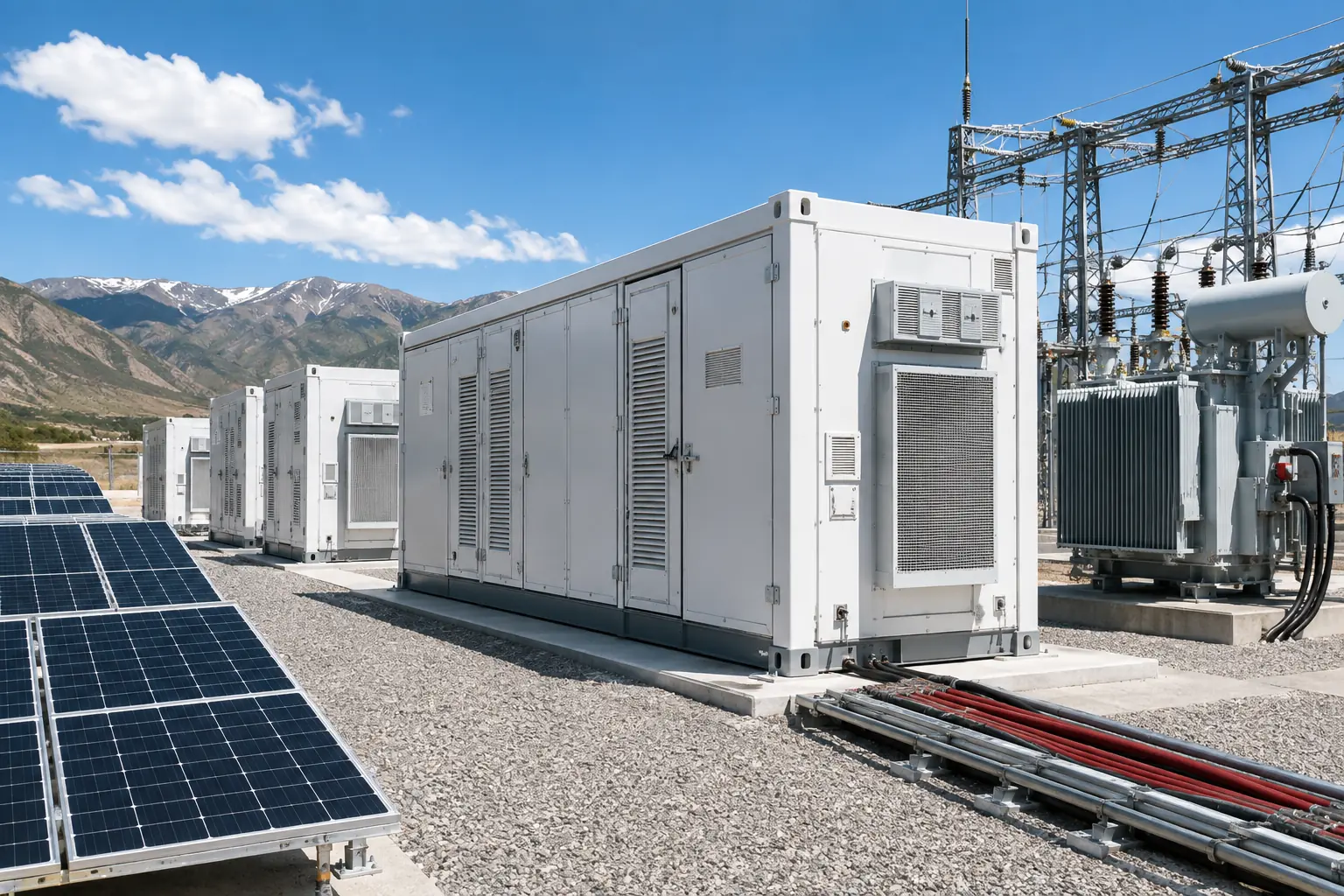
BESS containers are used to store large amounts of electricity in a modular, transportable enclosure for applications such as renewable-energy integration, peak shaving, backup power, microgrids, grid stabilization, energy arbitrage, EV charging support, and industrial energy management. A container typically integrates battery racks with monitoring, thermal management, electrical protection, and fire-safety systems.
I think of a BESS container as a prefabricated energy-storage building block. Instead of constructing a custom battery room around every project, manufacturers can integrate major battery subsystems into standardized outdoor enclosures and deploy multiple units to reach the required MW and MWh. This makes containerized architecture particularly useful for commercial, industrial, renewable-energy, microgrid, and utility-scale projects.
What Is a BESS Container?
A BESS container is much more than a shipping container filled with batteries. It is an engineered electrical and thermal enclosure designed around a large stationary battery system.
A BESS container is a containerized battery energy storage system that houses battery racks and supporting equipment inside a factory-integrated enclosure. Depending on the design, it may contain the batteries, BMS, thermal-management equipment, fire detection and protection, electrical distribution, controls, communications, and auxiliary systems needed to operate the battery safely.
What Is Inside a BESS Container?
A typical containerized system may include:
| Component | Main Function |
|---|---|
| Battery cells | Store electrical energy |
| Battery modules | Group cells into manageable units |
| Battery racks | Organize modules into larger strings |
| BMS | Monitors and protects batteries |
| Cooling system | Controls cell and rack temperature |
| Fire detection | Detects smoke, heat, gas, or abnormal conditions |
| Fire-protection system | Helps manage abnormal thermal events |
| DC distribution | Connects battery strings electrically |
| Sensors | Monitor temperature, voltage, current, and environment |
| Communications | Connect BMS and site controllers |
| Auxiliary power | Powers controls, cooling, and monitoring |
| EMS interface | Coordinates charge/discharge commands |
CATL's EnerC containerized system, for example, integrates batteries, fire protection, liquid-cooling equipment, control units, UPS functions, and electrical distribution within the storage platform.
Wärtsilä similarly describes its GridSolv Quantum architecture as including an enclosure with pre-installed liquid-cooled battery racks and HVAC-related subsystems, together with DC/AC interfaces and communications.
The power conversion system may be integrated with the enclosure in some products or installed as separate equipment nearby.
So I do not assume every BESS container has the exact same internal design.
The more useful definition is:
battery storage + environmental control + protection + monitoring packaged into a repeatable outdoor energy-storage unit.
Why Put Batteries in Containers?
Containerization solves several practical problems at once.
It can make systems:
- Factory assembled
- Easier to transport
- Faster to install
- Modular
- Weather protected
- Easier to replicate
- Easier to expand
A project that needs more storage can often install additional battery enclosures rather than completely redesigning the battery architecture.
For example:
1 container → initial capacity
2 containers → larger capacity
10 containers → utility or industrial-scale system
The exact energy per container varies significantly by product generation, chemistry, voltage, and manufacturer.
This modularity is one of the main reasons containerized storage has become common at larger BESS sites.
How Are BESS Containers Used for Solar and Wind Energy Storage?
Renewable energy production does not always occur when electricity demand is highest, which creates one of the most important applications for containerized battery storage.
BESS containers are used with solar and wind projects to capture electricity when renewable production is high and discharge it later when production falls or demand rises. They can perform energy shifting, reduce renewable curtailment, smooth short-term production changes, and help make variable renewable generation more controllable for businesses and electric grids.
Solar Energy Can Be Shifted Into the Evening
Imagine a solar farm producing:
20 MW at noon
while local electricity demand is relatively low.
Instead of exporting every available megawatt immediately, part of that solar energy can charge a containerized BESS.
Later, solar production drops while electricity demand rises.
The BESS can discharge.
The energy flow becomes:
Daytime solar → BESS containers
then:
Evening → BESS containers → grid
DOE explains that battery storage allows energy to be saved for later use and can help firm short-term fluctuations in solar production.
DOE's energy-storage valuation work also describes real projects where batteries are used both to smooth rapid PV fluctuations and to shift solar energy toward evening peak demand.
Storage Can Reduce Renewable Curtailment
Sometimes a wind or solar plant is technically able to generate electricity, but the grid cannot absorb all of it.
That generation may be curtailed.
A battery can provide another destination for the electricity:
Renewable generation → battery
instead of:
Renewable generation → curtailed
Later:
Battery → grid
Whether this is economically attractive depends on:
- Electricity prices
- Interconnection limits
- Battery efficiency
- Battery degradation
- Available grid capacity
- Renewable production pattern
But the basic benefit is clear.
The BESS moves energy from a period when it is difficult or less valuable to use into a period when it is more useful.
Containers Make Large Solar-Plus-Storage Projects Easier to Scale
A large PV plant may require tens or hundreds of MWh of storage.
Containerized systems let developers create that capacity from standardized blocks.
A simplified project architecture becomes:
PV array
↓
PV inverter/transformer system
↓
Site electrical bus
↔
Multiple BESS containers
↓
Grid interconnection
This is why I frequently see containerized storage next to large solar plants rather than one giant custom battery building.
The design can grow by repeating a tested battery enclosure and electrical block.
How Are BESS Containers Used for Peak Shaving and Energy Cost Reduction?
Businesses and industrial facilities can have short electricity-demand peaks that are much higher than their normal load. Containerized storage can provide power during these periods.
BESS containers are used for peak shaving by charging when facility demand is low and discharging when demand approaches a high-cost peak. They can also perform time-of-use energy shifting by charging during lower-price periods and discharging when electricity is more expensive. The economic value depends on tariff structure, battery losses, degradation, and peak duration.
Peak Shaving Reduces Grid Demand
Suppose a factory normally requires:
3 MW
During part of the afternoon, several production lines increase demand to:
5 MW
If a BESS provides:
1.5 MW
then the grid sees:
5 MW − 1.5 MW = 3.5 MW
The factory still receives the full 5 MW.
The battery changes where part of that power comes from.
For commercial customers subject to significant demand-related charges, this can be economically valuable.
NREL's System Advisor Model specifically supports behind-the-meter battery dispatch for applications including peak shaving and response to time-varying electricity prices.
Power and Duration Determine Container Requirements
Suppose I need:
2 MW
for:
2 hours
My simplified storage requirement is:
2 MW × 2 hours = 4 MWh
If one container provides approximately 4 MWh usable for the project conditions, one battery enclosure might theoretically satisfy the energy requirement.
If I need 2 MW for four hours:
2 MW × 4 hours = 8 MWh
I need roughly twice the energy.
Actual system sizing must also include:
- SOC operating window
- Round-trip losses
- Battery degradation
- Temperature
- Auxiliary power
- Backup reserve
- PCS limits
This is why I never size a BESS container project from container count alone.
I begin with:
required MW + required MWh + required duration.
Energy Arbitrage Uses the Same Hardware Differently
A container can also charge when power is inexpensive:
Low-price period → BESS charges
and discharge when power becomes expensive:
High-price period → BESS discharges
The gross price difference is not the same as profit.
A realistic calculation includes:
avoided electricity cost
minus
charging cost
minus
storage losses
minus
battery degradation and operating costs.
The container provides the physical storage.
The EMS determines whether the storage creates economic value.
How Are BESS Containers Used for Backup Power and Microgrids?
Some organizations care more about losing electricity than about the normal electricity price. Containerized batteries can become part of a resilience system for these facilities.
BESS containers can support critical loads during outages when they are integrated with suitable grid-isolation, PCS, switching, and microgrid controls. They can respond quickly when the grid fails, bridge short interruptions, coordinate with generators and renewable resources, and help a facility operate as an islanded microgrid when the complete electrical architecture supports that function.
Battery Storage Can Respond Quickly
A facility may use:
Grid + BESS + solar + generator
during normal operation.
When the grid fails:
BESS responds
↓
Critical loads remain energized
↓
Generator starts if required
↓
Solar and BESS continue supporting the microgrid
The battery is especially useful because it can respond electronically without waiting for a combustion engine to start.
The generator may then provide longer-duration energy if the outage continues.
I Size Backup Around Critical Loads
Suppose an industrial site normally consumes:
6 MW
But during an outage, only these loads must remain operating:
| Critical Load | Power |
|---|---|
| Process controls | 200 kW |
| Refrigeration | 500 kW |
| Pumps | 300 kW |
| IT and communications | 100 kW |
| Essential production | 900 kW |
| Total | 2 MW |
If I need three hours of battery support:
2 MW × 3 hours = 6 MWh
That is very different from attempting to power the complete 6 MW facility:
6 MW × 3 hours = 18 MWh
Critical-load prioritization can therefore dramatically reduce required battery capacity.
Containerized BESS Fits Microgrid Architecture Well
DOE describes microgrids as systems in which distributed energy resources and loads can operate together either connected to the utility or islanded from it.
A containerized battery can act as one of those resources:
Solar
*
BESS containers
*
Generator
*
Grid
*
EMS/microgrid controller
↓
Critical facility loads
DOE's Viejas project provides a current real-world example of solar plus long-duration battery storage being used to build a microgrid serving commercial activities while also allowing excess generation to support the grid. The project includes 15 MW of solar and 70 MWh of storage.
This is one reason I see BESS containers as useful not only for energy savings but also for operational continuity.
How Are BESS Containers Used for Grid Stability and Grid Services?
Large BESS containers can respond rapidly to changes in the power system, making them useful for functions that require both stored energy and precise power control.
Grid-connected BESS containers can provide services such as frequency regulation, reserves, energy shifting, capacity support, and other ancillary functions where technical and market rules permit. Batteries are particularly useful for fast-response services because inverter-based storage can increase or decrease power rapidly without fuel startup.
Frequency Regulation
The grid needs generation and consumption to remain continuously balanced.
When supply and demand move apart, grid frequency changes.
A BESS can respond quickly:
Grid needs more power → battery discharges
Grid has excess power → battery charges
FERC's current ancillary-services guidance states that grid-scale batteries can provide frequency regulation because of their rapid response, accuracy, and lack of fuel requirements.
This is a very different duty cycle from four-hour solar energy shifting.
Frequency regulation can involve many small changes in charge and discharge power.
The battery therefore needs to be selected and operated for that specific duty cycle.
Capacity and Reserve Services
A battery can also hold energy in reserve.
If the grid experiences an unexpected supply shortage, the BESS can provide additional power.
That stored energy may help during:
- Generator outages
- Demand spikes
- Renewable forecast errors
- Other system imbalances
DOE lists applications including frequency regulation, reserve response, capacity firming, energy shifting, peak shaving, and black-start or microgrid-related functions among BESS use cases.
Market Participation Is Not Automatic
In the United States, FERC Order No. 841 required organized RTO/ISO markets to create participation models for electric storage resources in capacity, energy, and ancillary-service markets.
But I do not interpret this as:
“Every BESS container can automatically earn grid-service revenue.”
Actual participation depends on:
- Market location
- Interconnection
- Resource size
- Metering
- Communications
- Market registration
- Dispatch requirements
- Aggregation rules
- Utility arrangements
I therefore consider grid services a possible revenue stream rather than guaranteed value.
Where Else Are BESS Containers Used?
Containerized storage is useful anywhere a project needs significant battery capacity in a rugged modular format.
Beyond renewable plants and utilities, BESS containers can be used at factories, data centers, logistics facilities, EV charging sites, mines, campuses, hospitals, remote microgrids, and other facilities that need power buffering, resilience, energy shifting, or local capacity. Their modular enclosure design also makes them useful where deployment speed and future expansion matter.
Industrial Facilities
At a factory, I can use a BESS container for:
- Peak shaving
- Production resilience
- Solar storage
- Load shifting
- Grid-capacity support
A factory may not need utility-scale storage, but a containerized system can still provide MWh-level capacity without requiring a large indoor battery room.
EV Charging Sites
High-power chargers can create large short-duration peaks.
Imagine the grid connection supports:
1 MW
while facility loads plus EV chargers temporarily require:
1.5 MW
The BESS can contribute:
500 kW
during that period.
Later, when chargers are less active, the grid can recharge the battery.
DOE's BESS application guidance specifically includes synchronized charging for e-mobility among relevant storage functions.
Remote and Off-Grid Locations
Containerized batteries can also support remote energy systems.
Wärtsilä notes that modular energy-storage architecture can be rapidly deployed even in remote or off-grid locations.
A remote microgrid might use:
Solar + wind + BESS + generator
The battery reduces the need to run the generator continuously.
During strong renewable production:
renewables → loads + battery
Later:
battery → loads
The generator operates only when required.
Data Centers and Critical Facilities
Large digital infrastructure increasingly needs:
- High power
- Reliability
- Fast load response
- Backup capability
Containerized energy storage can become part of the site's broader electrical resilience strategy.
However, I do not assume a BESS replaces a UPS or generator without detailed engineering.
The required transfer time, redundancy, power quality, and backup duration must be defined first.
Why Use a Container Instead of Building a Battery Room?
Containerization is mainly about standardization, modularity, and deployment efficiency.
A containerized BESS can reduce site-specific construction because many battery racks, cooling components, controls, and safety subsystems are integrated before delivery. This can simplify transportation and repeat deployment while allowing storage capacity to grow by installing additional enclosures. However, the site still requires foundations, electrical interconnection, transformers or PCS equipment, clearances, and safety engineering.
Factory Integration Can Reduce On-Site Work
Instead of installing hundreds of individual modules at the final site, much of the system can be assembled under factory conditions.
The completed enclosure can then be transported to the project.
DOE documented a 2026 commercial-scale battery project in Michigan where a 1.15 MW BESS is planned in three outdoor battery storage containers placed on concrete pads next to an existing solar installation.
This illustrates a typical deployment concept:
Prepare site
↓
Install foundations
↓
Deliver containers
↓
Connect electrical infrastructure
↓
Commission BESS
The container does not eliminate site work.
It moves a significant portion of battery integration into a repeatable manufactured product.
Containers Can Be Designed for Harsh Conditions
Outdoor battery systems must deal with:
- Heat
- Cold
- Humidity
- Dust
- Rain
- Corrosion
CATL's EnerC containerized platform, for example, is designed with integrated liquid cooling and environmental protection for outdoor applications, including harsh climatic conditions.
Thermal management is especially important because battery life and power capability depend strongly on cell temperature and temperature uniformity.
Containerization Also Supports Project Expansion
Suppose an industrial project begins with:
4 MW / 8 MWh
Five years later it needs:
4 MW / 16 MWh
Depending on the PCS and electrical design, additional containerized battery capacity may be added to increase duration.
This modularity can make augmentation and expansion easier to plan.
But it must be designed in advance.
I check:
- Available land
- Transformer capacity
- PCS capacity
- Interconnection limit
- Site busbar rating
- EMS scalability
- Fire spacing
- Auxiliary power
before assuming another container can simply be added later.
Are BESS Containers Safe?
A container protects batteries from the environment, but putting large amounts of electrochemical energy inside an enclosure also creates safety requirements that must be addressed at system and site level.
BESS container safety depends on battery chemistry, BMS protection, thermal management, electrical isolation, fire and gas detection, enclosure design, emergency controls, installation spacing, and appropriate testing and certification. In North America, UL 9540, UL 9540A, and NFPA 855 are important parts of the stationary energy-storage safety framework.
UL 9540 and UL 9540A Are Different
UL 9540 is the foundational product safety standard for energy storage systems and equipment.
It addresses complete-system issues such as:
- Charging
- Discharging
- Protection
- Controls
- Communications
- Enclosures
- Grid interaction
UL 9540A is different.
It is a test method for evaluating thermal-runaway fire propagation behavior in battery ESS.
For containerized systems, large-scale testing can be particularly important because project developers and authorities want to understand what could happen if a severe battery failure occurs inside one enclosure.
UL explicitly performs large-scale testing on containerized BESS and notes that testing can evaluate behavior from cell and module level through complete containerized systems.
Modern Containers Can Include Multiple Safety Layers
A container may incorporate:
cell monitoring
↓
temperature monitoring
↓
BMS fault detection
↓
gas/smoke/heat detection
↓
ventilation or suppression functions
↓
system shutdown
Fluence's Gridstack Pro documentation, for example, describes enclosure-level HVAC, gas and multi-sensor detection, ventilation, and deflagration-related design features.
I therefore do not judge container safety from battery chemistry alone.
Safety is a property of:
cells + modules + racks + enclosure + BMS + fire design + installation.
My Insights: What Are BESS Containers Used For?
My main insight is that a BESS container is best understood as a modular power-management asset, not merely a large container for storing batteries.
BESS containers are used to store and control large amounts of electrical energy for renewable integration, peak shaving, energy shifting, backup power, microgrids, grid stabilization, EV charging, and industrial energy management. Containerization makes these applications easier to scale because battery racks, thermal controls, monitoring, and protection can be packaged into repeatable outdoor energy-storage blocks.
My First Insight: Containers Store Energy, but the Application Determines Their Value
A 5 MWh container can perform very different jobs.
At a solar farm:
store midday solar → discharge during evening demand
At a factory:
charge during low load → discharge during a demand peak
At a microgrid:
maintain reserve → support critical loads during an outage
At a utility project:
respond to grid dispatch or frequency signals
The hardware may be similar.
The EMS strategy is different.
That means I do not start a BESS project with:
“How many containers do I need?”
I start with:
“What service must the storage provide?”
My Second Insight: MW and MWh Matter More Than Container Count
Suppose two manufacturers each offer a container.
Container A stores:
5 MWh
Container B stores:
3 MWh
Saying:
“I need four containers”
means almost nothing without the product specification.
Instead, I define:
MW = required power
MWh = required stored energy
Duration = MWh ÷ MW
For example:
20 MWh ÷ 5 MW = 4 hours
Then I select the required number of battery enclosures and PCS blocks.
This keeps the system design tied to the actual application.
My Third Insight: Containerization Is Primarily a Deployment Strategy
The battery cell does not become better simply because it is inside a container.
The advantage comes from integration.
A container can package:
- Battery racks
- Cooling
- BMS
- Safety monitoring
- DC electrical systems
- Controls
into a transportable block.
CATL's containerized EnerC architecture illustrates this high-integration approach, while Wärtsilä similarly supplies pre-integrated battery enclosures for large-scale deployment.
This can reduce custom engineering at every project site.
My Fourth Insight: Containers Make Storage Scalable but Not Automatically Simple
A developer can add battery enclosures to increase energy capacity.
But every additional container affects:
- Site layout
- DC or AC collection
- Auxiliary power
- Transformers
- Fire separation
- Communications
- EMS configuration
- Interconnection
- Maintenance access
So modular does not mean:
plug in unlimited containers.
The complete plant must be engineered for the final scale.
My Fifth Insight: The Core Answer to “What Are BESS Containers Used For?” Is Energy Flexibility at Scale
This is the central idea behind What Are BESS Containers Used For?
Electricity traditionally needs to be consumed very close to the moment it is generated.
BESS containers change that relationship.
They allow me to:
generate energy now and use it later
buy energy now and use it later
hold energy now and reserve it for an outage
absorb power now and return it when the grid needs support
That creates several major application categories:
| BESS Container Application | What the Battery Does |
|---|---|
| Solar storage | Moves daytime solar to later hours |
| Wind integration | Stores variable renewable production |
| Peak shaving | Reduces maximum grid demand |
| Energy arbitrage | Shifts electricity between price periods |
| Backup | Supports critical loads during outages |
| Microgrid | Balances local generation and demand |
| Frequency regulation | Responds rapidly to grid imbalance |
| Grid reserve | Holds energy for system needs |
| EV charging | Buffers short high-power charging peaks |
| Industrial storage | Supports production and energy management |
| Remote power | Reduces dependence on generators |
| Capacity support | Helps manage constrained grid connections |
DOE's BESS guidance includes many of these same functions, including energy shifting, peak shaving, frequency regulation, reserve response, renewable integration, islanding, black start, and microgrid formation.
That is why I see the container itself as only part of the answer.
The real value comes from the combination:
Battery energy
*
PCS power
*
BMS protection
*
thermal management
*
EMS intelligence
*
site electrical infrastructure
A container makes those pieces easier to package and repeat.
The application determines how they create value.
Conclusion
BESS containers package large-scale battery storage into modular enclosures used for renewable integration, peak shaving, backup, microgrids, grid services, EV charging, and industrial power management.
](https://voltcrave-battery.com/wp-content/uploads/2026/09/What-Are-BESS-Containers-Made-Of-768x512.webp)
](https://voltcrave-battery.com/wp-content/uploads/2026/06/Why-Is-It-So-Important-to-Store-Energy-in-Large-Scale-Batteries-768x512.jpg)