

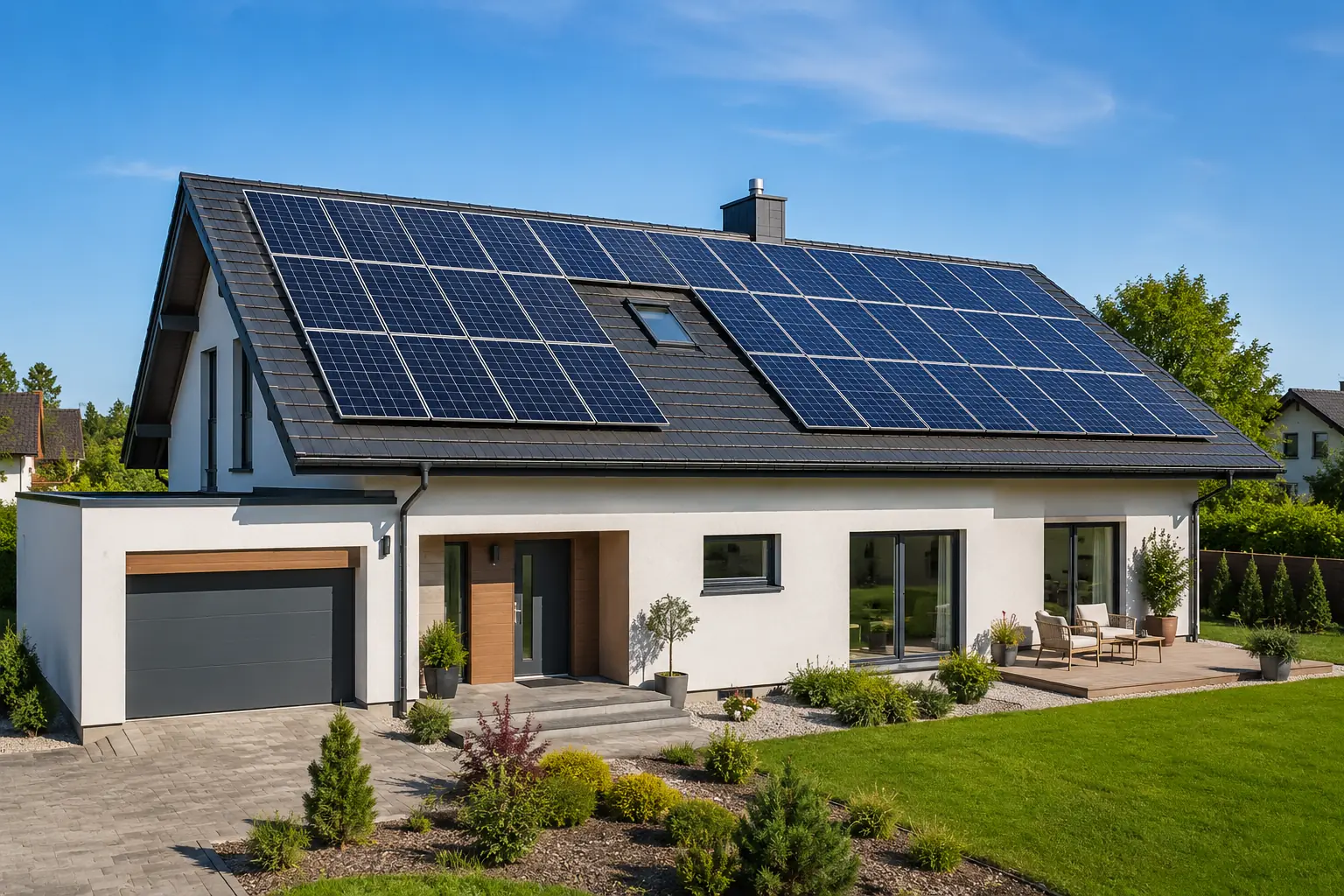
](https://voltcrave-battery.com/wp-content/uploads/2026/08/How-Many-Solar-Panels-Does-It-Take-to-Power-a-House.webp)
Installing too few solar panels leaves me dependent on grid electricity, while oversizing the system can increase cost without producing enough additional value.
Most U.S. homes may need roughly 15–25 modern solar panels to offset most or all annual electricity use, but there is no universal number. I calculate the requirement from annual household electricity consumption, panel wattage, local solar resource, roof orientation, shading, system losses, and the percentage of electricity I want solar to cover.
I therefore do not size residential solar from house size alone. My electricity bills are the best starting point. I then estimate how much energy each solar panel can produce at my location and divide annual electricity demand by annual production per panel.
How Many Solar Panels Does an Average House Need?
The phrase “average house” gives me a useful starting point, but electricity consumption varies significantly between households.
A typical U.S. home will often need around 15–25 solar panels, depending on panel wattage and local sunlight. EIA reported that U.S. residential customers purchased an average of about 865 kWh per month in 2024, or roughly 10,380 kWh annually. A home using that amount might need approximately 17–21 400-watt panels under common solar-resource assumptions.
I Start With Annual Electricity Consumption
The number I want first is not square footage.
It is:
annual electricity consumption in kWh
The U.S. Energy Information Administration reported average residential electricity purchases of about 865 kWh per month in 2024. Multiplying that by 12 gives:
865 kWh × 12 = 10,380 kWh per year
That gives me a useful national reference.
But my own home could use much less or much more.
For example:
| Monthly Electricity Use | Annual Electricity Use |
|---|---|
| 500 kWh | 6,000 kWh |
| 750 kWh | 9,000 kWh |
| 1,000 kWh | 12,000 kWh |
| 1,250 kWh | 15,000 kWh |
| 1,500 kWh | 18,000 kWh |
A small efficient home might use 6,000 kWh per year.
A large all-electric home with air conditioning, electric heating, a swimming pool, and EV charging might use 18,000 kWh or more.
That is why two houses of the same physical size can need very different numbers of solar panels.
A Simple 400-Watt Panel Example
Suppose I use:
10,380 kWh per year
and install:
400 W solar panels
If each panel produces approximately 500–630 kWh per year after accounting for location and normal system losses, I might need roughly:
10,380 ÷ 630 ≈ 17 panels
at the stronger-production end,
or:
10,380 ÷ 500 ≈ 21 panels
at the lower-production end.
That gives me a practical range of about:
17–21 panels
for this example.
Current consumer estimates also tend to fall in this general range. EnergySage's July 2026 guide estimates roughly 16–23 panels for many U.S. homes, while Solar.com's 2026 guide places many homes around 10–20 panels depending on usage, sunlight, and panel rating.
I use those figures only as benchmarks.
My actual solar design should be based on my own electricity use and location.
How Do I Calculate How Many Solar Panels I Need?
I can estimate panel count fairly easily once I know annual electricity use, expected solar production, and panel wattage.
I calculate the required number of solar panels by estimating my annual electricity demand and dividing it by the annual energy production of one panel. A more accurate calculation uses local solar-resource data, array tilt and orientation, shading, inverter efficiency, and system losses. NREL's PVWatts calculator is designed specifically for estimating PV system production.
My Simple Calculation
A useful simplified formula is:
Number of panels = Annual household kWh ÷ Annual kWh produced per panel
I can estimate annual panel production using:
Panel power in kW × peak sun hours per day × 365 × system efficiency factor
Suppose I have:
- 400 W panel = 0.4 kW
- 5 peak sun hours per day
- 14% system losses
My simplified annual production becomes:
0.4 × 5 × 365 × 0.86
which equals approximately:
628 kWh per panel per year
If my home uses:
10,000 kWh per year
then:
10,000 ÷ 628 ≈ 15.9
I would need approximately:
16 panels
under those assumptions.
Now suppose my location receives only the equivalent of four peak sun hours per day.
Annual production becomes:
0.4 × 4 × 365 × 0.86 ≈ 502 kWh
Then:
10,000 ÷ 502 ≈ 19.9
I now need about:
20 panels
The house has not changed.
The panels have not changed.
Only the solar resource has changed.
Why I Include System Losses
Solar panels do not deliver their laboratory-rated wattage every hour.
Real systems experience losses from factors including:
- Inverter conversion
- Wiring
- Module temperature
- Soiling
- Mismatch
- Shading
- Connections
NREL's PVWatts model includes system-loss assumptions and allows users to enter system size, module type, array type, tilt, azimuth, system losses, and inverter efficiency.
Its documented default system-loss assumption has historically been around 14%, although actual project losses should be modeled from the installation itself.
This is why I do not calculate:
400 W × sunshine hours
and assume every watt reaches my house.
I Prefer Annual Production Over Daily Production
Solar production changes by season.
Summer days may produce much more electricity than winter days.
My household consumption may also change seasonally because of:
- Air conditioning
- Electric heating
- Holiday usage
- Pool equipment
So I normally size grid-connected solar around annual kWh, rather than trying to make solar production equal household consumption every single day.
That gives me a much more realistic estimate.
How Does Sunlight Affect the Number of Solar Panels I Need?
Location can change the required number of panels significantly because the same module can produce different annual energy in different places.
The more usable sunlight my roof receives, the fewer solar panels I generally need for the same annual electricity target. Geographic location, cloud cover, roof direction, tilt, and shading all affect annual solar production. DOE recommends evaluating rooftop solar potential based on location, roof orientation, shade, roof characteristics, and the PV system being installed.
Sunlight Is More Important Than the House's Floor Area
Imagine two identical homes.
Both consume:
10,000 kWh per year
Both use:
400 W panels
House A has excellent solar exposure.
House B has lower solar irradiance and more cloudy weather.
House A may need 16 panels.
House B might need 20 or more.
The electrical demand is identical.
The annual energy production per panel is different.
This is why a statement such as:
“Every 2,000-square-foot house needs 20 panels”
is not technically reliable.
DOE notes that rooftop solar potential depends on geographic location, roof position relative to the sun, shading, and the PV system selected.
Roof Direction Matters
For U.S. installations, DOE notes that unshaded south-facing roofs generally provide strong solar performance, although orientations between southeast and southwest can also work well. Roof slopes between roughly 15 and 40 degrees are often favorable.
That does not mean an east- or west-facing roof cannot support solar.
It means I may need to account for different energy production.
An east-facing array may produce more electricity in the morning.
A west-facing array may produce more in the afternoon.
A south-facing array often maximizes total annual production in many northern-hemisphere locations.
The best orientation can also depend on electricity pricing.
If my utility has expensive late-afternoon rates, a west-facing system may have additional economic value even if its total annual kWh is somewhat lower than an ideal south-facing array.
Shading Can Increase Required Panel Count
Trees, chimneys, nearby buildings, roof sections, and other objects can cast shade.
DOE specifically identifies shading as an important factor in rooftop solar potential.
If shading reduces production by 10%, I may need more installed solar capacity to achieve the same annual energy target.
But simply adding more panels is not always the best solution.
Sometimes it makes more sense to:
- Use a less shaded roof section
- Change array layout
- Remove appropriate vegetation where practical
- Use suitable module-level power electronics
- Accept a lower solar offset
That is why a site-specific solar assessment is more useful than a generic panel-count calculator.
Does House Size Determine How Many Solar Panels I Need?
House size can influence energy consumption, but I do not use square footage as my primary solar-sizing metric.
A larger house often uses more electricity, but square footage alone does not determine solar panel count. Two equally sized homes can have very different consumption because of insulation, climate, heating systems, air conditioning, appliances, number of occupants, pools, EVs, and household behavior. I therefore size solar from historical kWh consumption whenever possible.
A 2,000-Square-Foot Home Is Not One Standard Load
Consider two 2,000-square-foot homes.
House A has:
- Gas heating
- Gas water heating
- No EV
- Efficient air conditioning
- Two occupants
House B has:
- Electric heat pump
- Electric water heater
- EV
- Swimming pool
- Five occupants
- Heavy air-conditioning use
Their roofs may be exactly the same size.
Their electricity use could be very different.
So asking:
“How many panels does a 2,000-square-foot house need?”
is less useful than asking:
“How many kWh did this house use last year?”
DOE recommends reviewing previous electricity bills to determine annual and seasonal electricity needs before sizing a solar installation.
My Electricity Bill Gives Me Better Information
I normally collect 12 months of electricity bills.
I add the monthly kWh values.
For example:
| Month | Example Consumption |
|---|---|
| January | 800 kWh |
| February | 700 kWh |
| March | 650 kWh |
| April | 600 kWh |
| May | 700 kWh |
| June | 900 kWh |
| July | 1,200 kWh |
| August | 1,250 kWh |
| September | 900 kWh |
| October | 700 kWh |
| November | 650 kWh |
| December | 750 kWh |
| Annual | 9,800 kWh |
Now I have a useful sizing number.
If I expect future electrical loads, I add those before finalizing the design.
Future Loads Matter
A solar system may operate for decades.
My electricity use in five years may be higher than it is today.
I therefore consider planned additions such as:
- Electric vehicle
- Heat pump
- Electric water heater
- Induction cooking
- Home office
- Additional air conditioning
- Swimming pool
- Battery storage
Suppose my current usage is:
9,000 kWh/year
and I expect an EV to add:
3,000 kWh/year
My future target becomes approximately:
12,000 kWh/year
Sizing only for today's 9,000 kWh could leave the future solar system undersized.
That is why the number of panels should reflect both current and realistic future electricity consumption.
Can Solar Panels Power an Entire House?
Yes, solar panels can produce enough annual electricity to offset the consumption of many homes, but “power the whole house” can mean two different things.
A grid-connected solar system can be sized to generate roughly as much electricity over a year as the house consumes. However, that does not mean the home can operate independently from solar panels every hour. Nighttime, cloudy periods, seasonal variation, and grid outages require grid power, battery storage, another energy source, or a deliberately designed off-grid system.
Annual Solar Offset Is Not the Same as Instantaneous Independence
Suppose my home uses:
10,000 kWh/year
and my solar system produces:
10,000 kWh/year
I can call that approximately a:
100% annual energy offset
But production and consumption happen at different times.
At noon:
Solar production = 6 kW
Home load = 2 kW
I have 4 kW of excess production.
At midnight:
Solar production = 0 kW
Home load = 1 kW
I need another electricity source.
Without batteries, that source is normally the utility grid.
This distinction is essential.
Grid-Connected Solar Uses the Grid as Part of the Energy Balance
During the day:
Solar → home
and potentially:
Solar → grid
At night:
Grid → home
The exact financial treatment of exported electricity depends on the utility and local compensation rules.
DOE notes that solar economics depend partly on how utilities compensate customers for excess electricity sent back to the grid.
So producing 100% of annual consumption does not necessarily mean eliminating 100% of the electric bill.
Fixed charges, export compensation, time-of-use rates, and other tariff rules still matter.
Off-Grid Solar Needs More Than Panels
If I want my house to operate without the grid, I need to size for periods when the sun is unavailable.
That usually requires:
- Solar panels
- Battery storage
- Off-grid or hybrid inverter
- Energy management
- Adequate reserve
- Sometimes a generator
I also need to account for winter production.
An off-grid system cannot rely on annual average production alone.
It must survive the difficult periods.
That can require significantly more solar panels and battery capacity than a normal grid-connected system designed for annual bill offset.
Does Adding a Battery Change How Many Solar Panels I Need?
A battery changes when I can use solar electricity, but it does not automatically change the amount of solar energy required to cover my annual household consumption.
A solar battery mainly shifts energy from one time to another. If my annual electricity demand remains unchanged, adding a battery does not inherently reduce the amount of solar generation required. However, system losses, backup goals, charging strategy, and desired off-grid capability can justify installing additional solar capacity.
Solar Panels Produce Energy; Batteries Store It
I separate their jobs:
Solar panel = electricity generation
Battery = electricity storage
Suppose my solar panels generate 20 kWh during the day.
My house immediately uses 10 kWh.
Without a battery, the remaining 10 kWh may go to the grid.
With a battery, some of it can be stored.
Later:
Battery → evening household loads
The battery has not created additional electricity.
It has changed when I can use the solar energy.
Battery Losses Matter
No battery storage process is 100% efficient.
Some energy is lost through:
- Battery charging
- Battery discharging
- Inverter conversion
- Internal resistance
- Auxiliary equipment
Therefore, if a large portion of my solar production travels through the battery before reaching the house, I may need slightly more solar generation to deliver the same useful household energy.
The exact amount depends on the battery and inverter system.
Backup Goals Can Increase the Solar Requirement
Imagine I want enough solar and battery capacity to survive an extended grid outage.
Now I need enough solar production not only for ordinary daytime loads but also to:
run the home + recharge the battery
after nighttime use.
That may justify a larger PV array.
For example:
Daily home consumption:
24 kWh
Battery needs to recover:
12 kWh
The solar system may need to generate enough electricity during daylight to cover both direct daytime consumption and battery recharging.
Weather conditions become especially important.
This is why sizing solar-plus-storage for backup independence is different from sizing solar for annual electricity offset.
What If My Roof Cannot Fit Enough Solar Panels?
Sometimes my electricity calculation says I need 22 panels, but the roof can only fit 16. That does not mean solar is useless.
If roof space limits the number of solar panels, I can use higher-wattage or higher-efficiency modules, improve home energy efficiency, use additional suitable roof surfaces or ground mounting, accept a partial electricity offset, or combine solar with grid electricity. Roof structure, shading, orientation, fire setbacks, and local requirements can all limit practical array size.
Available Roof Area Creates a Physical Limit
A roof may contain:
- Chimneys
- Skylights
- Vents
- Dormers
- Shaded areas
- Different slopes
- Required access paths
So gross roof area is not the same as usable solar area.
DOE notes that the size, shape, slope, orientation, shade, and physical condition of the roof all affect solar suitability.
Higher-Wattage Panels Can Help
Suppose my roof fits 18 modules.
With 350 W panels:
18 × 350 W = 6.3 kW
With 450 W panels:
18 × 450 W = 8.1 kW
The module count is identical.
Installed DC capacity is significantly different.
This is why the question:
“How many panels?”
is incomplete without asking:
“What wattage is each panel?”
Energy Efficiency Can Reduce the Required Solar Array
DOE recommends evaluating household energy efficiency before or during the solar-sizing process.
If I reduce consumption from:
12,000 kWh/year
to:
9,000 kWh/year
through insulation, efficient HVAC, lighting, controls, or appliances, I reduce the solar generation needed for a 100% offset by:
3,000 kWh/year
That can mean several fewer solar panels.
Energy efficiency is therefore sometimes the cheapest way to make a limited roof work better.
My Insights: How Many Solar Panels Does It Take to Power a House
My main insight is that the correct number of solar panels is an energy-balance calculation, not a house-size calculation.
To determine how many solar panels it takes to power a house, I start with annual electricity use, estimate annual solar production at the specific property, select panel wattage, include realistic system losses, and choose the desired solar offset. For many U.S. homes this produces roughly 15–25 panels, but individual results can vary substantially.
My First Insight: Annual kWh Is the Most Important Starting Number
I would rather know that a home uses:
10,000 kWh/year
than know that it has:
2,000 square feet
The kWh figure directly tells me how much electrical energy needs to be replaced by solar.
Floor area only gives me an indirect clue.
That is why DOE recommends reviewing electricity bills when determining current and future solar needs.
My Second Insight: Panel Wattage Changes the Answer
If my required array size is 8 kW:
Using 400 W panels:
8,000 W ÷ 400 W = 20 panels
Using 450 W panels:
8,000 W ÷ 450 W ≈ 17.8
I would need approximately:
18 panels
Same house.
Same electricity use.
Different panel count.
Therefore, panel count without panel wattage is not enough information.
My Third Insight: Location Can Matter as Much as Consumption
The same 400 W solar panel can produce more annual kWh in a sunny, unshaded location than in a cloudy or shaded location.
NREL's PVWatts tool exists precisely because PV production depends on location and system design. It uses inputs including system size, module type, array configuration, losses, tilt, azimuth, and inverter efficiency to estimate annual energy production.
So my preferred sizing method is:
Electricity bill + property location + PVWatts or equivalent professional simulation
rather than:
house size + generic panel-count table
My Fourth Insight: “Power a House” Needs a Definition
If I say solar powers 100% of a house, I may mean:
Solar produces as many kWh annually as the household consumes.
That is different from:
The house can run without the grid 24 hours a day.
The first is relatively common for suitable grid-connected homes.
The second generally requires battery storage and a system designed for periods without sunlight.
That distinction changes the required system size dramatically.
My Fifth Insight: The Real Question Is How Many Panels Are Needed for This Specific House?
This is the core question behind How Many Solar Panels Does It Take to Power a House?
I use this process:
- Collect 12 months of electricity consumption.
- Calculate annual kWh.
- Add realistic future loads such as EV charging or a heat pump.
- Choose the desired solar offset—50%, 80%, 100%, or another target.
- Choose a realistic panel wattage.
- Estimate local solar production using NREL PVWatts or equivalent software.
- Include roof tilt, orientation, shading, and system losses.
- Calculate the required DC system size in kW.
- Divide system wattage by panel wattage.
- Check whether the roof can physically fit that number of panels.
For a simplified example, suppose my home uses:
10,380 kWh/year
which is close to the 2024 average grid electricity purchase reported by EIA.
Assume:
- 400 W panels
- 5 equivalent peak sun hours
- 14% simplified system losses
- 100% annual energy target
Estimated production per panel:
0.4 kW × 5 hours × 365 × 0.86 ≈ 628 kWh/year
Required panels:
10,380 ÷ 628 ≈ 16.5
I would round up to approximately:
17 panels
Now change the location to the equivalent of four peak sun hours:
0.4 × 4 × 365 × 0.86 ≈ 502 kWh/year per panel
Then:
10,380 ÷ 502 ≈ 20.7
I would need about:
21 panels
That one example explains why I cannot answer every homeowner with the same number.
For a typical U.S. house, roughly 15–25 modern panels is a reasonable first planning range. Current 2026 consumer-market estimates generally fall around this area as well.
But for an actual installation, I would never stop at the national average.
I would calculate the system from the home's real annual energy consumption and real solar resource.
That turns the question from:
“How many panels does a house need?”
into the much more useful question:
“How many kWh does this house need solar to produce each year, and how many panels will produce that energy at this location?”
Once I have those two numbers, the required panel count becomes much easier to estimate accurately.
Conclusion
Most homes may need roughly 15–25 solar panels, but I size the system from annual kWh use, local sunlight, panel wattage, roof conditions, and the desired solar offset.
](https://voltcrave-battery.com/wp-content/uploads/2026/09/What-Is-the-Difference-Between-EV-Battery-and-ESS-Battery-768x512.webp)
](https://voltcrave-battery.com/wp-content/uploads/2026/09/How-to-Choose-a-Complete-Solar-Energy-System-for-Home-and-Business-768x512.webp)
](https://voltcrave-battery.com/wp-content/uploads/2026/08/What-Is-a-High-Voltage-LiFePO4-Battery-768x512.webp)