

](https://voltcrave-battery.com/wp-content/uploads/2026/09/What-Is-the-Number-One-Portable-Power-Station.webp)
Choosing the best portable power station is difficult because maximum capacity, portability, inverter power, solar charging, battery life, and price often pull in different directions.
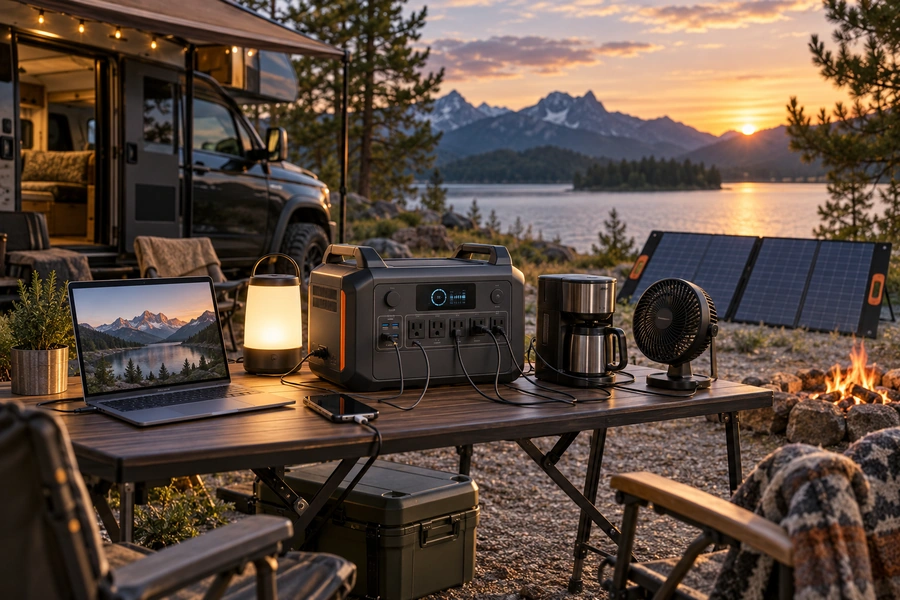
For most users, the EcoFlow DELTA 3 Plus is one of the strongest choices for the number one portable power station in 2026 because it combines a 1,024Wh LFP battery, 1,800W continuous AC output, fast charging, strong solar input, sub-10ms UPS capability, app control, expansion options, and relatively manageable weight.
For most users, the EcoFlow DELTA 3 Plus is a top all-around choice, balancing strong performance, portability, battery capacity, fast charging, and versatile everyday use.
What Is the Best Portable Power Station Overall?
The best overall unit should not simply have the largest battery. Once a power station becomes extremely heavy, its usefulness as a genuinely portable product changes.
My best overall choice is the EcoFlow DELTA 3 Plus because it balances approximately 1kWh of storage with 1,800W continuous AC output, 3,600W surge output, LFP chemistry, multiple charging methods, expandable capacity, UPS functionality, and a weight of about 27.6 lb. That combination makes it practical for camping, backup, mobile work, and everyday emergency power.
Independent reviews support that conclusion, although rankings are not unanimous.
TechRadar's 2026 portable-power-station guide ranks the DELTA 3 Plus as its best overall model, highlighting its balance of capacity, output, UPS capability, and portability.
Popular Mechanics also named the DELTA 3 Plus its best overall EcoFlow portable power station after real-world use, including a five-day off-grid festival test. It particularly highlighted the unit's balance of power and portability.
EcoFlow's current specifications list:
| Specification | EcoFlow DELTA 3 Plus |
|---|---|
| Battery capacity | 1,024Wh |
| Battery chemistry | LiFePO4 |
| AC continuous output | 1,800W |
| Surge output | 3,600W |
| Solar input | Up to 1,000W total |
| AC charging | Up to 1,500W |
| Cycle life | 4,000 cycles to 80%+ |
| UPS transfer | <10ms |
| Weight | Approx. 27.6 lb |
| Expandable capacity | Up to 5kWh |
| Warranty | 5 years |
These official specifications explain why I see it as a particularly balanced product rather than simply the most powerful one.
Is the EcoFlow DELTA 3 Plus Really Number One?
It depends on what “number one” means.
The EcoFlow DELTA 3 Plus is a strong number-one choice for all-around use, but it is not objectively the best in every category. A user needing 2kWh of storage, maximum AC output, whole-home backup, or minimum cost may be better served by a different model. The strongest recommendation therefore depends on balancing capacity, output, weight, charging speed, battery life, and intended use.
This distinction is important because portable power stations now range from:
200–300Wh compact units
to:
4,000Wh+ mobile home-backup systems.
A massive 4kWh station may outperform the DELTA 3 Plus in absolute capacity.
But it may weigh:
100 lb or more.
That dramatically changes portability.
Similarly, a 300Wh model may weigh less than 10 lb, making it much easier to carry.
But it may struggle with:
microwaves,
coffee makers,
large refrigerators,
power tools,
or:
extended outage backup.
The DELTA 3 Plus sits near the middle.
Its approximately:
1,024Wh capacity
is enough to provide useful backup and camping energy without pushing the unit into the extremely heavy class.
Its:
1,800W continuous inverter
also means it can support many ordinary household appliances individually, provided their continuous and startup demands remain within the station's limits.
This combination is why “best overall” is more meaningful than “most powerful.”
What Makes a Portable Power Station the Best?
A large battery specification alone does not tell me whether a power station is good.
The best portable power station needs the right balance of usable battery capacity, inverter output, surge capability, battery chemistry, AC and solar charging speed, weight, ports, UPS performance, expandability, warranty, software, noise, and price. The ideal model should provide enough energy for real loads without becoming too large or expensive to move conveniently.
I use several metrics together.
Battery Capacity
Capacity is measured in:
Wh — watt-hours.
A:
1,024Wh battery
theoretically stores approximately:
1.024kWh.
If a load consumes:
100W,
the simple theoretical runtime is:
1,024Wh ÷ 100W = 10.24 hours.
Real runtime is lower because of:
inverter losses,
electronics consumption,
battery reserve,
and:
load characteristics.
Inverter Power
Power is measured in:
W — watts.
A 1,800W inverter determines approximately how much continuous AC load can be supported.
Capacity and power therefore answer different questions:
Wh = how long?
W = how much at once?
Battery Chemistry
Modern premium power stations increasingly use:
LiFePO4 / LFP.
The DELTA 3 Plus is rated by EcoFlow for 4,000 cycles before reaching 80%+ capacity under the manufacturer's specified conditions.
For a product intended to be used repeatedly for years, this is an important advantage.
How Much Power Can the EcoFlow DELTA 3 Plus Run?
The inverter rating determines which appliances can operate, while battery capacity determines runtime.
The EcoFlow DELTA 3 Plus provides 1,800W of continuous AC output with a listed 3,600W surge rating. That makes it capable of powering many refrigerators, TVs, laptops, routers, coffee makers, microwaves, CPAP machines, fans, lights, and selected power tools, provided total continuous and startup demand remains within the power station's limits.
Consider this hypothetical load:
| Device | Example Load |
|---|---|
| Refrigerator | 150W running |
| Wi-Fi router | 20W |
| Laptop | 70W |
| LED lights | 50W |
| TV | 100W |
| Fan | 50W |
| Total | 440W |
A 1,800W inverter has substantial continuous power margin for this load.
However, the refrigerator compressor may briefly require more power during startup.
That is where surge capacity matters.
For higher-power appliances, consider a hypothetical:
1,500W electric kettle.
The DELTA 3 Plus has enough nominal continuous inverter capacity to support such a load by itself.
But if another:
500W
of devices are running simultaneously, total demand becomes:
2,000W.
That exceeds the station's normal 1,800W continuous AC rating.
EcoFlow offers an X-Boost mode for certain higher-wattage appliances, but Popular Mechanics notes that this feature can reduce output voltage rather than actually increasing the inverter's normal continuous rating, making it unsuitable for some sensitive electronics.
So I still size loads against normal rated output first.
How Long Will a 1,024Wh Portable Power Station Run Appliances?
A 1kWh battery is a useful middle ground between compact camping units and heavy home-backup batteries.
A 1,024Wh portable power station could theoretically run a 100W device for roughly ten hours or a 500W device for about two hours before losses. Actual runtime is lower because the inverter, battery electronics, temperature, discharge rate, and reserve consume some of the available energy. Therefore, rated Wh should be treated as a starting point rather than guaranteed AC output energy.
A simple formula is:
Runtime ≈ Usable Wh ÷ Load W
Examples before accounting for losses:
| Load | Theoretical Runtime from 1,024Wh |
|---|---|
| 50W | 20.5 hours |
| 100W | 10.2 hours |
| 200W | 5.1 hours |
| 500W | 2.0 hours |
| 1,000W | 1.0 hour |
| 1,800W | 0.57 hour |
Real-world runtime will be shorter.
This explains an important purchasing rule:
Do not buy a power station based on inverter watts alone.
A system might have:
2,000W output
but only:
500Wh capacity.
It can potentially run a high-power appliance, but not for long.
Conversely, a station could hold:
2,000Wh
while offering only:
1,000W output.
It has more stored energy but cannot support certain large appliances.
The best portable power station therefore needs both:
enough W
and:
enough Wh.
Is the BLUETTI Elite 200 V2 Better Than the EcoFlow DELTA 3 Plus?
For buyers who prioritize battery capacity and high output over low weight, it can be.
The BLUETTI Elite 200 V2 is a strong alternative because it offers about 2,073.6Wh of storage and 2,600W AC output, substantially exceeding the DELTA 3 Plus in both capacity and normal output. However, the BLUETTI weighs significantly more, making the EcoFlow easier to carry and arguably better balanced for genuinely portable everyday use.
Popular Mechanics' 2026 multi-brand testing actually selected the BLUETTI Elite 200 V2 as its best overall portable power station, illustrating why there is no universal industry consensus about a single number-one model.
Current product information lists the Elite 200 V2 at approximately:
2,073.6Wh
with:
2,600W output.
That is roughly twice the battery capacity of the DELTA 3 Plus.
This makes the BLUETTI especially attractive for:
longer outages,
RV use,
larger appliances,
multi-day camping,
and:
users who need more stored energy.
The tradeoff is portability.
The DELTA 3 Plus weighs approximately:
27.6 lb.
The Elite 200 V2 is in a substantially heavier class.
So my choice becomes:
More energy and output → BLUETTI Elite 200 V2
Better balance of carrying weight and capability → EcoFlow DELTA 3 Plus
Both can legitimately be called a best-in-class option depending on how “portable” is defined.
Is the Jackery Explorer 2000 V2 Better for Home Backup?
For buyers wanting more energy without moving to an extremely heavy system, it is another strong alternative.
The Jackery Explorer 2000 V2 offers 2,042Wh of LFP storage, 2,200W rated AC output, and 4,400W surge capability while weighing about 39.5 lb. That combination gives it roughly twice the battery capacity of the DELTA 3 Plus while remaining considerably lighter than many traditional 2kWh portable power stations.
Jackery rates the battery for:
4,000 cycles to 70%+ capacity.
It also lists approximately:
1.75 hours
for AC charging under its specified conditions.
For home backup, the extra capacity is meaningful.
Suppose essential loads average:
300W.
The DELTA 3 Plus's 1,024Wh capacity provides a theoretical:
1,024 ÷ 300 ≈ 3.4 hours
before conversion losses.
The Jackery's 2,042Wh provides:
2,042 ÷ 300 ≈ 6.8 hours
before losses.
Those are simplified calculations, but they show the impact of doubling battery capacity.
So if I expected:
long outages,
refrigerator backup,
extended router operation,
or:
overnight CPAP use,
I might favor a 2kWh station.
For regular transport and mixed everyday use, however, the smaller EcoFlow remains easier to handle.
Is a Bigger Portable Power Station Always Better?
No. More battery capacity creates a direct penalty in weight, size, charging requirements, and often cost.
A bigger portable power station is better when long runtime and high-power backup matter more than mobility. A smaller 1kWh system is often better for camping, mobile work, car travel, and short outages because it is easier to carry and recharge. The best size is the smallest unit that reliably supports your required power, runtime, and surge loads.
I use this formula:
Required battery energy ≈ Load × Runtime ÷ system efficiency
Suppose I want to operate:
200W
for:
4 hours.
The load consumes:
800Wh.
A 1,024Wh station is a logical size because it leaves some allowance for losses and operating margin.
Now suppose I need:
500W
for:
8 hours.
Energy demand becomes:
4,000Wh
before losses.
A 1kWh power station is no longer sufficient unless it can be recharged continuously.
This is why the number-one portable power station for one user can be completely wrong for another.
The correct decision starts with:
load watts
followed by:
runtime hours.
Then I compare:
battery Wh,
inverter W,
solar input,
weight,
and:
price.
Is Solar Charging Important in the Best Portable Power Station?
Yes, especially for camping, RVs, emergency preparedness, and longer grid outages.
Solar charging can turn a portable power station from a finite battery into a renewable-energy system that can be replenished while off-grid. Higher solar input reduces recharge time when sufficient sunlight and panel capacity are available. However, actual solar output varies with weather, panel angle, temperature, shading, and available sunlight.
EcoFlow currently specifies two DC solar inputs on the DELTA 3 Plus with up to:
500W each
for a maximum listed solar charging capability of:
1,000W.
Theoretically, charging:
1,024Wh
with:
1,000W
could appear to require just over one hour.
Real solar charging normally takes longer because panels rarely operate at nameplate power continuously and because charging efficiency and battery-control behavior reduce net input.
Still, strong solar input is valuable.
Imagine a campsite consumes:
700Wh per day.
If the solar array can reliably return around that amount each day, the station can support a much longer trip than its battery capacity alone would suggest.
This is why solar input is one of my major criteria when judging a genuinely versatile portable station.
Why Is LiFePO4 Important in a Portable Power Station?
Portable power stations are increasingly expected to last for many years rather than a few hundred charge cycles.
LiFePO4 batteries are well suited to modern portable power stations because they offer long cycle-life potential, strong thermal stability, and good performance for repeated energy-storage use. For buyers who expect frequent camping, solar charging, backup use, or UPS operation, battery longevity can be more valuable than minimizing every kilogram of weight.
EcoFlow rates the DELTA 3 Plus for:
4,000 cycles to 80%+ capacity.
That does not mean it suddenly stops working on cycle 4,001.
Instead, the specification describes capacity retention under the manufacturer's testing conditions.
If one full equivalent cycle occurred every day:
4,000 ÷ 365 ≈ 11 years.
That is only a mathematical illustration.
Real battery aging also depends on:
temperature,
SOC,
depth of discharge,
C-rate,
and:
calendar aging.
Still, the high cycle specification makes LFP attractive for a product designed to be charged and discharged repeatedly.
This is one reason I would generally favor a current LFP power station over an older portable station with a much shorter-cycle battery when prices and other specifications are comparable.
What Should You Look for Before Buying the Number One Portable Power Station?
A review ranking is useful, but your electrical requirements matter more than the ranking.
Before buying a portable power station, calculate the highest simultaneous wattage, motor or compressor surge, daily energy consumption in Wh, required runtime, preferred carrying weight, solar charging requirement, number of ports, UPS requirement, expansion plans, battery cycle rating, warranty, and budget. The best model is the one that meets these needs with reasonable reserve.
I start with four numbers:
1. Maximum load in watts
2. Startup surge in watts
3. Energy needed in watt-hours
4. Acceptable carrying weight
Suppose your camping setup contains:
refrigerator: 60W average
laptop: 70W for 5 hours
lights: 40W for 5 hours
phones and electronics: 100Wh daily
Approximate daily energy becomes:
60 × 24 = 1,440Wh
plus:
70 × 5 = 350Wh
plus:
40 × 5 = 200Wh
plus:
100Wh
for a total of approximately:
2,090Wh per day.
A 1kWh station alone would not cover that full day.
Solar charging or a larger 2kWh class battery would make more sense.
This calculation is more useful than automatically buying whatever a review calls number one.
My Insights: What Is the Number One Portable Power Station
There is no universal winner, but one model currently offers an unusually strong balance of the features most buyers actually use.
For most users in 2026, I would choose the EcoFlow DELTA 3 Plus as the number one all-around portable power station because it combines 1,024Wh LFP capacity, 1,800W continuous AC output, strong solar charging, fast AC charging, UPS functionality, expansion to 5kWh, a five-year warranty, and a relatively portable 27.6 lb design.
My First Insight: “Number One” Should Mean Balanced, Not Biggest
A:
4kWh
power station is clearly better than a:
1kWh
power station for runtime.
But if it weighs:
100+ lb,
I no longer consider it equally portable.
Likewise, an:
8 lb
station may be wonderfully portable but have too little capacity for home backup.
The number-one all-rounder should sit between these extremes.
That is where the DELTA 3 Plus performs well.
It offers enough battery and inverter capability for meaningful work while remaining practical for one person to move.
My Second Insight: The Best Power Station Needs Both Watts and Watt-Hours
I would never choose a unit based only on:
2,000W output
or:
2,000Wh battery capacity.
I need both.
Watts answer:
What can it run?
Watt-hours answer:
How long can it run?
A useful all-around portable station needs sufficient inverter power for ordinary appliances and enough stored energy to make that inverter useful.
The DELTA 3 Plus's:
1,800W + 1,024Wh
combination is a strong middle ground.
My Third Insight: Fast Recharging Can Be More Valuable Than Extra Capacity
Imagine two batteries.
Station A:
1,000Wh
but recharges rapidly from AC and accepts substantial solar input.
Station B:
1,500Wh
but charges slowly.
For repeated daily use, Station A may provide more practical energy because it can be replenished more frequently.
This is especially important for:
solar camping,
mobile work,
RV use,
and:
emergency preparedness.
The battery does not operate in isolation.
Its recharge rate determines how quickly stored energy becomes available again.
My Fourth Insight: Independent Rankings Prove There Is No Absolute Winner
The strongest evidence is that reputable reviewers do not agree completely.
TechRadar's 2026 guide names the EcoFlow DELTA 3 Plus as its best overall portable power station.
Popular Mechanics' 2026 multi-brand roundup names the BLUETTI Elite 200 V2 its best overall model after testing units for output, usable capacity, charging, and portability.
That disagreement is useful.
It tells me the answer depends on weighting.
If portability matters more:
EcoFlow becomes more compelling.
If roughly 2kWh of energy and 2,600W output matter more:
BLUETTI becomes extremely attractive.
My Fifth Insight: What Is the Number One Portable Power Station?
This directly answers the H1.
| Priority | My Pick | Why |
|---|---|---|
| Best all-around | EcoFlow DELTA 3 Plus | Excellent balance of power, capacity, charging and weight |
| Best for larger capacity | BLUETTI Elite 200 V2 | ~2,073Wh and 2,600W output |
| Strong 2kWh portable option | Jackery Explorer 2000 V2 | 2,042Wh, 2,200W and ~39.5 lb |
| Home backup priority | Larger expandable system | More kWh matters |
| Light camping | Smaller 300–600Wh unit | Lower weight |
| Solar/off-grid use | High solar-input system | Faster renewable recharging |
| UPS/home office | Fast transfer-time system | Protects sensitive loads |
If I had to recommend only one portable power station for a buyer who had not yet defined a specialized use case, I would choose:
EcoFlow DELTA 3 Plus.
Why?
Not because it has the largest battery.
It does not.
Not because it has the highest inverter output.
It does not.
Instead, it combines the specifications that matter most often:
1,024Wh battery
1,800W continuous AC
3,600W surge
LFP chemistry
4,000-cycle rating to 80%+ capacity
up to 1,000W solar input
sub-10ms UPS switching
capacity expansion
and:
27.6 lb weight.
TechRadar independently reaches a similar conclusion in its 2026 roundup, naming it the best overall portable power station.
Popular Mechanics' hands-on EcoFlow testing also chose it as that brand's best overall option, highlighting its power-to-portability balance.
However, I would change that recommendation immediately for someone who says:
“I need twice the energy.”
Then the BLUETTI Elite 200 V2 or Jackery Explorer 2000 V2 becomes more attractive.
I would also change it if someone says:
“I need whole-home backup.”
Then I would move into a much larger expandable system.
And if someone says:
“I only need phones, a laptop, lights, and a fan while camping,”
a 1kWh station may actually be unnecessarily large.
So the most useful final answer is:
The EcoFlow DELTA 3 Plus is my number-one all-around portable power station for most users, but the real winner depends on required watts, watt-hours, portability, charging options, and budget.
That is a better way to define “number one” than simply choosing the battery with the biggest number on its specification sheet.
Conclusion
The EcoFlow DELTA 3 Plus is my top all-around portable power station, combining useful capacity, strong output, fast charging, LFP longevity, UPS support, and genuine portability.
](https://voltcrave-battery.com/wp-content/uploads/2026/08/What-Makes-a-High-Voltage-LiFePO4-Battery-Structurally-Superior-768x512.webp)
](https://voltcrave-battery.com/wp-content/uploads/2026/08/Who-Makes-the-Best-Solar-Backup-Battery-768x512.webp)
](https://voltcrave-battery.com/wp-content/uploads/2026/06/Does-Rechargeable-Battery-Last-Longer-and-Cost-effective-768x512.jpg)