

](https://voltcrave-battery.com/wp-content/uploads/2026/09/How-Much-Battery-Storage-Do-You-Need-for-a-Solar-System.webp)
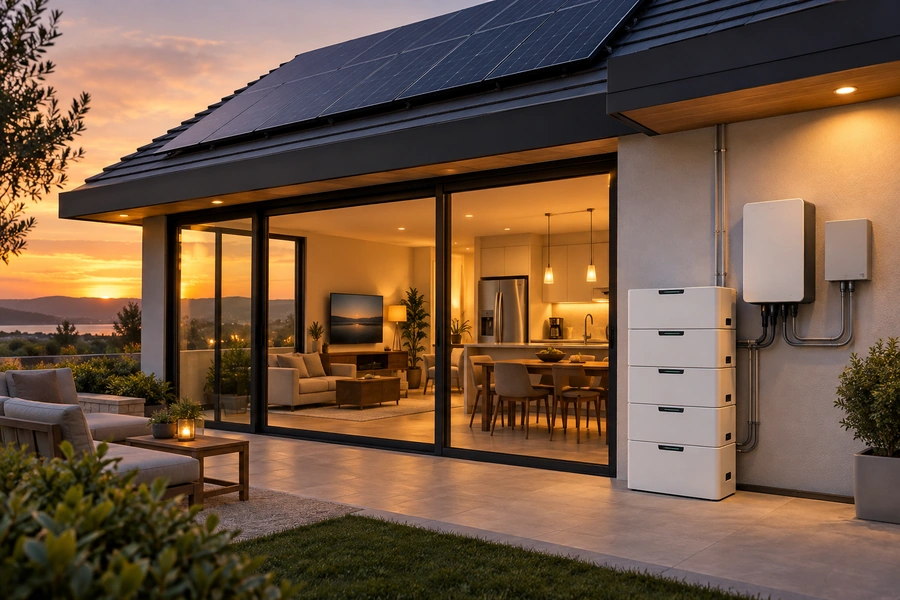
An oversized solar battery wastes money, while an undersized one can leave essential appliances without power when solar production disappears.
For many homes, roughly 10–20kWh of usable battery storage can cover evening consumption or essential backup loads, but there is no universal size. The right capacity depends on daily electricity use, critical loads, desired backup hours, solar production, usable battery capacity, efficiency, and whether the system is grid-tied or off-grid.
I size solar batteries from the energy the loads actually need, not simply from the number of solar panels installed.
How Do You Calculate Battery Storage for a Solar System?
Battery sizing becomes much easier once electrical loads are converted into daily energy consumption.
To calculate solar battery storage, multiply each appliance's wattage by its daily operating hours, add the results, and adjust for usable battery capacity, inverter losses, reserve requirements, and desired backup duration. A home requiring 10kWh of usable overnight energy may need more than 10kWh of nominal battery capacity after these factors are included.
The basic calculation is:
Energy (Wh) = Power (W) × Time (hours)
Suppose essential appliances use:
Refrigerator:
150W × 8 equivalent hours = 1.2kWh
Lights:
100W × 5 hours = 0.5kWh
TV:
100W × 4 hours = 0.4kWh
Wi-Fi and electronics:
100W × 10 hours = 1.0kWh
Fans:
150W × 6 hours = 0.9kWh
Other essential loads: 1.0kWh
Total:
5.0kWh/day
The battery must provide approximately 5kWh of useful AC energy.
But I would not automatically specify a:
5kWh nominal battery.
I also need to account for:
usable state-of-charge window,
inverter efficiency,
system losses,
temperature,
battery degradation,
and:
reserve capacity.
A useful planning relationship is:
Required Nominal Battery Capacity ≈ Required AC Energy ÷ System Efficiency ÷ Usable Battery Fraction
That gives a much more realistic starting point.
How Many kWh of Battery Storage Does an Average Home Need?
There is no single average battery size that is correct for every household because electricity consumption patterns vary dramatically.
A residential solar battery system often falls somewhere around 10–20kWh when the goal is evening solar use or essential-load backup, but homes with low consumption may need less while all-electric homes can require much more. Battery capacity should therefore be based on the home's actual kWh consumption and backup objective rather than a generic average.
Consider three households.
Low-Energy Home
Daily consumption:
8kWh
If much of that electricity is used during daylight while solar is producing, the battery might only need to shift:
3–5kWh
into the evening.
Moderate-Energy Home
Daily consumption:
20kWh
Suppose:
8kWh
must be supplied after solar production falls.
A battery with around:
10kWh usable capacity
could potentially cover much of that overnight demand.
High-Energy Home
Daily consumption:
40kWh
If the house includes:
electric heating,
air conditioning,
electric water heating,
EV charging,
and:
electric cooking,
battery requirements can become much larger.
This is why monthly utility bills are useful.
If a home consumes:
900kWh/month,
average daily consumption is approximately:
900 ÷ 30 = 30kWh/day
But that still does not mean the home automatically needs a:
30kWh battery.
Some energy is consumed directly from solar during daylight.
Battery sizing should focus on the energy that actually needs to be shifted or backed up.
Is a 10kWh Battery Enough for a Solar System?
For many households, 10kWh can provide meaningful overnight or emergency energy, but whether it is enough depends entirely on the loads.
A 10kWh solar battery may be sufficient for essential loads, overnight solar shifting, or moderate household consumption. However, it may be too small for extended whole-home backup involving central air conditioning, electric heating, water heating, cooking, or EV charging. The important number is usable battery energy compared with actual load consumption.
Suppose the battery provides:
10kWh usable energy.
If average load is:
500W,
the theoretical runtime is:
10kWh ÷ 0.5kW = 20 hours
At:
1kW average load:
10 ÷ 1 = 10 hours
At:
2kW:
10 ÷ 2 = 5 hours
At:
5kW:
10 ÷ 5 = 2 hours
This demonstrates why battery capacity cannot be discussed without load.
A 10kWh battery sounds large when powering:
lights,
refrigerator,
internet,
and:
small electronics.
It can feel surprisingly small when powering:
central AC,
electric oven,
water heater,
and:
EV charger.
Energy management therefore matters almost as much as battery size.
During an outage, turning off nonessential high-wattage appliances can dramatically extend backup duration.
Is a 20kWh Battery Enough to Power a House?
A 20kWh battery can provide substantial residential backup, but it does not guarantee a full day of whole-home operation.
A 20kWh battery can power many homes for several hours to more than a day depending on average demand. At an average 1kW load, 20kWh theoretically represents about 20 hours of energy; at 2kW, about 10 hours. Real runtime is lower after reserve capacity, conversion losses, and operating limits are considered.
The calculation is straightforward:
Runtime = Usable Battery Energy ÷ Average Load
If usable battery energy is:
20kWh
then:
500W average load → 40 hours
1kW → 20 hours
2kW → 10 hours
4kW → 5 hours
These are theoretical values before other losses.
The important word is:
average.
A house may briefly consume:
6kW
when an air conditioner, microwave, and other appliances operate simultaneously.
But its average load over several hours could be:
1.2kW.
Battery kWh determines how much energy is available.
Battery/inverter kW determines how much power can be delivered at one moment.
Both must be sufficient.
A:
20kWh battery with a 5kW output limit
cannot necessarily operate:
8kW of appliances simultaneously
even though it contains plenty of stored energy.
How Much Battery Storage Do You Need for Overnight Solar Power?
Overnight battery sizing should focus on energy consumed between useful solar production periods.
For overnight solar storage, calculate electricity consumption from late afternoon until solar generation becomes sufficient the next morning. If a home consumes 8kWh overnight, the battery should provide at least that much usable AC energy, with additional capacity considered for conversion losses, reserve margin, battery aging, and nights with unusually high consumption.
Suppose solar production becomes low at:
5 p.m.
and becomes useful again around:
8 a.m.
That creates approximately:
15 hours
of battery-dependent operation.
Assume average overnight load is:
600W.
Required energy is:
0.6kW × 15h = 9kWh
Now account for inverter/system efficiency.
At a simplified:
90% efficiency:
9 ÷ 0.90 = 10kWh
of battery-side energy.
Then I may add reserve capacity.
This could push the practical battery requirement above:
10kWh.
But solar recharge also matters.
A large battery is not particularly useful if the solar array cannot recharge it reliably during the following day.
Battery and PV therefore need to be sized together.
How Much Battery Storage Do You Need for One Day of Backup?
One-day backup depends on whether “one day” means the entire house or only critical appliances.
To size a battery for one day of backup, estimate the kWh consumed by the loads you intend to operate during those 24 hours, then adjust for usable battery capacity, conversion losses, and reserve. A home normally using 30kWh per day may require far less storage if only refrigerators, lights, communications, and essential electronics remain powered.
Suppose normal consumption is:
30kWh/day.
But during an outage, the homeowner turns off:
EV charging,
electric dryer,
dishwasher,
pool equipment,
and:
nonessential air conditioning.
Critical-load consumption falls to:
12kWh/day.
Now the backup battery only needs to support approximately:
12kWh
rather than 30kWh.
If we assume:
90% system efficiency,
battery-side energy becomes:
12 ÷ 0.90 ≈ 13.3kWh
Then additional reserve and degradation margin may increase the desired nominal capacity further.
This illustrates why load management is often cheaper than simply buying more batteries.
Reducing a:
30kWh/day
backup requirement to:
12kWh/day
can dramatically reduce battery cost.
How Much Battery Storage Do You Need for Two or Three Days?
Multi-day backup increases storage requirements rapidly unless solar generation replenishes the batteries.
For multi-day backup without dependable solar recharge, multiply daily critical-load consumption by the required number of days and adjust for efficiency, usable capacity, and reserve. A home requiring 10kWh of critical energy per day would need roughly 20kWh for two days or 30kWh for three days before accounting for losses and design margin.
Suppose critical loads consume:
10kWh/day.
For:
2 days:
10 × 2 = 20kWh
For:
3 days:
10 × 3 = 30kWh
At a simplified:
90% efficiency,
three days becomes:
30 ÷ 0.90 ≈ 33.3kWh
before additional reserve.
This can become expensive quickly.
That is why multi-day solar backup is not just a battery-sizing problem.
It is an energy-system problem involving:
battery capacity,
solar-array size,
weather,
load management,
and:
possibly a backup generator.
If solar produces enough electricity each day, the battery may not need to store three complete days of energy.
It may only need enough capacity to bridge:
nighttime
and:
periods of low solar generation.
How Much Battery Storage Do You Need for an Off-Grid Solar System?
Off-grid systems generally need more careful battery sizing because there is no utility grid available when stored energy runs out.
An off-grid solar battery bank must support loads through nighttime and low-solar periods while maintaining adequate reserve. Sizing should consider daily kWh consumption, days of autonomy, seasonal solar production, usable battery capacity, system losses, battery temperature, maximum discharge power, and how quickly the PV array can recharge the battery.
Suppose an off-grid home uses:
12kWh/day.
Desired autonomy:
2 days.
Basic energy requirement:
12 × 2 = 24kWh
Now assume:
90% system efficiency.
24 ÷ 0.90 ≈ 26.7kWh
If additional reserve is required, the battery bank grows further.
But this calculation is incomplete unless solar production is considered.
Imagine the home has:
30kWh of battery storage
but its solar array produces only:
8kWh/day
during winter.
The battery cannot solve a persistent energy deficit.
The system eventually empties.
Therefore:
Battery storage handles timing.
Solar generation provides energy.
Both must be balanced.
For serious off-grid design, seasonal worst-case solar conditions are usually more important than annual-average production.
Should Battery Capacity Match Solar Panel Capacity?
Battery kWh and solar-panel kW measure different things, so they should not be matched one-to-one.
Solar-panel capacity is measured in kW because it describes generation power, while battery capacity is measured in kWh because it describes stored energy. The battery should be sized according to how much solar energy needs to be shifted or backed up, while the PV array should be large enough to serve daytime loads and recharge the battery.
For example:
Solar array:
8kW
Battery:
15kWh
These numbers are not directly comparable.
Suppose the 8kW array produces:
32kWh
on a particular day.
The house consumes:
18kWh
directly while solar is available.
Surplus:
32 – 18 = 14kWh
A battery capable of accepting approximately that surplus could capture much of the excess energy, subject to charging limits and losses.
Now imagine the battery is:
30kWh.
If only 14kWh of surplus solar is available, the system may not fully recharge the battery from solar that day.
This is why simply installing the largest possible battery is not always economically useful.
PV production and battery capacity should complement each other.
How Does Battery Depth of Discharge Affect Solar Storage Size?
Nominal battery capacity is not always equal to the energy available to the loads.
Depth of discharge and the permitted state-of-charge window determine how much of a battery's nominal capacity is practically usable. A nominal 10kWh battery may provide less than 10kWh of usable energy if the BMS or system controls maintain upper or lower SOC reserves for battery protection, backup reserve, or warranty requirements.
Suppose:
nominal battery capacity = 10kWh
usable fraction = 90%
Then usable energy is:
10 × 0.90 = 9kWh
If usable fraction is:
80%,
usable energy becomes:
8kWh.
Now suppose the home needs:
10kWh usable.
At 90% usable capacity:
10 ÷ 0.90 ≈ 11.1kWh nominal
At 80%:
10 ÷ 0.80 = 12.5kWh nominal
This demonstrates why comparing batteries only by nominal kWh can be misleading.
I look for:
nominal capacity,
usable capacity,
SOC limits,
warranty conditions,
and:
reserve settings.
For backup systems, some homeowners intentionally maintain an emergency reserve.
That improves outage preparedness but reduces the energy available for normal daily cycling.
How Do Inverter Losses Affect Battery Sizing?
The inverter consumes energy while converting battery DC into household AC.
Inverter efficiency reduces the amount of battery energy that ultimately reaches AC appliances. If a load needs 10kWh of AC energy and average conversion efficiency is assumed to be 90%, the battery must supply roughly 11.1kWh. Real system losses can also include battery losses, wiring, standby consumption, and auxiliary equipment.
The simplified calculation is:
Battery Energy = AC Load Energy ÷ Inverter Efficiency
For:
10kWh AC
at:
90% efficiency:
10 ÷ 0.90 = 11.1kWh
At:
95% efficiency:
10 ÷ 0.95 ≈ 10.5kWh
Efficiency therefore affects battery sizing.
But I avoid assuming one fixed inverter efficiency under every condition.
Efficiency can change with:
load level,
battery voltage,
temperature,
and:
inverter design.
The inverter also consumes some energy simply by remaining active.
For an off-grid system operating:
24 hours per day,
idle consumption can become meaningful over time.
So a detailed energy budget should include both:
conversion losses
and:
system standby consumption.
Is One Large Solar Battery Better Than Multiple Smaller Batteries?
Neither architecture is automatically better; modularity, power, redundancy, expansion, cost, and installation requirements all matter.
One large battery can simplify installation and controls, while multiple modular batteries can make future expansion easier and may provide greater design flexibility. The best configuration depends on total kWh, required kW output, inverter compatibility, battery communication, available space, redundancy goals, and whether additional storage may be needed later.
Suppose the target is:
20kWh.
Option A:
1 × 20kWh battery
Option B:
2 × 10kWh batteries
Option C:
4 × 5kWh batteries
All can theoretically provide similar energy capacity.
But their:
power output,
BMS architecture,
installation complexity,
wiring,
communication,
and:
expansion capability
may differ.
Modular storage can be attractive when a homeowner expects electricity demand to increase later.
For example, the home may add:
an EV,
heat pump,
electric water heater,
or:
additional living space.
Starting with:
10kWh
and expanding to:
20kWh
later may be practical if the battery platform supports it.
But expansion compatibility should be verified before purchase rather than assumed.
How Much Solar Battery Storage Do You Need for Essential Loads?
Critical-load sizing can dramatically reduce battery requirements compared with whole-home backup.
For essential-load backup, calculate only the appliances that must operate during an outage. Refrigeration, lighting, internet, medical or communications equipment, and selected outlets may require far less energy than central air conditioning, EV charging, electric water heating, cooking, and laundry. Reducing nonessential loads can extend backup time without increasing battery capacity.
Consider this example:
| Essential Load | Daily Energy |
|---|---|
| Refrigerator | 1.5kWh |
| Freezer | 1.0kWh |
| Lights | 0.5kWh |
| Internet | 0.4kWh |
| Electronics | 0.8kWh |
| Fans | 1.0kWh |
| Other essentials | 0.8kWh |
| Total | 6.0kWh/day |
Now compare that with normal household consumption of:
30kWh/day.
Critical-load backup requires only:
20%
of the normal daily energy in this example.
That can transform the economics of a battery system.
Instead of installing enough storage for every appliance, the homeowner can prioritize what actually matters during an outage.
This is often the first question I ask:
Do you want whole-home backup or essential-load backup?
The answer can change the required battery capacity by several times.
My Insights: How Much Battery Storage Do You Need for a Solar System
The right battery capacity comes from the energy you need after solar production falls, not from a universal battery-size recommendation.
For many residential solar systems, 10–20kWh of usable battery storage can be a practical starting range, but the correct size must be calculated from daily consumption, essential loads, desired backup duration, usable battery capacity, inverter losses, reserve margin, solar production, and whether the system is grid-connected or off-grid.
My First Insight: Start With kWh Consumption, Not Solar Panel Count
If someone tells me:
“I have 20 solar panels,”
I still cannot size the battery.
I need to know:
solar-array kW,
daily solar generation,
daily household consumption,
and:
when that electricity is consumed.
The battery stores:
energy in kWh.
Therefore, load energy should be the starting point.
My Second Insight: Whole-Home Backup and Essential Backup Are Completely Different
A home might normally consume:
30kWh/day
but need only:
8kWh/day
for essential loads during an outage.
That means the same property could reasonably need:
a relatively modest battery
or:
a very large battery bank
depending on the objective.
Before choosing battery capacity, define:
what must stay powered.
My Third Insight: Bigger Is Not Automatically Better
Oversizing a battery increases cost.
If the solar array cannot regularly recharge the extra capacity, some of that investment may remain underused.
A well-sized system balances:
solar production ↔ battery storage ↔ household consumption.
Battery capacity should therefore be evaluated as part of the complete energy system.
My Fourth Insight: kWh and kW Must Be Sized Together
A battery can contain plenty of energy and still fail to run all appliances simultaneously.
For example:
20kWh battery capacity
describes stored energy.
A:
5kW inverter/output limit
describes maximum power.
If appliances simultaneously demand:
8kW,
the system may not support them even though the battery contains 20kWh.
So:
kWh tells me how long.
kW tells me how much at once.
My Fifth Insight: How Much Battery Storage Do You Need for a Solar System?
This directly answers the H1.
A useful sizing framework is:
| Solar Battery Goal | Example Usable Storage Range |
|---|---|
| Small essential-load backup | 5–10kWh |
| Overnight solar shifting | 8–15kWh |
| Moderate home backup | 10–20kWh |
| Larger whole-home backup | 20–40kWh+ |
| High-energy all-electric home | 30kWh+ |
| One-day essential backup | Daily critical-load kWh |
| Two-day essential backup | About 2× daily critical-load kWh |
| Off-grid system | Based on daily load × autonomy plus solar recharge |
These are planning ranges rather than universal sizing rules.
The actual calculation should begin with:
Step 1: Calculate daily energy use
Suppose:
20kWh/day.
Step 2: Determine what portion needs battery power
Perhaps daytime solar directly supplies:
8kWh.
Energy needing storage:
20 – 8 = 12kWh.
Step 3: Account for conversion losses
At a simplified 90% efficiency:
12 ÷ 0.90 ≈ 13.3kWh.
Step 4: Account for usable battery capacity
If only 90% of nominal capacity is available:
13.3 ÷ 0.90 ≈ 14.8kWh.
Step 5: Add the required reserve
If the homeowner wants additional backup margin, capacity increases further.
This example might therefore point toward a battery system around:
15–20kWh
rather than simply buying a 10kWh battery because it is a common residential size.
For off-grid systems, the calculation changes further because I need to consider:
days of autonomy
and:
seasonal solar recharge.
If critical consumption is:
10kWh/day
and the goal is:
2 days of autonomy,
the starting energy requirement is:
20kWh
before efficiency, usable SOC, reserve, and other system factors.
The most important rule is:
Battery Size ≈ Energy Needed During Non-Solar Periods + Losses + Reserve
Not:
Battery Size = Solar Array Size.
A properly sized solar battery should store enough energy to meet the intended objective without adding unnecessary capacity that the solar system rarely uses or cannot reliably recharge.
Conclusion
Solar battery size depends on daily kWh use, backup hours, critical loads, usable capacity, losses, and solar recharge—not simply the number of panels installed.
](https://voltcrave-battery.com/wp-content/uploads/2026/09/Which-Industries-Are-Harnessing-the-Power-of-High-Voltage-Inverters-and-How-768x512.webp)
](https://voltcrave-battery.com/wp-content/uploads/2026/08/What-Are-the-Best-Home-Energy-Storage-Systems-768x512.webp)
](https://voltcrave-battery.com/wp-content/uploads/2026/09/12V-vs-24V-vs-48V-Batteries-for-Solar-Systems-Whats-the-Difference-768x512.webp)